
430 Stainless Steel for Truck Bumpers: Pros, Cons and Cost
October 29, 2026 · Francisco Hornelas

You're shopping for a replacement bumper, and the chrome looks about the same across several price points. One listing says 430 stainless steel, another says carbon steel, and another asks more for 304. Before you spend money on a Peterbilt 389 bumper or a Kenworth W900 chrome bumper, check what's under that shine.
430 can be a smart buy for dry routes and a truck that gets washed regularly. It's less forgiving when road brine stays behind brackets through winter. The right choice depends on your lanes, maintenance habits, bumper thickness, and mounting design, not just which material sounds more expensive.
Table of Contents
- 430 Stainless Steel Composition at a Glance
- How Chromium Protects 430 From Rust
- 430 Stainless Steel Strength on a Bumper
- 430 Compared With Carbon Chrome and 304
- Match Your Routes to the Right Bumper Grade
- How to Repair or Modify a 430 Bumper Safely
- Frequently Asked Questions About 430 Bumpers
430 Stainless Steel Composition at a Glance
430 stainless steel is a ferritic, iron-based stainless grade known as UNS S43000. Ferritic describes its internal structure, which makes it magnetic. For a truck owner, the useful distinction is simpler: it has chromium for corrosion resistance and little nickel compared with 304.
The Cleveland-Cliffs Type 430 product sheet specifies 16.0–18.0% chromium, with the principal composition limits summarized below. The annealed-sheet qualifications identify limits used for that product condition rather than promising identical chemistry in every sheet.
| Element | Limit by weight | What it does |
|---|---|---|
| Chromium (Cr) | 16.0–18.0% | Forms the thin protective oxide film that resists rust |
| Carbon (C) | 0.12% max, about 0.08% or less in annealed sheet | Limiting carbon helps preserve formability |
| Manganese (Mn) | 1.00% max | Aids melting and adds some strength |
| Silicon (Si) | 1.00% max in annealed product | Supports oxidation resistance at high temperature |
| Phosphorus (P) | 0.040% max | Kept low to protect toughness |
| Sulfur (S) | 0.030% max | Kept low because higher levels can reduce corrosion resistance |
| Nickel (Ni) | About 0.75% max | Reduces dependence on costly nickel compared with 304 |
| Iron (Fe) | Balance | Makes up most of the alloy |
These are specification limits, not guaranteed measurements for every heat, meaning each batch of steel. The governing standard and mill test report control what you're buying.
What the paperwork tells you
Ask for the base-metal designation, the applicable material standard, and a mill test report when material verification matters to the purchase. ASTM A240 commonly covers stainless plate, sheet, and strip. A statement that a bumper is stainless doesn't establish its grade, thickness, or finished construction.
Check the documents against the specific bumper configuration. A listing may offer carbon steel as standard and stainless as an option, so the page title alone isn't enough.
- Grade: Confirm that the selected option is 430, not merely chrome-finished steel.
- Product standard: Make sure the material designation applies to the sheet used for your bumper.
- Traceability: Match the paperwork to the material or production order when documentation is available.
The chromium content explains the corrosion resistance. The low nickel content helps explain the cost advantage. Neither tells you whether the brackets fit your truck or whether the sheet is thick enough for the job.
How Chromium Protects 430 From Rust
After a salted highway run, brine can sit behind a bumper bracket long after the visible face dries. That trapped moisture is where 430's corrosion resistance gets tested.
Chromium in 430 forms a thin, passive surface film when exposed to oxygen. If a light scratch exposes clean metal, the film can reform under suitable conditions. Salt deposits, tight crevices, and limited airflow make that recovery less reliable.
The thyssenkrupp Materials Type 430 guide describes good resistance to atmospheric exposure and fresh water, while noting that 430 is not resistant to most salts or seawater. For a highway truck, brine trapped around a mounting bracket poses a greater risk than ordinary rain on an exposed bumper face. This is the practical difference between corrosion resistance and corrosion immunity, as explained in this guide to what corrosion resistance means.
Inspect the hidden surfaces
A clean-looking bumper face does not show what is happening behind it. Check around brackets, bolt heads, cutouts, and folded edges for corrosion or trapped debris. Bracket design matters: tight pockets that hold wet salt are harder to keep clean and dry.
If plating is scratched or peeling, have it repaired with a finish-compatible process. Avoid grinding sound chrome to remove a small stain, since that can expose more of the underlying steel.
This finished-bumper example shows why appearance alone does not identify the base metal.
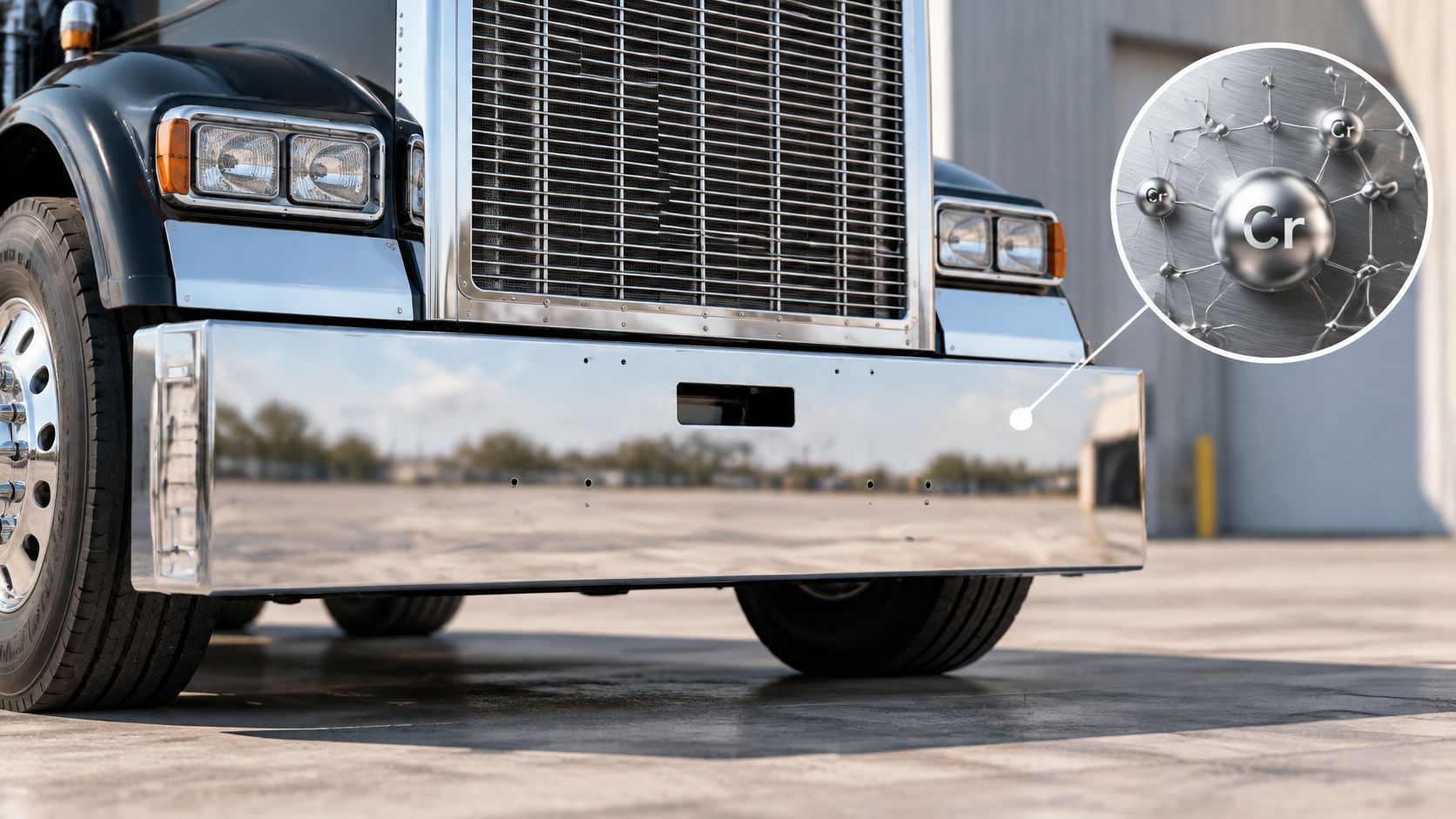
The Chrome bumper for Freightliner Classic offers chrome-plated steel and stainless configurations, with standard or blind mounting. The finish does not identify which base-metal option was selected.
430 Stainless Steel Strength on a Bumper
A stainless label doesn't tell you how a bumper will handle a hit. You need to know the material condition, sheet thickness, formed shape, and how the brackets carry the load.
Tensile strength measures how much pulling stress the metal takes before breaking. Yield strength marks where it starts to bend permanently. Elongation measures how far it stretches before it breaks.
Published values in the 430 Stainless Steel Alloy Data Sheet illustrate the difference between annealed material and cold-worked strip; the supplier minimum and typical values below describe material conditions, not a finished bumper's impact rating.
| Condition | Tensile strength | Yield strength | Elongation |
|---|---|---|---|
| Annealed, supplier minimum | 65 ksi (450 MPa) | 30 ksi (205 MPa) | 22% minimum |
| Annealed, typical sheet | 75,000 psi | 45,000 psi | 30% |
| Cold-rolled strip | Approximately 145,000 psi | Approximately 135,000 psi | 1% |
Annealing leaves the steel more forgiving during forming. Cold working can increase strength while sharply reducing how much the material can stretch. Don't read the strongest row as proof that it makes the best finished bumper.
Follow the load into the brackets
Say a deer strikes the bumper at highway speed. The contact loads the bumper face, then the formed sections, brackets, and mounting points. Thin decorative skin on weak mounts won't become an impact-protection system just because it's stainless.
A pallet dragged across the front creates a different load, but the same buying lesson applies. Sheet thickness and mounting geometry matter. No alloy designation alone establishes crash performance or animal-strike protection.
Before ordering, request these construction details:
- Exact thickness: Get the sheet thickness in gauge or millimeters for the selected material.
- Construction: Establish whether the bumper is single-skin or reinforced.
- Bracket specification: Check bracket material, condition, layout, and compatibility with the truck.
- Mounting arrangement: Confirm that bolts align without pulling the bumper into position.
Factory forming matters, too. Don't use a jack, chain, or torch to make an ill-fitting bumper match the truck. Material that has already been heavily worked may have little safe movement left before it cracks.
Buy the bumper shape your truck needs. Don't plan to create that shape in the service bay.
430 Compared With Carbon Chrome and 304
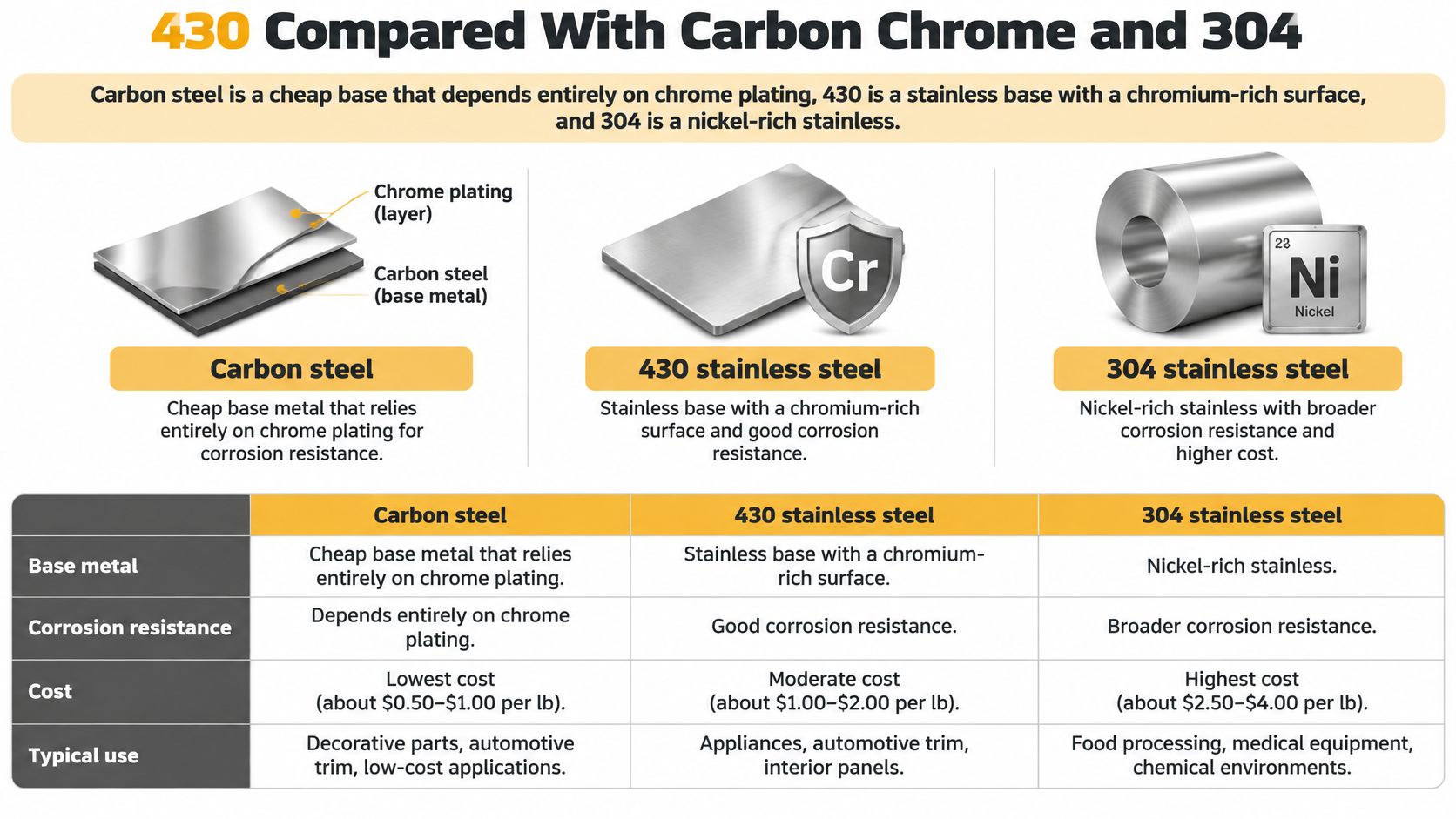
A truck running dry inland routes may get years of service from 430, while the same bumper on brine-treated highways needs closer washing and inspection. Carbon steel costs less up front, 430 balances cost with moderate corrosion resistance, and 304 provides more corrosion margin in salt exposure.
| Criterion | Carbon steel, chrome-plated | 430 stainless | 304 stainless |
|---|---|---|---|
| Base metal | Carbon steel | Ferritic stainless, chromium-rich | Austenitic stainless, higher nickel |
| Nickel content | Not a defining alloy addition | Low | Substantially higher |
| Magnetic | Yes | Yes | Generally no |
| Rust protection | Relies on intact plating | Protective chromium film, plus plating when specified | Protective chromium film with broader alloy corrosion resistance |
| Salt and chloride tolerance | Poor once plating is breached | Limited, not for seawater | Best margin of these choices, not immune |
| Weldability | Generally straightforward before finishing | Requires controlled heat and suitable filler | Generally good with a proper procedure |
| Relative upfront cost | Lowest | Middle | Highest |
These are general material comparisons, not ratings for every finished bumper. Ryerson's guide to 430 stainless steel explains why 430's low nickel content makes it an alternative to nickel-rich austenitic grades when their additional corrosion resistance is unnecessary. Nickel gives 304 a wider corrosion margin than 430, particularly in tougher exposure.
The visual comparison shows how different base metals can share a similar finished appearance.
Compare the installed cost
Compare delivered quotes, installation labor, and the likely cost of another replacement. A lower-priced bumper may cost more over time if corrosion leads to an early replacement and another shop visit.
For a long-term ownership comparison, include removal, mounting hardware, freight, finishing work, and truck downtime. Ask the seller what service conditions support any expected-life claim. Warranty covers manufacturing defects; ask the seller which salt exposure is covered, if any.
Use the same truck configuration when comparing 430 vs. 304 stainless steel. Differences in thickness, reinforcement, cutouts, or mounting hardware can otherwise obscure the material comparison.
A finished chrome surface can look nearly identical across these base metals. Galhor's stainless steel 430 tier is a chrome-plated Best Value Line with medium corrosion resistance and a 4-year warranty. Its stainless steel 304 tier is the chrome-plated Top Of The Line, with high corrosion resistance and a 5-year warranty. Both offer the same mirror-polished chrome finish; the steel differs.
Match Your Routes to the Right Bumper Grade
Where does the truck run, and how much salt does it see? That question should come before choosing a material tier.
Dry inland lanes favor 430's cost balance. Heavy winter brine and coastal exposure favor 304's broader corrosion margin. The ferritic stainless steel market overview provides industrial context for these alloys, but a finished truck bumper still needs to be judged by its exposure, fabrication, and maintenance.
| Operating environment | 430 suitability | 304 suitability | Practical note |
|---|---|---|---|
| Dry inland routes, light rain | Good | Good, extra margin may not be needed | Wash regularly and keep drains clear |
| Winter road-salt highways | Fair, needs frequent washing | Good | Rinse brine from brackets and crevices |
| Coastal or salt-air routes | Poor to fair | Good | Chloride exposure favors 304 |
| Wash-heavy or chemical exposure | Fair, chemistry must be checked | Generally better, chemistry must still be checked | Inspect finish and drainage after washing |
| High-temperature chloride service | Better chloride stress-cracking resistance | More vulnerable to that specific failure mode | Not a typical highway bumper condition |
The high-temperature exception matters because 304 doesn't win every corrosion comparison. It doesn't change the practical recommendation for normal highway salt exposure. Chemical service also needs its own review, since no general grade recommendation covers every cleaner or load residue.
Match the purchase to the work
An owner-operator running mostly dry lanes in Texas and Oklahoma can reasonably choose 430 and maintain a regular wash routine. The extra corrosion margin of 304 may not justify the added purchase cost for that use.
A fleet running Michigan and Ohio winter routes should price 304 first. If it selects 430, the maintenance plan needs prompt salt removal, access behind brackets, and inspections for early finish damage. A Gulf Coast hauler should also lean toward 304 rather than assume a shiny front face means the back is protected.
At Galhor, our 430 Best Value Line has medium corrosion resistance, a mirror-polished finish, triple-plated chrome, and direct bolt-on fit with no drilling for the matched configuration. Our manufacturing-defect warranty is 4 years for 430, compared with 2 years for carbon steel and 5 years for 304. Those terms cover manufacturing defects, not a guaranteed service life under every route condition.
Complete the pre-order checks
- Truck identity: Confirm make, model, and year. A Peterbilt 378/379, Kenworth T600, and Freightliner Coronado require their own fitment checks. Don't assume an International application matches another brand's mounts.
- Bumper configuration: Verify style, cutouts, mount type, and bracket alignment. For an 18 inch drop bumper, check clearance at yard entrances, ramps, and uneven loading areas.
- Maintenance commitment: Choose the grade for the washing routine the truck will receive, not the routine you hope to start.
Fast shipping across the United States helps only when the correct bumper arrives. Before placing an order, confirm the selected configuration's stock status, dispatch timing, freight arrangements, and delivery access with our team.
If the truck spends much of winter in road salt or regularly runs near the coast, price 304 first.
Choose 430 when your routes and maintenance support it. Confirm the exact fit, then order the material that fits the work rather than the lowest quote alone.
How to Repair or Modify a 430 Bumper Safely
Replace a cracked or badly bent 430 bumper rather than patching it. Collision damage, uncontrolled heat, or distorted brackets can compromise the fit and leave the metal more prone to cracking.
The Carpenter Technology Type 430 technical sheet outlines welding limits, suitable procedures, and possible post-weld annealing. Use it to guide a qualified shop's assessment, not as a roadside repair recipe.
Use this inspection-to-repair flow before authorizing shop work.
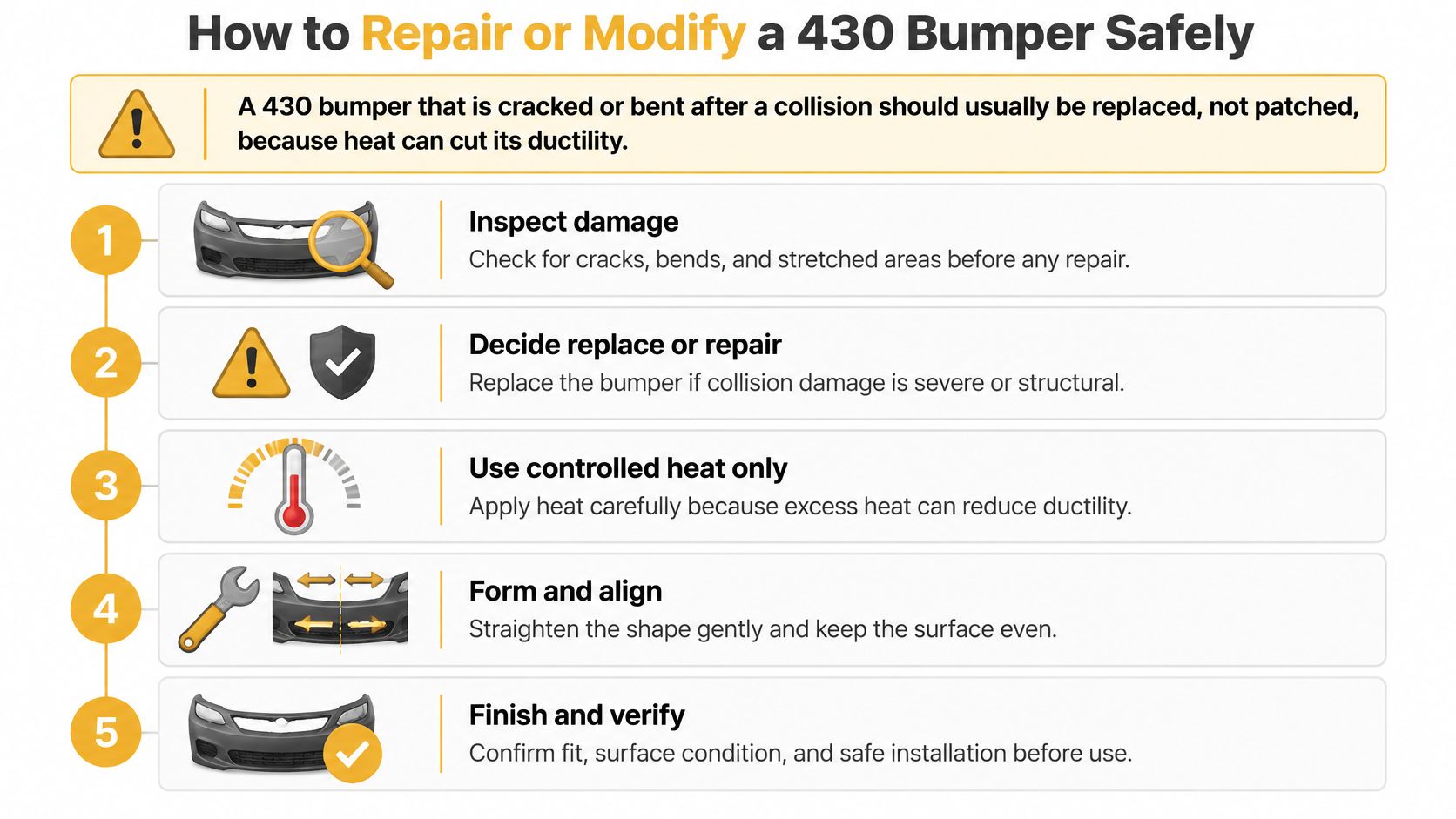
A safe repair decision
- Inspect before straightening. Check the face, folds, cutouts, mounting holes, brackets, and truck attachment points for cracks, stretching, bends, and finish damage.
- Replace damaged load-carrying parts. Replace cracked, severely bent, or heat-damaged components. A sound-looking bumper cannot compensate for a cracked bracket.
- Prefer approved bolted changes. If mounting changes are necessary, get manufacturer approval for hole location and edge clearance. Drilling near a bend or loaded mounting point can weaken the part.
- Use a qualified welding shop when welding is unavoidable. Shielded-fusion or resistance welding may suit the repair when the shop selects the correct procedure and filler. Keep the component out of service while it is assessed.
- Keep oxyacetylene off the bumper. Carbon pickup can impair weld performance. A torch also cannot safely force tight mounts into alignment.
- Anneal only under an established procedure. Post-weld heat treatment may be needed to restore ductility. It requires controlled conditions and can affect the finish.
- Restore the surface and verify fit. Have a suitable finishing shop address damaged plating and exposed edges, then inspect the completed work before installation.
An unsuitable carbon-steel welding procedure can leave cracks near the weld or distort the bumper enough to prevent proper mounting. The resulting removal, finishing, and downtime can outweigh the cost of replacement.
Questions for the body shop
- Procedure: Can the shop identify the alloy and follow a welding procedure suited to it?
- Heat treatment: Can it complete any required annealing under controlled conditions?
- Finish restoration: Who will restore damaged plating and inspect exposed edges?
- Final decision: Do repair labor, finishing, and downtime still make repair worthwhile?
If the shop cannot answer these questions clearly, replacement is the safer choice.
Frequently Asked Questions About 430 Bumpers
How can I tell a 430 bumper from a carbon chrome bumper?
A magnet won't reliably distinguish them. Ask for the base-metal designation and supporting material paperwork. A polished face, product photo, or stainless badge alone does not confirm the alloy underneath.
What thickness should I ask for?
Request the thickness in gauge or millimeters, and ask whether the bumper is single-skin or reinforced. Check the brackets separately. Match the truck's mounting requirements rather than choosing by front-face thickness alone.
How often should a winter truck wash its 430 bumper?
Rinse after salted routes when practical, paying attention to the mounting side and areas where debris can collect. That helps keep road salt and grime from sitting in hidden pockets.
Can a chrome finish stop rust on 430 by itself?
No finish eliminates the need to inspect for chips or exposed edges. If plating is damaged, arrange a compatible repair; covering active corrosion with touch-up material can leave the underlying problem in place.
Does 430 need special welding?
For welding or modification, use a shop familiar with the alloy and its repair limits. Confirm the shop can assess whether the proposed work is suitable before the bumper is altered.
Is 430 suitable for a fleet that keeps trucks for many years?
It can suit trucks on dry or lightly salted routes when maintenance is consistent. For sustained salt exposure, 304 is the safer starting point. Compare total cost of ownership, including installation, maintenance, replacement labor, freight, and downtime, rather than purchase price alone.
Galhor Inc. offers configurable chrome-plated carbon steel, 430 stainless steel, and 304 stainless steel bumpers for heavy-duty trucks. Visit Galhor Inc. to select your truck, compare material options, and confirm fitment and shipping before ordering. Choose the material that suits your routes, mounting needs, and maintenance plan.