
Bumpers for Semi Trucks: A Buyer's Guide to Fit and Finish
October 20, 2026 · Francisco Hornelas

You're parked beside two tractors that look alike from the cab to the grille. One still has a clean, bright bumper. The other is pitted and dull after hard winters. That difference isn't just polish. It comes down to the material, fit, mounting, and care the owner chose.
Bumpers for semi trucks take road salt, gravel, weather, loading-yard bumps, and regular shop work. A good-looking bumper that doesn't fit or hold up can cost you more in rework and downtime than it saves at checkout. Whether you're choosing a Peterbilt 389 bumper, a Kenworth W900 chrome bumper, or a replacement for a Freightliner or International, start with the truck's job, not the catalog photo.
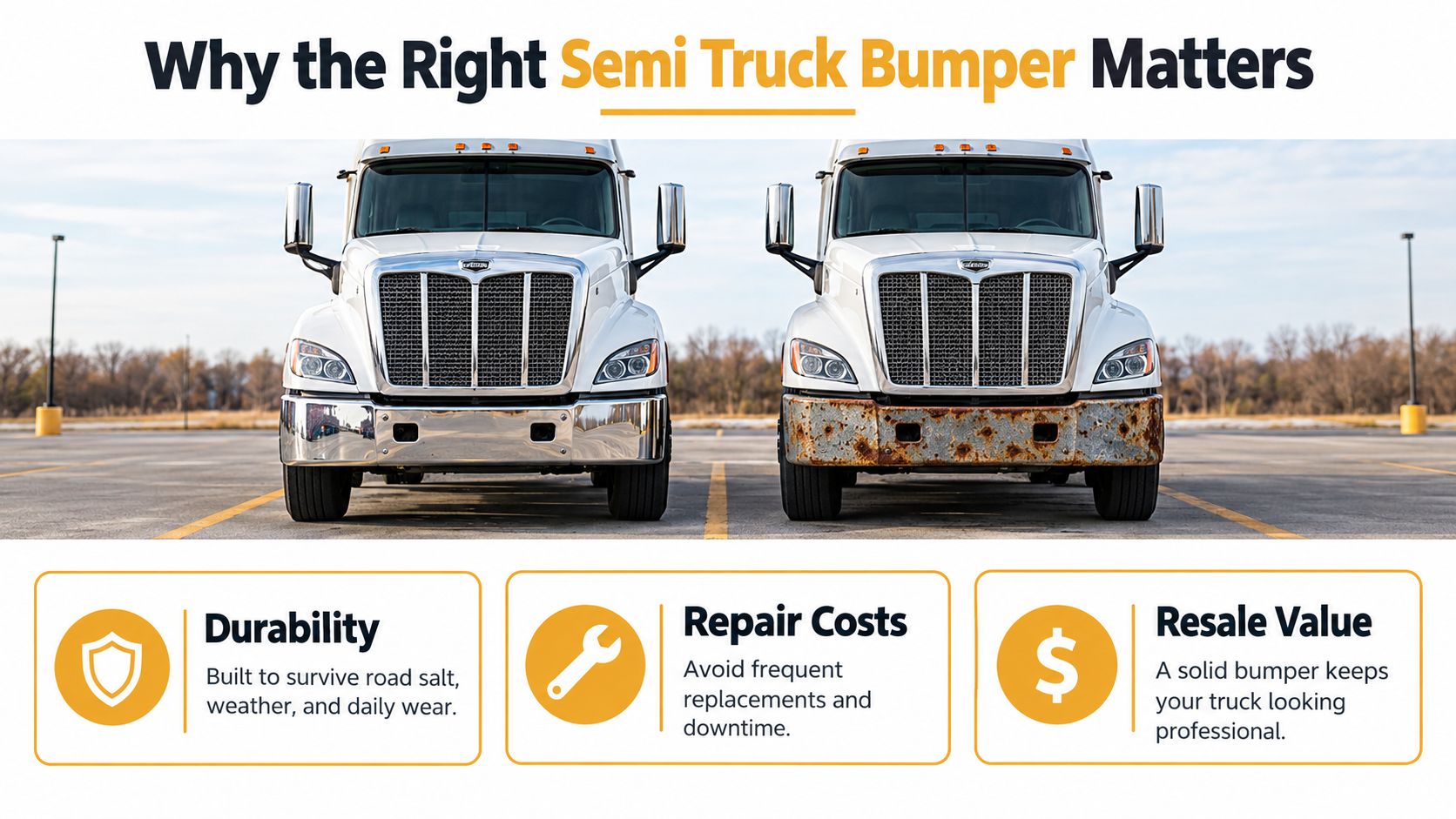
The choice comes down to four practical checks: style, material, fitment, and lifecycle cost. Get those right and chrome becomes more than a showroom finish. Durable fit, real materials, and dependable U.S. shipping should be the baseline, not extras.
Table of Contents
- Why the Right Semi Truck Bumper Matters
- Main Bumper Styles for Class 8 Trucks
- Carbon Steel vs Stainless Steel Bumpers
- How Material Choice Affects Long-Term Value
- Getting the Fit Right for Your Truck
- Installation Practices and Federal Bumper Rules
- What a Chrome Bumper Does in a Crash
- Choosing, Buying, and Getting Back on the Road
Why the Right Semi Truck Bumper Matters
A semi-truck bumper is easy to judge by its shine. On the road, that's the least important part of the decision. Salt spray works into damaged finishes, highway debris chips the front face, and repeated vibration tests the brackets and fasteners. A bumper can look sound from the curb while its mounting points tell a different story.
For an owner-operator, the cost of a poor choice isn't limited to replacing the part. It can mean lost time in the shop, another freight delivery to arrange, and a truck that looks tired when you arrive at a customer's yard. Fleet managers face the same calculation across more units. A bumper that matches the truck and the route is easier to install, maintain, and keep presentable.
Start with the work the truck does
A long-haul tractor that sees winter roads needs a finish and material suited to salt exposure. A truck working mostly in dry conditions may not need the same corrosion resistance. A low-profile show build has different clearance needs from a vocational tractor entering uneven yards.
Don't choose from appearance alone. Decide what you need the bumper to do, then confirm:
- Style: Will the shape and drop work on the roads, lots, and approaches you use?
- Material: Does it suit your climate and wash routine?
- Fitment: Does it match the exact truck and mounting arrangement?
- Long-term value: Will the cost make sense after installation, upkeep, and eventual resale?
Shop-floor rule: A bumper earns its keep by fitting cleanly and standing up to the route, not by looking heavy in a product photo.
Chrome and polished stainless can both deliver a sharp finish, but appearance doesn't prove structural strength or crash performance. Thickness, brackets, cutouts, and the bumper's intended use all matter. The right purchase is the one that looks right on your truck and stays practical after the first hard season.
Main Bumper Styles for Class 8 Trucks
Front bumpers for Class 8 tractors come in a few common shapes. Learn the style before comparing finishes, because shape affects clearance, mounting, and cutouts.
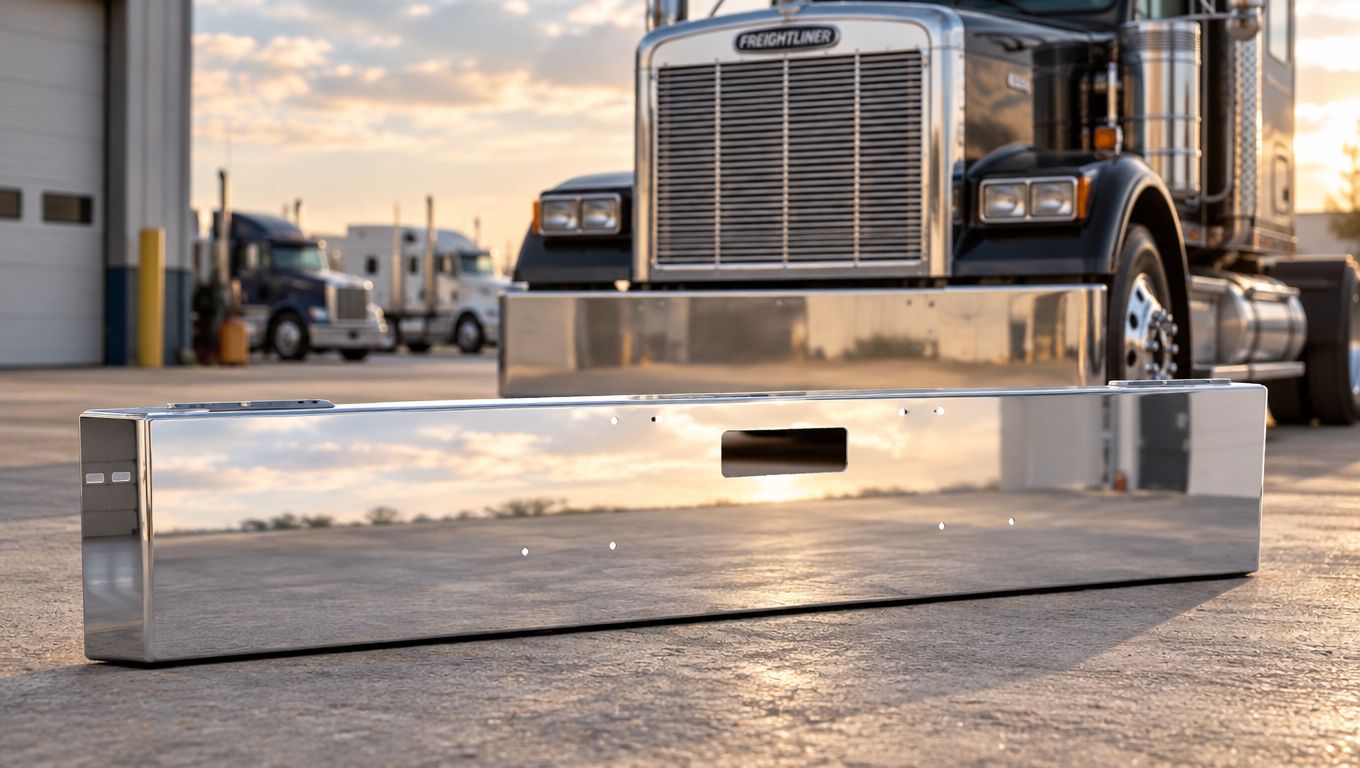
Match the shape to the truck and route
- Factory-style replacement: This is the straightforward choice when you want the original profile restored. Match the bumper to the specific truck model and year, and check the grille, lights, and mounting points before ordering.
- Extended or aerodynamic style: These bumpers change the front-end profile. Confirm that their length and shape clear the truck's equipment and suit the routes you run.
- Drop bumper: An 18 inch drop bumper is a distinct styling choice, but more drop can mean less clearance at driveways, uneven yards, and steep approaches. Don't buy one until you've considered the places your truck has to enter.
- Custom or show bumper: A contoured, polished bumper can give a long-hood truck a strong presence. Custom cutouts and brackets need careful checking so the finished part doesn't interfere with lights, tow hardware, or other equipment.
You'll see these styles across Peterbilt 389 and 379 trucks, Kenworth W900 and T880 models, Freightliner Cascadia and Coronado tractors, and International LT and Lonestar trucks. The name on the hood isn't enough to establish fit. Model year, grille shape, mounting configuration, and options can change what the bumper needs.
The Chrome bumper for Freightliner Classic is listed with a mirror-polished finish, 10-gauge chrome-plated steel, and a 3 mm chrome-plated stainless steel 304/430 option. The catalog also lists standard and blind mounts, with cutouts depending on configuration.
Before you compare prices, decide on the style, then verify material thickness, bracket design, and cutouts. A sharp-looking bumper that scrapes every yard entrance or needs shop-made mounting changes is the wrong choice for that truck.
Carbon Steel vs Stainless Steel Bumpers
A chrome finish doesn't tell you what metal sits underneath it. For a working truck, that distinction matters because the base material affects how the bumper handles corrosion and how much attention it needs after salt, moisture, or chemical washing.
Type 304 stainless typically contains 17.5–19.5% chromium and 8–10.5% nickel, while Type 430 typically contains 16–18% chromium and little or no nickel, according to the Type 304 stainless steel material data sheet. Chromium helps form a protective surface film. Type 304's nickel content supports its austenitic structure and broader corrosion resistance. Chloride exposure can still cause pitting or crevice corrosion, so no stainless bumper is maintenance-free.
Bumper Material Comparison
| Material | Typical gauge or thickness | Best environment | Watch out for |
|---|---|---|---|
| Chrome-plated carbon steel | 10-gauge is listed for a catalog bumper; verify the specific option | Milder exposure and buyers focused on the chrome finish | Damage to the plating can expose the base metal to corrosion |
| Chrome-plated 430 stainless | A 3 mm option is listed for the referenced bumper; confirm the product configuration | Less aggressive conditions where corrosion resistance and appearance both matter | Not the first choice for persistent chloride exposure |
| Chrome-plated 304 stainless | A 3 mm option is listed for the referenced bumper; confirm the product configuration | Salt, coastal air, frequent moisture, and chemical washing | Chlorides can still cause pitting and crevice corrosion |
Type 430 is ferritic, while Type 304 is austenitic. For a fleet running salt-belt routes, 304 is the stronger material choice. For milder conditions, 430 can make practical sense. Rinse either grade after salt exposure and check for trapped moisture around brackets and cutouts.
Don't treat material choice as a simple good-better-best ladder. Match the metal to the route, then compare the actual bumper's thickness, finish, mounting, and cutouts. For a closer look at the trade-offs, see stainless steel versus carbon steel bumpers.
How Material Choice Affects Long-Term Value
The cheapest bumper at checkout isn't automatically the cheapest one to own. Count the purchase price, freight, installation, cleaning, repair, replacement, and the time the truck spends off the road. For a fleet, those costs repeat across units. For an owner-operator, a poor fit or finish can turn a simple replacement into a shop visit that eats into working time.
Route exposure should drive the decision. A Northeast fleet that keeps tractors in service through salty winters has a strong reason to choose 304 stainless. A Southwest owner-operator who runs in drier conditions may accept more finish upkeep to choose a lower-cost material. A mixed fleet can specify different materials for units assigned to different operating areas instead of buying one finish for every truck.
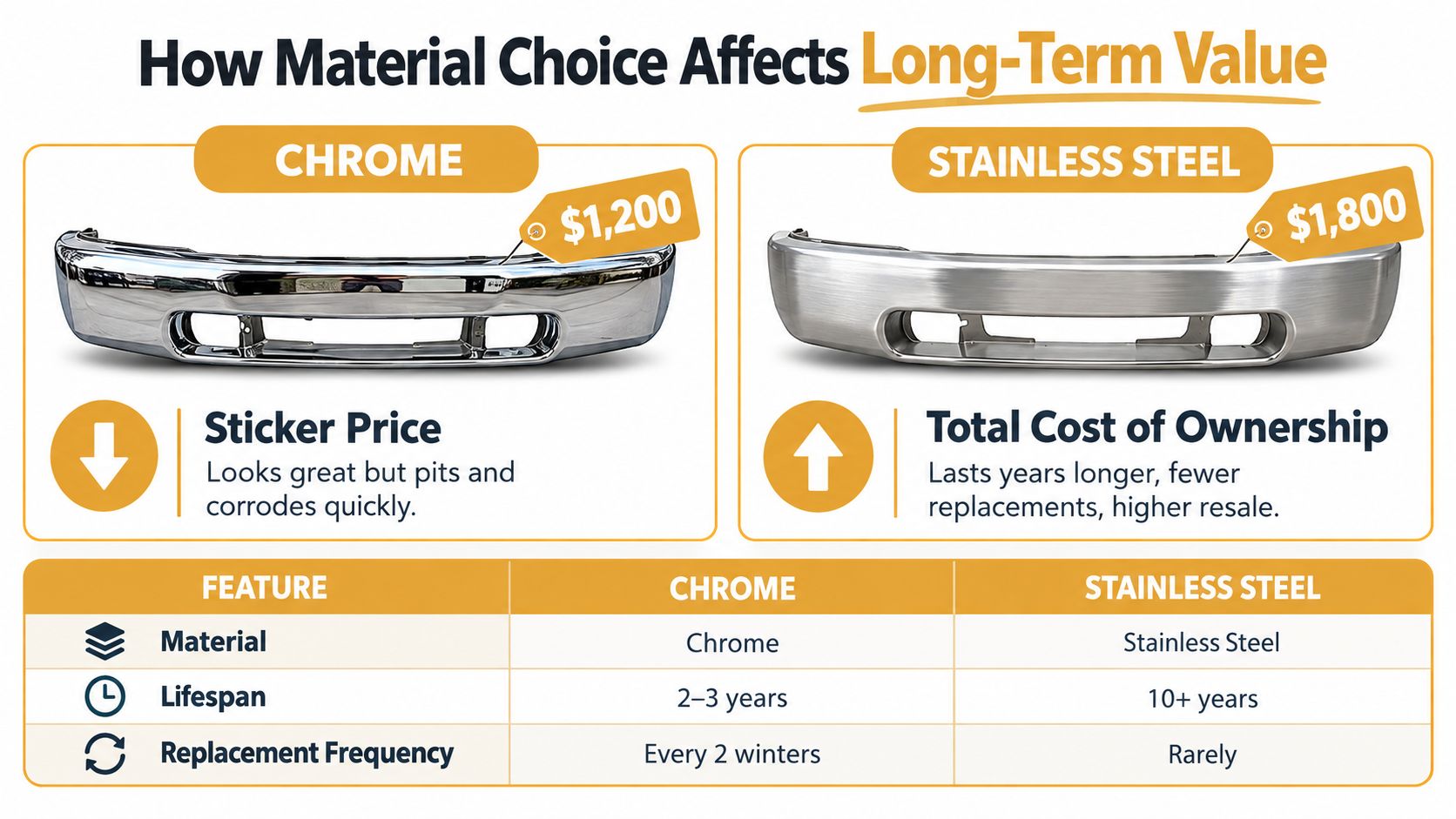
Build the decision around service conditions
Chrome-plated carbon steel can suit a truck whose owner accepts regular inspection and finish care. If the coating gets damaged, clean and address the area rather than letting road residue sit on it. A 430 stainless option can be a sensible middle ground in less aggressive conditions. For trucks that see road salt, coastal air, or frequent chemical washing, 304 stainless is the more defensible choice, though it still needs rinsing and inspection.
Don't assume a heavier bumper will last longer. Brackets can crack, mounting points can loosen, and cutouts can leave vulnerable areas. A thick face plate can't compensate for a poor fit or a weak mounting setup.
For fleet planning, compare the bumper's material and construction with the truck's expected service life and replacement process. If a unit runs harsh routes and stays in the fleet, corrosion resistance may matter more than the lowest initial cost. If the truck works in mild conditions and will be replaced soon, paying extra for a premium material may not be the right call.
Practical rule: Spend for 304 where salt and chloride exposure are routine, consider 430 for milder routes, and choose carbon steel only when its upkeep fits the truck's work and ownership plan.
Getting the Fit Right for Your Truck
Fitment is where a sharp-looking purchase can turn into a bad shop day. A bumper that looks close in a listing may have the wrong bracket spacing, grille profile, or light cutouts for your truck. Confirm the details before placing the order, not after the freight arrives.
Verify the truck, then verify the bumper
- Identify the exact truck. Record the make, model, and model year. Don't assume two Cascadias, W900s, or Peterbilts share the same bumper setup because they look similar.
- Check the front-end shape. Compare grille shape, headlight housing, tow-hook location, and bumper profile. If the truck has special equipment, note that too.
- Match the cutouts. Confirm openings for fog lights, tow hooks, air horns, or other equipment. A missing or misplaced cutout can mean extra shop work.
- Confirm the mounts. Compare the bumper's bracket type with the truck's frame spacing and mounting points. A direct bolt-on label isn't a substitute for verifying that the part matches your truck.
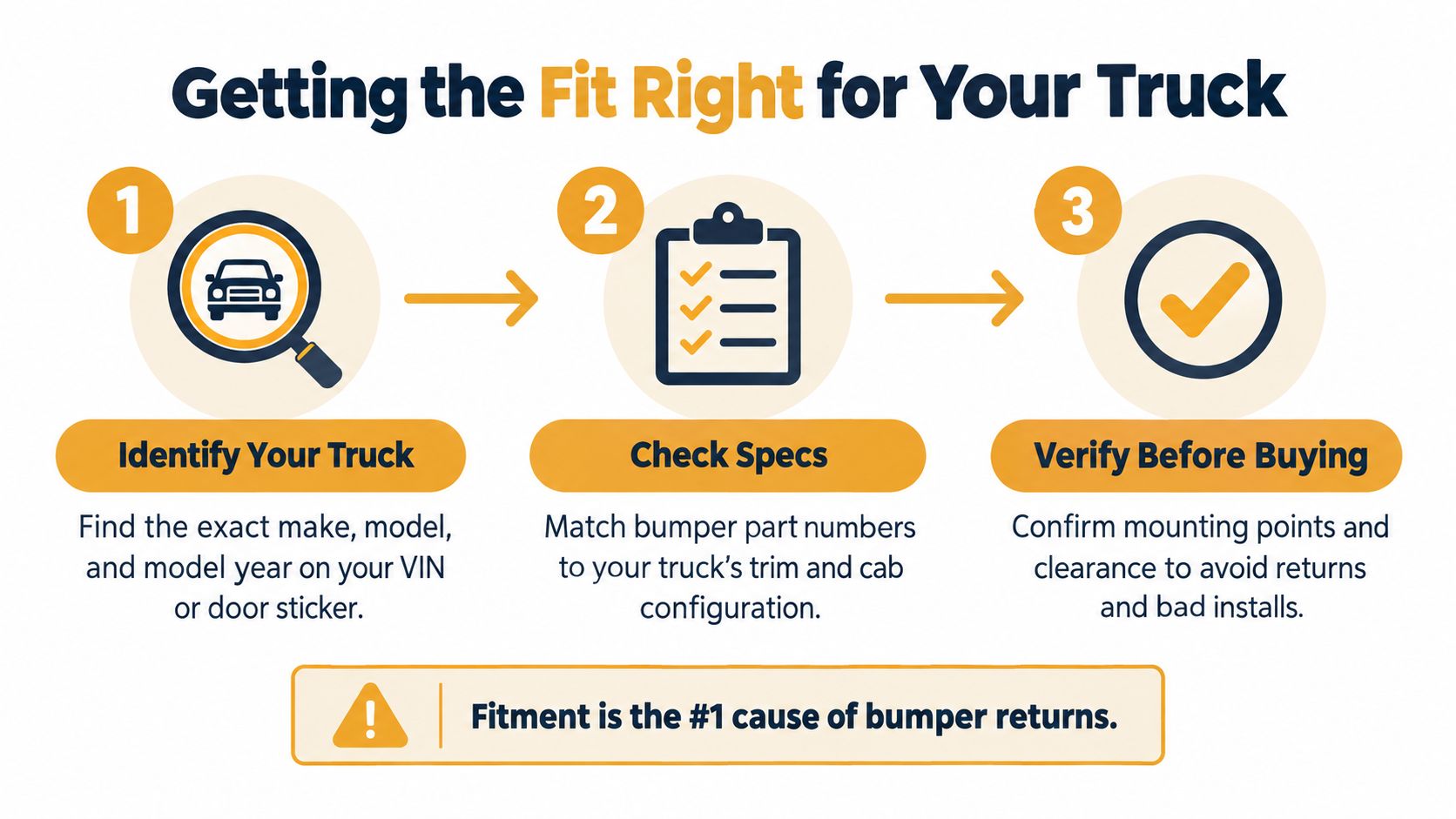
Bumper support brackets are part of the fit, not an afterthought. Review the bumper support bracket guide and check the bracket arrangement on your truck before you order.
A bumper listed for one Cascadia year range may not fit another without checking the mounting details. Use the same care for a Freightliner Coronado or a Peterbilt 389. Ask the supplier to confirm the fit against the truck's model year and configuration, and provide clear photos or measurements if the listing leaves room for doubt.
Before installation, compare the part against the truck without forcing it into place. If holes don't line up or the bumper needs drilling, cutting, or shimming, stop and resolve the mismatch. A correct fit should sit square, leave the needed clearance, and preserve access to lights and tow hardware.
Installation Practices and Federal Bumper Rules
A bolt-on kit can still leave you with a bad install. Bumpers get torqued down over paint, brackets get reused past their service life, and nobody checks the radar window until the collision mitigation system starts throwing codes. Check the mounting brackets, fasteners, weld areas, tow points, and clearance once the part is on the truck. Recheck them after collision repair or frame work.
Under 49 CFR § 393.203, a semi-truck front bumper must not be missing, loosely attached, or protruding in a way that creates a hazard. That makes attachment and condition an operational check, the kind a roadside inspector can flag. Federal requirements set minimum conditions, and the bumper safety standards guide lays out what those minimums cover, but a safe install still depends on the truck's actual fit and use.
Keep the tractor bumper and trailer guard separate
Rear-impact guard rules mainly apply to qualifying trailers and semitrailers, not ordinary tractor front bumpers. Under 49 CFR § 393.86, a trailer or semitrailer generally needs a rear-impact guard or another device that stops a passenger vehicle from riding underneath. Tractors, pole trailers, and driveaway-towaway vehicles are exempt.
For regulated guards, FMVSS 224 limits ground clearance to 22 inches, requires the guard to extend to within 4 inches of each trailer side, and limits rearward offset to 12 inches. Check FMVSS 224's rear-impact guard requirements after repairs, suspension changes, or collision work. A replacement that looks like the old part can still sit out of spec.
FMVSS 223 also sets structural tests for regulated rear guards, including force tests at specific locations with deflection limits. A polished tractor bumper does a different job than a certified trailer guard, so don't treat one as proof of the other.
Check lights and clearance before handing over the keys
After a swap, confirm lamps, reflectors, and conspicuity markings stay visible and securely mounted. FMCSA's lighting and reflector guidance spells out the visibility and mounting requirements. A custom cutout or drop bumper must not block required lighting.
On newer trucks, check what sits behind the bumper as well. Radar and camera-based collision mitigation systems need a clear line through or around the bumper, and a solid bar in the wrong place can blind them. Ask the installer to confirm the bumper sits square, fasteners are torqued, tow points stay usable, and the truck keeps its clearance through normal suspension travel. That check takes minutes and catches a bad install before the truck goes back to work.
What a Chrome Bumper Does in a Crash
A chrome bumper and a certified crash component are two different purchases, and plenty of buyers pay for one while expecting the other. Chrome describes a finish. It says nothing about the loads a bumper was tested to handle.
For regulated trailer rear guards, federal standards spell out geometry and structural performance, including force tests at defined points with strict deflection limits, as noted earlier in the federal bumper rules discussion. Those requirements apply to the guard. A polished tractor bumper carries no automatic claim to the same standard.
Front-end protection is its own question. NHTSA reported that roughly 70% of heavy-truck/light-vehicle crashes involve the truck's front structure and found that lowering a front bumper could reduce passenger vehicles overriding a truck while increasing crash loads, which raises occupant injury risk in some impacts. The agency concluded that forward-collision warning and automatic emergency braking reduce those crashes more effectively than front underride guards. Review the NHTSA front underride guard study before treating a custom bumper as a safety device.
Ask for engineering details, not visual promises
Before buying a bumper for a Peterbilt, Kenworth, Freightliner, or International, ask:
- Test evidence: What load cases, if any, was the bumper tested against?
- Mounting: Where does it attach, and how does the mounting system suit the truck?
- Sensors: Will the design block radar or camera-based collision mitigation equipment behind the bumper?
- Clearance: Does it preserve steering, lighting, tow-point, and cab clearance?
- Certification: Is the part certified for a specific crash-protection function, or is it a replacement or styling component?
Agency materials also describe a rear-guard testing target increase from 30 mph to 35 mph, with an estimated 1.4 lives saved per year in the analysis (NCDOT's rear-impact guard summary.pdf)). That figure applies to regulated rear guards. A front bumper is a different piece of hardware.
If you're ordering a custom front bumper, the Galhor 3D configurator lets you select truck brand, model, year, style, cutouts, and finish. Then ask the builder for fitment and engineering details. Weight and shine are not safety ratings.
Choosing, Buying, and Getting Back on the Road
Choose the style for your routes, the material for your weather, and the fit for your exact truck. Confirm the cutouts and brackets before checkout, then ask about shipping time for the configuration you need. In-stock stainless options and made-to-order bumpers can have different lead times, so confirm timing with the seller.
Get yours today only after those checks are settled. A bumper that fits without shop improvisation and suits the truck's working life is the one that earns its place on the road.
Galhor Inc. offers configurable chrome bumpers for Class 8 trucks, with choices for truck model, style, cutouts, and finish. Visit Galhor Inc. to check fitment and shipping options before you order.