
Custom Semi Truck Parts: A Buyer's Guide for Owner-Operators
September 3, 2026 · Francisco Hornelas

You're at a Pilot or TA, looking at a pitted front bumper and doing the math in your head. Run it another season, or replace it before the next California weighment? For an owner-operator, that decision isn't about shine alone. A loose bracket, rusted mount, or damaged cutout can turn a routine stop into a repair delay.
Custom semi truck parts need to earn their place on a working Class 8 truck. Material, fitment generation, finish, and shipping time all affect whether the truck keeps pulling or sits in a shop. The heavy-duty aftermarket is already a massive replacement and upgrade economy. One estimate placed it at USD 149.75 billion in 2024, with projected growth to USD 204.26 billion by 2033, while another estimated USD 155.8 billion in 2025 and projected USD 229.9 billion by 2036. Those figures include the wider heavy-duty segment, but Class 8 trucks are part of that market, which shows that custom upgrades are not a fringe purchase. Grand View Research's heavy-duty aftermarket analysis provides the market context.
Table of Contents
- Why Drivers Are Replacing More Bumpers Than Ever
- The Three Real Choices Behind Every Custom Semi Truck Parts Order
- Stainless Steel vs Chrome-Plated Steel for Heavy-Duty Bumpers
- Direct Bolt-On or Custom Fab: What Saves Downtime
- Model-Specific Fitment for Peterbilt Kenworth Freightliner and Volvo
- Durability ROI When Premium Materials Pay Back on Long Hauls
- Lead Times and Stocking Strategy for Fleets and Owner-Operators
- Ordering Your Custom Semi Truck Parts the Smart Way
Why Drivers Are Replacing More Bumpers Than Ever
At the truck stop, the question usually starts with a boot against the lower edge of the bumper. If the chrome flakes, the steel underneath may already be working loose. A driver who waits until a mount fails can face a much bigger problem than a dull finish, especially when the truck is loaded and far from the home shop.
Road salt, chemical de-icers, wash chemicals, and wet grime attack exposed metal from several directions. Chrome-plated carbon steel can look acceptable from ten feet away while corrosion works behind the plating and around the brackets. Coastal air adds another burden, while long interstate cycles keep the front of the tractor exposed to spray, gravel, and repeated washdowns.
Inspection concerns also matter. A corroded bumper isn't automatically an out-of-service violation, but loose hardware, damaged mounts, dangling brackets, sharp edges, and interference with lights or sensors can draw attention during a roadside inspection. The practical response is to inspect the whole mounting system instead of judging the part by its front surface.
The downtime question
A bumper replacement becomes expensive when it strands the truck. A failure in Yuma, for example, can leave a driver waiting several days for the right part to ship and arrive. The lost revenue and missed appointment may outweigh the difference between a budget replacement and a better-specified part.
Use this quick check:
- Inspect the mounts: Look for rust scale, cracked brackets, elongated holes, and missing hardware.
- Check the clearances: Confirm the hood, fenders, lights, wiring, and sensors still have even space.
- Watch the finish: Bubbling, deep pits, and rust bleeding from seams mean the damage is below the surface.
- Plan before failure: Order during scheduled maintenance when the truck can be worked on, not after a roadside impact.
Shop rule: Replace the bumper before the mounting hardware becomes the reason the truck stops.
A useful buying overview is this guide to the benefits of buying a semi-truck bumper online, especially when you need to compare fitment, material, and delivery before the truck reaches a repair bay.
The Three Real Choices Behind Every Custom Semi Truck Parts Order
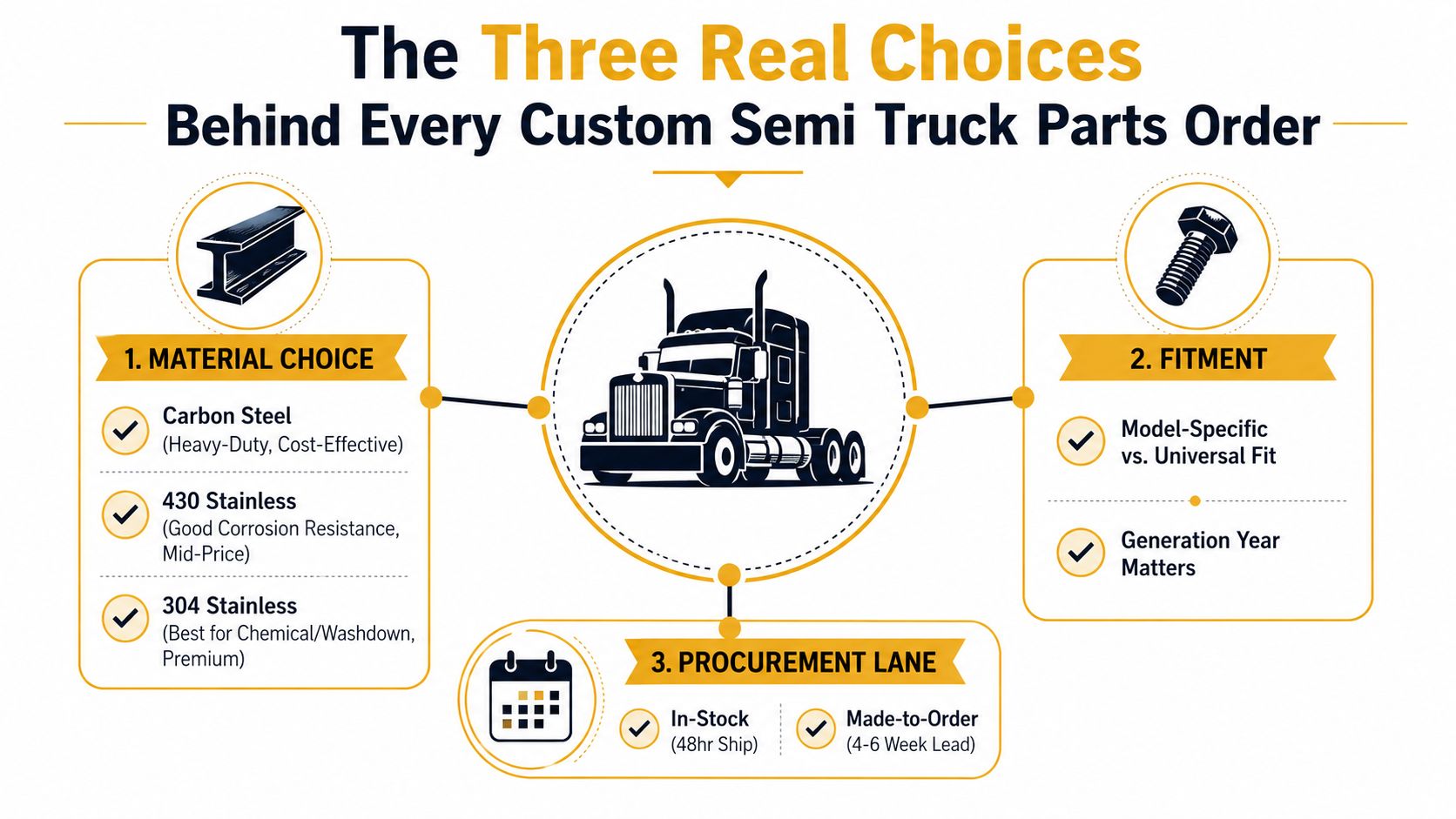
Stand beside the truck and make three decisions in order: material, fitment, and finish. Treat those choices like a bumper frame, its mounting pattern, and the protective surface. The wrong choice in any one category can waste the money you saved in another.
Start with the material
Carbon steel is strong and usually the lower-cost route, but its protection depends on the plating or coating staying intact. Once corrosion reaches the base metal, the repair clock moves quickly.
430 stainless steel offers a meaningful corrosion upgrade over chrome-plated steel. It's commonly the practical middle choice for moderate climates, though salty or chemically aggressive routes can still cause staining.
304 stainless steel is the premium corrosion-resistant option. Its nickel-bearing austenitic structure handles road salt, coastal air, and frequent wash cycles better than 430 stainless or chrome-plated steel. The material comparison in this stainless steel and carbon steel guide is useful when you're choosing for climate and service life.
Match the fitment
A direct bolt-on should use the truck's factory frame points, supplied brackets, and the correct cutouts. A fabricated assembly may need drilling, welding, bracket changes, or trimming. The first should fit like a replacement fender. The second is closer to building the part around the truck.
The Steel chrome bumper is made from 10-gauge chrome-plated steel, has a mirror-polished finish, and supports direct bolt-on installation with standard or blind mounting. Its finish uses a triple-layer hexavalent chrome process with 35 microns of nickel, and the product is covered against defects in workmanship and materials.
Choose the finish
A mirror polish gives the bright show-truck look but needs regular washing and careful polishing. Brushed satin hides light marks better. Chrome plating depends on the condition of the underlying steel and the quality of the plating process. Powder coating can make sense for a work-focused truck, but a damaged coating needs prompt repair before moisture reaches the substrate.
Stainless Steel vs Chrome-Plated Steel for Heavy-Duty Bumpers
There isn't one bumper material that fits every route. The right choice depends on exposure, maintenance habits, desired appearance, and how long you plan to keep the tractor.
Chrome-plated carbon steel remains common because it combines a familiar bright finish with a lower purchase cost. Its weak point is what happens after the plating pits. Water and salt reach the steel, rust pushes under the chrome, and the damage spreads around seams, edges, and mounting areas.
430 stainless steel is the middle ground. It offers better corrosion resistance than standard chrome-plated steel and can be a sensible choice for fleets operating in moderate climates. It's still more vulnerable than 304 in salty or chemically aggressive conditions, so regular rinsing matters.
304 stainless steel is the safer specification for road salt, coastal air, and frequent wash cycles. It holds base-metal integrity better and is the better fit when preserving a clean appearance and future resale matters more than the initial purchase price. Stainless guidance from Raney's Truck Parts explains the corrosion-resistance differences between 304, 430, and chrome-plated steel.
Bumper Material Comparison for Class 8 Trucks
| Material | Best Climate | Relative Cost | Expected Service Life | Maintenance |
|---|---|---|---|---|
| Chrome-plated carbon steel | Dry or moderate routes | Lower | Shorter in heavy salt exposure | Frequent washing, inspect pits and edges |
| 430 stainless steel | Moderate climates, controlled salt exposure | Mid-range | Longer than plated carbon steel | Rinse after salt exposure, remove staining early |
| 304 stainless steel | Mountain states, Upper Midwest, coastal routes | Higher | Longest corrosion resistance of these choices | Regular washing, protect the mirror finish |
The table is a decision guide, not a promise of a fixed service interval. Road treatment, impact damage, wash chemicals, storage, and maintenance all change results.
If the truck lives on salt-heavy lanes, choose the material for the road, not the sales invoice.
For a truck that stays mostly in the dry Southwest, 430 can be the value play when the owner keeps up with cleaning. For Upper Midwest, mountain-state, or coastal work, 304 is usually the more defensible long-service specification. Chrome-plated steel can still make sense when the budget is tight and the truck operates in less aggressive conditions, but inspect the plating and mounts instead of assuming the finish will protect the bumper forever.
Direct Bolt-On or Custom Fab: What Saves Downtime
A truck sidelined for fabrication can cost more than the bumper saved on the invoice. Direct bolt-on replacement is usually the faster choice when the frame points are standard, the correct generation-specific part is available, and the repair must get the tractor back on the road quickly.
A bolt-on bumper arrives with brackets, mounting holes, and cutouts matched to a specific truck configuration. The installer centers it, starts the fasteners loosely, checks hood and fender clearance, verifies light and sensor alignment, then torques the hardware. That order matters. It helps prevent binding, uneven gaps, and contact with a tilt hood.
When bolt-on is the right call
Choose direct fitment when:
- The truck uses a newer standard configuration: Factory mounting points reduce measuring, drilling, and installation uncertainty.
- The bumper must ship quickly: A stocked part avoids the drawing, fabrication, and finishing queue.
- The fleet needs repeatability: Tractors from the same model generation can follow one purchasing specification.
- Labor availability is limited: Less drilling, welding, and trimming leaves fewer opportunities for rework.
Bumper selection depends on truck generation, front or rear application, and sensor or lighting cutouts, not width alone. This truck bumper fitment guide also covers centering, loose initial fastening, consistent clearances, and final torque.
When fabrication earns its place
Custom fabrication fits older trucks, modified frames, and upfits that catalog parts cannot match. Recessed lighting, integrated steps, unusual guard layouts, and relocated brackets can justify the added shop time. The trade-off is clear: fabrication gives control over the final design, while measurement, welding, finishing, and test-fitting add more points where a repair can stall.
| Factor | Direct Bolt-On | Custom Fab |
|---|---|---|
| Mounting | Factory frame points | Bracket changes, drilling, or welding may be needed |
| Labor | Lower installation burden | Higher fabrication and fitting burden |
| Risk | Fitment depends on correct model and year | Template and measurement errors can cause rework |
| Best use | Standard replacement and uptime-sensitive repair | Modified trucks and special upfit requirements |
| Procurement | Often available as a stocked configuration | Usually requires drawings and production scheduling |
For fleet managers, route standard newer tractors toward bolt-on parts, and reserve fabrication for trucks with a documented fitment or upfit requirement. Include shop hours, missed dispatches, and rework exposure in the purchase decision, because those costs affect uptime and resale value.
Use direct bolt-on for standard trucks; fabricate only when the truck's configuration requires it.
Model-Specific Fitment for Peterbilt Kenworth Freightliner and Volvo
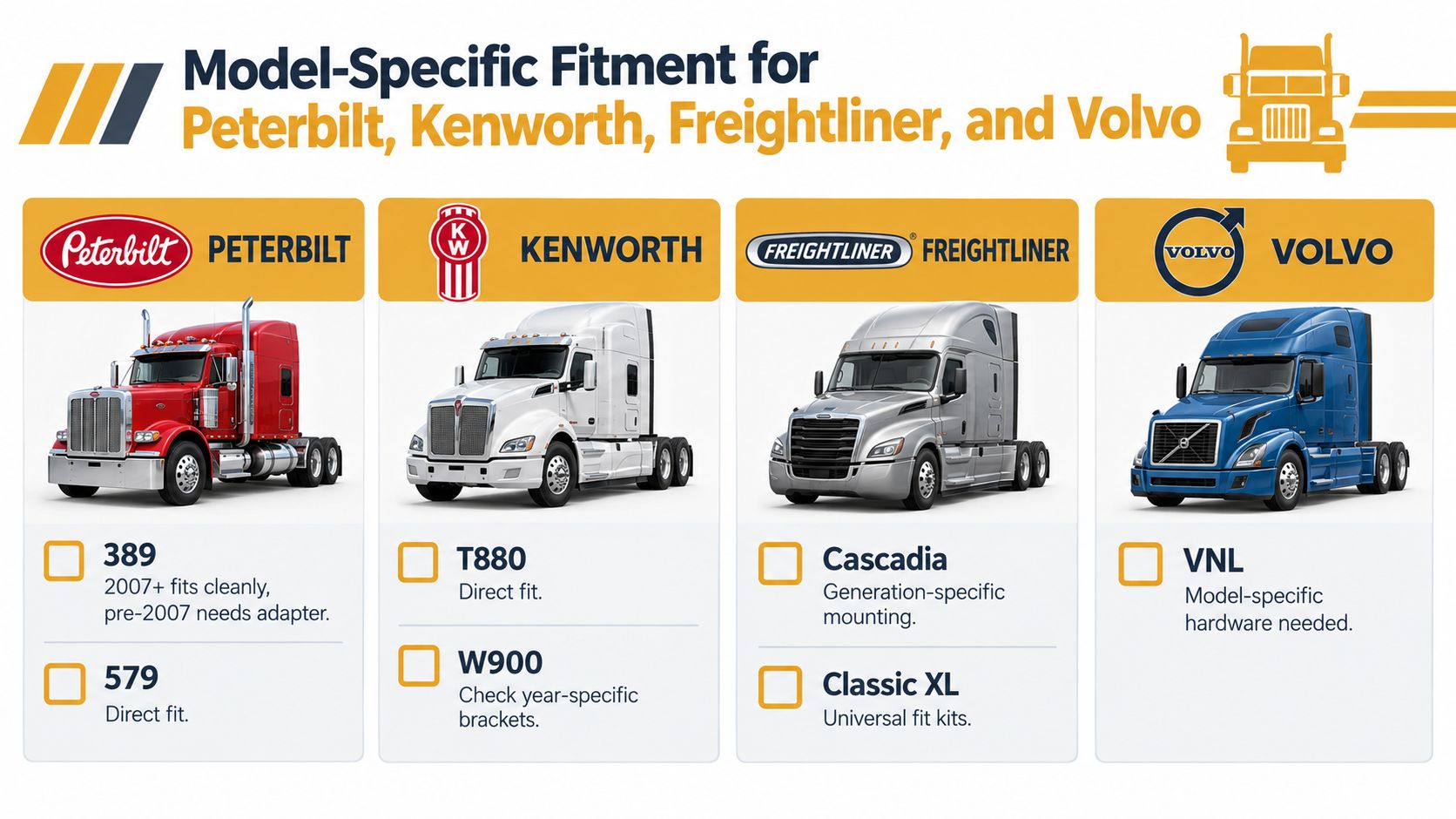
A bumper that fits one Class 8 truck may be wrong for the next truck with the same badge. Model name, model year, generation, bracket style, sensor openings, and mounting method all matter.
Peterbilt
For a Peterbilt 389, confirm whether the truck is from the 2007-and-newer range or an earlier generation before ordering. Earlier hood tower geometry can require an adapter rather than a simple replacement bracket. A Peterbilt 579 generally follows a direct-fit path when the bumper matches the truck's exact configuration, but cutouts and mount style still need verification.
Kenworth
The Kenworth W900 chrome bumper is a common custom-truck request, but similar-looking trucks can use different bracket spacing across model years. Check the year-specific holder and fender bracket layout instead of relying on photographs. A Kenworth T880 should also be matched to its model-specific hardware and front-end configuration.
Freightliner
Freightliner Cascadia bumpers require generation-specific checking. A facelift can change mounting locations, hood clearance, lighting, and sensor placement. Don't assume a pre-facelift Cascadia bumper transfers to a later truck because the cab badge looks similar.
A Freightliner Classic XL may use a universal-fit kit in some configurations, but the actual frame and bracket condition still control the installation. Universal doesn't mean measure-free.
Volvo
The Volvo VNL needs model-specific hardware and generation verification. The VNL 670 and VNL 760 shouldn't be treated as interchangeable without checking bracket geometry, hood shape, light openings, and bumper depth.
Before a custom semi truck parts order ships, send the seller:
- VIN and model year
- Exact model and generation
- Front or rear application
- Existing mount style and bracket photos
- Light, fog, radar, tow-hook, and sensor cutout details
Fitment check: A five-minute VIN review is cheaper than a freight return and a truck waiting on the wrong bumper.
Durability ROI When Premium Materials Pay Back on Long Hauls
Premium material only makes financial sense when the operating conditions use its advantage. A truck that runs dry western lanes and receives regular cleaning may not need the same specification as a tractor crossing salted mountain passes every week.
The payback comes from avoiding repeat work. A bumper that resists corrosion can reduce replacement cycles, protect the appearance buyers notice at trade-in, and prevent corrosion around mounts and seams from becoming a larger repair. Stainless can cost hundreds more per vehicle, according to TruckingInfo's corrosion prevention coverage, so the buyer needs to compare that premium with route exposure and planned ownership.
A practical payback test
Ask four questions:
- How much salt does the truck see? Winter lanes and chemical de-icers favor 304.
- How long will the truck stay in the fleet? Longer ownership gives corrosion resistance more time to matter.
- What condition must the truck show at resale? A clean bumper supports the overall presentation, though it won't fix worn mechanical systems.
- Can the shop replace it during planned service? Planned installation reduces the cost of choosing a better part later.
| Material Grade | Service Life | Cost Multiple vs Chromed Steel | Payback Trigger |
|---|---|---|---|
| Chrome-plated carbon steel | Shorter in harsh salt exposure | Lower | Lowest initial spend, moderate climate |
| 430 stainless steel | Longer corrosion resistance than plated steel | Mid-range | Regular use in moderate climates |
| 304 stainless steel | Longest corrosion resistance of these options | Highest | Salt-heavy routes, long ownership, resale focus |
A premium bumper doesn't create savings automatically. It earns its keep when the truck faces repeated corrosion, the owner plans to retain it for years, or an unexpected replacement would disrupt dispatch. Fleets should record material, truck route, wash practice, and replacement reason in their maintenance system. That turns personal preference into a procurement standard.
Lead Times and Stocking Strategy for Fleets and Owner-Operators
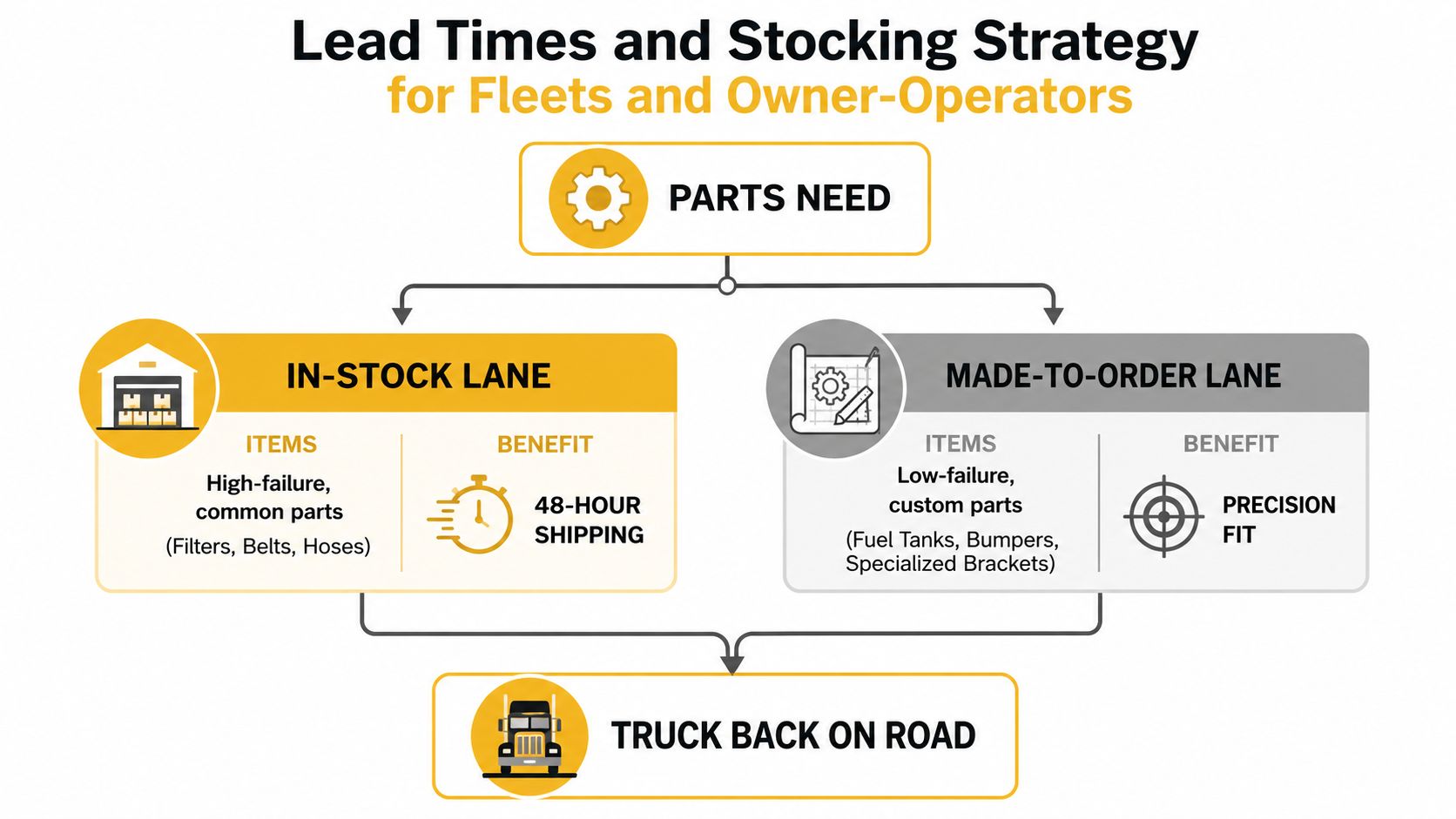
Procurement should follow failure risk, not habit. A part that can stop a truck deserves a different purchasing lane from a custom cosmetic upgrade that can be scheduled around the route.
Use two procurement lanes
In-stock lane: Common, high-failure items belong here. Galhor's published product information identifies 48-hour shipping for in-stock 430 and 304 flat bumpers, while made-to-order carbon steel units typically use a 4 to 6 week production window. Confirm current stock and shipping terms before placing an order.
Made-to-order lane: Specialized bumpers, unusual cutouts, custom brackets, and low-volume configurations belong here. Precision fit can justify the wait when the truck is already scheduled for a build, repaint, or major upfit.
For a small fleet, keep a record of the exact bumper configuration used on each tractor. A five-to-fifty-truck operation can standardize common wear items while ordering cosmetic upgrades ahead of predictable maintenance periods. Don't buy a custom bumper after the old one has already failed if the lead time will interrupt dispatch.
Read the quote carefully
Ask the supplier to state:
- Production status: “In production” should come with a clear expected ship date.
- Configuration: Material, thickness, cutouts, mount style, and finish should appear in writing.
- Freight method: Confirm LTL delivery requirements and damage-inspection procedures.
- Fabrication details: For custom work, ask how measurements, drawings, and weld quality are controlled.
- Return terms: Verify what happens if the supplied part doesn't match the approved fitment.
The total cost of ownership guide is a useful reminder to count labor, freight, downtime, and repeat replacement rather than comparing unit prices alone.
Stock the part when the cost of downtime exceeds the savings from waiting.
Ordering Your Custom Semi Truck Parts the Smart Way
A good order starts before you open the online configurator or call the parts counter. Decide what the truck needs, then give the supplier enough information to build the correct part the first time.
Material grade comes first. Choose chrome-plated carbon steel when initial cost and moderate exposure control the decision. Choose 430 stainless for a middle-ground corrosion upgrade. Choose 304 stainless when salt, coastal air, chemical washdowns, and long ownership make corrosion resistance worth the added cost.
Fitment type comes next. A direct bolt-on is the practical choice for a standard Peterbilt 389, Kenworth W900, Freightliner Cascadia, or Volvo VNL when the model year and bracket pattern match. Custom fabrication belongs on modified trucks or builds that need features unavailable in a standard configuration.
Finish completes the specification. Mirror polish delivers the bright appearance many truck enthusiasts want, while the plating process, substrate, and maintenance routine determine how that appearance holds up. Confirm thickness, cutouts, mount style, and hardware before the order is released.
Have this information ready
- VIN: It gives the supplier a reliable starting point for verification.
- Model year: Generation changes can alter brackets and clearances.
- Exact bumper application: State front or rear, standard or blind mount, and required openings.
- Truck photographs: Include the mounts, hood corners, fenders, lights, and sensors.
- Interference details: Report a headache rack, air cleaner, tow equipment, or other modification near the bumper.
- Delivery deadline: Decide whether the truck can wait for made-to-order production or needs an in-stock configuration.
Galhor Inc. offers configurable direct bolt-on bumpers for Peterbilt, Kenworth, Freightliner, and Volvo Class 8 trucks, with chrome-plated carbon steel, 430 stainless steel, and 304 stainless steel options. Its published product information also describes a triple-layer chrome process with 35 microns of nickel, U.S. shipping support, manufacturing-defect warranty coverage, and model and year selection through its configurator.
Don't buy twice because the first order skipped a VIN check or treated a generation-specific bumper as universal. Request a fitment confirmation, compare the delivery lane with your truck's schedule, and choose the material that matches the roads your tractor runs.
Visit Galhor Inc. with your VIN, model year, bumper style, and cutout details ready. Their team can help confirm a direct bolt-on configuration, select between chrome-plated steel and stainless options, and arrange U.S. shipping so your truck spends more time earning and less time waiting on blocks.