
Kenworth K100 Bumper Guide: Styles, Fit and Materials
November 5, 2026 · Francisco Hornelas

You're parked at a chrome shop with a dull cabover face, an egg-shaped tow hole, and a catalog line that only says "K100." A Kenworth K100 bumper is not one part for one truck. The name covers a family of North American cabovers, and the bolt pattern, grille, and lamp cutouts shifted as those trucks changed. Order from the shine alone and you can end up drilling frame flanges or paying return freight.
Style, height, and finish still change how the truck looks and how it clears the road. They don't decide whether the bumper bolts on. Match the build year and the variant first, then pick the metal for the lanes you run.
Table of Contents
- K100 Bumper Styles and Heights at a Glance
- Model Years and Variants That Change Bumper Fit
- How to Measure Your K100 Before You Order
- Chrome Steel, 430 and 304 Stainless Compared
- Federal and Safety Rules for Replacement Bumpers
- What K100 Bumpers Cost and When to Restore Instead
- Order the Right K100 Bumper Today
- K100 Bumper FAQs
K100 Bumper Styles and Heights at a Glance
K100 bumpers come in several vertical profiles, and the style you pick changes how the face sits on the frame. FleetTruckParts K100 listings show steel construction in boxed-end, tapered rolled-end, and Texas-square styles, with nominal heights running from 12 to 22 inches across listings. That spread is wide enough to change clearance, lamps, and brackets on the same truck.
| Style | Profile | Check before buying |
|---|---|---|
| Boxed-end | Square-cornered ends | Clearance from tires and steering parts |
| Tapered rolled-end | Tapered, rolled ends | Bracket alignment at each end |
| Texas-square | Flat, squared front face | Lamp and cutout placement |
Boxed-end bumpers keep square corners, and those corners need room. Put a 22-inch boxed-end face on a short-wheelbase cabover and crank the wheel to full lock: the squared end swings through an arc that can reach the steer tire's sidewall or a steering part. A taller face makes that sweep worse, not better.
Tapered rolled-end bumpers narrow toward the ends and roll the edges. The taper can help the approach angle on steep yard ramps and dock approaches. Each end still has to meet its bracket without a twist, or the roll puts a permanent lean in the bar.
Texas-square bumpers use a flat, squared front face. Fog lamps and tow cutouts have to land where your lights and hooks already sit, so compare the cutout spacing to your truck before you commit.
An 18 inch drop bumper is a height choice inside that band, not a separate style. A taller face lowers ground clearance, steepens the approach, and moves the lamp line. It can also shift how the bracket meets the frame horn.
Measure your current bumper from the ground to the top edge, write that number next to the end shape, and have both in hand when you call the seller.
Model Years and Variants That Change Bumper Fit
Two K100s parked side by side can take different bumpers. The name covers a production run that stretched across decades, and Kenworth changed the front end along the way.
Kenworth's history of the model places the K100 next to the W900 conventional in 1963, tracks the K100E arriving in 1984 with better aero and fuel use, and marks the end of regular North American production after 2002. The cab sat over the engine so the tractor stayed short inside length rules and left more length for freight or a sleeper. The "K" honored founder Frederick Kent.
The split that matters most at the parts counter runs through 1985. Kenworth cabover bumper guidance covering K100, K100E, and K123 trucks from 1963 to 2010 notes that mounting-hole patterns changed slightly between pre-1985 and later production. A bumper drilled for a late K100E will not land cleanly on an early rail.
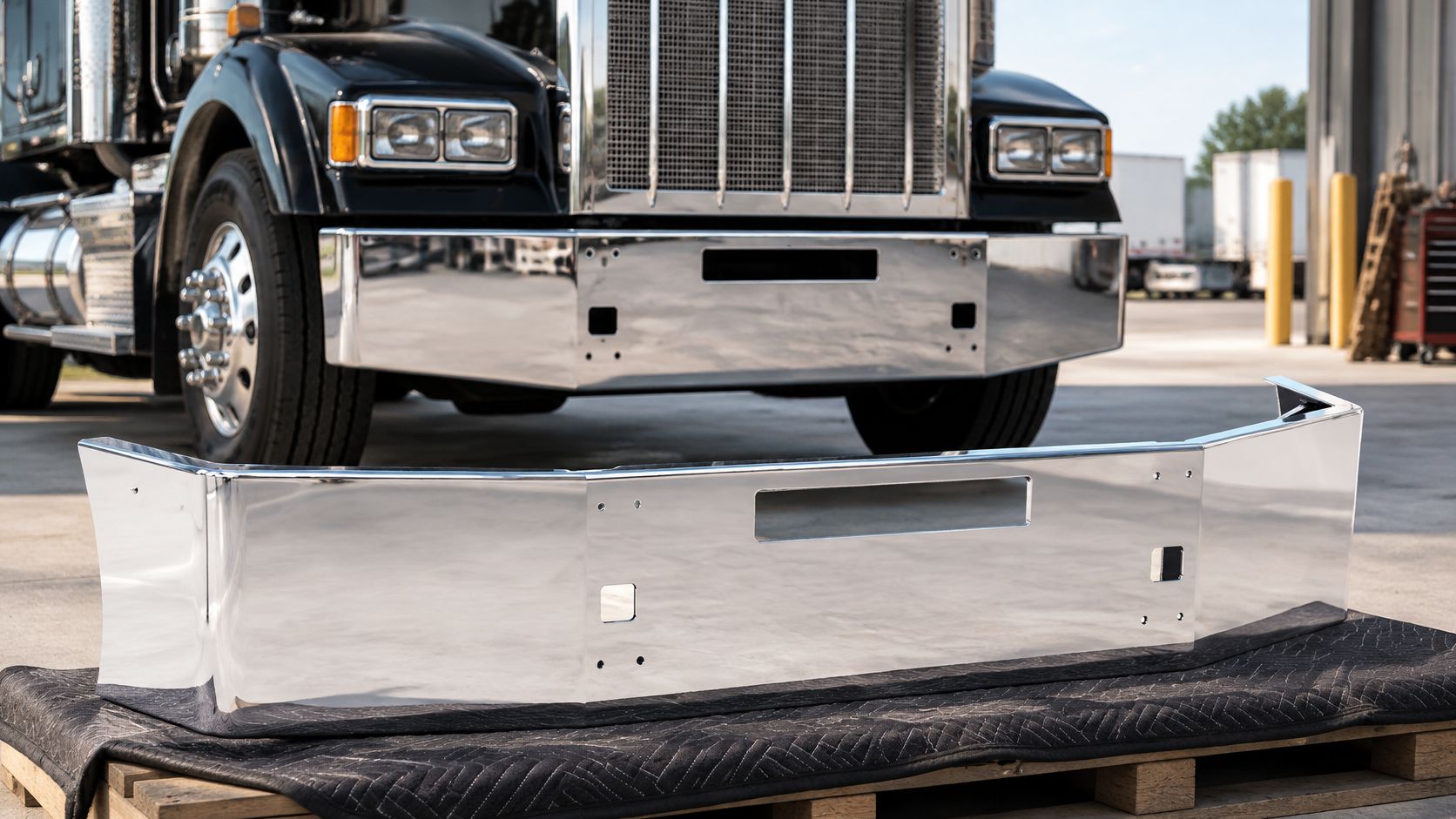
- Early K100: original grille and lamp layout, and on pre-1985 trucks the earlier hole pattern. Do not borrow a later template.
- K100E: the 1984 aero revision restyled the front end, and these trucks sit on the later pattern.
- K100 Aerodyne: its own grille treatment and its own lamp or tow-hook cutouts.
- Any of them: a listing labeled only "K100" can still need drilling, adapters, or a bracket change.
Match the bumper to the build year and variant, then ask the seller for a bolt-hole template in writing.
The same year rule shows up on conventionals. A Chrome bumper for Kenworth T800 (-2003) is built for a defined T800 year range and is not a K100 part. The year in the listing is the point.
How to Measure Your K100 Before You Order
A bumper that needs drilling or adapters can weaken frame flanges. Damaged or modified flanges can fail early. 4 State Trucks cabover bumper guidance treats model year as a fitment control: published guidance covers K100, K100E, and K123 cabovers spanning 1963 to 2010, and mounting-hole patterns changed slightly between pre-1985 and later production. Kenworth body-builder guidance recommends approved brackets or U-bolts instead of cutting the flange.
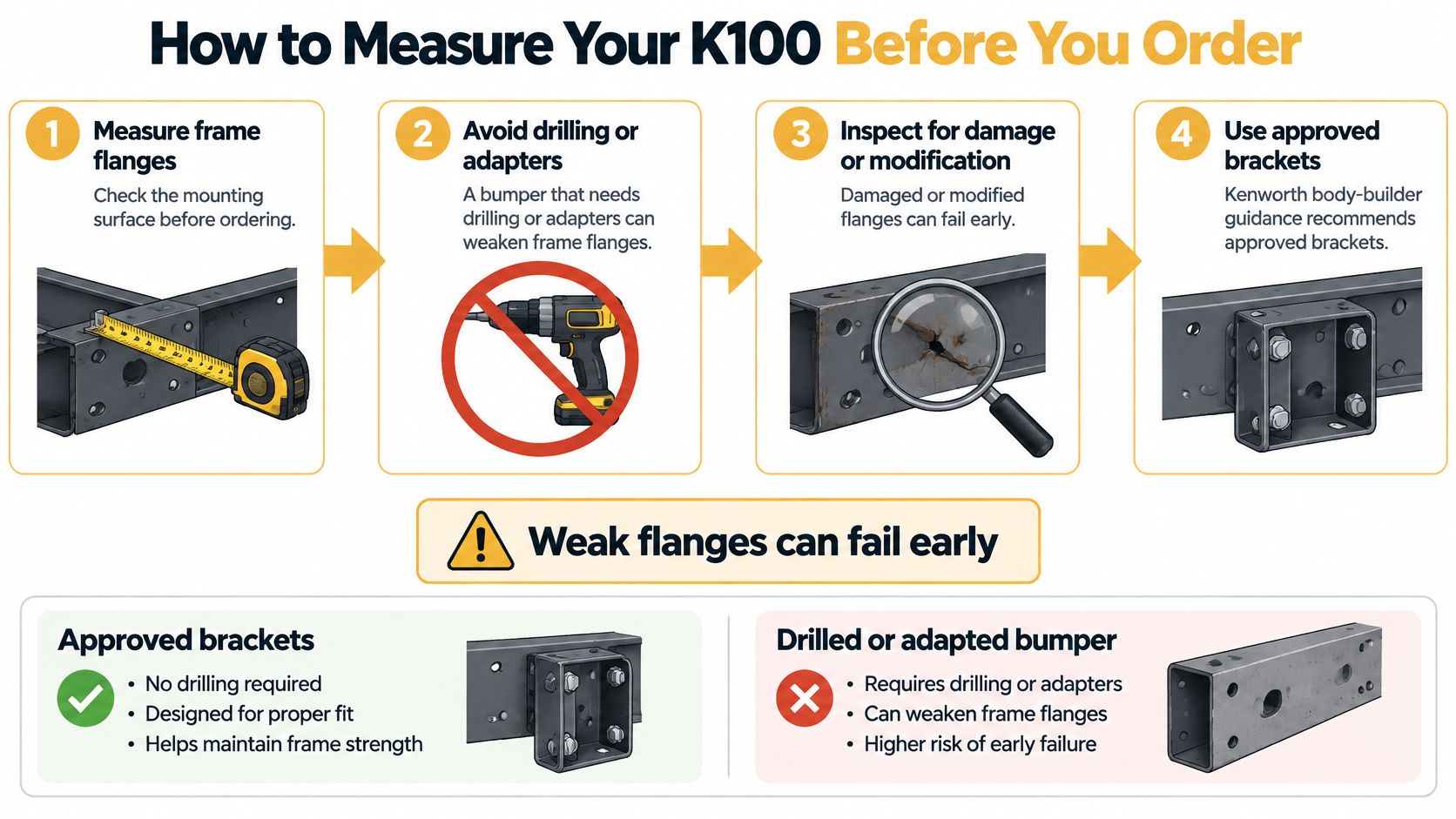
Seven checks before you pay
- Read the build year and variant off the identification plate. Confirm K100, K100E, or Aerodyne. The common miss is trusting the K100 name on the hood.
- Measure frame-to-frame mounting-hole centers on both rails. People measure the old bumper skin and miss a stretched hole in the rail.
- Lay those centers on the supplier's bolt-hole template before you order. A template "close enough" on a phone photo still misses in the shop.
- Confirm fog-lamp and tow-pin cutouts against the lamps and hooks you already run. A pretty face with the fog hole two inches off still fails a night pre-trip.
- Measure bumper height and check clearance from tires, steering parts, and anything mounted on the front. Don't stop at "it looks level" on the stand.
- Confirm a direct bolt-on, or brackets engineered for your frame. Improvised tabs are how flanges get chewed up.
- Recheck fit after the first loaded run. Settling and vibration move a bumper that looked straight in the bay.
Practical rule: Measure the frame, not the bumper you hope to copy. The holes in the rails are the fit.
A good fit shows even gaps, every bolt seated, no contact with steering parts, and no cutting or welding. If the template doesn't match, don't force it.
Chrome Steel, 430 and 304 Stainless Compared
An owner-operator on winter salt routes needs different metal than one who stays on dry western lanes. Salt, coastal spray, and harsh wash-bay chemicals attack a bumper face long before a show-truck lane does.
Ryerson's grade notes put Type 430 as a ferritic stainless with about 16 to 18 percent chromium and usually under 1 percent nickel. Type 304 carries about 18 percent chromium and roughly 8 percent nickel. That nickel is why 304 holds up better in salt, on coastal highways, and in wash bays with aggressive cleaners.
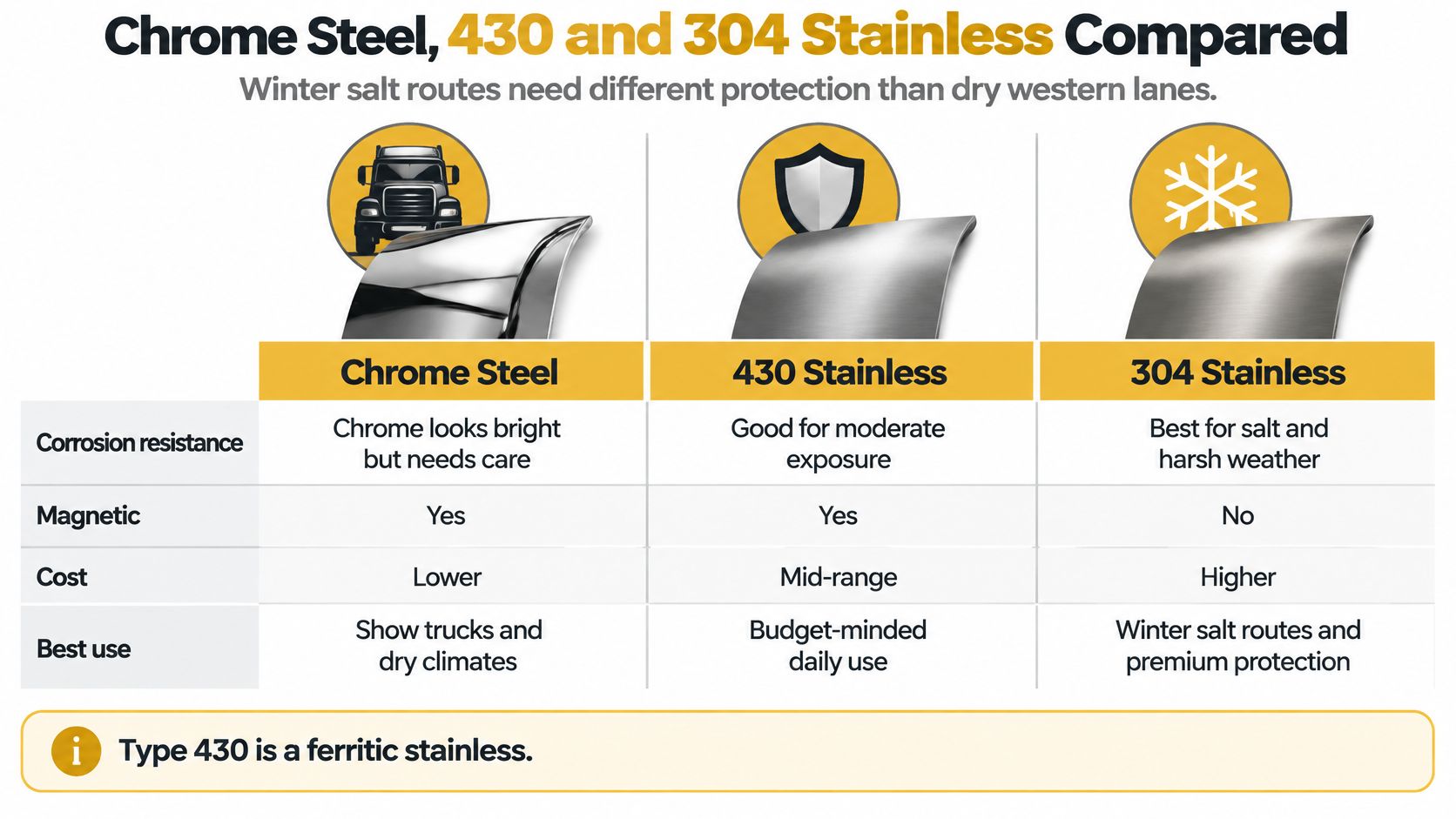
| Material | Key makeup | Corrosion behavior | Best fit |
|---|---|---|---|
| Chrome-plated carbon steel | Chrome plating over carbon steel | Bright at first; exposed steel rusts once plating chips | Dry routes and tight budgets |
| Type 430 stainless | About 16 to 18 percent chromium, under 1 percent nickel | Good corrosion resistance; best when highly polished; not rust-proof | Value pick where appearance matters |
| Type 304 stainless | About 18 percent chromium, roughly 8 percent nickel | Strongest of the three in salt and chemical exposure | Winter salt routes, coastal runs, harsh wash bays |
Chrome-plated carbon steel looks bright and costs less up front. Chip the plate and the steel underneath rusts. That's a fair buy for dry lanes if you'll watch stone chips.
Type 430 is a practical value when cost and looks both matter. It is not rust-proof. It resists corrosion best when the face is highly polished or buffed, and it still trails 304 in harsh chemical exposure.
Type 304 is the grade I would pick for salt-belt winters, coastal runs, and fleets that want the face to stay presentable for years. Our notes on 304 stainless for bumpers walk through why that nickel content earns its price on those routes.
Thickness, brackets, and care
A thicker skin doesn't make a stronger bumper if the brackets are thin or the welds are poor. Impact still has to travel into the frame through those brackets. Ask for sheet thickness, backing or reinforcement, weld quality, bolt size, and the finish process. "Stainless" on a listing is not a grade.
Clean chrome and stainless with products made for that finish. Skip abrasive pads and harsh chemicals. They dull the polish and shorten the life you paid for.
Ask for the actual grade in writing. Stainless steels don't all behave the same way once the salt hits.
Federal and Safety Rules for Replacement Bumpers
Chrome shine tells an inspector nothing. For U.S. interstate trucks, 49 CFR §393.203(e) requires the front bumper to be present, securely attached, and inside the vehicle's normal width. A missing, loose, or sticking-out bumper that creates a hazard fails that rule, and the rule approves no finish, brand, or thickness.
NHTSA's passenger-car bumper standard doesn't generally cover heavy trucks, and it doesn't apply directly to bumpers sold as replacement parts. A 1995 NHTSA interpretation also warns that a repair business must not knowingly make a safety device inoperative, and that replacement-part effects on crash performance have not been studied. A direct-bolt-on label describes fit rather than OEM crash performance.
What to document before it rolls
- Frame brackets: straight, uncracked, and on factory points or engineered brackets. No improvised extensions past the body line. Deep or custom drop styles are where this fails a roadside check.
- Lamps and markers: headlights, markers, and reflectors stay visible. A tall face that hides a lamp is a citation, not a style choice.
- Radar clearance: on a newer tractor in a mixed fleet, keep front radar such as Bendix Wingman Fusion clear and follow the radar maker's mounting rules. Bolt a tall boxed-end face onto a Kenworth T680 and it can sit inside the radar's field of view, tripping fault codes or blinding adaptive cruise. A K100 never carried that hardware, so this check only matters when your fleet runs both.
- Axle loading: confirm the bumper's weight doesn't push an axle past its limit.
- After the first run: recheck fasteners. Vibration and old collision bend can shift a bumper that looked straight on the hoist.
A bolt-on label is a fit claim, not a crash-test claim. Write down what you checked.
State inspection programs can add rules. Confirm them before you order a custom face. Our bumper safety standards notes explain how those limits work in practice.
What K100 Bumpers Cost and When to Restore Instead
Two 2026 listings show the spread before you even talk specs. Arrow Truck Parts listed a K100 aftermarket chrome-steel bumper at $650. FleetTruckParts listed a K100 1984-and-newer 22-inch boxed-end chrome-steel bumper at $997.80. Those are not the same part.
| Source | Listing | Listed price (2026) |
|---|---|---|
| Arrow Truck Parts | K100 aftermarket chrome-steel bumper | $650 |
| FleetTruckParts | K100 1984-and-newer 22-inch boxed-end chrome-steel bumper | $997.80 |
| Restoring your current bumper | Rechrome or repair of the bumper you have | Chrome shop quote, not a listed price |
Compare height, end style, brackets, and finish before you compare those dollars. Price moves with nominal height, end style, material grade, polish, and whether brackets come in the box.
Restoring costs whatever a chrome shop quotes for rechrome or repair. Get that number before you buy.
Restore when the chrome is pitted or dull but the steel is sound and the brackets are straight and free of cracks. Replace when you see cracks near the mounts, collision distortion, rust through the steel, or brackets that won't line up. A face that survives salt seasons means fewer swaps and fewer days the truck sits. Our repair versus replacement breakdown is the longer version of that choice. Get the bolt-hole template in writing before you order either listed option.
Order the Right K100 Bumper Today
You've already done the hard part. The measuring checklist gave you the packet a seller really needs: build year and variant off the plate, the height and end style on the truck now, frame-to-frame centers measured on the rails, and route type so the grade matches the weather you run.
That packet earns its keep in the reply. A seller worth your money confirms the brackets are included or engineered for your frame, states the material grade on the quote, and gives a real lead time. Vague answers on any of the three mean the catalog photo is doing the talking, and that is how trucks end up waiting on a return.
We build direct bolt-on bumpers in chrome-plated carbon steel, 430 stainless, and 304 stainless. For the Kenworth models in our catalog, send the frame numbers and we will check the fit before anything ships. In-stock 430 and 304 flat bumpers ship within 48 hours. Made-to-order carbon steel typically runs 4 to 6 weeks by LTL freight, and warranty covers manufacturing defects.
Send the build year and your measurements, get the fit confirmed, then order the K100 bumper. The frame you measured beats the model name every time.
K100 Bumper FAQs
What do I do if the template and my frame don't match?
Stop before any metal moves. Recheck the frame centers on the rails and confirm the build year off the plate, because one wrong digit there explains most mismatches. Send the measurements to the seller and ask whether brackets can be engineered for your frame. Drilling the rails to force a fit is where chassis damage starts.
Does the warranty cover rust or rock chips?
Warranty covers manufacturing defects, meaning flaws in the plating or welds that show up early. Chips from road debris and rust creeping in from an untreated chip count as wear. Touch chips up fast on chrome-plated carbon steel before the base metal sees moisture.
How will the bumper get to my shop?
Oversized bumpers ship by LTL freight on a pallet. Inspect the crate before the driver leaves and write any damage on the delivery receipt before you sign. A claim noted at the dock resolves far easier than a bend discovered in the shop a week later.
Can an owner-operator install a direct bolt-on bumper alone?
It's possible when the fit is direct bolt-on. Measure first, check lamp and tow clearance, and have the alignment looked at again after the first road run. If the holes don't match, stop. A second person and a shop hoist beat a bumper hung crooked on a Friday night.
Galhor Inc. builds direct bolt-on chrome and stainless bumpers for Kenworth and other Class 8 trucks, including faces you can match to year, cutouts, and finish. If your K100 needs a bumper that bolts to the frame you measured, not a guess from the model name, visit Galhor Inc. and send your build year with those frame centers. Confirm the fit, then order.