
Peterbilt 379 Price in 2026: Ranges, Factors and Costs
November 9, 2026 · Francisco Hornelas

A 1996 Peterbilt 379 sleeper listed at $187,500, while a 1997 truck was advertised at $22,000 on Machinery Pete. That spread explains why a Peterbilt 379 price guide needs more than model years. For a U.S. owner-operator or fleet manager, the useful number is the cost of a truck that can do the job, including repairs, replacement parts, and time out of service.
Table of Contents
- What a Peterbilt 379 Costs Today
- Why Condition Beats Model Year
- Spec Checks That Protect Your Budget
- Reading Auction Sales Against Asking Prices
- Where to Buy and Sell a 379
- Restoration Costs for a Peterbilt 379
- Peterbilt 379 Bumper Price and Your Budget
- Peterbilt 379 Price FAQs
What a Peterbilt 379 Costs Today
A Peterbilt 379 can be listed for $5,800 or $280,000 in the examples below. That spread reflects differences in price type, configuration, condition, and documentation, not a single market rate. Machinery Pete reports an observed range of approximately $12,500 to $100,000 for its Peterbilt 379 semi-truck and trailer category.
Use the range as a starting point, not a valuation. For example, if a truck with visible damage is priced near the $12,500 floor, compare the asking price with the inspection findings and the work needed before it can haul. A low price alone does not establish that the truck is a sound buy.
Peterbilt 379 Prices by Model Year and Price Type
The examples below come from marketplace listings and Purple Wave auction records. The price type matters: a current bid may change, an asking price is the seller's stated figure, and a closed sale records a completed transaction.
| Model year | Price | Price type | Notable detail |
|---|---|---|---|
| 1995 | $5,800 | Auction listing | Listed price, not a confirmed closed sale |
| 1996 | $16,500 | Current bid | Bid amount, not a final sale |
| 2007 | $15,000 | Current bid | Bid amount, not a final sale |
| 1997 | $22,000 | Asking price | Listed price, not a verified sale |
| 2003 | $66,000 | Closed auction sale | Completed auction transaction |
| 2005 | $86,900 | Closed auction sale | Completed auction transaction |
| 2007 | $100,100 | Closed auction sale | Completed auction transaction |
| 2006 | $135,000 | Asking price | Dealer or seller listing |
| 1996 | $187,500 | Asking price | Sleeper configuration |
| 2007 | $280,000 | Reported sale | Pre-DEF, 20,817 miles, one owner |
These figures are not a depreciation chart. They cover different configurations and conditions, including an unusually preserved truck. Averaging them would conceal the differences that determine whether a specific 379 fits a buyer's budget.
Compare the Truck You Need
Start with examples that match the truck's intended job. Then check:
- Configuration: Compare sleeper or day cab, engine, and transmission.
- Mechanical readiness: Distinguish road-ready trucks from projects or damaged units.
- Documentation: Review service records and repair invoices alongside the truck's visible condition.
- Remaining investment: Account for inspection findings and needed repairs when judging the price.
The useful comparison is between trucks that could do the same work. A lower purchase price is better value only if the purchase cost plus required work leaves a dependable truck at a sensible total cost.
Why Condition Beats Model Year
Model year sets a starting assumption. Mileage, service records, and engine condition help show whether a truck is ready for work or likely to need repairs. For buyers, those checks matter more than age alone.
A 2007 pre-DEF 379 reportedly sold for $280,000, with one owner, covered storage, and just 20,817 miles, according to Purple Wave's inventory and resale information. Treat it as an outlier, not a typical working-truck comparable. Its preservation and documented history help explain the price.
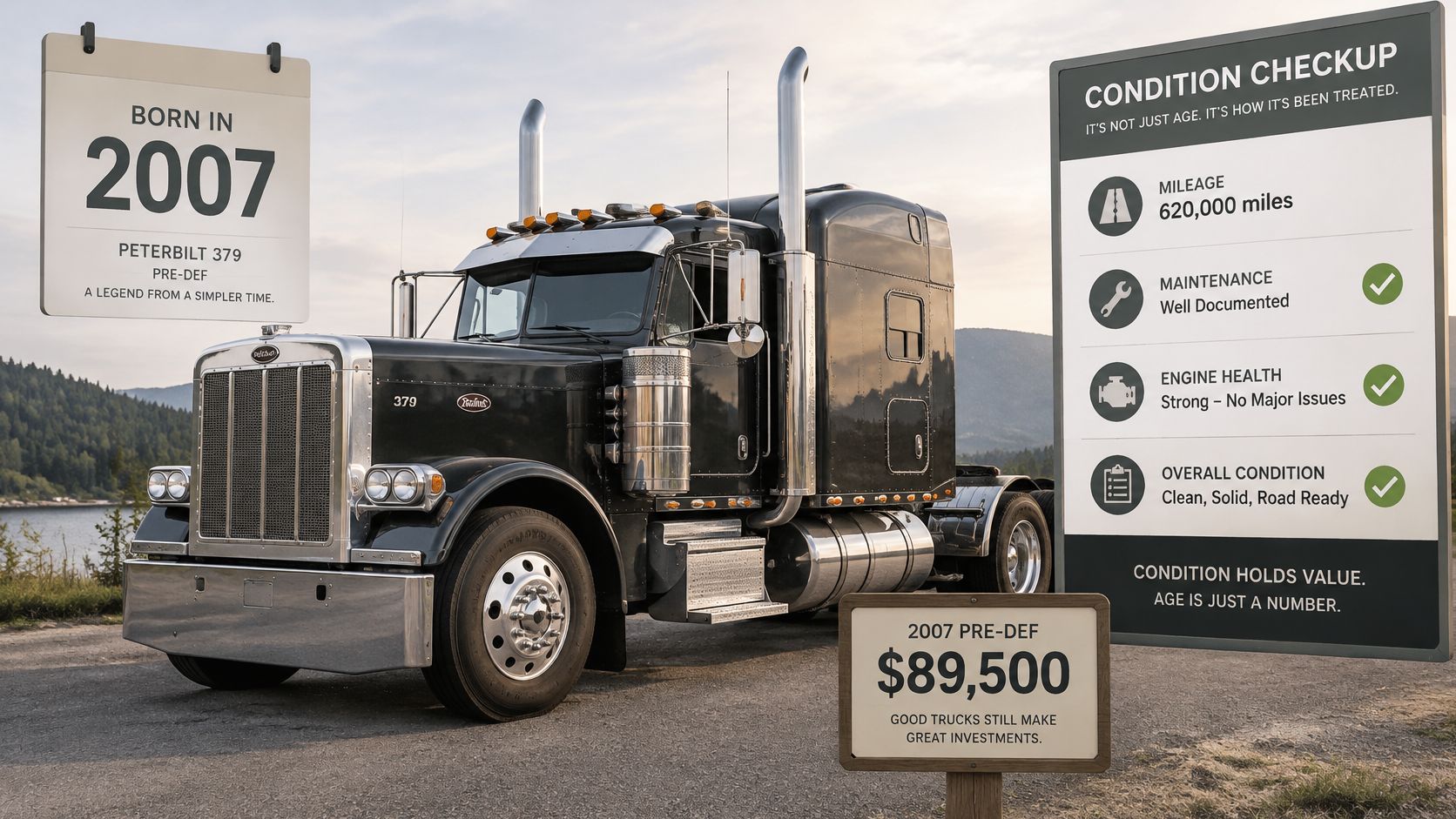
The 379 was built from 1987 through 2007, with Detroit Diesel Series 60, Cummins N14, ISM, and ISX engines, as well as Caterpillar C11, C12, C13, C15, C16, 3406C, and 3406E options, according to Allstate Peterbilt. Because the model spans multiple engine families, confirm the actual engine and its history rather than relying on the model name.
Turn Value Drivers Into Questions
Ask the seller for evidence that connects the truck's condition to its likely work and repair needs:
- Mileage: Does the odometer agree with service records and available engine records?
- Engine and transmission: What repairs were completed, who performed them, and are invoices available?
- Sleeper configuration: Does it suit the time you expect to spend on the road?
- Maintenance history: Are there dated records, or only a general claim that maintenance was done?
- Emissions suitability: Does the truck's configuration fit the places where you plan to operate?
- Cosmetic condition: Could fresh paint be covering repairs, corrosion, or frame damage?
A documented rebuild can support a stronger valuation, but the word “rebuilt” alone tells you little. Ask which parts were replaced and whether supporting systems were checked.
Rank the purchase checks in this order: drivetrain, frame, paperwork, then appearance. Chrome may improve a sound truck's presentation, but it cannot resolve an uncertain title or reduce the risk of a failing transmission.
Spec Checks That Protect Your Budget
A 2005 listing from Boom and Bucket described a 475-horsepower engine, 1,650 lb-ft of torque, an 18-speed manual transmission, 12,000-pound front and 38,000-pound rear axle ratings, and a stated 48,000- to 52,000-pound GVWR, depending on configuration. Those are specifications for that example, not every 379.
Use the specification summary as a prompt to inspect the truck's own labels and records.
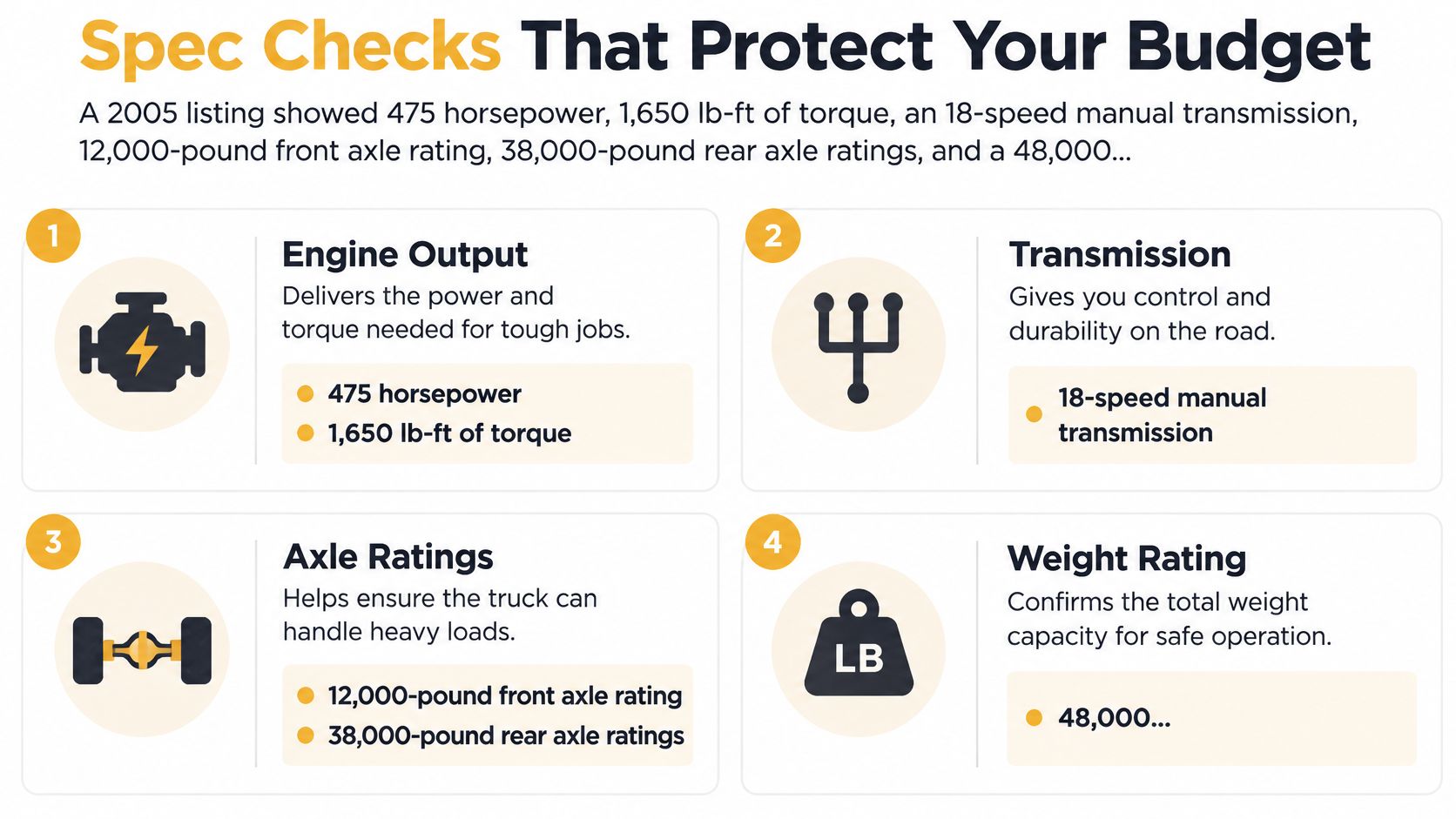
Horsepower and torque help describe pulling performance. Transmission gearing and axle ratio determine how that output fits your loads and lanes. Axle ratings and GVWR describe equipment limits, but they don't establish legal payload by themselves. Actual weights, route rules, and the complete combination still matter.
A Buyer's Verification Checklist
- Match the engine family and serial number. Photograph the identification plate and compare it with invoices. The common mistake is trusting the hood badge or advertised engine description.
- Confirm output and transmission. Check the engine rating and transmission identification, not just the shift knob. A replacement transmission or changed engine setup may differ from the original build.
- Read the door sticker and axle tags. Record ratings directly. Don't calculate a usable payload by adding axle ratings and ignoring the rest of the truck.
- Verify title and accident history. Match the VIN across the title, chassis identification, and sale paperwork. Don't accept a promise that a title problem will be fixed after payment.
- Inspect the frame, suspension, steering, and fifth wheel. Have a qualified heavy-duty technician check cracks, corrosion, loose components, and wear. Fresh paint isn't proof of a sound chassis.
- Confirm the emissions configuration. Identify what's installed and whether it suits your operating area. Don't assume an older truck's advertised description settles compliance.
Hood configuration also matters when ordering replacement parts. Use the Peterbilt 379 long-nose guide to help identify the configuration, then confirm dimensions on the truck itself.
Missing identification tags aren't a reason to guess. They're a reason to pause the purchase.
A walkaround can help you plan questions, but it doesn't replace a hands-on inspection.
If the seller can't produce the sticker, tags, or title, treat the valuation as unverified. Don't pay a premium for specifications nobody can document.
Reading Auction Sales Against Asking Prices
Auction results are most useful when compared by configuration and sale terms, then adjusted for documented differences in the truck. A model year alone cannot explain the gap between two results.
Purple Wave's completed-sale records show 2007 trucks selling for $100,100 on April 3, 2025, and $72,600 on September 26, 2024. The difference is $27,500, so using either result as a price target without comparing the trucks would be weak valuation.
A separate Purple Wave market-value page records 2000 models at $69,300 to $74,800 and 2006 models at $86,900 to $118,800 in closed auctions. Those ranges reinforce the need to compare like with like, rather than assign a fixed price by model year.
Build a Defensible Offer
- Collect comparable completed sales. Begin with the same model year and configuration. If close matches are scarce, widen the search and record the differences.
- Compare current listings. Look for the gap between advertised prices and completed transactions. A higher asking price needs support from condition, equipment, or documentation.
- Adjust only for verified differences. Use the spec and inspection checklist before adjusting for drivetrain, title status, or mechanical readiness. Consider mileage and regional demand, but avoid assigning an unsupported dollar premium to each feature.
- Reserve money for repairs. Turn inspection findings into shop quotes. Separate required repairs from optional appearance upgrades.
For example, a buyer considering a 2007 379 could treat the $72,600 and $100,100 results as comparison points, not automatic offers. First compare configuration, condition, and sale terms. If the candidate truck is closer in documented condition to the lower-priced sale, the buyer can use that result as a more relevant starting point, then account for quoted repairs and required purchase costs. The higher result supports a stronger offer only if verified differences justify it.
A rebuilt engine may support a higher valuation when invoices document the work. A pre-emissions configuration may suit a particular buyer, but the buyer still needs to confirm it fits the intended job.
Compare Total Cost, Not Just the Bid
A documented working truck may cost more than one with uncertain transmission condition. The cheaper truck is the better choice only if repairs, transport, fees, and downtime keep its total cost below the alternative.
Read auction terms before setting a ceiling. Confirm whether the displayed result includes buyer charges, and check payment and removal requirements.
Write down your maximum total purchase budget before bidding or negotiating. Work backward from that ceiling to set the offer, with repairs included from the start.
Where to Buy and Sell a 379
A Peterbilt 379 has no single market price. The sales channel affects what you can inspect, how quickly you must act, and which costs need to be settled before purchase.
Compare the Sales Channels
- Auction houses: Purple Wave and similar auction sellers can provide completed-sale comparisons. Before bidding, confirm inspection access, buyer fees, payment deadlines, and removal requirements.
- Listing sites: Machinery Pete, Soarr, and Boom and Bucket let buyers compare advertised trucks. Ask who owns the truck and who is responsible for the transaction.
- Dealers: Compare what the asking price includes. Get any warranty or repair commitment in writing.
- Private sellers: Ask to see the title before paying a deposit, and arrange an inspection before agreeing on a price.
On Soarr, a 1997 379 with 2,737,226 miles was listed at $54,950. Another 1997 with 770,000 miles was listed at $49,950 on Soarr. A 2005 model with 584,000 miles was advertised at $55,900 on Soarr. These are asking prices, not confirmed sale prices. The spread shows that mileage alone cannot explain the price; condition, configuration, and records still need checking.
Check Costs and Prepare Records
Before making an offer, account for auction fees, pickup, transport, and title-transfer costs. Use the inspection checklist to assess the truck rather than relying only on a seller's walkaround video.
Sellers can help buyers assess value by stating the year, configuration, mileage, service history, and known accident history. Clear photos of the engine identification, frame, sleeper, and tires give buyers specific details to review.
The Class 8 truck buying guide offers broader shopping context. Choose a channel based on the time and inspection access you have, along with the transaction risks you are prepared to handle.
Restoration Costs for a Peterbilt 379
Market records here do not support one restoration total for a Peterbilt 379. Price the truck from itemized shop quotes tied to inspection findings, not from a percentage of the asking price.
A sound long-haul truck and a truck that still needs frame or drivetrain work are different commercial decisions. Cosmetic spending can be reasonable when you are improving an asset you plan to keep working. Frame or powertrain problems require a harder look at whether the repair is worth finishing.
Quote the Work Separately
Split the estimate into separate lines so one vague allowance cannot hide the expensive jobs:
- Bumper and trim: Include material, mounting hardware, cutouts, freight, and installation.
- Paint and body: Ask the shop to identify corrosion repair separately from refinishing.
- Lighting and glass: Include damaged wiring, seals, and mounting parts.
- Cab and sleeper: Price upholstery, leaks, interior trim, and comfort repairs.
- Tires and brakes: Base the quote on inspection findings.
- Engine and transmission: Require a defined repair scope rather than a vague overhaul allowance.
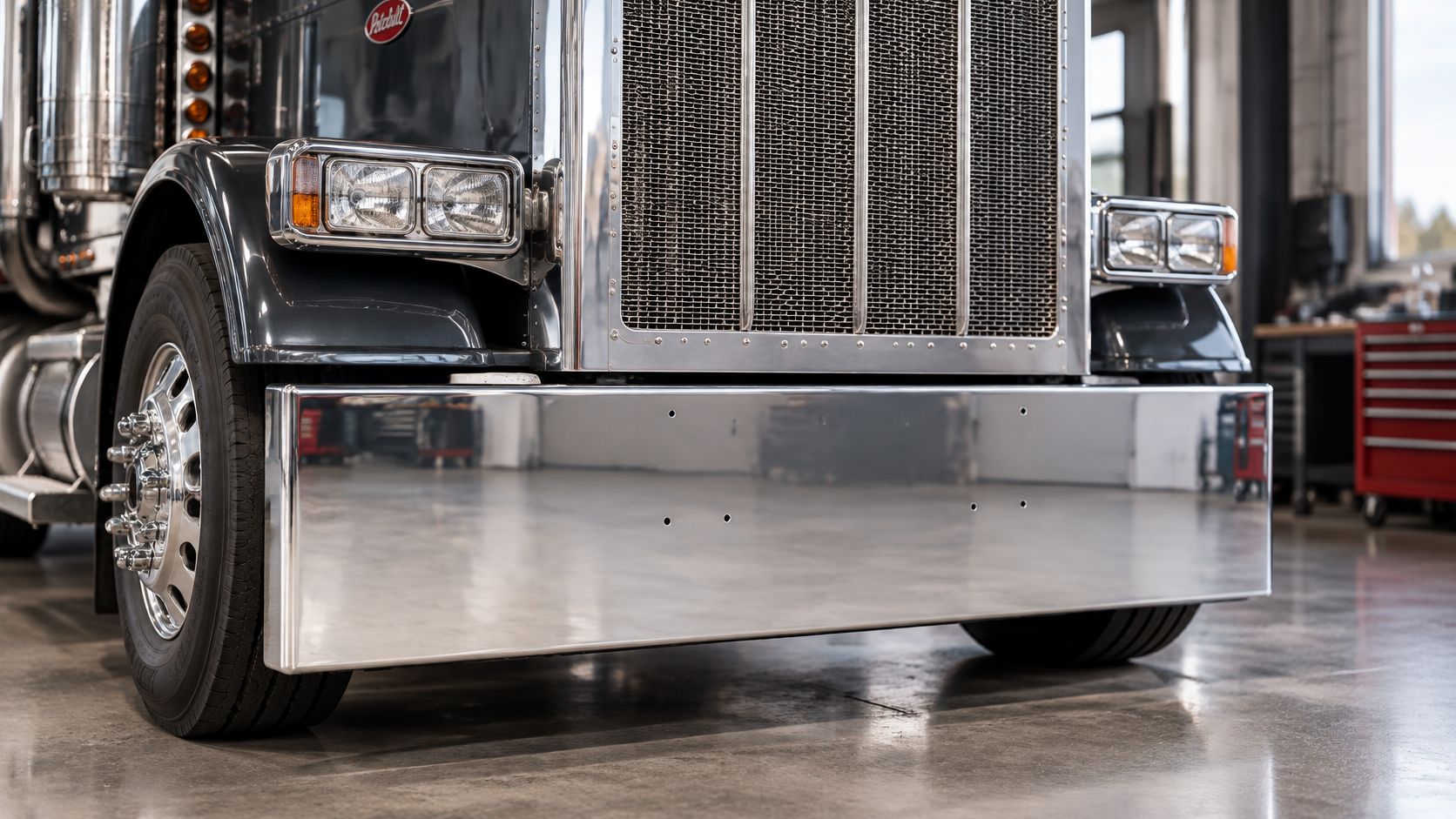
One parts line you can identify before the truck is in the shop is the Chrome bumper for Peterbilt 378 / 379. Engineered in-house by Galhor Inc. and manufactured under its quality control, it uses 10-gauge chrome-plated steel, with a 3 mm chrome-plated stainless steel 304/430 premium option.
Set the Restoration Cap
Get competing itemized quotes. Add them to the inspection repair list and to your purchase price, then compare that full investment with comparable trucks already in finished condition.
Restoration limit: If purchase, restoration, and mechanical repairs exceed the truck's likely finished value, another truck is usually the stronger commercial buy.
Set a written restoration cap before authorizing work, and require approval for added repairs. That cap is what stops a planned refresh from turning into an open-ended rebuild.
Peterbilt 379 Bumper Price and Your Budget
A Peterbilt 379 has no single market price, and replacement parts belong in the same budget calculation as the truck and its repairs. Galhor's Peterbilt 378 / 379 chrome bumper starts at $874.99. The listed American Eagle, Road Runner and selected tapered styles cost $973.99, so confirm the style price before ordering.
Galhor Peterbilt 378 and 379 Chrome Bumper Prices by Style
| Style group | Price | Notes |
|---|---|---|
| Box End, Mitered End, Tapered Box, Tapered Miter, Tapered Open End, Tapered Texas, Texas Square | $874.99 | Standard listed options |
| American Eagle 6" and 8", Road Runner Long Lip, Road Runner Short Lip, Tapered American, Tapered Road Runner | $973.99 | Listed style options |
| Premium 3 mm stainless steel 304/430 | Price not listed | Premium material option |
Price is only one part of the fit decision. Match the material, mounting configuration, end style and cutouts to the truck before placing an order.
Material, Finish, and Installation
The standard bumper is made from 10-gauge chrome-plated steel with a mirror-polished finish. The premium option uses 3 mm chrome-plated Stainless Steel 304/430. Choose based on the truck's service conditions and the material you want, rather than treating finish as a substitute for fit.
Standard mount and blind mount configurations are available. The bumper is a direct bolt-on fit for the listed model, with no drilling or cutting required. Check the selected mount and the truck's existing brackets before installation, especially if the mounting hardware is damaged.
For an 18 inch drop bumper, confirm the actual dimensions and ground clearance. A style name alone does not establish bumper depth or fit. Galhor's Peterbilt 378 and 379 bumper options are designed for the listed models, so check the truck's fitment before ordering.
Keep the Upgrade Inside the Truck Budget
Set the truck's value based on comparable condition and equipment, then account for inspection repairs before adding cosmetic parts. A bumper can be a manageable purchase on a sound truck, but on a lower-value project, it may compete with money needed to make the vehicle roadworthy. Keep the parts budget tied to the truck's likely use and condition.
The bumper is covered against defects in workmanship and materials. Confirm your style, finish and mounting choice before ordering, and include the part cost in the total amount you are prepared to spend on the truck.
Peterbilt 379 Price FAQs
Is the Peterbilt 379 Still in Production?
No. Production ended before the current decade, so buyers are shopping the used market. Assess the truck's present condition and equipment rather than assuming every 379 has the same factory configuration.
How Can I Verify a Rebuilt Engine?
Ask for the rebuild invoices and compare their engine details with the serial number on the engine. Check that the paperwork identifies the work completed and parts replaced. If the seller cannot provide supporting records, treat the rebuild as unverified when assessing the truck's value.
How Do I Confirm I'm Looking at the Right Truck?
Match the chassis identification and title, then compare the engine serial number, door sticker, and axle tags with the listing. Resolve discrepancies before paying a deposit.
Why Do Same-Year Trucks Sell So Far Apart?
Condition, equipment, documentation, and repair risk shape what buyers are willing to pay. A preserved truck and a repair project are poor comparables, even if their model years match. The asking price alone does not tell you which one is better value.
What If the Bumper Mounting Hardware Is Damaged?
Inspect the truck's mounting points and brackets before ordering a replacement. Damaged hardware can prevent a properly selected bumper from fitting as intended, so address the mounting issue before installation.
What Should I Check Before Ordering a Replacement Bumper?
Match the bumper to the truck's model and choose the required style, finish, and mounting configuration. Galhor Inc. offers configurable chrome bumpers for Peterbilt and other listed truck models. The Peterbilt 378 / 379 bumper starts at $874.99, with pricing depending on style.
A replacement bumper is one cost to account for alongside the truck's condition and repair needs. Review the available Peterbilt 378 and 379 bumper options and confirm the configuration before ordering.