
Stainless 430 vs 304 for Chrome Bumpers: Which to Buy
October 28, 2026 · Francisco Hornelas

Choose 304 for coastal, northern road-salt and wash-heavy trucks, and 430 for dry or moderate routes where a lower price matters more than maximum corrosion margin. In the stainless 430 vs 304 decision, you're choosing how much corrosion protection to buy underneath the chrome, not just how the bumper looks on delivery day.
You might be pricing a replacement after a winter run, or building a truck that needs to look sharp at the customer's dock. Either way, the right order starts with your route, then moves to thickness, mounts and cutouts.
Table of Contents
- The Short Answer on Stainless 430 vs 304 for Your Bumper
- Stainless 430 vs 304 Specs Side by Side
- How Road Salt and Coastal Air Attack Each Grade
- Strength, Formability and Finish on a Real Bumper
- What the 304 Premium Costs and When It Pays Off
- Which Grade Fits Your Route and Fleet
- Confirm the Order Before You Buy Your Bumper
The Short Answer on Stainless 430 vs 304 for Your Bumper
Your truck comes back from Ohio with salt packed behind the bumper brackets. Or you're running a coastal Texas lane and notice brown spots around the bolt holes, even though the chrome face still shines.
Take a tractor on a Great Lakes lane all winter, parked outside and run through an alkaline wash bay every week. Brine sits in the seam between shell and bracket, and hot water hits stressed metal at every bolt hole. That truck gets 304. A dry-route Southwest hauler sees a rinse instead of a salt bath and can run 430 while banking the savings.
Both grades ship chrome-plated with the same mirror-polished finish, so the steel underneath is the whole decision. The warranty tracks it: 4 years on the 430 line, 5 on the 304.
Buy for the Work, Not the Shine
Outokumpu's stainless grade guide calls the austenitic grade an all-purpose material with good corrosion resistance, formability and weldability, and puts the ferritic grade in mildly corrosive service. A datasheet cannot show where each steel gives up on a truck.
304 holds the edge on pitting and crevice attack, the failures that start behind brackets and at cutout edges where brine sits still. 430 holds one edge of its own. The austenitic structure in 304 is prone to chloride stress-corrosion cracking at warm, tensioned spots near the mounts, and the ferritic structure shrugs that mechanism off.
- Salt-state owner-operator: Pay for the corrosion margin, because the first pits form behind the plating you already paid for.
- Dry-route buyer: Same chrome, same fit; the material premium is the only real gap.
- Fleet manager: Price install labor and down hours, not just the invoice line.
Trapped water behind a mount or chipped plating at a light cutout will beat either grade, so wash habits and fitment count as much as the alloy.
Counterman's rule: After the first hard winter run, check behind the mounting brackets before you look at the face. That seam is where brine hides and where pitting starts.
Stainless 430 vs 304 Specs Side by Side
Stainless 430 vs 304 at a glance
| Spec | Stainless 430 | Stainless 304 | What it means on a truck |
|---|---|---|---|
| Steel type | Ferritic | Austenitic | Sets forming behavior and salt tolerance |
| Chromium, nominal | About 16 to 18% | About 18 to 20% | Builds the passive oxide film that resists rust |
| Nickel | Little or none | About 8 to 10.5% | Adds ductility and chloride resistance |
| Magnetic | Yes | Normally no; cold-worked areas can show slight pull | A magnet separates the grades only partly |
| Corrosion resistance | Medium, suited to mild atmospheres | High, better suited to salt and coastal exposure | Helps decide which routes each grade suits |
| Formability and welding | Harder to form and weld | Easier to form and weld | Matters for tight bends, cutouts and drop designs |
The composition ranges in the table come from Essentra's stainless steel comparison, which lists approximately 16–18% chromium for the ferritic grade and 18–20% chromium with 8–10.5% nickel for the austenitic grade.
What Those Specs Mean at the Parts Counter
Chromium helps create the thin protective surface film. Nickel stabilizes the austenitic structure and helps the material stay ductile, so it can tolerate forming without behaving like a brittle sheet.
Shop shorthand calls the austenitic grade 18-8, referring to roughly 18% chromium and 8% nickel, as described in the World Stainless machining reference. That nickname describes alloy chemistry, not thickness, chrome quality or an impact rating.
Magnetism comes from the steel's structure. It isn't a quality score, and a strong pull doesn't mean a stainless bumper is counterfeit or poorly made.
Use these field checks as screening tools:
- Try a magnet: No pull points toward austenitic stainless. A pull can't separate ferritic stainless from chrome-plated carbon steel, and slight attraction at a formed bend doesn't settle the question.
- Inspect edges and cutouts: These are better places to inspect the substrate than the mirror face. Look for flaking plating, rust trails and rough fabrication, but confirm the grade through the order specification rather than color alone.
A clean face and a magnet are useful clues. Neither replaces a written material description tied to your exact bumper configuration.
How Road Salt and Coastal Air Attack Each Grade
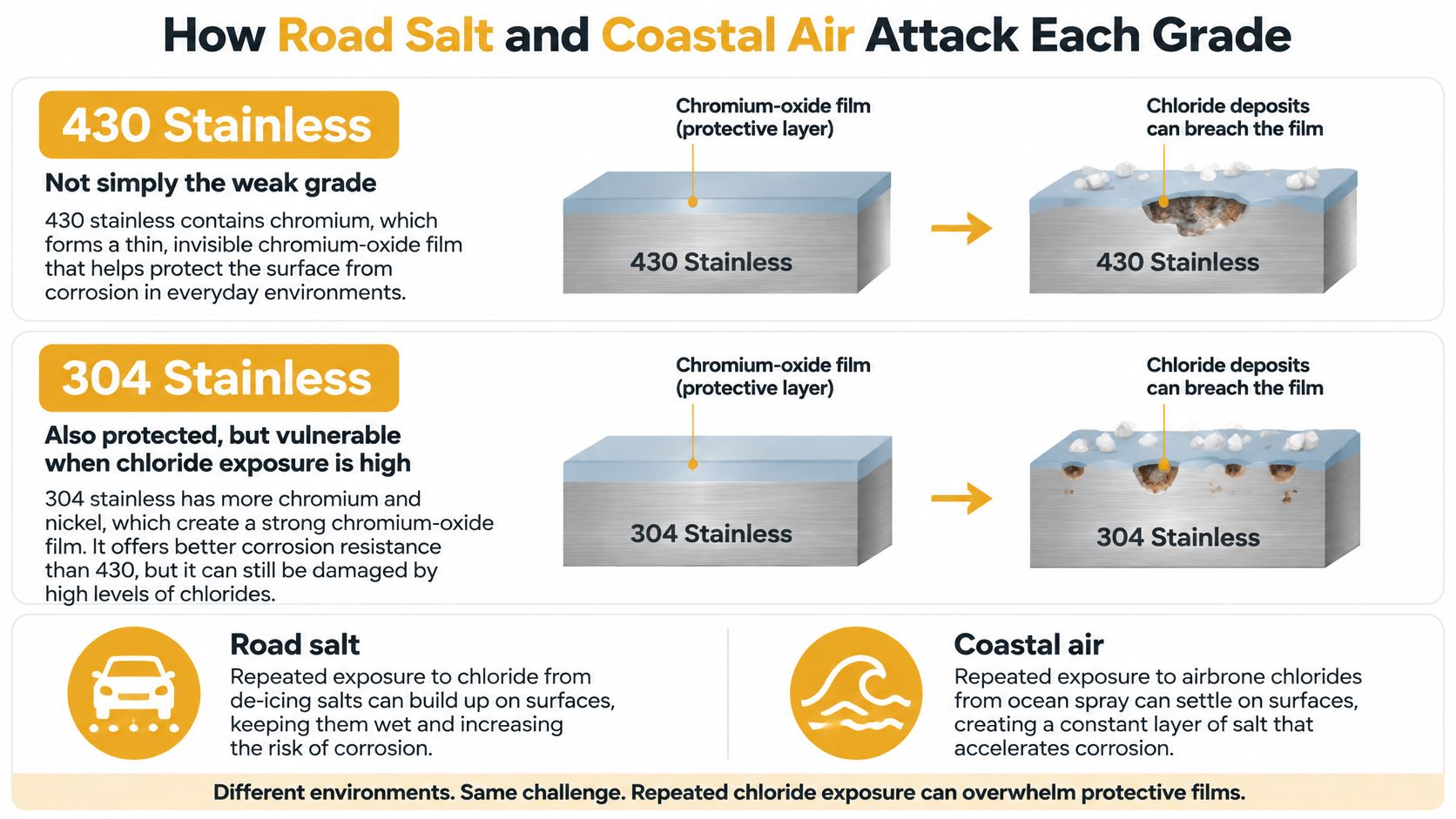
430 isn't the weaker steel. It loses ground against common salt damage, but it has an advantage against a different kind of chloride-related failure.
Both steels rely on a thin chromium-oxide film for protection. The World Stainless guide to stainless steels explains that surface condition, contamination and service conditions affect how well that protection works.
Tiny Pits and Tight Gaps Cause the Usual Trouble
Salt can eat tiny pits into the surface and attack tight, wet gaps. Those failures are called pitting and crevice corrosion.
On a bumper, inspect bolt holes, bracket interfaces, fog-light openings, tow-hole cutouts, weld spots and scratches where the chrome has been breached. The wide, easy-to-wash face may look fine while contamination stays packed behind a bracket.
These common operating conditions favor 304:
- Northern winter routes: Repeated salt film makes 304 the safer choice. Rinse after winter runs, including the back of the bumper, and remove packed grit around mounting points.
- Coastal lanes: Salt air can reach surfaces that rain never cleans. Choose 304, flush sheltered gaps and let trapped moisture drain or dry.
- Wash-heavy fleets: Frequent chemical cleaning adds another exposure. Choose 304, use a cleaner compatible with the finish, and rinse it off completely rather than letting it dry on the part.
304 wins the salt fight, but 430 is not the weaker steel in every failure.
Cracking Under Stress Is a Different Problem
Cracking under stress, called stress-corrosion cracking, isn't the same as salt staining or surface pits. TubingChart's grade comparison identifies better resistance to chloride-induced stress-corrosion cracking in ferritic stainless, while the austenitic grade can become susceptible above roughly 50°C, about 122°F.
A sun-baked or engine-warmed area near the bumper may deserve attention if chlorides, heat and stress occur together. That temperature isn't a prediction that a bumper will crack, and the ferritic advantage doesn't cancel its weaker pitting resistance.
Independent grade guidance also cautions against regular exterior use of bare 430. A chrome-plated truck bumper is a different finished assembly, but I'd still reserve it for low-salt service with dependable cleaning and drainage.
Our explanation of chrome plating and corrosion resistance helps separate the coating's job from the base metal's job. Deal with chips early through proper finish repair; wiping polish over exposed steel won't restore the plating.
Strength, Formability and Finish on a Real Bumper
Grade isn't gauge, and gauge isn't an impact rating. A bumper's thickness, reinforcement, mounting system and fabrication all matter.
The World Stainless design guidelines support comparing the finished construction rather than treating alloy chemistry as proof of strength. Don't assume a stainless upgrade makes a bumper suitable for pushing, recovery work or impacts beyond its stated design.
Match the Material to the Exact Model
Our standard bumpers use 10-gauge chrome-plated carbon steel. Specific models offer 11-gauge 430 stainless, including the Kenworth T600.
The Chrome bumper for Freightliner Coronado (2002–2009) also offers that stainless option, with standard-mount, direct bolt-on installation and no drilling or cutting. Its fog holes and light openings follow the selected configuration.
Other fitments need their own order check. Don't transfer a mount, year range or bracket assumption from one Freightliner model to another.
The Peterbilt 378 and 379 premium option includes 3 mm chrome-plated stainless steel 304 or 430. Confirm the chosen thickness and mounting arrangement before assuming that upgrade makes the complete assembly stronger.
Look Past the Chrome Face
All our material tiers share the same mirror-polished, triple-layer chrome finish with 35 microns of nickel. The base steel is the material difference, not a different intended look.
That distinction matters when comparing chrome-plated parts with mirror-polished stainless steel. Bare polished stainless and chrome over stainless aren't interchangeable finish descriptions.
Fabrication still affects the finished part:
- Tight bends: More ductile material gives the fabricator more freedom, but the finished radius and surface condition still need inspection.
- Weld spots: Check for clean workmanship and protected surfaces, especially where moisture can collect.
- Drop-bumper shapes: Confirm the drop, ground clearance and support arrangement rather than choosing by appearance alone.
Ferritic stainless can't be hardened through heat treatment, as explained in the World Stainless ferritic machining reference. Its grade number isn't a shortcut to extra strength.
For a Peterbilt 389 bumper, Kenworth W900 chrome bumper or 18 inch drop bumper, compare the exact thickness, mount, cutouts and stated fitment. Some premium options include a bracket and Gauge-7 hardware; that hardware description doesn't change the bumper sheet thickness.
What the 304 Premium Costs and When It Pays Off
Warranty and corrosion profile by material tier
| Material tier | Galhor warranty | Corrosion resistance | Best fit |
|---|---|---|---|
| Carbon steel, chrome-plated | 2 years | Lowest; relies on intact chrome protection | Dry routes and the lowest upfront cost |
| Stainless 430, Best Value Line | 4 years | Medium | Mild exposure and moderate budgets |
| Stainless 304, Top of the Line | 5 years | High, salt-tolerant | Coastal, northern salt and wash-heavy fleets |
These warranties cover manufacturing defects. They aren't promises that road damage, every stain or every environmental failure will qualify for replacement.
Our Top of the Line material offers the longest lifespan in the range. That doesn't mean it's automatically the best return for every truck.
Compare Complete Assemblies, Not Raw Sheet Prices
The Chrome bumper for Freightliner Classic illustrates why an exact configuration matters: it offers 10-gauge chrome-plated steel or 3 mm stainless steel 304/430, plus standard or blind mounting. Compare matching mounts and cutouts before calling the difference a material premium.
430's low nickel content reduces its exposure to nickel-price swings. But a cheaper bumper stops being a saving if premature cosmetic damage leads to another freight bill, installation appointment and truck interruption.
A peer-reviewed evaluation of stainless carriers found corrosion-related elemental residues on the tested ferritic carrier but not the tested austenitic carrier. That supports caution around aggressive chemical exposure, but it doesn't establish truck-bumper life or a replacement interval.
Build a Break-Even Calculation That Works
Use your own quotes and maintenance records:
- Record matching prices. Write down the delivered price for each grade in the exact configuration you need.
- Find the premium. Subtract the lower-grade quote from the higher-grade quote.
- Calculate an avoided replacement. Add the replacement bumper, freight, shop labor and the value of lost truck time. Don't count freight twice if it's already in the delivered price.
- Compare the same ownership period. Estimate whether the better material can avoid enough replacement cost during that period to recover its premium.
Record salt seasons per year as an exposure input, not a lifespan formula. Then record days out of service per replacement using your own shop scheduling and operating costs.
You can't calculate years to payback from salt seasons alone. You also need a reasonable replacement-life estimate for each complete assembly.
Value test: Pay the premium when avoiding a likely replacement costs less than buying the cheaper bumper twice.
Our total cost of ownership guide uses the same purchasing lens: count the complete ownership cost. For recurring salt or harsh wash exposure, 304 deserves the first quote; for light exposure, make 430 prove its savings on the same specification.
Which Grade Fits Your Route and Fleet
Grade to choose by operating situation
| Operating situation | Grade to choose | Why | Watch for |
|---|---|---|---|
| Dry southwest or plains routes, budget owner-operator | 430 | Low chloride exposure makes the lower-cost option practical | Keep bolt holes and cutouts free of grit |
| Northern road-salt corridors in winter | 304 | Better protection against localized salt attack | Rinse salt film after every winter route |
| Coastal lanes and regular salt air | 304 | Better pitting and crevice resistance | Check behind brackets each season |
| Fleets running pressure washers and strong cleaners | 304 | More corrosion margin during chemical exposure | Rinse cleaners off completely |
| Mixed fleet buying one part number | Grade for the worst lane | The harshest assignment should set the shared specification | Confirm physical fitment separately for each model |
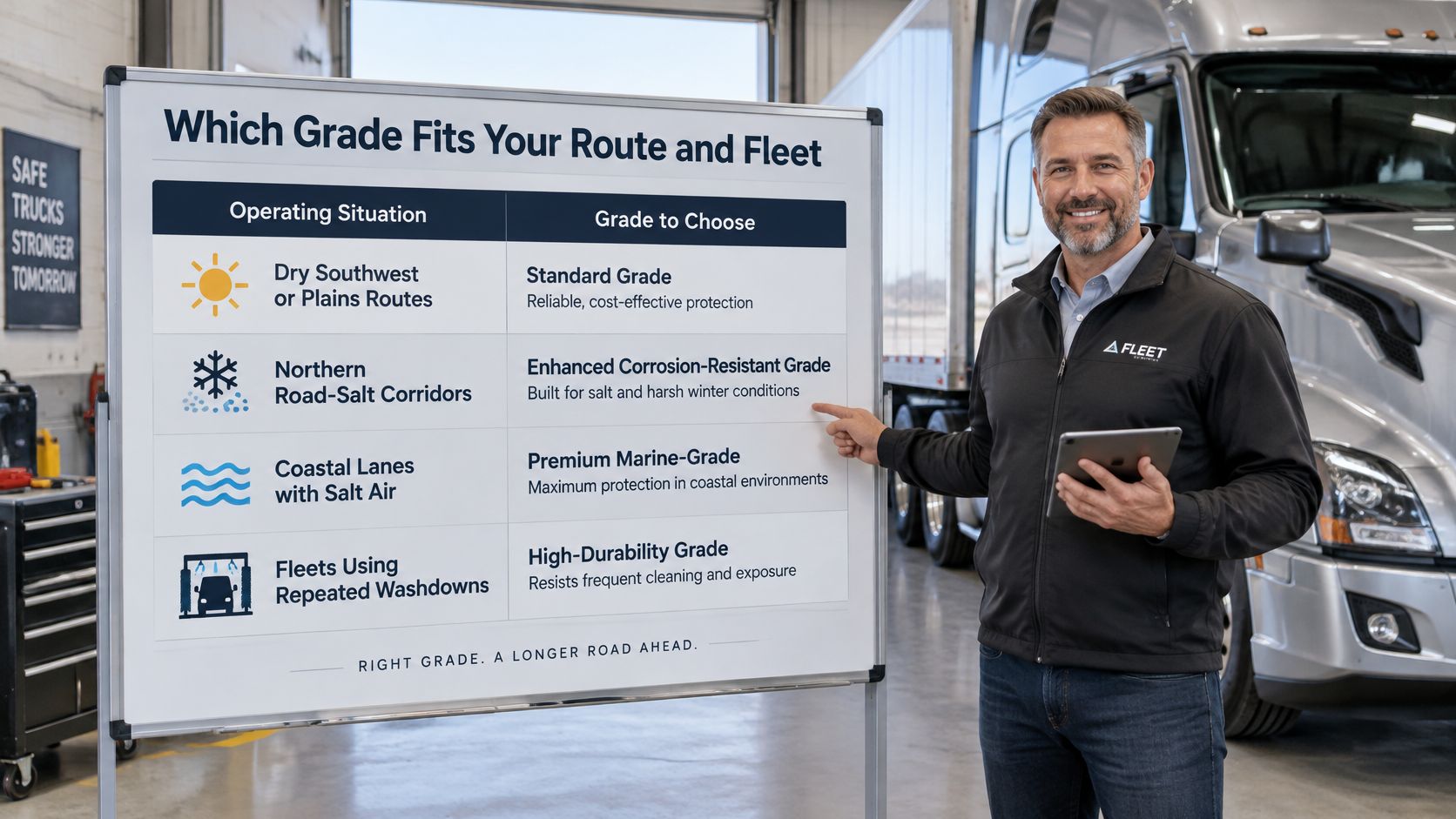
Classify each truck by the lanes it runs. A rig domiciled in Arizona that pulls freight over salted mountain passes all winter belongs in the northern corridor row, whatever the home terminal looks like. And grade name decides less than people assume. Route, cutouts and wash discipline drive most outcomes, and 430 is not the weaker steel: its ferritic structure resists chloride stress-corrosion cracking better than austenitic 304, which matters around brackets and hardware that stay under tension.
Use the Worst-Lane Rule
If you want a shared material standard, spec for the toughest regular assignment. An easy summer lane should never set the spec for winter service.
Say an owner-operator runs dry regional lanes during warm weather but accepts northern freight when rates improve. I'd choose 304, because the winter work creates the difficult exposure even when it accounts for less of the calendar.
A fleet can land on the opposite answer. Take twenty trucks running the same southern regional lanes year-round with a documented wash routine that rinses residue from behind the brackets. No truck sees road salt, so standardizing on 430 saves money on every unit without giving up service life. Have the wash crew log where staining or coating damage shows up on each truck, so a recurring cleaning problem never gets billed to the material.
A shared grade simplifies purchasing. A shared physical part number only works when truck fitment, mounts and openings also match.
Separate the Wash Process From the Material Choice
Set the spec around cleaner chemistry, retained residue, damaged plating and whether crews reach the back of the bumper. A truck that gets a finish-compatible cleaner, a full rinse and a look behind the mounts can run 430 for years. A truck hit with strong degreasers and left unrinsed burns through its corrosion margin fast, whatever the grade.
Give the wash crew a repeatable process. Start with a cool surface, remove loose grit, use a finish-compatible cleaner, rinse thoroughly and inspect hidden mounting areas.
Confirm the Stainless Option for Your Truck
Our Freightliner FLD 120 offers 11-gauge 430 stainless as its corrosion-resistance upgrade. The Freightliner Columbia 2008+ also offers 11-gauge 430 stainless.
Those options reflect what is offered on those particular bumpers. Grade 304 still carries the stronger resistance to salt pitting and crevice attack.
Use the model and construction checks before choosing a material option. For International, Peterbilt, Kenworth or another Freightliner model, confirm the exact application rather than assuming a stainless option crosses over.
A lower-cost grade makes sense when the operating conditions support it. If salt exposure is uncertain and you plan to keep the truck, buying more corrosion margin is usually the cleaner decision.
Confirm the Order Before You Buy Your Bumper
The order is where grade choice either pays off or turns into a fitment problem.
- Confirm make, model and year. Match the truck's actual configuration exactly.
- Choose the material for the route. Account for winter work, coastal runs and the wash process.
- Confirm gauge or thickness. Write it into the order so a material upgrade doesn't hide a construction mismatch.
- Confirm the mount. The Peterbilt 378 and 379 offer standard or blind mounting; select the arrangement your truck needs.
- Confirm every cutout. Check fog lights, tow holes and light openings against the truck and any accessories.
- Confirm the finish. Our material tiers use mirror-polished chrome, not bare polished stainless.
- Match the tier to the warranty table above. Keep a copy of the terms with the order.
Plan the Installation Before the Freight Arrives
Our 430 option uses direct bolt-on fitment with no drilling. Where a product specifies no cutting, that still assumes the ordered application and configuration are correct.
Some premium options pair 11-gauge 430 stainless with a bracket and Gauge-7 hardware, so read the configuration line instead of assuming every chrome bumper ships with identical hardware.
For installation, support the bumper with a padded lift or a helper before loosening the mounts. Test-align the mounting holes, check clearance around lights and tow access, and use the truck's service specifications for fastener torque.
Don't pull a misaligned bumper into place by tightening the bolts. Find the wrong mount, damaged bracket or incorrect configuration before loading the assembly.
Match Delivery to the Shop Calendar
For fast shipping across the United States, our in-stock 430 and 304 flat bumpers can ship within 48 hours. Treat that as the time the order leaves the dock; delivery still depends on LTL freight scheduling.
Made-to-order carbon steel bumpers typically ship in 4–6 weeks. Arrange receiving access, a dock or lift point, and enough help before the carrier sets an appointment.
A documented road incident also qualifies replacement bumpers for 15% off carbon steel, 20% off 430 and 25% off 304. Keep the incident documentation with the estimate so the replacement order is handled under that program.
Book the dock, lift support and installers before the carrier calls, and keep the packaging until the bumper is aligned and bolted on.
Galhor Inc. offers configurable chrome bumpers in carbon steel, stainless 430 and stainless 304, so you can match corrosion protection to your route and budget. Visit Galhor Inc., build your bumper in the 3D configurator, select the right grade, mount and cutouts, and order now so it's on the truck before the next salt season.