
Stainless Steel Bumper Guide for Heavy-Duty Trucks
October 23, 2026 · Francisco Hornelas

A stainless steel bumper isn't maintenance-free, and anyone who sells it that way is setting you up for a surprise after the first hard winter. Stainless resists rust far better than plain carbon steel, but road salt, coastal air, and trapped grime can still stain or pit it. The right choice depends on your route, your wash habits, and whether you're spec'ing a Peterbilt 389 bumper, a Kenworth W900 chrome bumper, or a fleet unit that needs uptime more than show shine.
Table of Contents
- Why Chromium Keeps a Stainless Steel Bumper From Rusting
- Comparing 304 and 430 Stainless Steel Grades
- Thickness, Strength and Fitment for Class 8 Trucks
- Finishes That Keep a Stainless Steel Bumper Shiny
- Road Salt, Pitting and Routine Cleaning Care
- Rear Impact Guard Rules to Check Before You Buy
- Choosing the Right Stainless Steel Bumper and Ordering Today
Why Chromium Keeps a Stainless Steel Bumper From Rusting
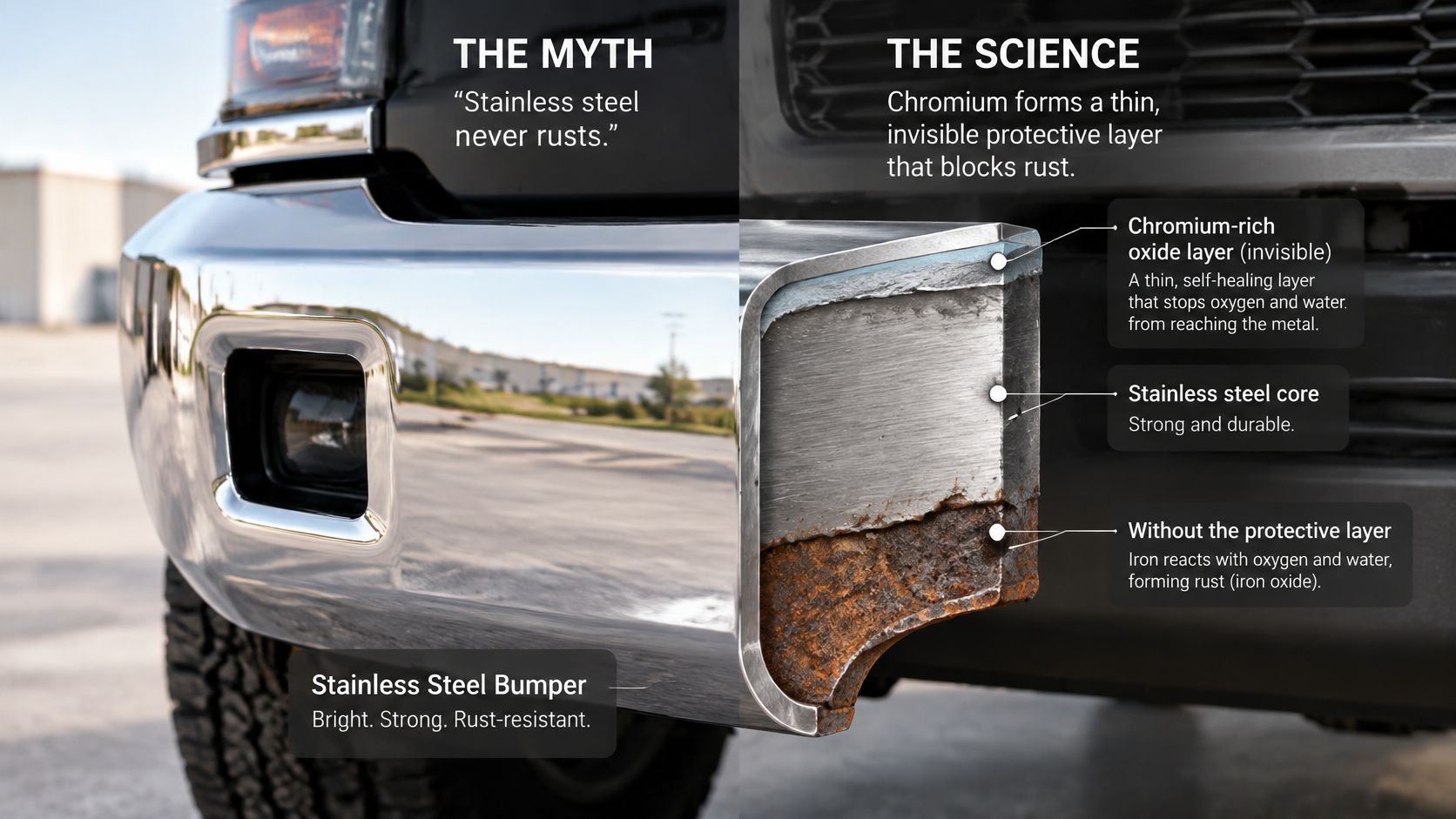
Forget the claim that stainless never rusts. It resists rust because of its chemistry, not because it's magic. A driver who understands that difference will keep a bumper looking sharp for years. A driver who believes the sales talk will blame the metal when salt does its work.
The protection starts with chromium. Technical guidance sets roughly 10.5 percent chromium as the minimum for stainless steel, and that chromium reacts with oxygen to form a thin passive oxide layer on the surface, as explained in technical guidance on stainless steel composition and its protective oxide layer. You can't see the layer. It's not paint or plating. It's part of the metal's surface, and it blocks water and air from reaching the steel below.
What Self-Healing Really Means
That oxide layer can reform after a light scratch or cut when oxygen is available. Rock chips and small scuffs from dock work don't automatically open the door to rust the way they do on plated carbon steel. That's a real advantage on a working truck. Gravel, chain racks, and tight yards won't be kind to any bumper face.
But self-healing has limits. The layer needs sound base metal and a reasonably clean surface to do its job. Welds, cut edges, and spots where salt packs in and stays wet are weaker points. If chloride sits in a crevice behind a bracket, the layer gets attacked in that spot while the flat face still looks fine.
Field rule: Judge a stainless bumper by its alloy, welds, and edges, not by how bright it looks on delivery day.
Finish Is Not the Same as Protection
A polished or chrome finish helps appearance and makes washing easier. It doesn't replace good alloy or clean fabrication. Poor weld cleanup, contaminated surfaces, and sharp unprotected edges will show problems no matter how deep the shine is. Owners who want the full picture on how corrosion resistance works in truck parts should start there before comparing finishes.
Think of chromium as the foundation and finish as the top coat on a house. The top coat matters. It just can't fix a weak foundation. Once you accept that, grade choice becomes a practical decision instead of a guess based on shine alone.
Comparing 304 and 430 Stainless Steel Grades
Stainless isn't one material. For Class 8 bumpers, the choice usually comes down to 304 or 430, and they behave differently in salt, weld shops, and daily service. Treating them as the same metal leads to bad specs and disappointed owners.
Grade 304 is austenitic, with at least 18 percent chromium and roughly 8 to 10.5 percent nickel, while grade 430 is ferritic, with roughly 17 percent chromium and little or no nickel, according to a comparison of 304 and 430 stainless steel composition. The nickel in 304 stabilizes its structure and supports stronger general corrosion resistance in wet, outdoor service. Grade 430 costs less because it skips that nickel, and it still clears the stainless threshold covered above.
304 vs 430 Stainless Steel for Truck Bumpers
| Grade | Structure | Chromium | Nickel | Magnetic | Best Fit |
|---|---|---|---|---|---|
| 304 | Austenitic | At least 18% | About 8 to 10.5% | Generally no | Salt belt, coastal, wet yards |
| 430 | Ferritic | Roughly 17% | Little or none | Yes | Milder exposure, lower alloy cost |
Which Grade Fits Your Route
Pick by exposure, not by habit.
- Heavy salt and coastal runs: Choose 304 when the truck sees de-icing chemicals, port air, or frequent wetting with irregular washing.
- Mild to normal atmospheric service: Choose 430 when exposure is less severe and a polished surface gets regular care.
- Custom fabrication: Note that 304 usually offers better weldability and cold-forming, which helps on complex shapes and cutouts.
- Quick field check: Use a magnet as a rough sorting clue, since 430 is magnetic and 304 generally isn't, then confirm the grade on paper.
That magnet test won't replace a material spec. It just keeps a buyer from paying 304 money for an unknown grade at a swap meet or salvage yard.
For context on construction, a Steel chrome bumper built from 10-gauge chrome-plated steel with direct bolt-on installation and standard or blind mount options shows how base material, fit, and finish are separate spec items. Whether the base is carbon steel, 430, or 304, ask for each item in writing. Grade, gauge, mount style, and finish should never be lumped into one vague promise of quality. A fleet manager who specs those four items clearly will get consistent bumpers across Peterbilt, Kenworth, Freightliner, and International units, and drivers will know what care each one needs.
Thickness, Strength and Fitment for Class 8 Trucks
Alloy numbers only tell part of the story. A bumper works as an assembly. Sheet thickness, brackets, fasteners, and frame attachment decide how it handles a parking lot tap or a deer strike at highway speed.
Published minimum data for annealed type 430 list about 310 MPa yield strength, 483 MPa tensile strength, and 22 percent elongation, with another datasheet reporting 517 MPa tensile strength and 30 percent elongation for bar stock, per published mechanical data for type 430 stainless steel. In plain terms, 430 is strong enough for serious forming work and can bend under load instead of cracking right away. That elongation matters. A bumper that deforms in a controlled way protects the hood, grille, and cooling package better than one that stays rigid and passes every bit of force into the frame horns.
Material Benchmarks Are Not Crash Ratings
Don't read those numbers as a promise about any single crash. They're material benchmarks from test stock, not ratings for a finished bumper. Cutouts for fog lights and tow pins change local strength. Weld geometry, temper, and bracket design change it again. Two bumpers in the same grade can behave very differently if one uses thinner sheet or weaker mounts.
If a seller quotes alloy strength as proof of bumper strength, ask about gauge, brackets, and mounting hardware next.
Fitment Checks Before You Order
A direct bolt-on design that uses factory mounting points saves shop time and avoids drilling fresh holes in frame components. Confirm these items before you pay:
- Truck and year: Match the exact model, such as Peterbilt 389, Kenworth W900, Freightliner, or Volvo cab and hood style.
- Mount style: Confirm standard mount or blind mount and whether your brackets carry over.
- Cutouts: Verify fog light, tow, and step openings line up with your current setup.
- Height and style: Check ground clearance on drop styles, including an 18 inch drop bumper, against your usual docks and ramps.
As a construction example, 10-gauge chrome-plated steel with direct bolt-on fit and no drilling or cutting shows the kind of spec detail worth demanding. Measure your current bumper width, bolt pattern, and bracket spacing with the truck on level ground. Take photos of both frame horns. Shops that get those details up front ship the right part the first time, and you avoid a bumper sitting on the shop floor while the truck should be earning.
Finishes That Keep a Stainless Steel Bumper Shiny
Finish sells bumpers at truck shows. It also affects how salt and grime behave on the surface. Owners need both facts before picking between mirror polish and chrome plating over stainless.
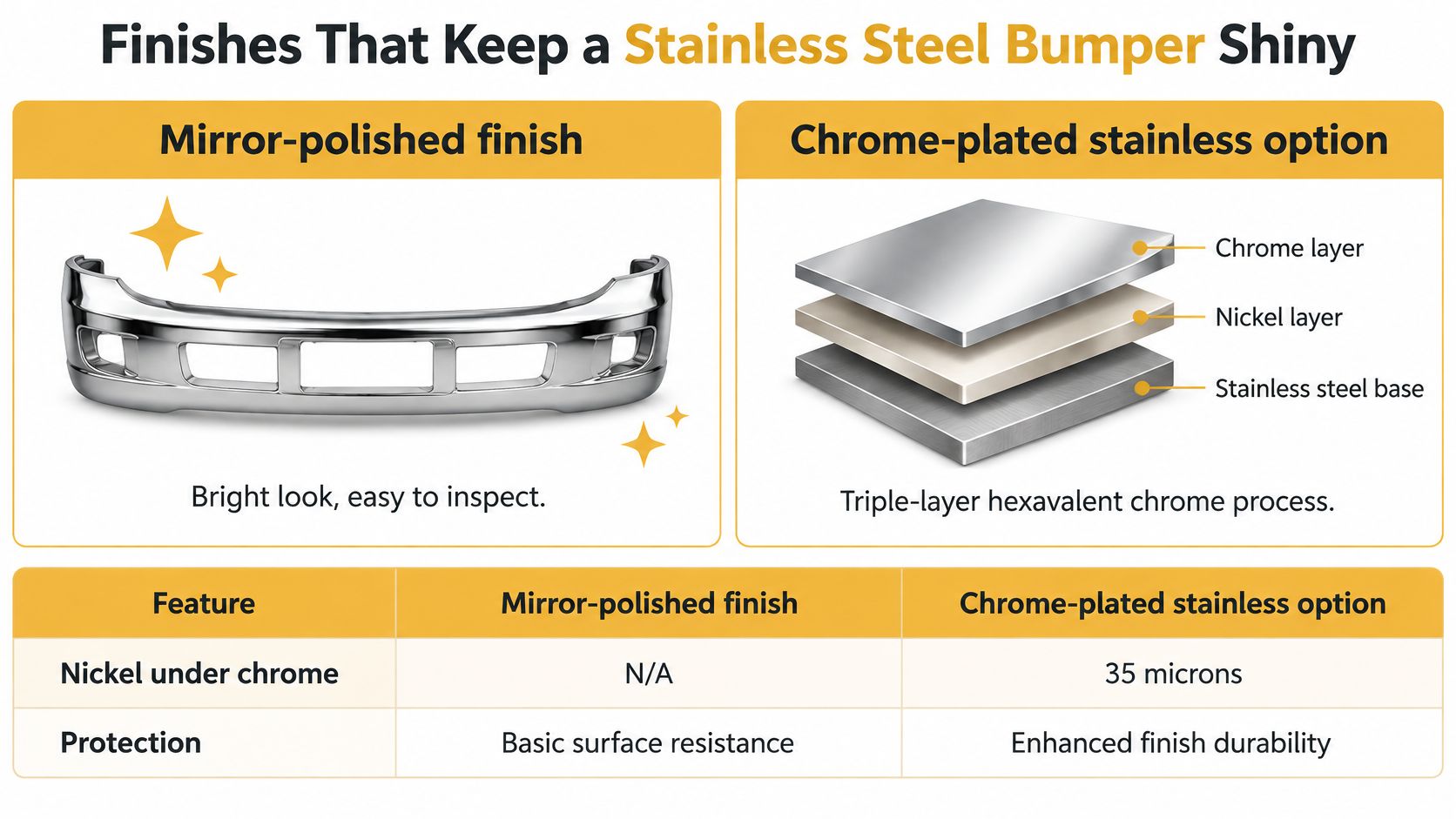
Start with the visual difference between the two main options.
Mirror-Polished Stainless
A mirror polish is the stainless surface itself, buffed until it reflects. There's no coating to chip off, and light scratches can often be blended back with proper polishing. For 430, polish does more than look good. Its corrosion resistance is strongest on a well-polished or buffed surface, because a smoother face gives salt and dirt fewer spots to sit and concentrate. Fleet units that get washed often and inspected at the same time suit this finish well. Inspectors can spot staining early because nothing hides under a coating.
Chrome-Plated Stainless Options
Chrome plating over stainless adds a separate layered finish. Quality options use a triple-layer hexavalent chrome process with 35 microns of nickel under the chrome, finished to a mirror polish, based on catalog specifications for these bumpers. The nickel layer supports depth and shine, and the hard chrome top gives that deep, liquid reflection show trucks are known for. Underneath, the stainless base still carries the corrosion defense if the surface gets nicked.
Watch how that layered finish looks on a finished bumper before you judge it from photos alone.
Matching Finish to the Truck
- Show and pride trucks: Chrome over stainless gives the deepest shine for a Peterbilt 389 or W900 that earns attention at customers and shows.
- Working fleet trucks: Mirror-polished stainless keeps care simple and makes damage easy to see and buff.
- Either choice: Neither finish compensates for standing saltwater, trapped deposits in crevices, or a breached surface left unwashed.
Finish choice won't save a neglected bumper. It sets how the surface looks and how it cleans. The care routine in the next miles of ownership decides how long it stays that way.
Road Salt, Pitting and Routine Cleaning Care
Run I-94 through a Midwest storm, then park the truck wet for a weekend. The bumper face may rinse clean at the wash, but salt brine dries behind brackets and around bolt heads. That's where trouble starts, and it starts out of sight.
Experimental work on automotive materials observed pitting in stainless steel at chloride concentrations above about 0.6 mol/dm³, showing that concentrated salt can break down the passive film, as reported in experimental research on chloride corrosion of automotive materials. Road crews don't need to reach lab conditions roadside for owners to get the point. Repeated wetting and drying concentrates chloride in crevices, and that's where pits form first.
Three Problems That Look Alike
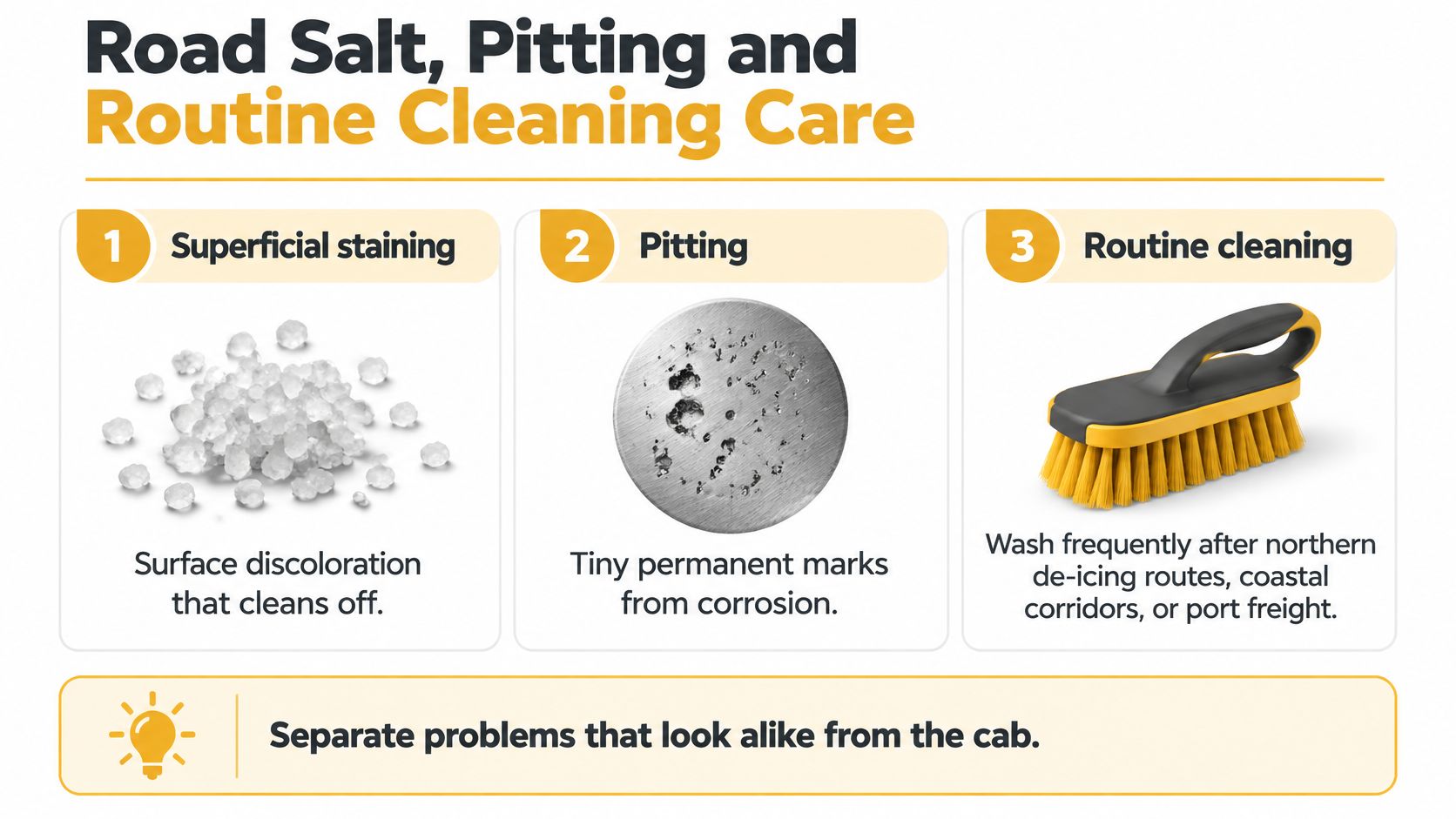
Learn to separate them during a walk-around.
- Superficial staining: Brownish tea staining or dull film from salt and moisture that generally cleans off the surface.
- Pitting: Small, dark, permanent marks where chloride has broken through locally, often near edges and fasteners.
- Structural corrosion: Deep attack or perforation, which is unlikely on a sound stainless bumper under typical conditions when damage is caught early.
Staining tells you washing is overdue. Pitting tells you chloride sat too long in one spot. Neither one means the bumper has failed, but pitting won't polish away, so prevention beats correction every time.
Where Chloride Hides
Flat faces rinse easily. These spots don't:
- Bracket interfaces where the bumper meets mounts and road spray packs in
- Fastener heads and bolt holes that hold moisture after the face dries
- Weld seams and cutout edges where deposits cling to rougher surfaces
- The underside lip, which catches slush and rarely gets direct wash pressure
A Realistic Wash and Inspection Routine
Wash after salt exposure, not on a fixed calendar. Trucks on northern de-icing routes and Canadian winter corridors need salt removed as soon as the run ends. Coastal and port trucks need regular rinsing even without snow, since salt air settles daily. Dry-climate trucks can go longer, but brackets and cutouts still deserve a look at every service.
Use clean water and mild detergent, rinse the underside and mount areas with intention, and dry standing water where you can reach it. Skip harsh pads that gouge the finish. Pair washing with a two-minute inspection of seams, fasteners, and any rock chip. Grade choice, drainage, edge protection, fastener compatibility, and cleaning interval work as one system. Owners who run heavy salt and can't wash often should spec 304 and accept the higher alloy cost as insurance.
Rear Impact Guard Rules to Check Before You Buy
Confusing a front styling bumper with a regulated rear impact guard can waste money and create compliance headaches. They're different parts under federal rules, and most Class 8 tractors sit outside the guard rule entirely.
Under 49 CFR §393.86, a rear impact guard is generally required on motor vehicles manufactured after December 31, 1952 when the rear body or chassis sits more than 30 inches above the ground while empty, as set out in the federal text of 49 CFR §393.86 on rear impact guards. When the rule applies, the guard's bottom edge must be no more than 30 inches above the ground. Gaps between multiple guards can't exceed 24 inches. Outer surfaces must sit within 18 inches of each side of the vehicle, and the guard must be no more than 24 inches forward of the rear extremity. It also must be substantially attached by bolts, welding, or comparable means.
Who the Rule Leaves Out
The rule doesn't apply to truck tractors, pole trailers, pulpwood trailers, certain road-construction trailers, or vehicles in driveaway-towaway operations. That exclusion covers the typical Peterbilt, Kenworth, Freightliner, and Volvo tractor buying a front bumper for protection and appearance. Your front stainless steel bumper is not a rear impact guard, and guard measurements don't spec it.
Don't let a seller apply trailer guard dimensions to a tractor's front bumper. Ask which rule applies to your vehicle type.
What to Verify Before Ordering
Straight trucks, trailers, and specialty bodies are a different case. If your vehicle falls under the rule, guard height, width placement, and attachment method become compliance items, not style choices. State rules can add requirements on top of federal ones, and they vary. Owners reviewing key regulations for semi truck bumpers before ordering will know which questions to ask their shop and inspector. Confirm the vehicle category, measure rear chassis height empty, and keep documentation with the truck's compliance file. Five minutes with a tape measure beats explaining a wrong part during a roadside inspection.
Choosing the Right Stainless Steel Bumper and Ordering Today
Pull the decision together in order. Route first, grade second, finish third, fitment last. Owners who start with shine and work backward end up with the wrong metal for their winters.
A Short Decision Path
- Heavy salt, coastal air, or spotty washing: Spec 304 for the larger corrosion margin, polished or chrome-plated over stainless.
- Milder exposure with regular washing: Spec 430 for solid stainless performance at lower alloy cost, and keep it polished.
- Tight budget in dry service: Consider chrome-plated carbon steel only if you accept that a deep chip exposes plain steel and needs fast attention.
Then match cutouts for fog lights and tow points, pick standard or blind mount, and confirm bolt pattern against your frame horns. Weigh the purchase against replacement cycles and wash labor, not sticker price alone. The math behind total cost of ownership for truck bumpers helps fleet managers justify the grade that fits the route instead of the cheapest line on a quote.
How Ordering Works
Galhor Inc., based in Magnolia, Texas, manufactures and sells chrome bumpers for Class 8 trucks including Freightliner, Peterbilt, Kenworth, and Volvo. Its 3D configurator lets buyers select brand, model, year, style, cutouts, and finish. In-stock 304 and 430 flat bumpers can ship within 48 hours, while made-to-order carbon steel units typically take about 4 to 6 weeks, with LTL freight delivery available across the United States. Products are engineered in-house with U.S.-sourced steel, and orders carry warranty coverage for manufacturing defects in workmanship and materials.
That mix suits owner-operators who need a Peterbilt 389 bumper fast after a deer strike and fleets planning scheduled replacements. Fast shipping on stock stainless units cuts downtime. Configured cutouts cut shop fabrication. Both save money that never shows up on a parts invoice.
Frequently Asked Questions
Does stainless stay rust-free without washing? No. It resists corrosion, but salt staining and pitting still happen when chloride sits in crevices.
Can a scratch be fixed? Light scratches in polished stainless can usually be blended with proper polishing. Deep pits can't be removed, only cleaned and monitored.
What should I confirm before I order? Grade, gauge, mount style, cutouts, and exact model and year fitment.
Configure your bumper today, confirm fitment, and upgrade your truck with metal matched to the roads you run.
Order now from Galhor Inc. and configure a direct bolt-on stainless steel bumper by brand, model, year, style, cutouts, and finish for your Peterbilt, Kenworth, Freightliner, or Volvo. Get yours today with fast shipping on in-stock stainless units, LTL freight delivery across the United States, and warranty coverage backing your purchase.