
Triple Chrome Plating Explained for Class 8 Truck Bumpers
November 10, 2026 · Francisco Hornelas

Most buying advice for a chrome truck bumper comes down to two words: check the shine. Make sure it's triple chrome plated, make sure the reflection looks deep, and you're set. That advice is half right, and the half it skips is the half that costs you money.
The mirror finish is the cheapest part of the build. Triple chrome plating is a three-metal stack over a base metal, and the layer doing the rust-fighting work sits under the surface where no photo can show it. A bumper with thin nickel and a flawless topcoat will look perfect on a listing page and start blistering around the cutouts after one winter of salted roads.
That's the gap between a shopper and an informed buyer. The shopper judges the photo. The buyer asks for the layer stack, the nickel thickness and the base metal grade, then matches those numbers to the route the truck runs. Here's how to read the whole finish, from the steel up.
Table of Contents
- How Triple Chrome Plating Builds Shine and Shield
- The Plating Steps and Quality Controls Behind Every Bumper
- Carbon Steel vs 430 vs 304 for Your Route
- How Triple Chrome Holds Up on Long Hauls
- Where Triple Chrome Plating Fails First and How to Check
- Confirm the Layers, Grade and Warranty Before You Order
How Triple Chrome Plating Builds Shine and Shield
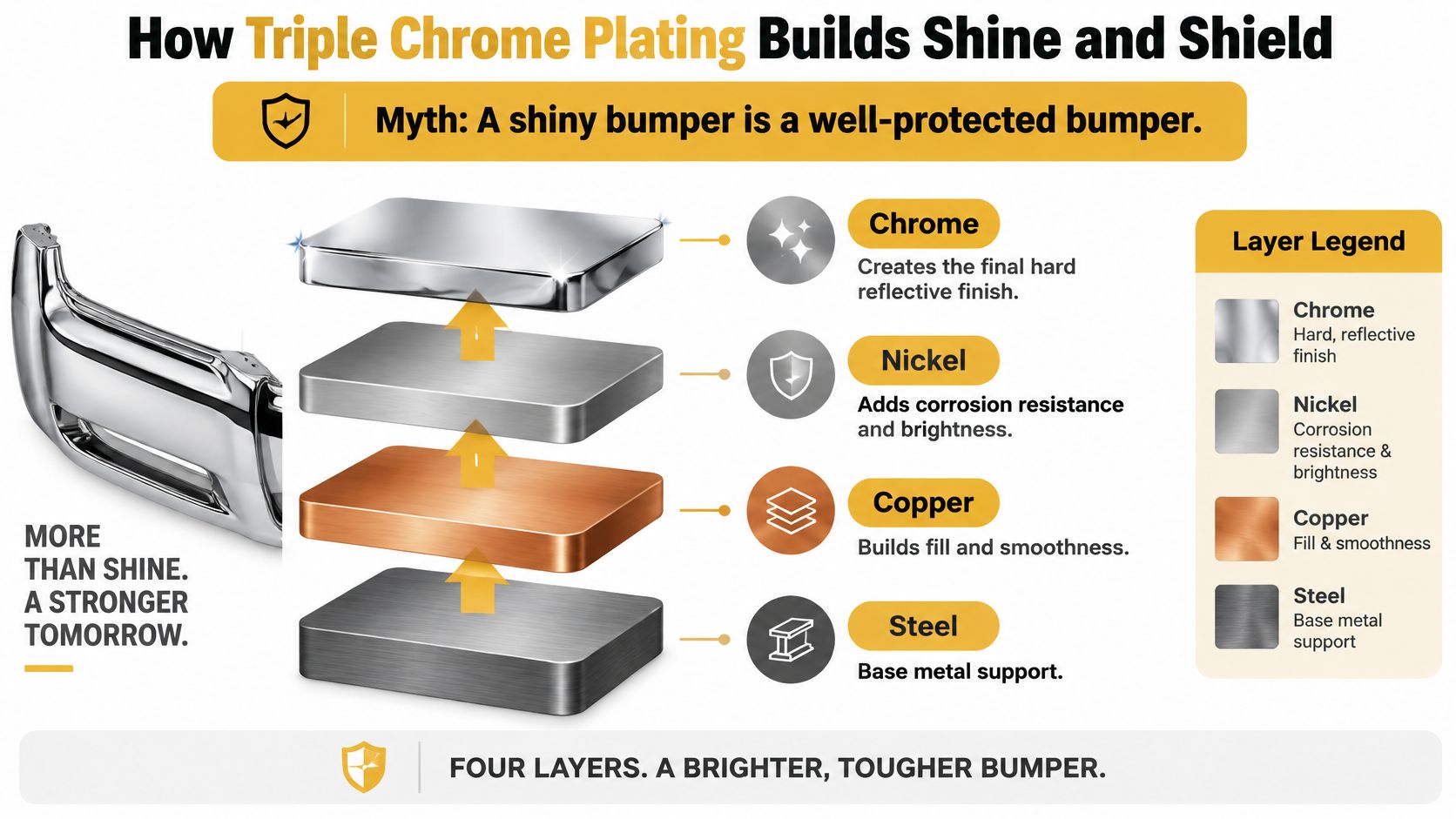
A mirror finish is easy to see; the protection beneath it is harder to judge. Triple chrome plating uses copper and nickel underlayers beneath a thin chromium finish. The nickel system does most of the work against corrosion, while chromium provides the bright, tarnish-resistant surface.
The EPA's decorative chromium plating guidance describes copper and nickel undercoats beneath the chromium finish, with nickel often applied in semibright and bright stages. The undercoats help prevent unwanted reactions with the substrate; the chromium layer is very thin. For a bumper buyer, the practical point is simple: the shine comes from the surface, but corrosion resistance depends heavily on the layers below it.
| Layer | Typical Thickness | Main Job | What Goes Wrong If Weak |
|---|---|---|---|
| Copper underlayer | About 10-25 microns, as described in the EPA's decorative chromium plating guidance | Fills small surface flaws and helps adhesion | Scratches and pits show through the finish |
| Nickel, semibright and bright | About 20-35 microns total, as described in the EPA's decorative chromium plating guidance | Main corrosion barrier and wear layer | Pinholes let rust reach the base metal under the shine |
| Chromium topcoat | About 0.1-0.5 microns, as described in the EPA's decorative chromium plating guidance | Blue-white shine and tarnish resistance | Dulls fast, shows wear and light scratches |
Reading the Stack from the Steel Up
Copper levels minor surface flaws and gives the following layers a smoother foundation. Nickel is applied in semibright and bright stages, forming the main barrier between the base metal and moisture, road salt, and wash chemicals. A bright topcoat cannot make up for nickel that is too thin or porous.
The chromium finish supplies the blue-white color and helps resist tarnish. Its thinness makes it a poor stand-alone shield, so judging a bumper by its reflection alone misses the part of the stack that matters most for corrosion resistance.
A useful comparison: Chromium works like a clear coat, nickel like primer, and copper like filler. Each layer has a different job, and the finish depends on all of them.
Why the Shine Lies
A bumper can have a clean reflection across its face while showing dullness or haze around openings and mounting holes. Check these areas closely when comparing finishes; the corners and cutouts are common weak points.
Ask what nickel thickness the seller specifies and whether it is checked at vulnerable areas. A clear answer gives you something concrete to compare; words like “premium” and “mirror finish” do not describe the protective layer.
The OSHA chrome plating directive distinguishes decorative bright chrome, used for appearance and wear resistance, from hard chrome, used mainly for industrial wear. Truck bumpers use a decorative finish, so the quality of the layers beneath the chromium matters more than the topcoat's shine.
The Plating Steps and Quality Controls Behind Every Bumper
A plating line is a chain of phases, and each one exists to fix a problem the previous one could leave behind. Rush a phase and the bumper still comes out shiny. It just won't stay that way. Here's the sequence, with the reason behind each step and the slip that shows up most often.
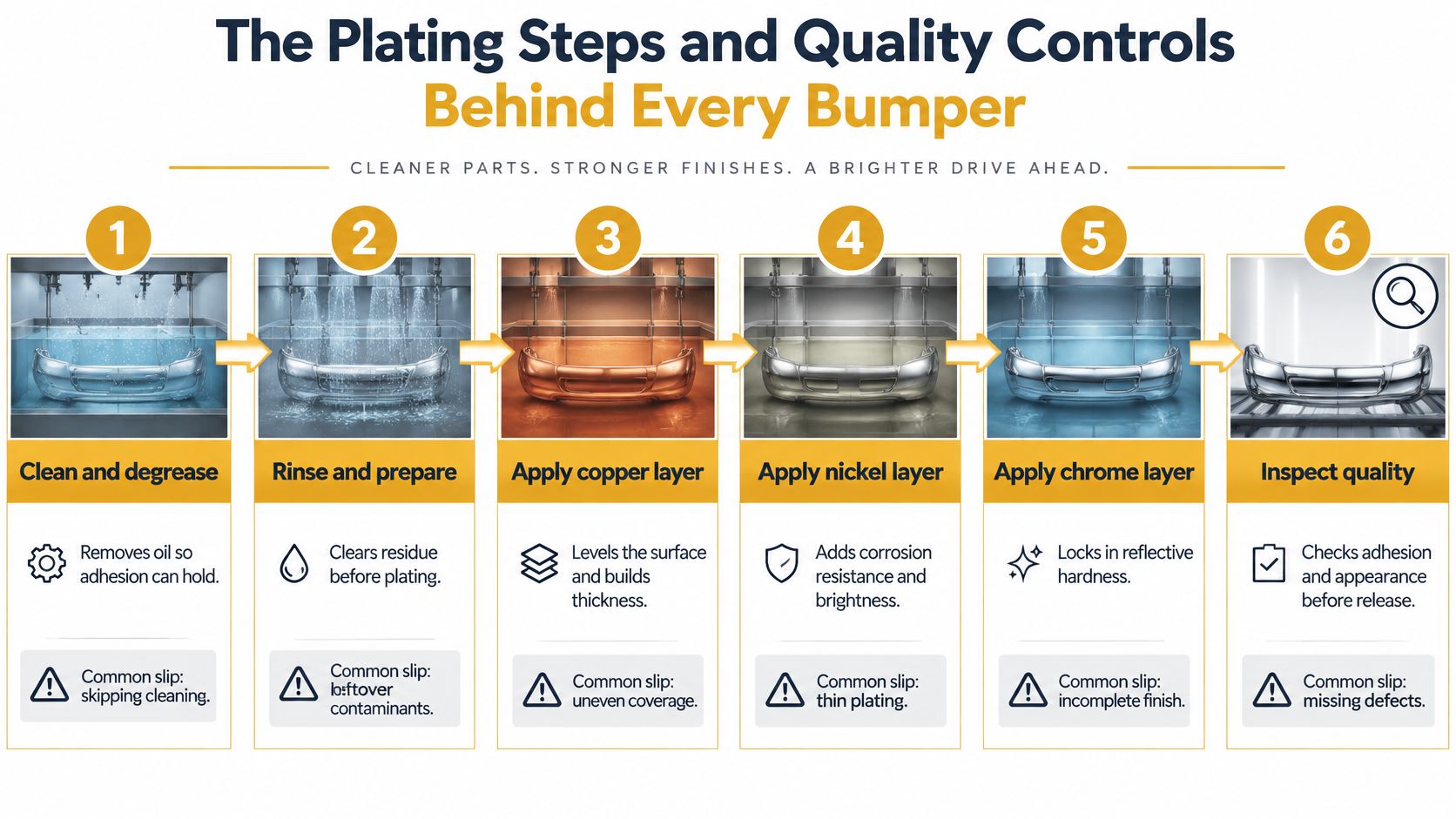
- Clean and degrease. Oil, polishing residue and handling grease block the first metal layer from bonding. The common slip is treating this as a quick dip. A bumper that flakes off in sheets a year later usually lost the argument right here.
- Rinse and activate. Rinsing clears the cleaner and activation prepares the surface so copper can grip. Contamination left at this stage shows up as a patchy, blistered finish that no amount of polishing will fix.
- Apply the copper layer. Copper levels the steel and builds the foundation. The slip is uneven coverage, thick across the middle of a panel and thin around brackets and weld seams.
- Apply the nickel layers. Semibright then bright nickel is where corrosion resistance and color depth get set. Bath temperature, current density and plating time all move the result. Too much current burns edges into a dull gray mark, too little starves corners and cutouts.
- Apply the chrome topcoat. Thin, fast and unforgiving. Timing decides whether the shine lands even or streaked, and there's no repair afterward short of stripping the part and starting over.
- Inspect. Thickness, adhesion and pinholes get checked here. The slip is inspecting the flat face, liking what you see, and shipping it.
Bath Controls Decide Whether the Result Repeats
Chemistry drives all of it. ASTM B456 requires inspection for appearance, thickness, adhesion, elongation, ductility, corrosion, sulfur content, density and discontinuities. That list is a long way of saying a real plating specification gets measured, not eyeballed. A shop with written bath controls can repeat a result next month on a different batch. A shop with one nice showroom bumper can't.
What good looks like at the end of the line is boring and consistent: even color across the whole face, no burn marks or dull bands at the edges, no haze around the cutouts, and a reflection that stays sharp instead of going milky.
Longevity in this trade shows up as consistency rather than marketing copy. Galhor has 86 years of OEM chrome plating experience dating back to 1940, and its quality control procedures treat thickness and adhesion as measured results rather than opinions.
Carbon Steel vs 430 vs 304 for Your Route
The shine is the cheapest part of the finish. If the plating gets breached, the base metal determines how the bumper handles exposure. Match the steel to the toughest conditions on your route, and check the nickel thickness at edges and cutouts before you buy.
| Base Metal | Chromium and Nickel Content | Corrosion Resistance | Best Fit |
|---|---|---|---|
| Carbon steel | No alloyed chromium or nickel | Lowest, relies fully on the plating | Dry regions and budget builds where the plating stays intact |
| Stainless 430 | 16–18% chromium, no more than 0.75% nickel | Medium, passive film slows rust | Mixed use where cost control matters and salt exposure is light |
| Stainless 304 | 18–20% chromium, 8–10.5% nickel | Highest of the three in salty or damp conditions | Coastal routes, winter salt and frequent washing |
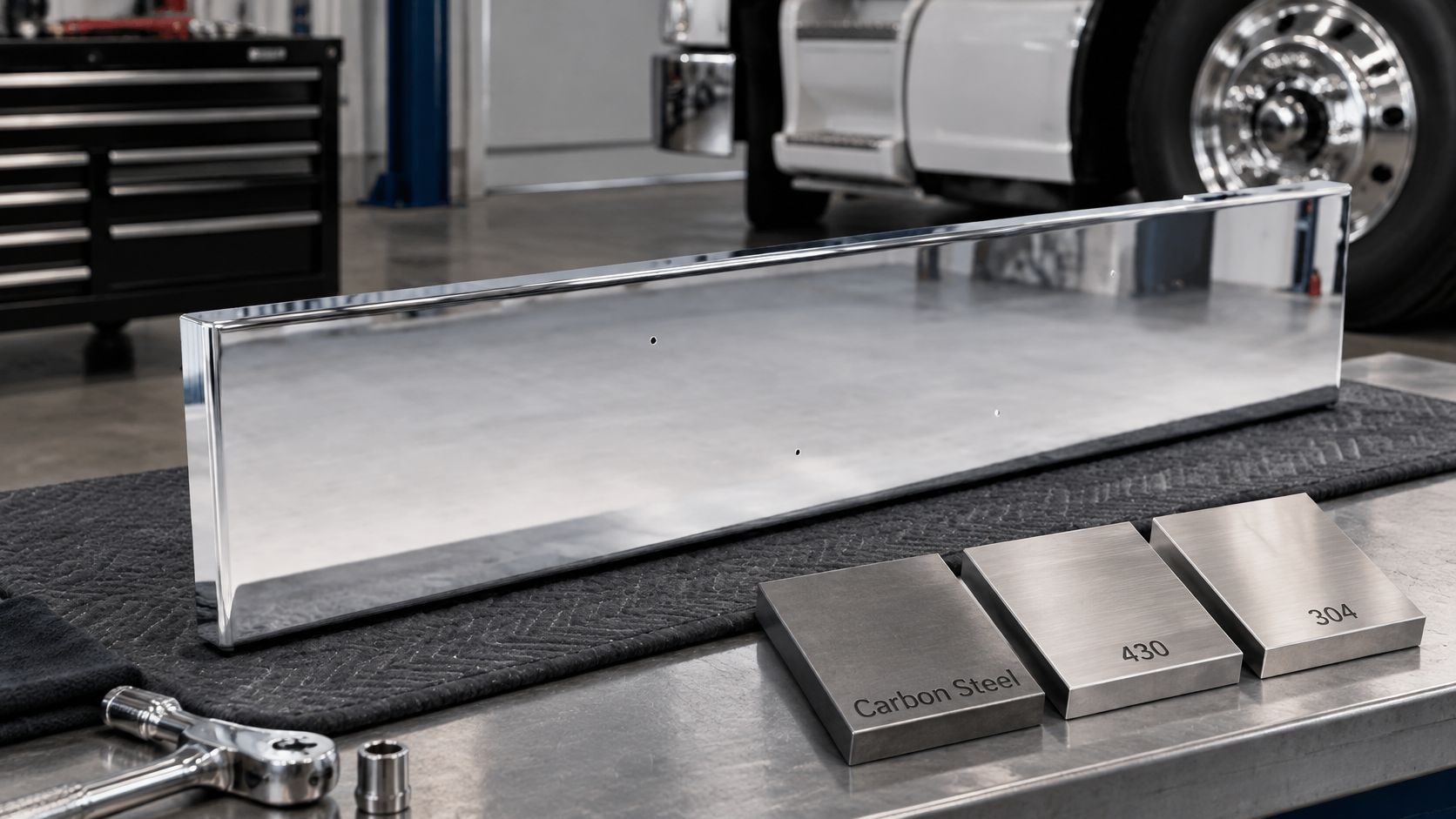
The 304 and 430 stainless steel comparison lists those typical composition ranges. Chromium forms a passive oxide film that slows rust, while nickel improves corrosion resistance in damp or acidic conditions. That makes 430 a value-oriented choice and 304 a stronger option for regular salt or moisture exposure.
Three Routes, Three Answers
Coastal salt, Kenworth W900. Salt air and humid nights favor 304. The higher nickel content improves corrosion resistance, but no steel grade makes a damaged plating layer harmless. Inspect chips and scratches before they spread.
Dry Western lanes, Peterbilt 389. Carbon steel can suit a dry route where road salt is rare and the plating stays intact. It costs less than stainless, but offers the least corrosion resistance if a chip exposes the base metal.
Frequent washing, Freightliner Columbia. Repeated water and detergent exposure can work into weak spots at edges and cutouts. If that use describes your fleet, 304 offers more corrosion resistance than 430 or carbon steel.
All three material tiers can have the same mirror-polished chrome finish. The steel is the difference. Review the differences between carbon steel and stainless steel before choosing a tier.
For example, Galhor's carbon steel bumper uses 10-gauge chrome-plated steel with a mirror-polished finish and a triple-layer hexavalent chrome process with 35 microns of nickel. Galhor bumpers follow OEM specifications. Check the nickel thickness at edges and cutouts, where coverage can be harder to maintain, rather than judging the finish by its reflection alone.
Route rule: Match the grade to the worst conditions on your route, not the average week. A truck that crosses a salted mountain pass needs a choice that accounts for that exposure.
How Triple Chrome Holds Up on Long Hauls
A bumper can still throw a mirror at 80,000 miles and be one hard winter from blistering. The shine is the cheap layer. Nickel thickness and the steel under it decide how many seasons you get once the road starts working the finish.
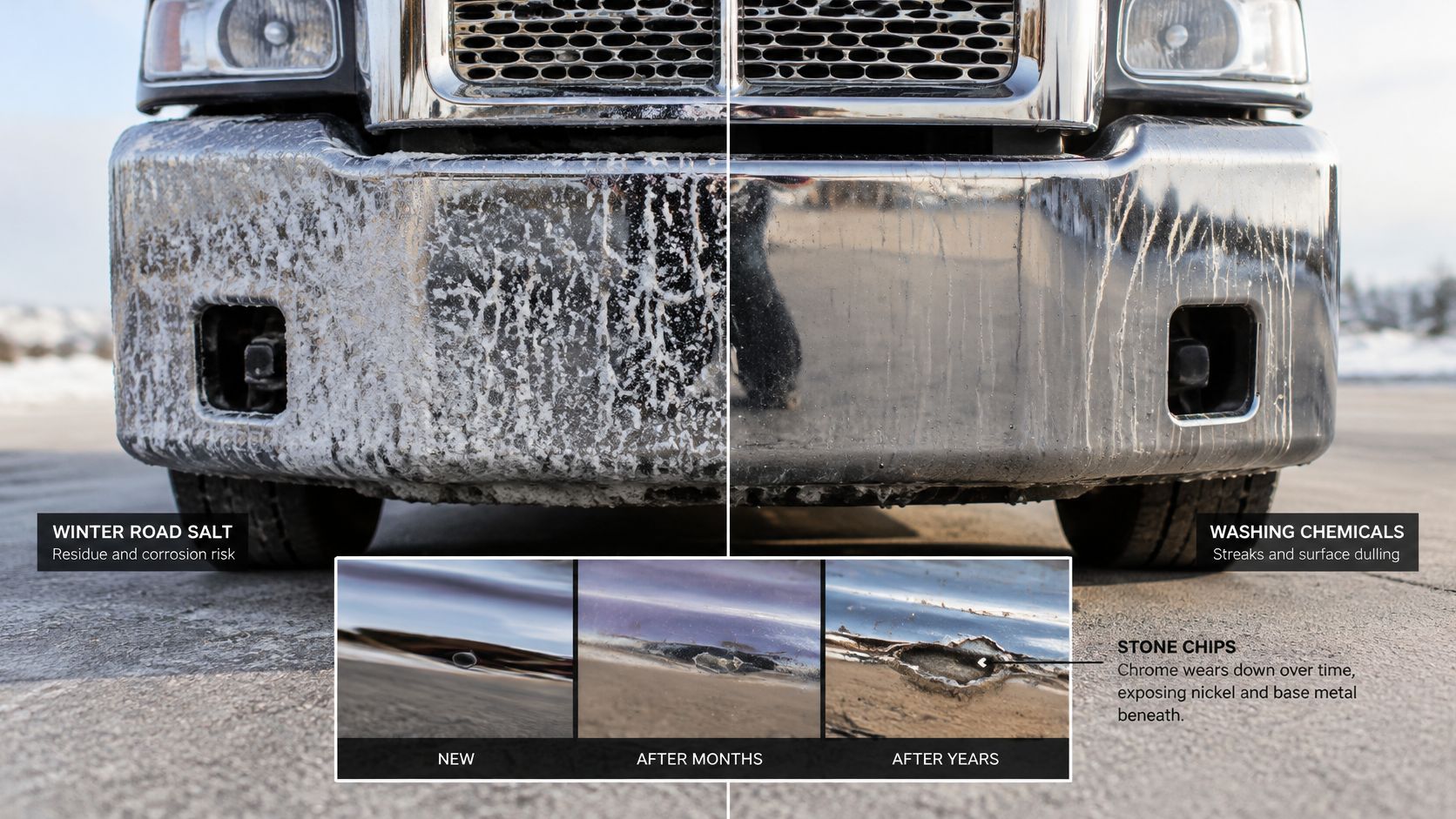
Chromium takes the abrasion. It is hard, and it is thin enough that a stone or a sharp impact cracks it. Water then reaches the nickel. Nickel is the barrier that keeps the steel dry. Once that barrier is gone in a spot, rust grows under the coating and lifts chrome in flakes, even on a panel that still looks bright from the cab.
How the stack ages
Wear moves in sequence.
Early on you get chips and fine cracks in the chromium. The mirror is still there. Run a hand over the face after a wash or you will miss them.
Moisture works those cracks next. Road film and detergent hold water longer than a rain shower does. Nickel starts to pit in small spots. Photos still look fine.
After the nickel is breached, the base metal sets the clock. Carbon steel rusts and pushes the coating off. 430 slows that spread. 304 slows it further. All three can carry the same mirror chrome. They do not buy the same years.
The uptime math that matters: a replacement bumper is the cheap part. A shop visit, a delayed load and two days of a truck sitting idle cost more than the price gap between two grades of steel.
Rinse salt within a day or two of a winter run. Do not wait for spring. Skip abrasive pads and cutting compounds. The chromium topcoat is measured in fractions of a micron, and those pads cut through it. Seal a chip early with a chrome-safe coating so corrosion does not travel under intact shine.
Shop repair is a different job from washing. OSHA's hexavalent chromium exposure guidance sets an 8-hour permissible exposure limit of 5 micrograms of Cr(VI) per cubic meter and requires employers to assess exposure and use feasible engineering and work-practice controls. Grinding, stripping or welding a plated bumper in a collision shop should not be handled like a wash-bay job.
Where Triple Chrome Plating Fails First and How to Check
The mirror on a flat face is the cheap part of the finish. Nickel thickness at the edges and cutouts, plus the steel under it, decides how long a bumper lasts once stone and salt find those thin spots.
Durability is the full stack working together. EPA technical guidance frames it as the interaction of substrate, nickel barrier and thin chromium topcoat, and names thickness verification at the thin spots as the practical control. A center-panel reading will not tell you what the bumper does on the road.
For steel and stainless parts, ASTM B456 covers nickel-plus-chromium and copper-plus-nickel-plus-chromium systems and ranks service from mild exposure through extended very severe exposure. Match that grade to the route, and make the seller name it.
Six Checks to Run Before You Pay
- Get the plating stack in writing. Copper, nickel and chromium as separate layers with thickness figures. A listing that says only "chrome" or "polished finish" leaves the stack unknown, and a chrome-look part is usually polished stainless with no plating at all.
- Ask where thickness was measured. Edges and cutouts, not only the flat face. If the only answer is the flat face, keep asking.
- Inspect under bright light. Pits, dull spots, haze or a dull band near an edge points to thin plating or a polishing shortcut.
- Request corrosion test results. Salt spray or cyclic testing, and ask whether the parts tested were formed bumpers or flat coupons. Formed parts tell you far more.
- Check adhesion. A light scoring test shouldn't lift or peel the coating along the edge of the score.
- Match the service grade to the route. Mild through extended very severe is a real scale, and a bumper built for the wrong one fails on schedule.
Buyer's rule: a bumper with measured thickness on paper beats a bumper that looks great in a photo. Every time.
Photos still help once you know where to look. Zoom in on the cutouts and lower corners and hunt for a hazy or faintly yellow band. That's a thin deposit showing through the polish.
Confirm the Layers, Grade and Warranty Before You Order
The shine is the cheapest part of the finish. Before ordering, confirm the exact fitment, steel grade, nickel thickness at edges and cutouts, and warranty. A bumper must match your frame width, tow-hook layout, sensor openings and lighting arrangement. Tractor bumpers and trailer rear impact guards serve different purposes; FMCSA's rear impact guard guidance explains the trailer requirement and its exceptions.
Match the bumper to your truck's brand, model, year and style. Cutouts for tow holes, fog lights and sensors affect fit, so check each one before placing the order.
Galhor Inc. makes chrome bumpers for Freightliner, Peterbilt, Kenworth and Volvo Class 8 trucks. Its 3D configurator lets you select the truck, style, cutouts and finish for a direct bolt-on bumper. All three material options receive the same triple-layer hexavalent chrome finish with 35 microns of nickel. The steel underneath determines the material tier.
| Grade | Corrosion Resistance | Warranty | Shipping |
|---|---|---|---|
| Stainless 430 Best Value Line | Medium | 4 years | In-stock flat bumpers can ship within 48 hours |
| Stainless 304 Top Of The Line | High, with the longest lifespan | 5 years | In-stock flat bumpers can ship within 48 hours |
| Carbon steel | Depends on the plated finish | Confirm coverage for manufacturing defects | Made to order, typically 4–6 weeks |
Timing and Terms Worth Knowing
In-stock stainless steel 430 and 304 flat bumpers can ship within 48 hours. Made-to-order carbon steel bumpers typically take 4–6 weeks, so account for the lead time before scheduling a replacement.
If you find a comparable chrome bumper at a lower price within 7 days of purchase, Galhor beats the price by 5% on carbon steel and 304 bumpers, or gives a free material upgrade on a 430 bumper. Check the nickel plating thickness details, then confirm the warranty and exact fitment in writing before you order.
Before paying, use this checklist:
- Verify the bumper matches your truck's brand, model, year and selected style.
- Confirm the tow-hook, lighting and sensor cutouts you need.
- Ask for the material grade and confirm the triple-layer finish with 35 microns of nickel.
- Review the warranty terms for the selected material.
- Check the expected shipping timing, especially for made-to-order carbon steel.