
Chrome Bumper Exchange for Fit and Cost
November 21, 2026 · Francisco Hornelas

The average U.S. Class 8 tractor is 6.3 years old, the highest level in more than a decade, according to FleetOwner's aging-fleet coverage. That makes a chrome bumper exchange a working-truck decision, not just a shine upgrade. When the tractor still earns its keep, the right replacement protects your maintenance budget by fitting without extra fabrication or another missed load.
Table of Contents
- Why Trucks Exchange a Chrome Bumper
- Chrome Bumper Exchange Choices by Damage
- Fitment and Ground Clearance by Truck
- Carbon, 430, and 304 on Salt Roads
- Rules That Still Apply After the Swap
- Real Setups on Peterbilt Kenworth and Freightliner
- Order the Bumper Before the Next Load
Why Trucks Exchange a Chrome Bumper
Say a driver catches a dock approach and bends a bumper corner. The face still shines, but the mounting ear has shifted. After a salt season, rust also shows around the tow opening. Polishing won't straighten that mount or restore the metal behind the chrome.
A chrome bumper exchange means replacing a bent, peeling, or rusting front bumper with a part that matches the truck's model, year, brackets, and cutouts. This guide addresses working Peterbilt, Kenworth, Freightliner, International, and Volvo trucks. A brand badge alone isn't enough to select the replacement.
Inspect behind the shine
Chrome isn't a solid bumper material. A typical plated bumper has a steel base, intermediate metallic layers, and a thin chromium finish, as described in this history of automotive chromium plating. The base metal supports the part. The plating protects its surface.
Inspect the places that don't show in a parking-lot photo:
- Tow openings: Look for chipped edges and rust beneath the finish.
- Bracket pockets: Check for trapped dirt, moisture, and loose hardware.
- Mounting ears: Look for distortion, cracking, or pulled holes.
- Backside seams: Check where salt collects and cleaning rarely reaches.
An aging fleet supports ongoing replacement demand, but fleet age doesn't measure bumper failures. The practical point is simpler: plenty of tractors need sound replacement parts long after their original purchase.
Shop rule: Judge the bumper by its mounts and backside before you judge its reflection.
A well-planned exchange keeps useful equipment working. A rushed order can leave the shop drilling holes, moving lights, or returning a part that looked right online.
Chrome Bumper Exchange Choices by Damage
When to repair, exchange, or step up the steel
| Damage you see | Best move | Steel lean | Uptime reason |
|---|---|---|---|
| Light scuffs, plating intact, mounts straight | Polish and keep | Leave the current bumper | No shop day |
| Stone chips and edge rust | Exchange before rust spreads | 430 mild routes; 304 salt or coast | Stops a repeat visit |
| Deep dent or bent mount ear | Exchange; don't hammer chrome | Same style, sound brackets | Avoids fab hours |
| Collision, frame and mounts still straight | Exchange and inspect hardware | 304 if you will keep the truck | One planned downtime |
| Bright face but pits at pockets | Exchange and fix trapped water | 304 in salt belts | Rust was out of sight |
Light scuffs don't justify throwing away a sound bumper. Wash the area, inspect it under good light, and use a polish suitable for the finish. If the plating remains intact and the mounts are straight, keeping the existing part is usually the simplest choice.
Stone chips and edge rust need a closer look. A small exposed edge can become a larger plating problem when the truck keeps running salted roads. Plan the exchange before loose finish and deeper corrosion turn a cosmetic repair into a mounting concern.
Separate surface damage from mounting damage
Don't hammer a dented chrome face back into service and assume the job is done. Straightening can crack the finish, and a bent mounting ear can pull the replacement out of position. Check the brackets independently rather than using the bumper to force them into alignment.
After a collision, establish that the frame and mounting structure are straight before ordering a bolt-on replacement. Preserve the truck's lights, tow points, and visibility equipment. If the frame interface needs repair, a new bumper isn't the first repair step.
Bright chrome with pitting around pockets needs a different response. Replace damaged metal, but also correct the water trap. Otherwise, the replacement goes back into the same wet, salty mounting area.
Our bumper repair versus replacement guide can help separate damage worth cleaning up from damage that calls for an exchange.
Count the whole job
Industry reporting puts combined heavy-duty parts and labor costs 27.4% higher in early 2026 than in 2020, with cab-and-sheet-metal costs 63.8% higher; the same maintenance-cost coverage reports average intervals between breakdowns or unscheduled repairs falling from 38,249 miles in 2024 to 36,891 miles in 2025. Those aren't bumper-specific failure rates. They explain why another unplanned shop visit deserves attention.
Build the purchase around these costs:
- Delivered price: Include freight, not just the advertised bumper price.
- Installation work: Include bracket repair, hardware, and light transfer.
- Lost availability: Account for the load you can't take while the truck waits.
- Ownership period: Match the steel to how long you'll run the tractor.
A cheaper bumper that needs fabrication can cost more than a correctly configured replacement. Measure the truck next. Don't choose the style from a photo alone.
Fitment and Ground Clearance by Truck
Sample front bumper ground clearance
| Example truck | Model year | Ground clearance |
|---|---|---|
| Peterbilt 579 | 2020 | 9 inches |
| Freightliner Cascadia | 2018 | 12 inches |
| Kenworth 680 | 2018 | 12 inches |
| International TranStar | 2012 | 14 inches |
| International ProStar | 2017 | 14 inches |
| Volvo VNL 300 | 2012 | 14 inches |
| Freightliner M2 | 2016 | 17 inches |
Treat these as example measurements, not ordering specifications. The linked clearance reference doesn't provide a truck measurement document you can use to verify an individual vehicle. Measure the actual truck before selecting a lowered bumper.
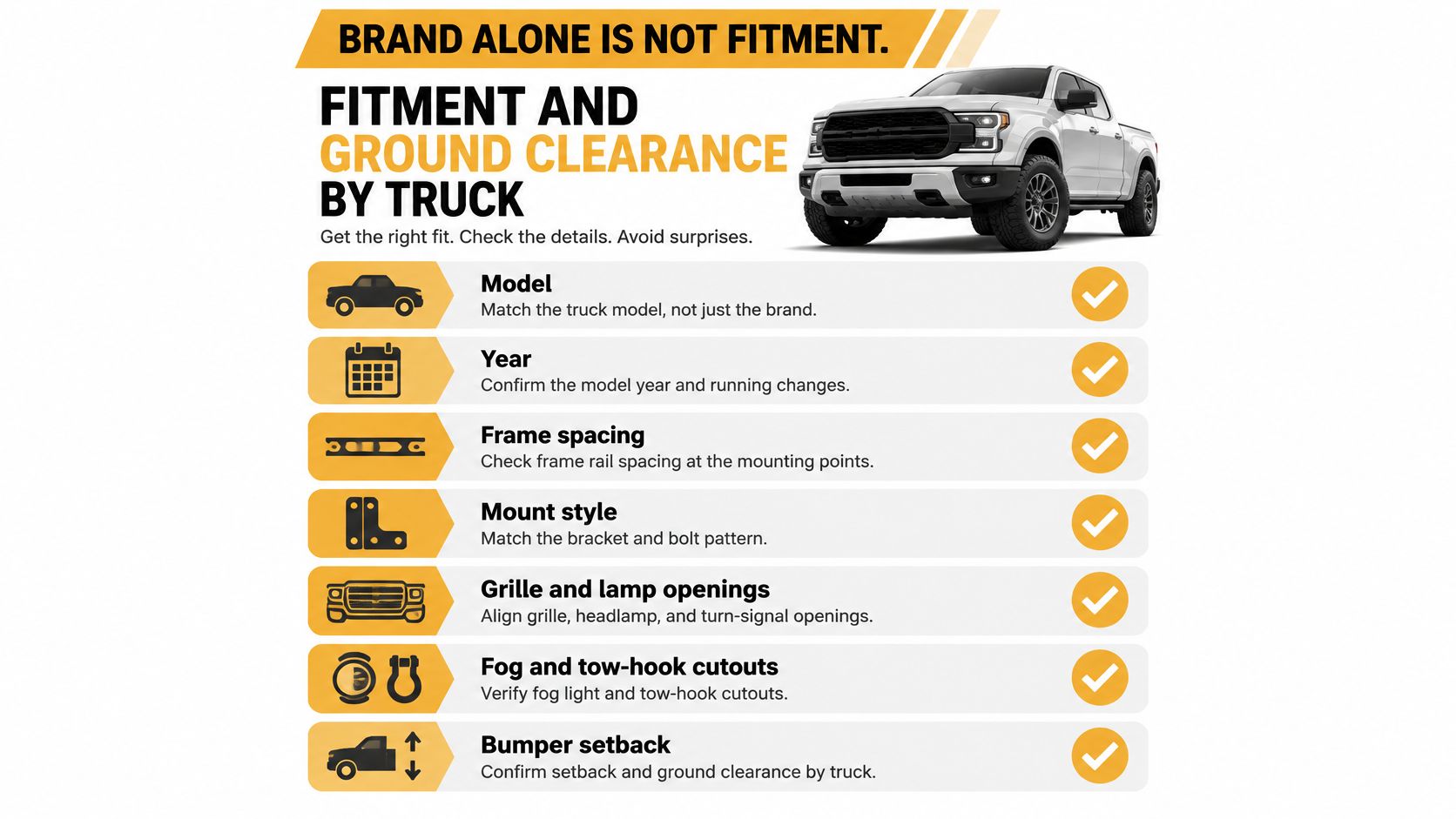
Brand alone is not fitment. Match the model, year, frame spacing, mount style, grille and lamp openings, fog and tow-hook cutouts, and bumper setback. Tire size, suspension condition, and previous modifications can change the space you're working with.
Measure for the route, not the parking lot
An 18 inch drop bumper describes a product choice. It doesn't guarantee a particular installed ground clearance. Ask how the seller measures the face, then check where its bottom edge will sit on your truck.
Park on level ground at normal ride height. Use a tape measure and straightedge to record the existing bumper position. Measure mounting-hole centers and photograph the brackets from the front and side.
A lower face may look right outside the chrome shop and still scrape at a steep receiver entrance. Consider the docks, crowned roads, yard ramps, and uneven approaches the driver uses. Don't use a deep bumper to hide a suspension problem.
A direct bolt-on should match the truck's mounting geometry. It shouldn't need a pry bar to make the holes agree.
Use a complete order check
Before buying a Peterbilt 389 bumper, Kenworth W900 chrome bumper, Freightliner bumper, or International bumper, record:
- Model and year: Include the VIN when confirming the application.
- Mount type: Identify standard, blind, or other mounting arrangements.
- Cutouts: Mark tow access, fog lamps, other lights, and sensors.
- Ground clearance: Measure at normal ride height and consider approach clearance.
- Projection: Record the factory reference position and proposed installed position.
Configurable replacements can eliminate unnecessary cutting, including application-specific Volvo VNL options. That benefit only holds when the selected configuration matches the truck.
Before removal, photograph light wiring and bracket orientation. Support the old bumper before loosening its fasteners. If the new part needs unplanned drilling, stop and resolve the fitment problem instead of turning an exchange into a custom fabrication job.
Carbon, 430, and 304 on Salt Roads
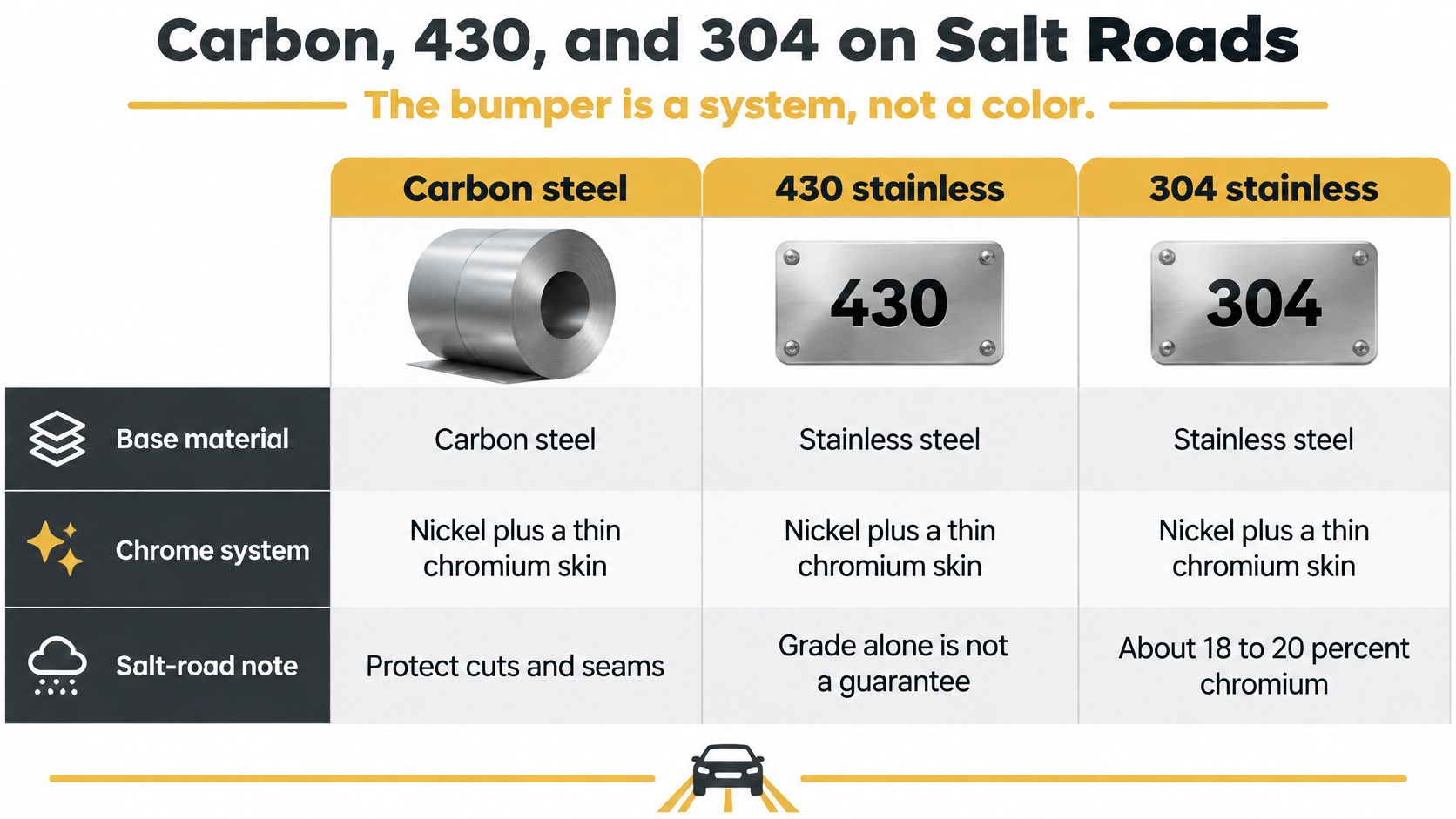
The bumper is a system, not a color. Base metal, thickness, forming, mounting support, and finish all matter. Chrome-plated carbon steel and chrome-plated stainless can look similar when new while requiring different care over their service lives.
Bumper steel grades for U.S. road salt
| Base metal | Chromium | Nickel | Best use |
|---|---|---|---|
| Chrome-plated carbon steel | Not a stainless grade | Not a stainless grade | Drier routes and tighter budgets |
| Stainless 430 | About 16–18% | Little or none | Mixed miles, milder salt |
| Stainless 304 | About 18–20% | About 8–10.5% | Salt belt, coast, long ownership |
The stainless compositions shown in the table come from thyssenkrupp Materials' comparison of 304 and 430. Its comparison supports choosing 304 for stronger corrosion resistance in aggressive conditions, while 430 offers a lower-cost stainless option.
Match thickness and finish to the job
Ask for the actual stainless grade on a Peterbilt 389 bumper or Kenworth W900 chrome bumper. The word stainless doesn't tell you which alloy you're buying. Our 430 versus 304 stainless comparison explains that buying choice in more detail.
Thickness matters too, but don't judge the whole bumper by gauge alone. Bracket support, bends, cutout placement, and mounting condition affect durability. A thick face attached to damaged brackets isn't a sound installation.
For a specific carbon-steel example, the Steel chrome bumper uses 10-gauge chrome-plated steel, a mirror-polished finish, and a triple-layer hexavalent chrome process with 35 microns of nickel. Its configured standard or blind mounting arrangement provides direct bolt-on installation without drilling or cutting.
Read the old corrosion pattern
Even stainless needs cleaning. IMOA's stainless-steel selection guidance identifies chloride exposure and localized corrosion as material-selection concerns. Wet pockets behind brackets deserve attention even when the front remains bright.
Before installing the replacement:
- Remove deposits: Clean salt and packed dirt from the mounting area.
- Inspect contact points: Rust rings can signal trapped moisture or unsuitable metal interfaces.
- Use compatible hardware: Follow the bumper and truck mounting requirements.
- Keep drainage open: Don't seal water inside a pocket while trying to protect it.
Choose 304 for long ownership in harsh salt exposure. Consider 430 for milder mixed routes. Chrome-plated carbon remains a practical budget choice for drier work, provided you inspect chips and clean the backside.
Rules That Still Apply After the Swap
No federal truck bumper standard doesn't mean any bumper is safe to bolt on. In its interpretation of the Part 581 Bumper Standard, NHTSA states that the standard applies to passenger motor vehicles and that no federal bumper standard applies to trucks. That distinction doesn't approve a particular replacement or installation.
The installer still needs to protect mounting strength, frame compatibility, tow and recovery access, lighting, sensor clearance, and the truck's intended configuration. State requirements, carrier policies, and insurance conditions may also affect the job.
Don't confuse appearance with crash certification
A polished bumper isn't automatically a certified crash-protection system. Neither a thick plate nor a deep drop proves that the part delivers a documented crash result.
Buying caution: If someone sells a bumper as certified crash equipment, ask for documentation covering that exact part and application.
A commonly repeated 6-inch resilient-bumper projection limit also needs proper legal verification before you apply it to a custom installation. The linked projection reference is a stainless-steel article, not the governing federal regulation. Record the installed projection and confirm the applicable rule rather than relying on that reference as legal authority.
Our bumper safety standards guide helps frame the questions to resolve before release.
Keep trailer rear guards separate
A tractor's front chrome bumper isn't a trailer rear-impact guard. For applicable trailers and semitrailers with a GVWR of at least 4,536 kg, or 10,000 lb, FMVSS 224 requires a guard certified to FMVSS 223, extending within 100 mm, or 4 inches, of each side, with maximum ground clearance of 560 mm, or 22 inches, and a rear surface no more than 305 mm, or 12 inches, forward of the specified rear plane.
Those requirements concern the complete guard and its installation. A similar-looking shell doesn't establish equivalent performance when brackets or positioning change.
Before releasing a truck after a front bumper exchange, document:
- Vehicle identity: Model, year, and selected bumper style.
- Mounting condition: Brackets, frame interfaces, fasteners, and any repairs.
- Installed measurements: Height, setback, and projection.
- Function checks: Lights, sensors, tow access, and clearance.
Use the specified fasteners and the manufacturer's tightening procedure. Don't invent a universal torque value for different brackets and trucks.
Real Setups on Peterbilt Kenworth and Freightliner
Peterbilt style without a dock problem
Say a Peterbilt 389 owner-operator wants a show-ready face and a drop bumper. Start with the truck's mount holes and required openings, then check the bottom edge against the approaches used on the weekly route.
A bumper that looks good at a truck show can be a poor choice for steep docks. Approve the style only after checking approach clearance. If the part needs cutting to fit, the exchange isn't ready.
Kenworth on winter long hauls
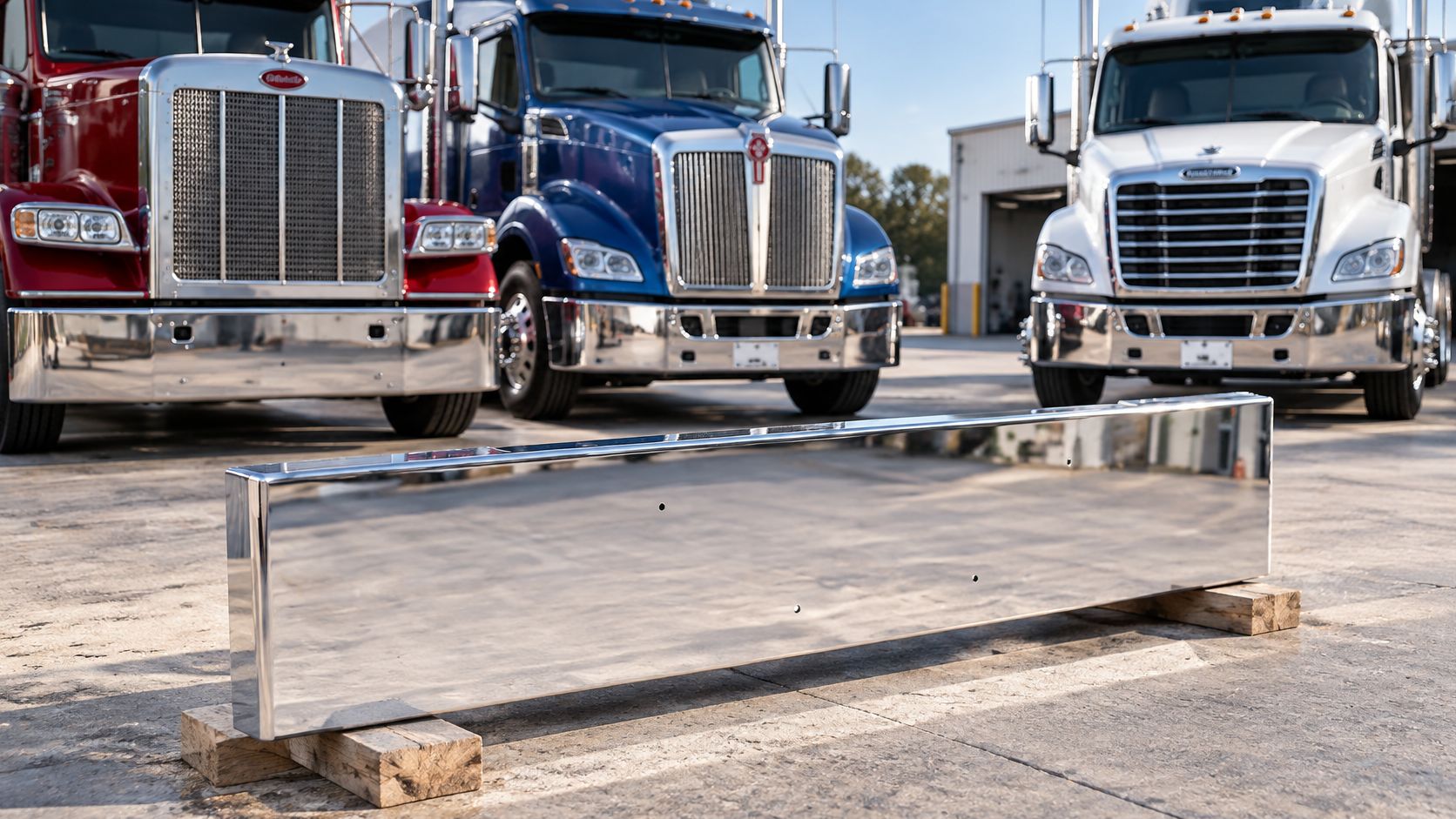
A Kenworth W900 running salted interstate miles calls for a different judgment. I would lean toward 304 when the owner plans to keep the truck through repeated winters.
The installation still needs accessible bracket pockets and a cleaning routine. Choose the material for the route, not just the reflection. Reject a configuration that requires cutting around a tow point.
Freightliner in fleet service
For a Cascadia or Columbia, the maintenance lead may value a repeatable installation more than a custom profile. Preserve the factory mounting position, transfer the correct lights, and keep recovery access usable.
Don't assume another Freightliner model uses the same bumper because its face looks similar. Match the application before scheduling the shop slot. Unplanned fabrication means the exchange isn't ready.
International needs its own order check
An International ProStar and a TranStar need separate model-year and cutout checks. A photo showing the right general shape won't identify every bracket or opening.
Photograph the existing installation before ordering an International bumper. Compare the mounting details with the replacement drawing. Don't approve the job on brand recognition alone.
Volvo needs the complete configuration
The Chrome bumper for Volvo VNL (2004–2017) is offered in 10-gauge chrome-plated steel or 11-gauge 430 stainless, with an included gauge-7 mounting bracket. Tow holes, fog holes, and light openings follow the selected configuration.
The listed standard-mount application is direct bolt-on, without drilling or cutting. That doesn't remove the need to confirm the truck's current setup, especially if someone changed its brackets before you bought it.
Across these setups, our online configurator lets buyers select brand, model, year, style, cutouts, and finish. Use photographs and measurements while making those selections. A configurator works best when the information entered describes the actual truck.
Order the Bumper Before the Next Load
Make the exchange when damaged metal or corrosion makes another repair visit likely. Match the truck before choosing the face. Select the steel for the route and ownership period. Don't mistake a chrome bumper for certified underride equipment.
Put the delivery window on the work order
We process and support orders from Magnolia, Texas, and ship directly to owner-operators, fleets, and chrome shops across the United States and Canada by LTL freight. Fast shipping across the United States matters, but the dispatch window needs to match the material and configuration you're ordering.
We stock base models of nearly all popular bumpers and finish them to the customer's specifications. In-stock 430 and 304 stainless flat bumpers can ship within 48 hours; made-to-order carbon-steel units typically ship in 4 to 6 weeks. Shipping time isn't the same as delivery time, so don't book installation based on dispatch alone.
Our bumper page lists individual bumpers from $874.99 to $1,679.99, with the Classic starting at $874.99. Each bumper is sold individually. Available builds include U.S.-sourced steel, direct bolt-on fit, and a triple-layer chrome finish with 35 microns of nickel.
Compare support as well as steel
Manufacturing-defect coverage differs by material:
- Economy carbon steel: A 2-year warranty.
- Standard 430 stainless: A 4-year warranty.
- Premium 304 stainless: A 5-year warranty.
After a documented road incident, replacement pricing provides 15% off carbon, 20% off 430, and 25% off 304. Keep the purchase details and incident documentation with the truck's maintenance records.
Before placing the order, have the shop confirm the configuration and receiving arrangements. Plan who will inspect the freight, where the bumper will be stored, and when the truck can enter the bay. Check the shipment for visible damage before the installation appointment.
The best value is a bumper that arrives in the correct configuration, installs as intended, and suits the truck's remaining working life. Order before the current damage forces the schedule. Don't let an otherwise ready tractor sit because nobody confirmed the mount style or freight timing.
Galhor Inc. offers configurable chrome bumper replacements for working Freightliner, Kenworth, Peterbilt, and Volvo trucks, with material choices for different routes and ownership plans. Visit Galhor Inc., configure your model, year, style, and cutouts, and confirm the shipping window before your next planned shop visit. Order now if your current bumper is hiding rust or damaged mounts behind a bright face.