
Semi Truck Parts Online Buying Guide That Saves Time
September 15, 2026 · Francisco Hornelas

A damaged bumper can put a Peterbilt 389, Kenworth W900, Freightliner, or International truck out of service at the worst possible time. If the truck has a long haul scheduled, waiting for a local counter order or discovering that the replacement doesn't fit can cost more than the part itself. The right semi truck parts online buying process helps you confirm fitment, compare materials, protect the finish, and plan delivery before downtime starts.
Online ordering is no longer just a backup for hard-to-find parts. MacKay & Company survey data cited by Truck Parts & Service showed fleets moving from 10% of medium- and heavy-duty parts purchases online in 2017 to 12% in 2019 and 13% by 2021. Fleets expected that share to reach 15% within the next three years, which points to a lasting change in how maintenance teams source truck and trailer parts.
This guide is for owner-operators, fleet managers, repair shops, and truck enthusiasts who need more than a low online price. You'll learn how to verify a direct bolt-on bumper, compare chrome-plated steel with 430 and 304 stainless steel, understand LTL freight, and check return and warranty terms. The goal is simple: buy the correct part the first time, get it delivered safely across the United States, and keep the truck earning.
Table of Contents
- Introduction to Buying Semi Truck Parts Online Without Downtime
- How the Online Heavy Duty Parts Ecosystem Works
- OEM vs Aftermarket Parts and What to Choose for Your Truck
- How to Verify Fitment and Quality Before You Order
- Understanding Bumper Materials Finishes and Durability
- Shipping Lead Times Returns and Warranty Essentials
- Your Final Checklist to Order Semi Truck Parts Online With Confidence
Introduction to Buying Semi Truck Parts Online Without Downtime
Your Freightliner is ready for its next run, but a damaged bumper still has to be replaced. The truck may be mechanically sound, yet the bumper can affect lighting, appearance, and road readiness. An online listing seems straightforward until the seller asks about standard or blind mounting, required cutouts, and the exact model year.
That pause protects your uptime. A bumper can match the truck in a product photo while using different brackets, openings, mounting points, or dimensions. If the configuration is wrong, the purchase becomes more than a return. You may pay another freight charge, schedule shop labor again, and leave the truck parked while the replacement is sorted out.
Online ordering is now an established part of heavy-duty parts purchasing, as earlier industry reporting documented. The practical lesson is simple: an online price does not represent the full cost. Material grade, plating or finish thickness, stock status, and shipping method all influence how long the part lasts and how quickly the truck returns to service.
What a careful online order should answer
Before paying, confirm these details:
- Exact fitment: Does the part match the truck's year, make, model, mounting style, and cutouts?
- Construction: Does the seller identify the steel or stainless grade and list its thickness or gauge?
- Finish: Is the surface chrome plated, polished stainless, brushed, or powder coated? Plating thickness and surface preparation affect corrosion resistance and appearance.
- Delivery plan: Is the bumper in stock, made to order, or shipped by LTL freight? A lower item price may not offset freight damage or a delivery delay.
- Risk protection: What happens if the part arrives damaged, fails to fit, or has a manufacturing defect?
A direct bolt-on bumper works like a replacement panel made for the truck's existing mounting points. That convenience depends on accurate configuration. Choosing a thinner or less suitable material may lower the initial price while increasing repair frequency, whereas a durable finish can protect the investment over longer service.
Confirming these details before checkout takes minutes. It can prevent a second order, extra labor, and a truck sitting in the yard instead of moving freight.
How the Online Heavy Duty Parts Ecosystem Works
The U.S. Class 7 and 8 aftermarket uses two primary distribution channels, OEM dealer networks and independent distributors. Repair operations, body shops, and fleets with in-house maintenance install the parts after those channels supply them. Understanding that structure helps you choose a seller based on the job, not just the first price shown in search results.
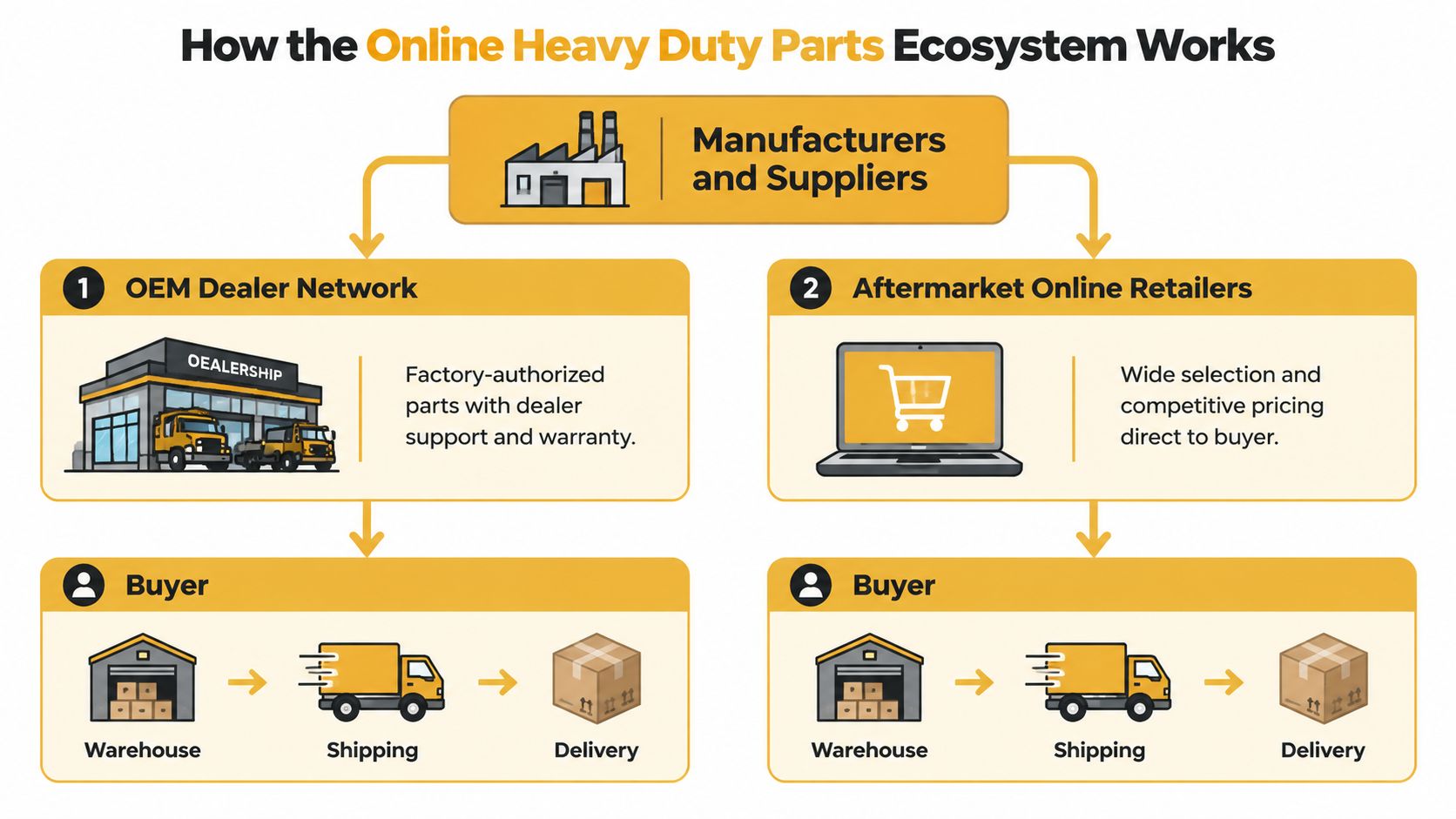
OEM dealer networks
OEM dealers are useful when you need factory support, original documentation, warranty coordination, or a part tied closely to a dealer service process. They may also help identify a component through manufacturer records. That support can be valuable for electronic, engine, transmission, and safety-related parts where the wrong specification can create larger problems.
The tradeoff is that a dealer catalog may focus on factory replacement parts rather than appearance upgrades or multiple material choices. A buyer looking for a Kenworth W900 chrome bumper or a custom 18 inch drop bumper may need an independent source that offers more configurations.
Independent distributors and online retailers
Independent distributors serve a wide aftermarket. Their strength often comes from broader selection, competitive pricing, and access to replacement or styling parts for popular trucks such as Peterbilt, Kenworth, Freightliner, and International. Internet-based retail is growing faster than traditional aftermarket channels, according to industry analysis from Alro.
Look for a seller that combines a searchable catalog with real fitment support. A large inventory doesn't help if the listing leaves out mounting details, material specifications, or vehicle-specific guidance. Online lookup should reduce phone calls and delays, but technical support still matters when a truck has prior body work, aftermarket brackets, or an uncommon configuration.
For example, the Chrome bumper for Freightliner Classic is listed as a direct bolt-on option with standard mount and blind mount configurations. Its catalog details identify 10-gauge chrome-plated steel, a 3 mm chrome-plated 304 or 430 stainless steel option, a mirror-polished finish, and cutouts based on configuration.
Practical rule: Choose the channel that can prove the part fits your truck and support the order after checkout.
The buyer's real cost includes more than the checkout total. Inventory depth affects waiting time. Fitment support affects rework. Shipping protection affects damage risk. A seller that answers those questions clearly may deliver better total value than a lower-priced listing with incomplete information.
OEM vs Aftermarket Parts and What to Choose for Your Truck
OEM and aftermarket parts both have a place in heavy-duty maintenance. The right choice depends on whether you're replacing a factory component, matching an existing appearance, adding a custom style, or reducing long-term replacement risk.
For a collision replacement on a truck that must match the original configuration, an OEM part can make sense. For a chrome bumper, however, an aftermarket manufacturer may offer options that the factory catalog doesn't, such as a deeper drop, different cutouts, blind mounting, or a choice between carbon steel and stainless steel.
| Criteria | OEM Parts | Aftermarket Parts |
|---|---|---|
| Fit | Built around factory specifications and catalog identification | Can offer direct bolt-on designs, but the buyer must verify model, year, mounting, and configuration |
| Finish | Usually follows the original factory appearance | May offer chrome, polished stainless, custom drops, and other appearance choices |
| Durability | Designed for the original application | Depends on gauge, stainless grade, plating, polish, and manufacturing controls |
| Support | Dealer support and factory documentation | Seller support, fitment assistance, return terms, and product warranty |
| Value | Useful when exact factory replacement is the priority | Useful when customization, material choice, or long-term appearance matters |
Match the source to the part
Use an OEM dealer when the part depends heavily on factory records, software, or a precise mechanical specification. Use an independent online retailer when you need a broad selection, replacement alternatives, or a configurable appearance part.
A Peterbilt 389 bumper deserves the same fitment discipline as a mechanical part. Check the model generation, bumper profile, mounting arrangement, lamp openings, and any existing brackets. A polished or chrome finish won't make up for a bumper that requires drilling or forces a shop to modify the truck.
The material also changes the value calculation. A bumper used on salted winter routes or near coastal air may justify a stainless option because corrosion can damage both appearance and service life. A truck that spends most of its time in a milder climate may lead the owner toward chrome-plated carbon steel if the product's construction and maintenance requirements match the route.
For a broader discussion of how factory and aftermarket choices differ, review this OEM and aftermarket parts comparison. The important point is not that one category always wins. The important point is that the listing must explain what you're buying and why it suits the truck.
How to Verify Fitment and Quality Before You Order
Fitment is the most common point of confusion in online truck parts buying. Industry reporting has identified fitment certainty as an underserved need because many e-commerce sites organize vehicle data poorly and lack VIN lookup tools, as discussed by Trucking Dive.
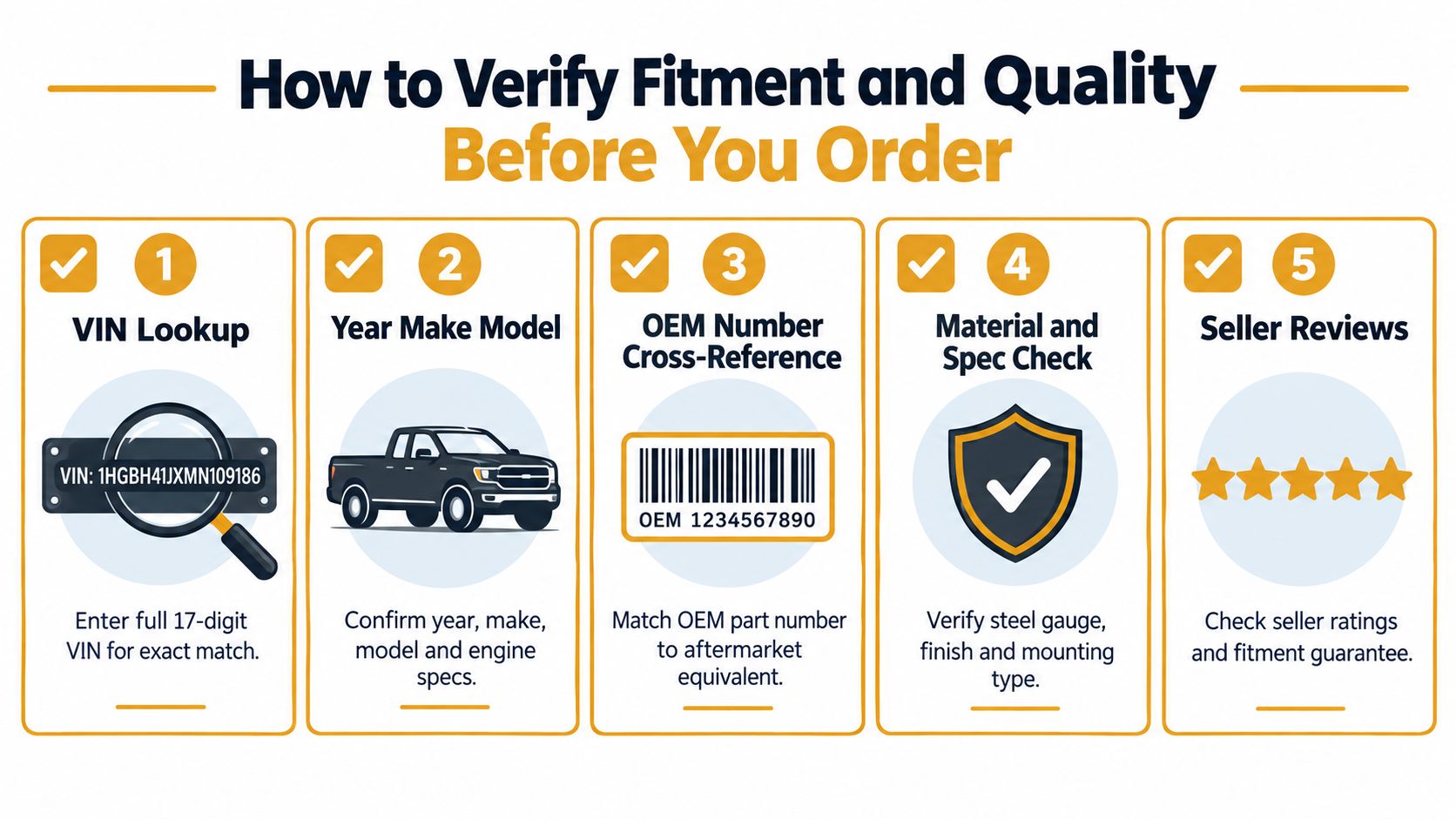
Follow the identification sequence
- Start with the truck record. Write down the VIN, year, make, model, engine details, and whether the truck has factory or modified front-end equipment. For a Peterbilt 389 or Kenworth W900, don't assume every truck with the same badge uses the same bumper.
- Use VIN lookup when available. Enter the complete VIN into the seller's system and compare the returned application with the product description. If the site doesn't offer VIN lookup, contact the seller before ordering and provide the truck information.
- Cross-reference the part number. Match the OEM number, interchange number, or manufacturer reference when one is listed. A visual match is helpful, but it shouldn't replace a part-number or vehicle-application check.
- Confirm the physical details. Check width, height, drop depth, mounting type, lamp openings, tow hook openings, license plate location, and cutouts. Ask whether the bumper is a direct bolt-on or requires drilling, cutting, bracket changes, or fabrication.
- Read the specifications. Confirm steel gauge or stainless thickness, finish, mounting hardware, packaging, warranty coverage, and the definition of a defect.
Use the product page as a technical document
A useful listing should answer practical shop questions. It should state whether the part is sold individually, identify included cutouts or hardware, and show enough photos to compare the mounting area. For a replacement bumper, also inspect the truck before ordering. A previous collision may have bent brackets or shifted frame-mounted hardware, so a correct bumper may still need truck-side repairs.
A configurator can help when it shows the exact selections being made. Galhor's online truck customizer is one example of a tool that lets buyers work through truck-specific choices rather than relying on a generic image.
Before checkout: Save the product configuration, fitment response, measurements, and written answers from the seller. Those records make a return or warranty conversation clearer if the shipment doesn't match the order.
Don't treat “fits Peterbilt” or “fits Freightliner” as complete information. The dependable listing connects the part to the exact truck application and explains what changes with each option.
Understanding Bumper Materials Finishes and Durability
A bumper's appearance comes from more than the word “chrome.” Base metal, thickness, surface preparation, plating, and maintenance all affect how the part handles road salt, moisture, gravel, and repeated washing.
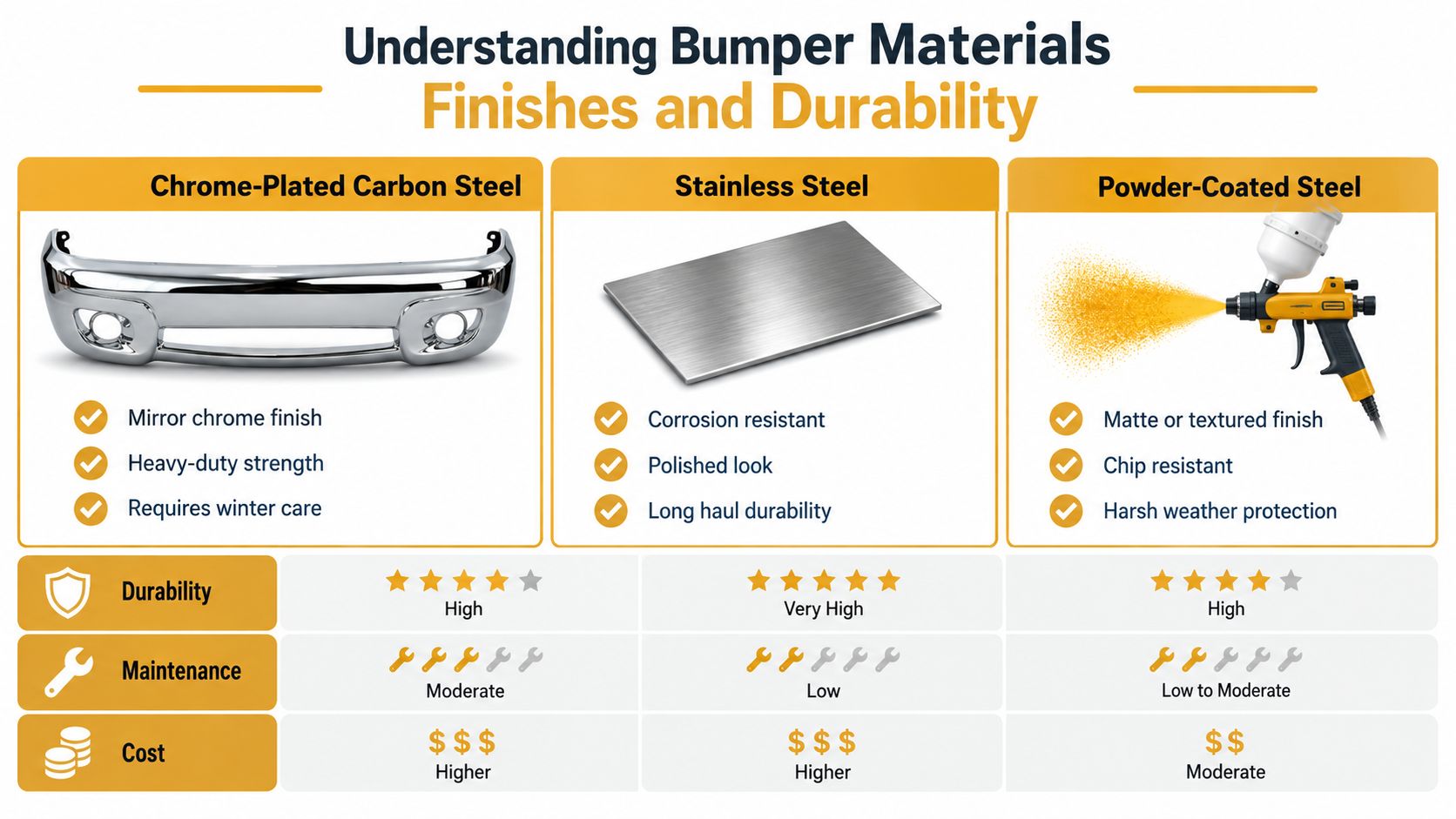
Chrome-plated steel and stainless options
Chrome-plated carbon steel can provide a bright mirror finish and strong structure. The tradeoff is that exposed damage or poor winter care can allow corrosion to reach the base metal. Ask for the steel gauge, plating process, nickel layer, and surface preparation instead of accepting a general durability statement.
Chrome-plated stainless steel 430 is a ferritic alloy with 17% chromium, and it has long been used for decorative automotive trim, including bumper medallions and other bright exterior parts, according to Carpenter Technology's 430 stainless data sheet. Its polished surface can suit an owner who wants a bright appearance with a stainless foundation.
Grade 430 has good resistance to several corrosive media, but its resistance is highest when the surface is highly polished or buffed. It has lower pitting and crevice corrosion resistance than 304 and generally isn't the first choice for harsh exterior exposure, as explained in the worldstainless grade sheets.
Grade 304 is an austenitic stainless alloy with roughly 18% nickel and chromium content in automotive-use summaries. RANEY'S stainless guidance describes 304 as immune to rusting through in typical automotive use, while noting that surface rust can still appear in severe climates or after damage. That makes 304 the stronger corrosion choice for heavy road salt, coastal air, and frequent wash cycles.
Plating and surface quality
Plating thickness gives you a more useful durability question than a vague “triple chrome” label. One industrial steel source associates 0.001 inch of standard chrome plate per side with a minimum of 500 hours of corrosion resistance in ASTM B117 salt-spray testing. The same source reports that a 0.0005-inch-per-side option can reach 1,000 hours on certain induction-hardened chrome-plated bars, so the result depends on the substrate, hardening, and process, not thickness alone. See the technical discussion from CVSN.
For a mirror finish, ask whether the surface was polished before plating, how the nickel layer is applied, and whether the seller identifies the process. A triple-layer hexavalent chrome process with 35 microns of nickel is listed for the Galhor bumper configuration described earlier.
Choose for the route
A chrome bumper suits owners who prioritize traditional shine and are willing to clean and inspect it after winter exposure. A 430 stainless option can offer a stainless base with a polished appearance. A 304 stainless option makes more sense when corrosion exposure is a major part of the ownership calculation. Review the material choices in this stainless steel truck parts guide before selecting the finish.
Shipping Lead Times Returns and Warranty Essentials
A bumper is large, heavy, and vulnerable to handling damage. Shipping terms should be part of the purchase decision, not an afterthought added after payment.
Less-than-truckload freight, or LTL, is common for bumpers because multiple shippers share trailer space and each pays for the portion used. Industry guidance places common LTL shipments between roughly 150 and 15,000 pounds, with some practical ranges beginning around 500 pounds, according to LJ Transportation Services.
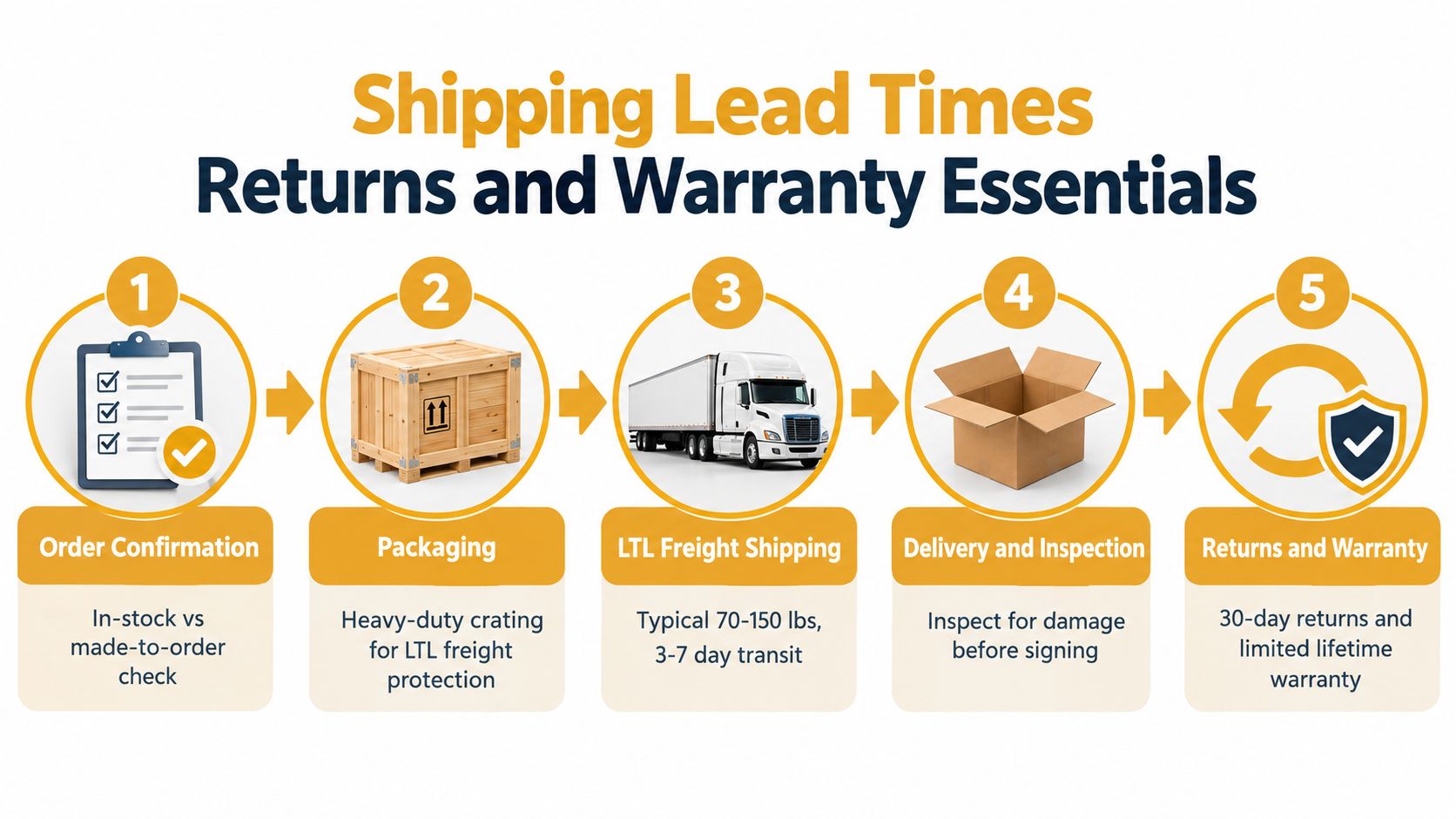
Check the delivery promise
Ask whether the bumper is in stock or made to order. A listing may show a fast transit service while the actual production lead time remains unclear. For a truck waiting on a collision replacement, those are two separate timelines.
Before ordering, confirm:
- Production status: Is the selected material and configuration ready to ship?
- Freight preparation: Will the bumper use protective crating or reinforced packaging?
- Delivery location: Can the carrier deliver to your shop, terminal, or commercial address?
- Inspection process: What should you do if the crate or bumper shows damage?
- Signature rules: Does signing without a damage notation affect a freight claim?
Inspect the packaging before signing. Photograph dents, torn material, crushed corners, and exposed metal. If the bumper itself is damaged, record that on the delivery paperwork and contact the seller promptly.
Read the return policy before checkout
Heavy-duty return policies often require unused condition, original packaging, return authorization, and restocking fees. Electrical, special-order, or installed parts may be excluded, according to the published policies in the Bruckner Truck Parts customer service FAQs.
That matters even more for configurable bumpers. Don't install the part just to see whether it fits. Compare the mounting points and cutouts first, while the bumper remains in returnable condition.
Warranty language should identify coverage for manufacturing defects in workmanship and materials, the claim process, exclusions, and the period of coverage. It shouldn't be treated as protection against incorrect ordering, freight damage, or truck-side modifications unless the written policy says so.
Your Final Checklist to Order Semi Truck Parts Online With Confidence
A bumper order should be judged by the miles and labor it saves, not only by the checkout total. Use this decision path for a Peterbilt 389 bumper, a Kenworth W900 chrome bumper, an 18 inch drop bumper, or another direct bolt-on part.
Choose by ownership cost
- Fitment certainty: Save the confirmed part number, mounting points, dimensions, brackets, and cutouts. Correct alignment reduces installation time, rework, and downtime.
- Material and finish: Compare steel gauge or stainless thickness, base material, plating, and polish. The right 430 or 304 stainless, chrome-plated steel, or other finish can reduce corrosion-related replacement costs on your routes.
- Configuration: Confirm whether the bumper bolts on or requires drilling, cutting, or fabrication. Avoiding extra shop work improves the return on the purchase.
- Shipping method: Check production status, protective LTL packaging, delivery address, and inspection requirements. A damaged shipment can turn a lower price into lost operating time and added freight claims.
- Support record: Keep written fitment answers and the final configuration before payment. Clear documentation makes a mismatch easier to resolve and protects the value of your order.
- After-sale terms: Review return authorization, packaging rules, exclusions, restocking fees, manufacturing-defect coverage, and the claim process. Knowing the remedy before installation limits stranded-part costs.
One practical rule ties the choices together: a part that fits the truck, matches the route, arrives intact, and avoids repeat labor protects uptime, appearance, and ROI.
Galhor Inc. offers configurable chrome and stainless steel bumpers for Class 8 trucks, including direct bolt-on options for Peterbilt, Kenworth, Freightliner, and Volvo applications. Review the fitment, material, finish, shipping, and warranty details, then visit Galhor Inc. to choose the right bumper for your truck and order with confidence.