

Stainless Steel Truck Parts: 304 vs 430 and Chrome
You're standing at the chrome shop looking at three bumpers that seem identical from across the counter. One is chrome-plated carbon steel, one is 430 stainless, and one is 304 stainless. The question isn't which one shines today. It's which metal will still look right after long hauls, winter brine, Gulf humidity, and years of loading miles. This guide puts that decision in practical terms for a Peterbilt 389 bumper, Kenworth W900 chrome bumper, Freightliner, or Volvo build, including the trade-off between corrosion resistance, finish, thickness, fitment, shipping, and upfront cost.
Table of Contents
- Why the Material Behind Your Bumper Matters
- The Three Metals Used on Truck Parts Today
- Stainless 304 vs Stainless 430 Head to Head
- How Each Metal Holds Up on Real Trucking Routes
- Cost, Lead Time, and Lifecycle Value Compared
- Best Material Pick by Truck Model
- Maintenance That Keeps Stainless and Chrome Looking New
- Choosing Your Bumper and Getting It on the Truck
Why the Material Behind Your Bumper Matters
A bumper takes abuse before the rest of the truck does. It catches road spray, gravel, bug residue, brake dust, wash chemicals, and winter salt. On a working tractor, the material underneath the finish matters just as much as the shine on top.
You'll usually choose among three paths:
- Chrome-plated carbon steel, selected for its deep mirror appearance and familiar price position.
- 430 stainless steel, chosen for a lower-cost stainless option in drier service.
- 304 stainless steel, selected when salt, humidity, and long service life justify the premium.
The right answer depends on your lanes. A truck running I-90 through northern winters needs more chloride resistance than a tractor hauling dry freight across Texas and Arizona. A coastal hauler near Atlantic or Gulf ports faces salt air even when the forecast looks clean. A show-trim Peterbilt 389 owner may care about finish retention and resale as much as the initial purchase price.
Chromium is the reason stainless works. Stainless steels need roughly 10.5% chromium or more to form a passive chromium oxide film that protects the surface from corrosion in moisture, weather, and road-salt exposure, according to Outokumpu's stainless corrosion guidance. In certain atmospheric conditions, utility stainless steel lasted up to 250 times longer than unpainted carbon steel in long-term outdoor testing reported by the International Stainless Steel Forum through that reference.
Shop-floor rule: Stainless is corrosion-resistant, not corrosion-proof. Your route, wash routine, fasteners, and trapped moisture still decide how the part ages.
For a northern fleet, 304 is the safe recommendation. For dry desert work or a budget-oriented build, 430 can make sense. Chrome-plated carbon steel still earns its place when mirror finish, fit, and initial budget matter more than maximum corrosion margin.
The Three Metals Used on Truck Parts Today
Your route determines which metal earns the money. Chrome-plated carbon steel delivers the brightest finish at the counter, 430 stainless fits dry or moderate lanes, and 304 stainless gives northern, coastal, and salt-exposed trucks more corrosion resistance. None of them is corrosion-proof. The wrong choice shows up after repeated wash cycles, winter brine, and trapped moisture around mounts.
Chrome-plated carbon steel uses a mild-steel core covered with layered plating, commonly copper, nickel, and chrome. That stack creates the mirror finish truck owners want, but the protection relies on an unbroken surface. A chip, deep scratch, or damaged edge exposes the steel underneath and starts the corrosion process.
430 stainless steel is a ferritic alloy with roughly 16% to 18% chromium and no or negligible nickel, as described in this 430 stainless steel technical guide. It is magnetic, usually less expensive than 304, and a practical choice for trim, brackets, and bumpers working in dry or moderate climates. Its chromium-rich passive layer resists corrosion, but chloride-heavy routes leave it with less margin.
304 stainless steel contains about 18% chromium and 8% nickel, while 430 contains about 16% chromium and 0% nickel, according to Ryerson's 430 stainless comparison. Nickel improves resistance in moist, acidic, and salt-prone conditions. For bumpers, headache racks, fuel-tank straps, exhaust parts, and exterior hardware, 304 is the stronger recommendation when the truck sees hard weather.
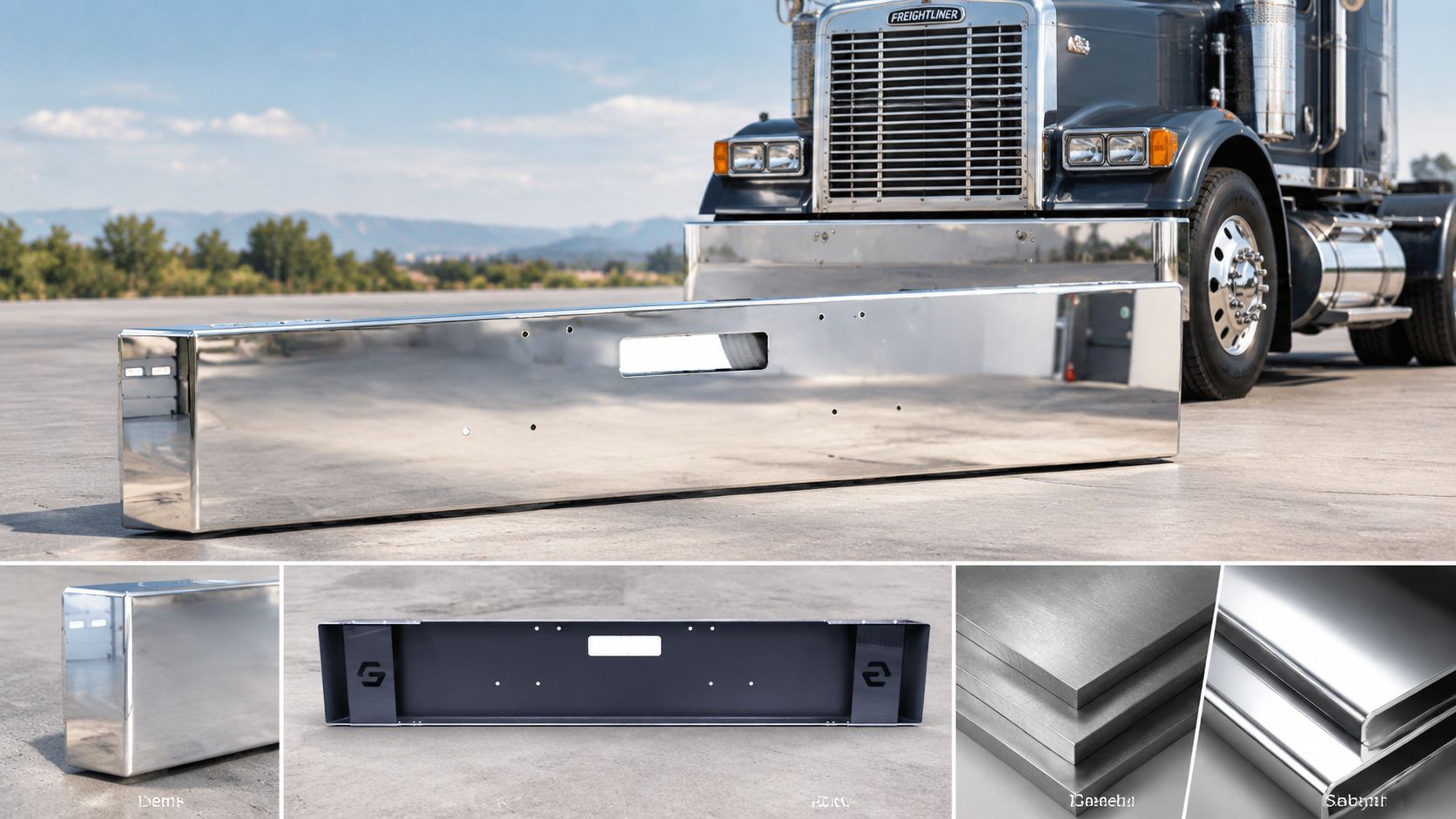
Why the grade changes the job
The chemistry controls what happens after the truck leaves the wash bay. Carbon steel depends heavily on its plating. 430 relies on its chromium film and keeps material cost down, while 304 combines chromium and nickel for better protection where salt and moisture remain on the surface.
This technical overview of 430 stainless steel explains why the grade appears in cost-conscious truck accessories. Use it for the right route, not as a universal substitute for 304.
The Chrome bumper for Freightliner Classic is made by Estañadora, owner of Galhor, Inc. The verified listing shows a $689.99 bumper with 100 configurable variants and in-stock availability. It uses 10-gauge chrome-plated steel, a mirror-polished finish, standard-mount or blind-mount configurations, configuration-based cutouts, and direct bolt-on installation for the Freightliner Classic without drilling or cutting. The chrome finish uses a triple-layer hexavalent chrome process with 35 microns of nickel. The bumper is sold individually with coverage for workmanship and material defects.
Stainless 304 vs Stainless 430 Head to Head
A truck running salted I-90 lanes needs a different bumper grade than a dry Southwest tractor. 304 stainless buys more corrosion margin. 430 stainless keeps the purchase price lower for mild routes. The choice also affects strength, magnetism, forming, and how the finish looks after repeated freight cycles.
| Property | 304 Stainless | 430 Stainless |
|---|---|---|
| Chromium content | About 18% | Roughly 16% to 18% |
| Nickel content | About 8% | No or negligible nickel |
| Corrosion resistance | Stronger in moist, acidic, and salt-prone service | Lower margin in chloride-rich and humid service |
| Typical tensile strength | Generally higher in comparable annealed conditions | Around 450 MPa |
| Typical yield strength | Generally higher in comparable annealed conditions | Around 205 MPa |
| Elongation | Generally more ductile | About 22% |
| Magnetism | Usually non-magnetic in annealed condition | Magnetic |
| Best fit | Salt lanes, coastal work, premium exterior builds | Dry routes, moderate climates, budget-conscious builds |
| Finish retention | Better resistance to staining and pitting | More likely to show tea-staining or surface rust in salt |
304's nickel content improves resistance to pitting near coastlines and on winter roads treated with salt. The Aoxing Metal comparison of 304 and 430 stainless supports the broader point: 304 offers substantially better protection in chloride and acidic service. Treat that as corrosion resistance, not a guarantee against staining or pits.
430 still earns its place on the right truck. Its ferritic structure makes it magnetic, which can help during installation when a shop sorts steel hardware or uses magnetic sweeps. It suits a dry Southwest tractor, a parade truck washed after use, or a budget build that stays off salted winter lanes. On those routes, paying for 304 may add cost without delivering a useful service-life gain.
The chloride question
Salt exposure changes the recommendation quickly. A British Stainless Steel Association salt-spray summary reports that 304 would not be expected to pass satisfactorily in a 3% salt spray, though it may be acceptable around a 0.3% salt solution for up to 120 hours. The same guidance describes 430 as poor in winter road-salt environments, with a greater tendency to pit or develop surface rust sooner than 304, as documented in this 430 stainless salt-spray reference.
For an I-90 truck, specify 304 and budget for regular rinsing. For mostly dry Texas, Arizona, or New Mexico work, 430 is a sensible value pick when the owner accepts closer finish inspection. Review this guide to 304 stainless steel plate material and fabrication choices before comparing thickness, bends, and mounting details rather than judging the product by grade alone.
How Each Metal Holds Up on Real Trucking Routes
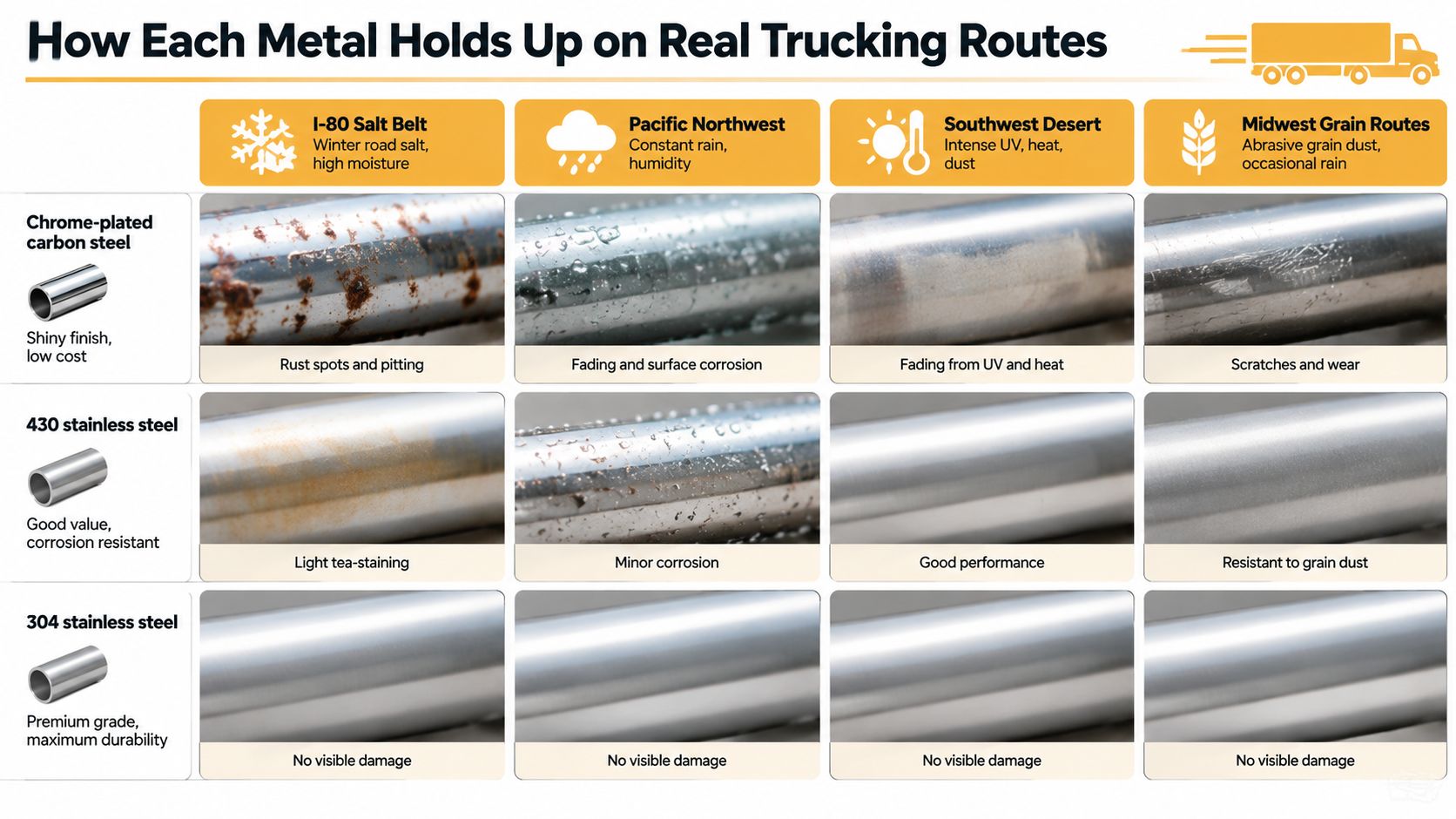
The same bumper can be a smart purchase in one region and a bad one in another. Route conditions decide how quickly salt, moisture, heat, dust, and scratches attack the finish.
On I-80 and I-90 winter lanes, chrome-plated carbon steel needs frequent washing because chips and scribe lines can expose the steel core. 430 may develop light tea-staining or pitting sooner in road salt. 304 gives the driver the largest corrosion margin, but it still needs a thorough rinse after brine exposure.
The Pacific Northwest brings a different problem. Constant rain and humidity keep contaminants wet against the bumper. Chrome can hold its shine when the plating remains intact, while 430 needs closer inspection around edges, brackets, and trapped moisture points. 304 is the better choice for a truck that spends long stretches wet and gets cleaned on a regular schedule.
Route decisions at the counter
Coastal freight around Houston, New Orleans, Charleston, or Atlantic ports adds salt air to the normal road film. That environment favors 304, especially when the truck carries a polished look and the owner wants fewer finish repairs. Chrome-plated carbon steel can still work, but damaged plating deserves immediate attention.
Desert routes from Phoenix to El Paso are easier on corrosion but harder on finish maintenance. UV, dust, heat, and thermal cycling can dull or scratch a surface, yet the lack of constant chloride exposure makes 430 a practical budget choice. Chrome remains attractive for a show-oriented truck if the owner keeps the surface clean and repairs plating damage promptly.
A simple rule works:
- Salt belt or coastal routes: Buy 304.
- Rain-heavy service: Favor 304, especially with trapped moisture around brackets.
- Dry Southwest routes: 430 can deliver good value.
- Show truck with careful upkeep: Chrome-plated carbon steel can make sense.
- Mixed national freight: Choose 304 if downtime and finish retention matter more than the initial premium.
Cost, Lead Time, and Lifecycle Value Compared
The cheapest bumper at checkout isn't always the cheapest bumper for the truck. A fair comparison includes the part, freight, installation time, cleaning, refinishing, replacement risk, and the revenue lost while the truck sits in a bay.
Public market forecasts show strong continuing demand for automotive stainless steel. One estimate places the global automotive stainless steel market at USD 126.6 billion in 2025, with a projection of USD 176.9 billion by 2035 and a 3.4% CAGR, according to Market.us automotive stainless steel data. Another estimate places the stainless steel automotive and general industrial products market at USD 46.28 billion in 2025, growing at 4.6% annually through its forecast period, according to Emergen Research's market analysis. Those figures describe market direction, not the price of your individual bumper, so don't use them as a substitute for a written quote.
| Cost Factor | Chrome-Plated Carbon Steel | Stainless 430 | Stainless 304 |
|---|---|---|---|
| Initial purchase | Often the budget-focused choice | Premium over basic carbon steel may be lower than 304 | Highest material tier in many builds |
| Salt-lane exposure | Plating damage can expose the steel core | More vulnerable to staining and pitting | Strongest choice for chloride-heavy service |
| Refinishing risk | Watch chips, scratches, and lifted plating | Polishing may not remove corrosion damage | Usually less frequent finish correction |
| Lead-time planning | Made-to-order units can require advance scheduling | In-stock configurations may move faster | In-stock configurations may move faster |
| Downtime impact | Replacement or repair can interrupt a load cycle | Better route fit reduces avoidable rework | Best fit when uptime and appearance carry high value |
| Lifecycle logic | Makes sense when budget and appearance lead | Makes sense on dry routes | Makes sense when corrosion risk is expensive |
A bumper's exact build matters, too. One truck-bumper industry document lists stainless thickness standards at 0.160 inch for a 25/75 ratio and 0.125 inch for a 32/68 ratio, showing that material name alone doesn't define durability. Confirm the actual thickness, mount style, cutouts, reinforcement, and cab fitment before comparing quotes. Review the truck bumper thickness reference with your installer.
Use your own payback math
Write down the bumper price, expected replacement or repair cost, installation labor, and the income lost during downtime. Then compare that total with the stainless premium.
A practical formula is:
Breakeven miles per dollar = added stainless cost divided by the miles you expect the stainless bumper to serve before replacement or major repair.
That won't predict an exact service life, but it forces the right question. If your truck runs salted lanes, carries high-visibility freight, and stays on the road for long freight cycles, 304 usually earns a stronger business case. If the tractor stays in dry country and the owner can clean it regularly, 430 or chrome may be the smarter spend.
Best Material Pick by Truck Model
Truck model matters because the bumper must fit the cab, frame, mounting pattern, grille profile, and selected cutouts. Route matters because the same Peterbilt or Kenworth can live in very different conditions.
Peterbilt 389 and 567
For a Peterbilt 389 bumper, choose 304 when the truck runs western lanes that include winter mountain passes, coastal freight, or long-term show-trim service. The classic hood and polished exterior put the bumper in a high-visibility position, so finish retention matters. Chrome-plated carbon steel works for a careful owner who washes often and wants the traditional mirror look, but 304 gives more room for road grime and salt exposure.
The Peterbilt 567 deserves the same route-based decision. Fleet trucks that spend most of their time dry and inland can use 430 to control upfront cost. A national operation that wants fewer corrosion-related replacements should standardize on 304 where the budget allows.
Kenworth W900 and T680
A Kenworth W900 chrome bumper is often part of the truck's identity, not just a collision part. For a dry-climate owner who keeps the truck polished, chrome-plated carbon steel or 430 can fit the build. For a W900 that crosses the northern tier, 304 is the better call because road salt attacks the finish while the truck is still earning.
The T680 usually works harder than it shows. Mixed regional freight, rain, winter exposure, and frequent wash cycles favor 304. A budget build that stays south can use 430, but don't select it for a salted route just because it carries the word stainless.
Freightliner Cascadia and Coronado
Cascadia and Coronado owners focused on mileage, resale, and fewer shop interruptions should choose 304. These trucks often spend long stretches moving freight across multiple states, so the buyer can't assume a dry route year-round. The extra corrosion margin supports a cleaner appearance and reduces the chance that a replacement bumper becomes an avoidable maintenance event.
Volvo VNL 760 and 860
The Volvo VNL 760 and 860 pair premium cab trim with a modern exterior. A polished 304 bumper matches that presentation and makes sense for owner-operators who want the truck to look cared for at every stop. Choose 430 when the truck stays in moderate, dry service and the initial material tier carries more weight than long-term finish retention.
My recommendation: If the truck crosses the country, sees winter salt, or must stay presentable for years, buy 304. If it stays dry, your budget is firm, and you'll maintain the finish, 430 can do the job.
Maintenance That Keeps Stainless and Chrome Looking New
A good bumper still needs a good wash routine. Road salt, dust, and brake residue sit in seams and around fasteners, where they can stain stainless or attack damaged chrome.
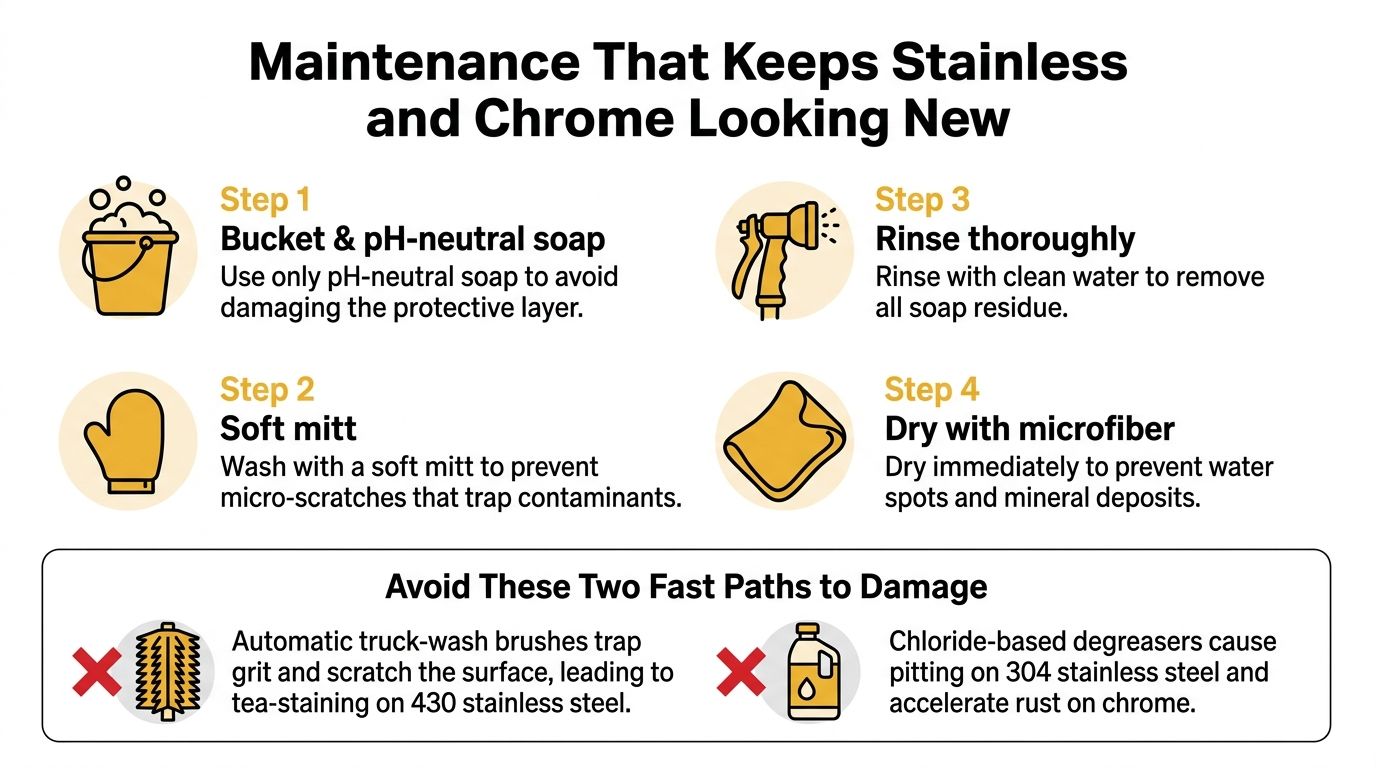
Start with a pre-rinse. Use clean water to knock off loose grit before a soft mitt touches the surface. Wash with a pH-neutral soap, rinse the full bumper and undercarriage, then dry with microfiber instead of letting mineral spots bake onto the finish.
Salt-season routine
During winter, pay attention to the back side of the bumper, mounting pockets, bracket seams, and the area behind the grille. Trapped moisture can remain after the visible face looks clean.
- Pre-rinse first: Remove loose salt and grit before wiping.
- Flush underneath: Direct clean water into the undercarriage and mounting areas.
- Dry the finish: Use microfiber to reduce water spots and residue.
- Inspect edges: Look for chips, scratches, staining, and contact with steel hardware.
- Protect the joints: Use nylon washers, isolating grommets, or suitable anti-seize where the installation allows.
Dissimilar-metal contact deserves attention. Stainless brackets touching steel bolts, aluminum steps, or raw steel hangers can create trouble when moisture and road chemicals stay trapped between them. The stainless part may be resistant, but the surrounding hardware and contact point can still corrode.
Polish without damaging the surface
Chrome benefits from a mild metal polish every 60 to 90 days, according to the care approach specified for this routine. Avoid abrasive compounds that thin or haze the plating. Stainless generally needs less polishing, but an occasional passivation rub can help remove light surface contamination when the product and finish allow it.
Automatic truck-wash brushes can hold grit and create micro-scratches. Chloride-based degreasers are also a bad choice, especially around 304, because they can promote pitting. Use the practical guide to polishing chrome bumpers before applying a product to a visible finish.
Store spare parts in a dry, protected area. Don't leave bug residue, brake dust, or wet road film sitting between washes, and touch up damaged chrome before moisture reaches the carbon-steel core.
Choosing Your Bumper and Getting It on the Truck
Start with fitment, not finish. Select the truck brand, model, year, bumper profile, cutouts, mount style, and bracket pattern before choosing chrome, 430 stainless, or 304 stainless. A polished bumper that doesn't match the cab or frame is still the wrong part.
Confirm the build
Use this order at the counter:
- Identify the truck: Peterbilt, Kenworth, Freightliner, or Volvo, then confirm the exact model and year.
- Choose the material: Chrome-plated carbon steel for traditional shine and budget control, 430 for dry-route value, or 304 for salt and coastal exposure.
- Select the finish: Polished, brushed, black, or the exact chrome treatment offered for the configuration.
- Verify thickness: Ask whether the quote specifies the actual gauge or millimeter thickness.
- Check mounting: Confirm standard mount, blind mount, bracket pattern, and included hardware.
- Review cutouts: Make sure fog-light, tow-hook, sensor, or other openings match the truck.
Lead time can vary by material, configuration, production schedule, freight class, and crating. Galhor's publisher information states that in-stock stainless 430 and 304 flat bumpers can ship within 48 hours, while made-to-order carbon-steel units typically ship in 4 to 6 weeks. Confirm current timing before scheduling a shop appointment, especially if the bumper is part of a collision repair or a tight freight cycle.
Inspect the crate and bumper when the LTL shipment arrives. Photograph visible damage before signing, compare the part with the order, and check the mounting pattern before removing the old bumper. The installer may supply tools, replacement fasteners, isolators, or special brackets unless the product listing specifically includes them.
Galhor Inc. supports U.S. orders from Magnolia, Texas, offers configurable direct bolt-on bumper options, and provides warranty coverage for manufacturing defects under its published policies. The decision rule stays simple: 304 for salt, coast, national freight, and long ownership; 430 for dry routes and controlled budgets; chrome-plated carbon steel for traditional shine when you'll protect the plating.
Galhor Inc. offers configurable chrome bumpers for Peterbilt, Kenworth, Freightliner, and Volvo trucks, with chrome-plated carbon steel, 430 stainless, and 304 stainless options. Visit Galhor Inc. to confirm your fitment, choose the material and finish, and order a bumper built for your route.