
Truck Rust Prevention for Working Class 8 Trucks
November 12, 2026 · Francisco Hornelas

You just shut the truck down after a treated interstate. The face of the bumper still looks clean. Brine is sitting in the lower lip, the tow-hook pockets, and the bolt holes. That is the spot that fails first on a Peterbilt, Kenworth, Freightliner, or International, not the mirror in the middle.
Truck rust prevention is the habit that gets chloride off the steel before the next load. Chrome and stainless slow rust. They do not cancel salt trapped behind the bumper. Liquid brine sticks in crevices and keeps the mount wet long after the face looks ready for a photo.
I would start with the rinse you can do today, then pick steel for the miles you run. Shine comes last.
Table of Contents
- Salt and Brine Wash Timing by Route
- How to Rinse a Bumper After Salt
- Where to Inspect and When to Repair
- Storage and Season Habits That Stop Rust
- Pick Bumper Steel for Your Routes
- Truck Bumper Rust FAQs
Salt and Brine Wash Timing by Route
A truck can leave a treated interstate with a clean-looking bumper and still carry brine behind the mounts. Set wash timing by route exposure, then check the spots where runoff collects.
| Route exposure | Wash timing | Rinse these spots | Inspect for |
|---|---|---|---|
| Snow-belt rock salt or liquid brine | Same day after exposure, weekly minimum while salting | Bumper lip, seams, brackets, frame rails, fasteners | Chips, red rust at mounts, packed white salt |
| Coastal or port air | After each salty run | Face, underside, hardware, drain paths | Pits, discoloration, crust at bolts |
| Dry inland lanes | Monthly, plus after mud or chemical splash | Lower edge and wheel-splash zone | Stone chips down to bare steel |
| Fresh chip or bumper impact | Same day, before next dispatch | Damaged face, cutouts, bent areas | Bare metal, cracked mounts, loose bolts |
| Spring after the last salt storm | One full underbody flush | Winter pockets and drain holes | Hidden scale before summer heat |
Why wet salt keeps working
Rust needs chloride, water, and oxygen. When salty water stays in a seam, corrosion can continue between storms. The bumper face may still shine while the mounts stay wet.
The Federal Highway Administration deicer manual identifies sodium chloride as the most widely used chemical deicer and explains that salt can enter materials through roadway runoff. A truck bumper takes that runoff as spray along the road.
Liquid brine can cling in laps and around fasteners after the visible film dries. Use the route table to set the wash schedule: same-day rinsing after brine exposure, regular cleaning while roads are being salted, and a full underbody flush after the final salt storm. Coastal work calls for rinsing after salty runs; dry inland routes need attention after mud or chemical splash.
A fresh chip or impact needs attention before the next dispatch. Check for exposed steel, damaged mounts, and loose bolts. Keep a simple log of the date, route, and any bright chips so the next inspection has a clear starting point.
How to Rinse a Bumper After Salt
This is a bay job you can finish at a truck stop or the shop. Match the timing to the route. Same day after brine. Weekly minimum while the salt belt is active. Do not seal anything until the metal is dry.
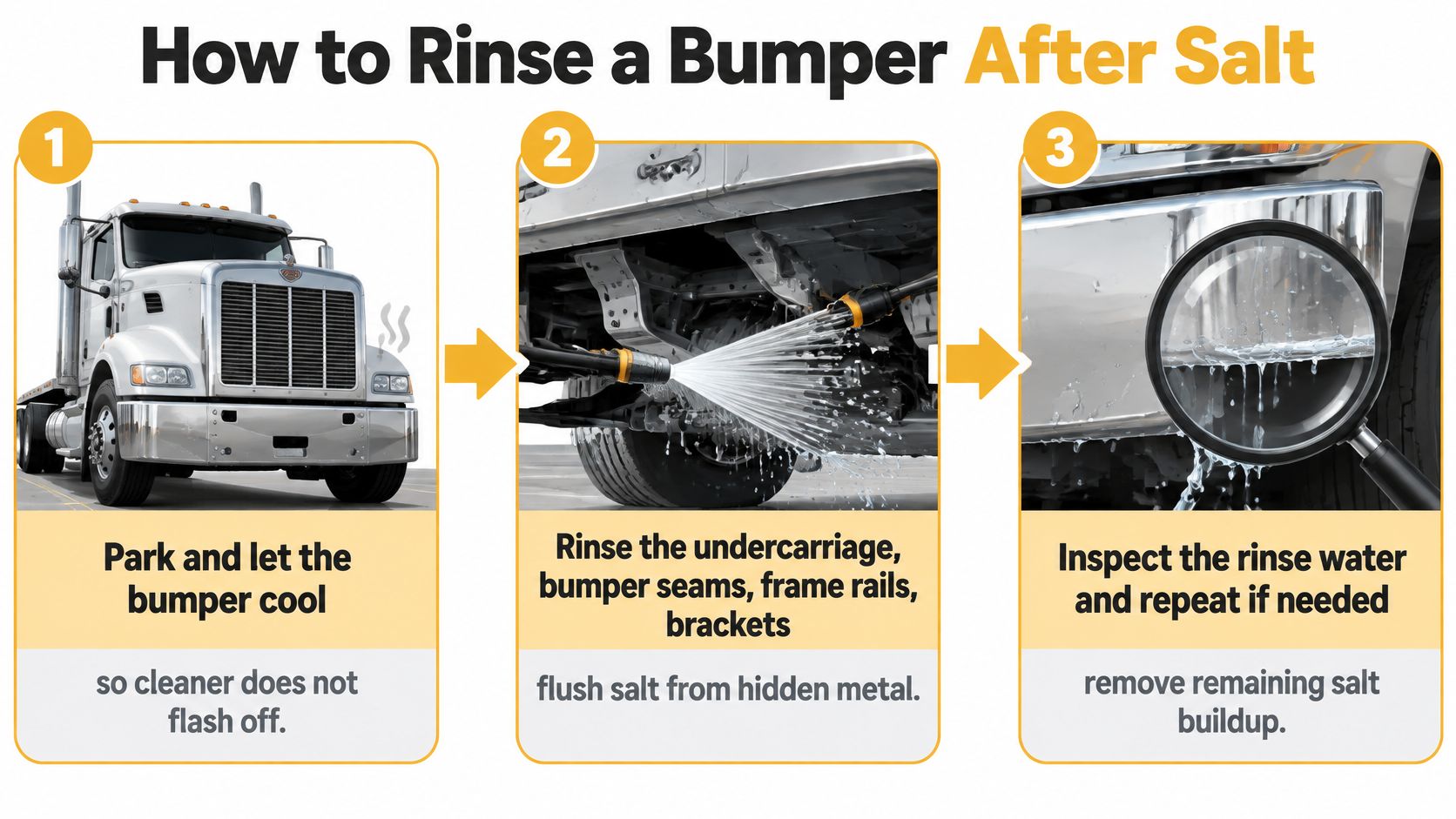
The U.S. Army corrosion-control guide recommends washing equipment daily with fresh water where salt is used for snow and ice control or where airborne salt is high. The same guidance treats weekly cleaning as critical during winter operations. One review it cites attributes about 50% of vehicle corrosion in snow-impacted regions to road salt. For a working truck, daily is the call when you live in brine. Weekly is the floor, not the goal.
The bay sequence
- Park and let the bumper cool. Hot chrome makes cleaner flash off before it loosens film. Give it a few minutes after shutdown.
- Rinse with low-pressure fresh water. Hit the undercarriage, bumper seams, frame rails, brackets, fasteners, drain holes, and rear-facing cavities. You want chloride moving out, not packed deeper.
- Brush the packed spots. Brine dries hard in laps and behind the bumper. A nylon brush and a little agitation beat a harder blast. More pressure is not better. A hard jet can drive salt into crevices, connectors, seals, bearings, and under chrome edges.
- Wash with a truck-safe detergent. Household dish soap strips wax and protective film. That film is part of the defense on plated steel. Skip it.
- Rinse again until the runoff is clear. Milky water means salt is still leaving. Keep going.
- Let it drain and dry. Do not wipe wax, oil, or cavity spray onto wet steel. Sealing wet salt makes a pocket that keeps corroding between storms.
- Film only dry steel. On bare spots and enclosed cavities, wipe a corrosion-inhibiting product made for that metal. If water is still beading in a pocket, wait.
A hard blast feels productive. It often hides the salt you meant to remove.
Retained chloride stays an electrolyte. Coating thickness does not save a lap joint that never got flushed. That is also why chrome plating corrosion resistance still depends on what you leave behind the plate.
Write four things before you leave the bay: wash date, route exposure, any coating damage, and the next treatment date. Spring still gets one full underbody flush after the last salt storm, even if the face already looks bright.
Where to Inspect and When to Repair
Dirt hides breakdown. This pass starts only on a clean, dry bumper. Yard light at noon will lie to you. Use a strong side light and look along the surface, not straight at it.
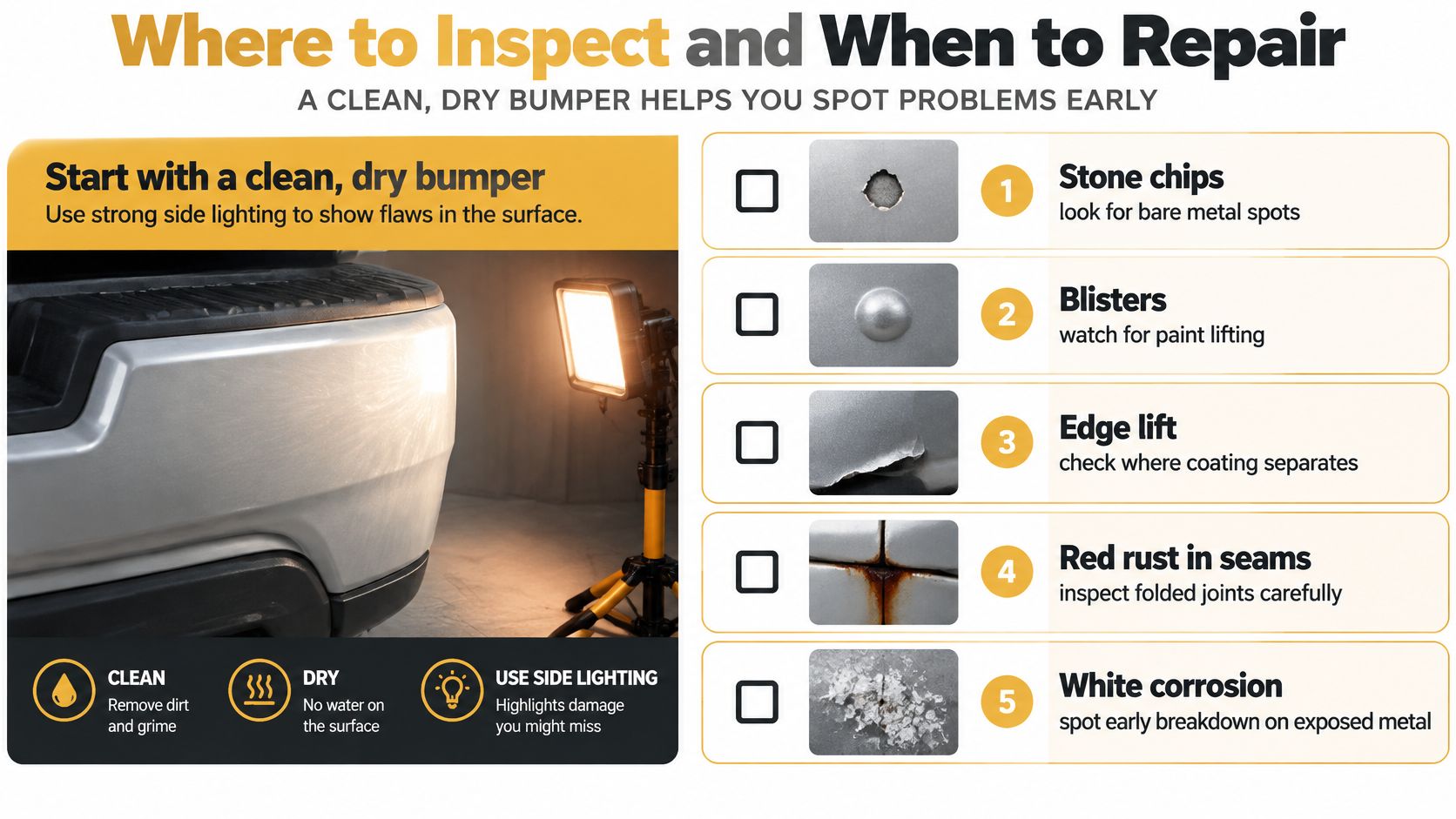
Army corrosion-control practice is clean first, inspect second, and preserve third, because dirt and electrolyte residues conceal coating breakdown. The Army inspection and preservation manual calls for strong oblique light on chrome and paint. An FHWA study it cites estimated U.S. motor-vehicle corrosion costs at $23.4 billion in 1999 dollars, covering repairs, maintenance, protection materials, and depreciation. A small chip fixed today is cheaper than a mount that fails on a loaded Friday.
What the side light should find
- Stone chips: Bare metal in the face or the lower edge. Mark every one.
- Blisters: Paint or plate lifting in a bubble. Water is already under it.
- Edge lift: Coating peeling at a cut line or a return flange.
- Red rust in seams: Orange at a lap, not just road dust.
- White crust: Powder where two metals touch, often at a bracket or a bolt.
Check the bumper-to-bracket joint and every fastener hole on their own. The wide face can stay mirror bright while crevice rust eats the mount. That bright lip with rusted bolts is not a healthy bumper.
Fix it the same day when
Trigger work now for any chip to bare steel, a crack around a mount, a hole through the metal, or a bolt that no longer bites. Waiting for a full bumper swap turns a chip into a missed load.
Scrape loose rust back to sound metal. Use a method that does not grind grit into the steel. Dry the spot completely. Do not wax, oil, or paint over trapped salt or moisture. Repair with a system that matches the metal and the top coat. Cavity film goes on only after water has drained. Old temporary preservative has to come off and go back on, or it stops protecting.
After a hit, recheck brackets, cutouts, and drain paths even when the replacement face looks new. Fold this pass into your truck maintenance checklist so it happens at every service interval, not only when someone complains about shine.
Storage and Season Habits That Stop Rust
A roof over the truck does nothing if salt stays on the steel. Covered and salty still rusts. Dry and drained does not.
The FHWA chloride corrosion report points to marine air and deicing salts carried by water as common chloride sources. That is why a Peterbilt 389 bumper or a Kenworth W900 chrome bumper can pit in a shed. The salt rode in with the truck. Galvanic attack speeds up where bumper hardware and brackets are different metals and moisture bridges them.
Before a long sit, confirm bumper and frame drain holes are open. Melt water should leave, not pool behind an 18 inch drop bumper. Grease bracket contact points and bolts so water cannot sit in that joint.
Summer is not a free pass. Bug film and fertilizer dust hold moisture the same way winter brine does. Wash them off before a hot week in the yard.
Season checklist
- Before winter. Confirm drain paths are open, chips are repaired, and cavity film is renewed on dry metal.
- Before a long sit. Rinse, then let the bumper dry on a short highway run or under a shop fan. Do not roll a wet, salty front clip into a closed bay.
- Before summer. Wash off bugs and fertilizer dust so they do not hold dew against the plate.
Fleet rule: a supervisor spot-checks two trucks a week. A binder nobody opens is not a program. Owner-operator rule: send a Friday phone photo of the lower lip and the mounts through salt season. You will see scale start before a customer does.
Dry and drained beats covered and salty.
Pick Bumper Steel for Your Routes
A truck can come off a salt road with a bright bumper face and brine packed behind its mounts. Choose steel for the route, then inspect the places where salt stays trapped. Chrome and stainless slow corrosion. Neither stops crevice rust at a wet bracket.
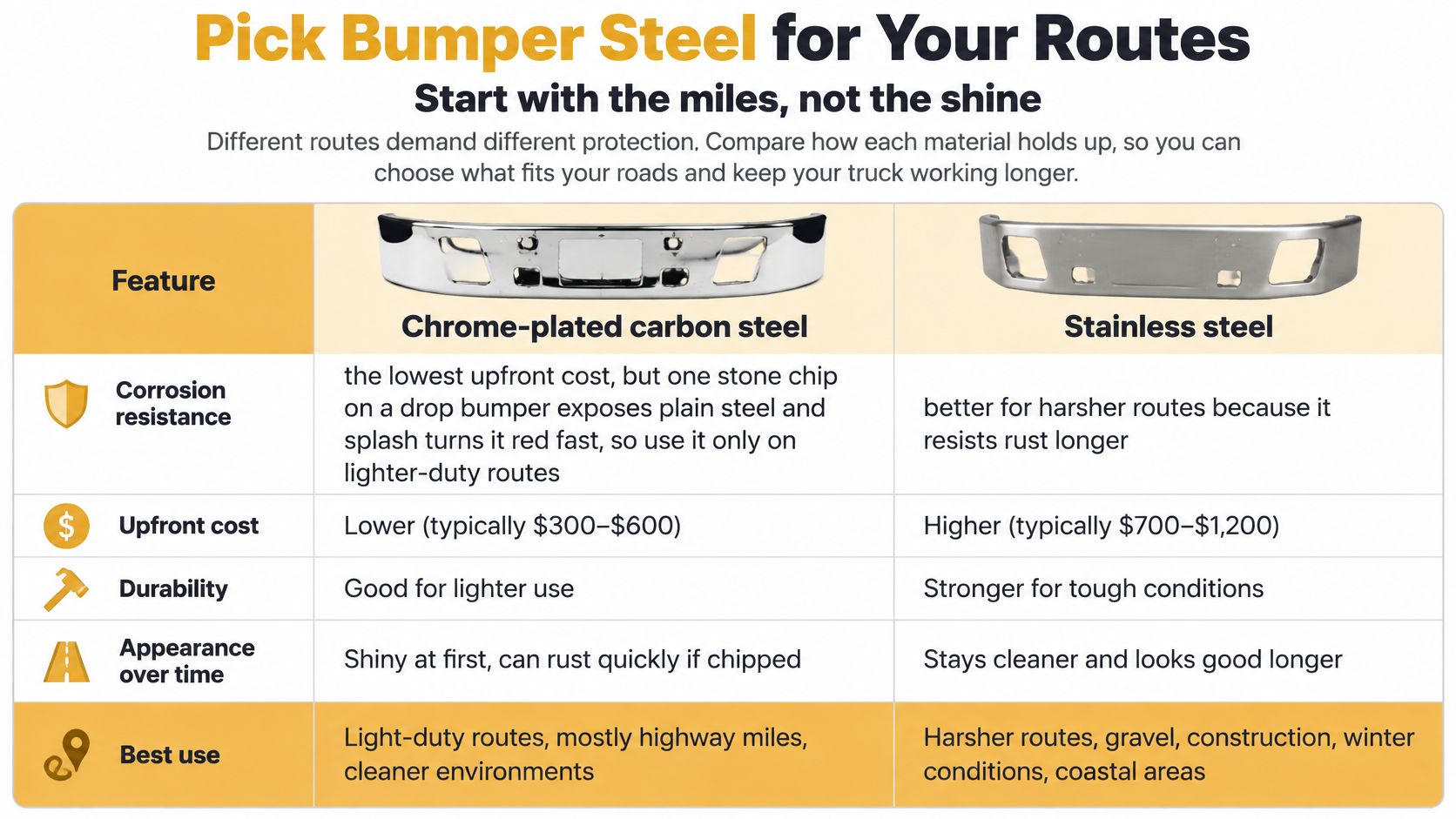
| Material | Salt resistance | Thickness | How it fails | Best fit |
|---|---|---|---|---|
| Chrome-plated carbon steel | Very low | 10-gauge | A chip exposes steel to red rust | Lowest upfront cost; mild, dry routes with prompt chip repair |
| Chrome over 430 stainless | Corrosion-resistant | 11-gauge option | Chloride trapped at mounts can cause pitting | Mixed routes with regular rinsing |
| Chrome over 304 stainless | Higher salt tolerance | Heavier gauge | Local pitting and stress cracking can occur at welds and fasteners | Salt-belt and coastal rigs |
| Paint or underbody film alone | Depends on intact film | Not applicable | Chips and missed wash zones expose the surface | Frame and wheel wells, alongside rinsing |
Match the tier to the lane
Chrome-plated carbon steel is Galhor's Work Truck Line: the lowest upfront cost, very low corrosion resistance, a short lifespan, and a 2-year warranty. A chip can expose the steel underneath, so this tier suits milder, drier routes where damage gets prompt attention.
Chrome over 430 stainless offers a corrosion-resistant alloy, mirror-polished finish, triple-layer chrome, and direct bolt-on fit with no drilling. It is a middle ground for mixed routes, provided salt is rinsed away instead of left packed around the mounts. Compare 430 and 304 stainless steel before choosing between the two.
Chrome over 304 stainless is the more salt-tolerant choice for coastal and salt-belt work. Its higher nickel content, heavier-gauge steel, and deeper chrome saturation suit rigs that see frequent chloride exposure. The Premium 304 bumper carries a 5-year warranty, but trapped brine can still attack crevices.
Localized corrosion can develop where chloride collects. Stress near welds and fasteners can also leave those areas vulnerable to cracking. Inspect welded corners, mounting holes, cutouts, brackets, and bolts, not just the polished face. Paint and underbody film can protect frame areas while intact, but they do not replace rinsing.
Order for the truck you run
Confirm fit by truck brand, model, year, and bumper width before you buy, since Galhor offers chrome bumpers for Freightliner, Kenworth, Peterbilt, and Volvo trucks with U.S.-sourced steel and processes every order from Magnolia, Texas. Galhor's bumpers are manufactured in Mexico. In-stock 430 and 304 flat bumpers ship within 48 hours across the United States. Made-to-order carbon chrome takes 4 to 6 weeks.
Pick the steel for the salt your truck sees and the upkeep your crew can sustain. Even the more corrosion-resistant option needs clean, dry mounts to last.
Truck Bumper Rust FAQs
Is stainless steel rust proof?
No. Type 304 resists chloride better than lower-grade stainless, but it can still pit where salt concentrates and crack near welds and fasteners. It still needs a rinse and a side-light check after winter or coastal miles.
Can I use dish soap on a bumper?
No. Dish soap strips wax and protective film. Use a truck-safe detergent and rinse until the runoff is clear. Then let the steel dry before any film goes back on.
How do I know which bumper fits my truck?
Match the model, the year, and the bumper width and drop height to the part spec sheet before you order. A direct bolt-on should not need drilling. If the sheet does not list your truck, do not guess.
How fast does an order ship?
In-stock 430 and 304 flat bumpers ship within 48 hours across the United States. Made-to-order carbon chrome takes 4 to 6 weeks. Stock flats are cut to your spec before they leave.
Can I fix a chip myself?
Yes, if you clean it, scrape loose rust to sound metal, dry the spot completely, and use a repair system that matches the metal and the top coat. Call a shop if the chip is near a mount or the bolts no longer hold. A loose mount is a downtime problem, not a polish problem.
Galhor Inc. builds chrome bumpers for working Class 8 trucks, in carbon, 430, and 304, so the steel matches snow-belt, coastal, or dry-lane miles. A bumper that fits, drains, and holds chrome cuts the replacements that steal uptime. Visit Galhor Inc. and order the bumper for your truck today.