
Volvo Bumper Guard Comparison for U.S. Trucks
November 2, 2026 · Francisco Hornelas

Buy the thickest, heaviest bar you can find. That's the advice most drivers hear at the chrome counter. It's wrong for a modern Volvo.
A Volvo bumper guard that blocks radar, sticks past the nose, or hides a cracked mount isn't safer. It's a roadside problem, a sensor problem, and a repair bill waiting to happen. The right guard fits your exact chassis and year, clears your lights and collision system, and stays tight on its brackets. Steel comes after those checks, not before them.
Table of Contents
- Volvo Bumper Guard Types Side by Side
- Fitment Sensors and Legal Checks
- Steel Gauge Finish and Salt Life
- Fleet and Owner-Operator Buying Calls
- How to Install a Volvo Bumper Guard
- Order a Bolt-On That Matches the Truck
Volvo Bumper Guard Types Side by Side
A dock tap leaves the grille looking clean and the tube slightly bent. The radar behind that steel still has to see the road, and the brackets still have to sit square. That small hit explains why style comes before shine.
On a U.S. Class 8 Volvo, a Volvo bumper guard is either a tube guard that runs over the grille and headlights or a full replacement bumper that takes the place of the factory piece. Those two forms set the fitment, sensor clearance, and legal checks. Pick the job first, then pick the finish.
Volvo bumper guard styles compared
| Style | Build | Best job |
|---|---|---|
| Polished stainless tube guard | Stainless tube with a polished finish | Grille and headlight cover on selected VNL, VNM, VNX, and VT trucks |
| Hinged brush guard | Reinforced uprights and anti-rattle pivots | Highway tractors that need less rattle and front service access |
| Low-profile tube guard | Tube guard with rubber faces and short uprights | Trucks that still need under-hood access |
| Chrome replacement bumper | Plated steel replacement face | Dock rash, tow holes, and a mirror face |
| Moose or wildlife bar | Headlight tubes plus a front guard | Northern routes only when the listing keeps radar clear |
What the published numbers tell you
The Lippert Retrac Tuff Guard II listing shows a guard with 3-inch-diameter, 14-gauge stainless-steel tubing that weighs about 110 pounds and ships at 95 inches long by 32 inches wide by 12 inches high for selected Volvo VNL, VNM, VNX, and VT applications. That weight is enough to plan a two-person lift or a jack, and to add that mass to the steer axle math.
It does not give you a crash score. 14-gauge is a lighter wall than 8-gauge tube, but gauge alone does not prove energy absorption or frame-load limits. Treat gauge as a size clue. Check the uprights, mounting plates, welds, and brackets as one system.
A heavier Volvo guard is not the safer buy if it blocks collision sensors, hangs past the nose, or gets straightened where Volvo says that area should be replaced. A clear sensor window, square brackets, and a fit for your year beat extra pounds every time.
Match the row to your week
A hinged brush guard suits a highway tractor. The pivot helps with service access. Anti-rattle hardware cuts noise and movement on long runs. A low-profile guard suits a truck where techs open the hood often and cannot fight a tall bar.
A chrome replacement bumper suits dock rash and looks. You get a finished face, tow holes where you spec them, and a clean front at the fuel island. For price context, 4 State Trucks listed a 16-inch chrome taper-rolled-end bumper with tow and vent holes for the Volvo VHD at $529.99 in 2026. Put that number next to a bent-bar repair and bay time before you decide to patch an old face.
A moose bar belongs on northern wildlife routes only when the listing keeps the radar window open. If it does not say that, do not guess.
Lock one row to your model year before you compare polish. A polished guard on the wrong nose is just expensive scrap with good shine.
Fitment Sensors and Legal Checks
A 2004 VNL and a 2018 VNL share a badge and almost nothing else up front. A bumper shaped for the VNL from 2004 through 2017 won't follow the nose of a 2018-and-up VNL or VNX, even when the width looks close in a photo. Fitment starts at the chassis. Order by generation first, then confirm the year, the cab, and the tow openings.
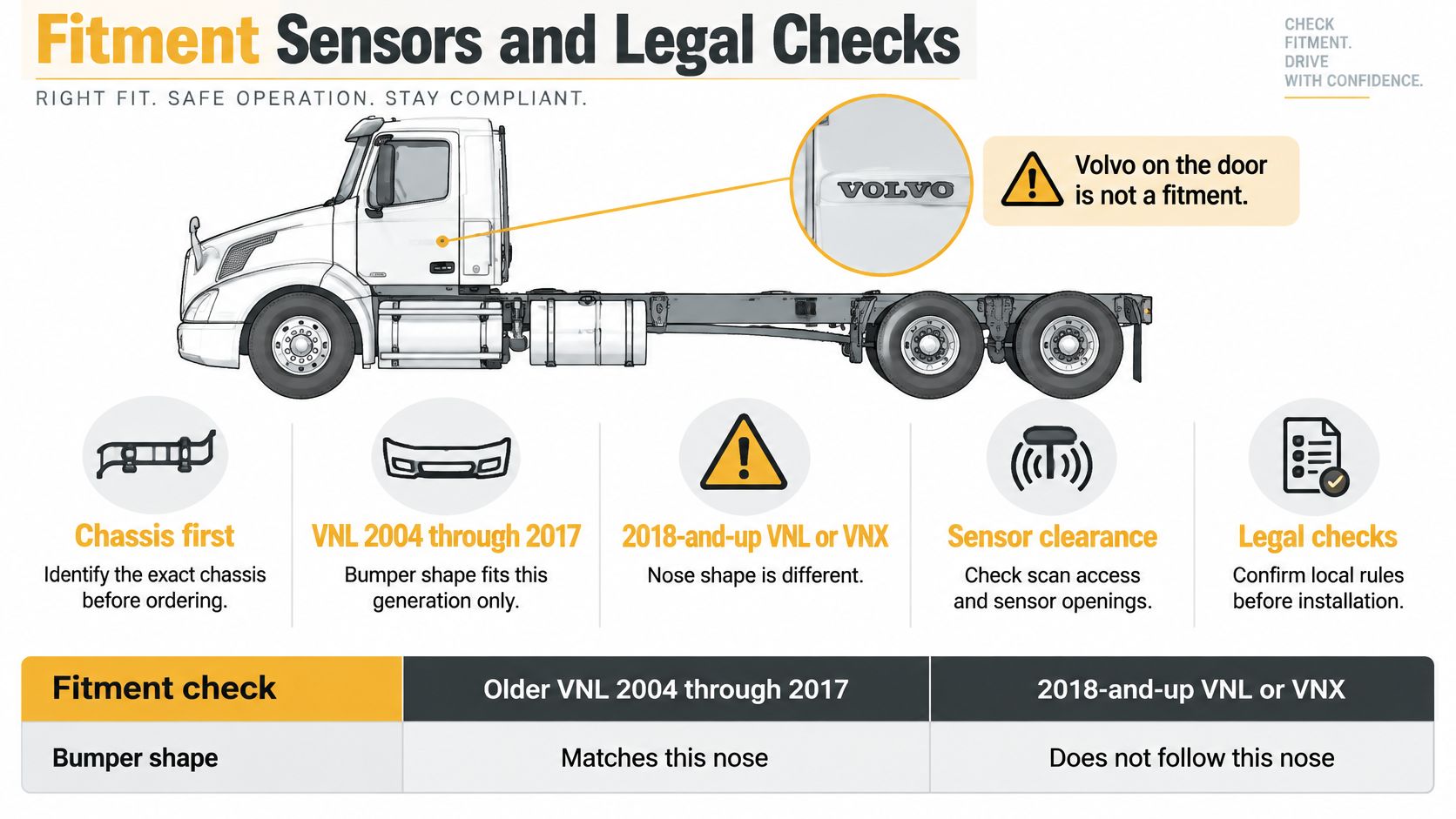
Volvo guard fitment by chassis and year
| Chassis and years | Front-end type | Guard approach | Check before ordering |
|---|---|---|---|
| Volvo VNL 2004-2017 | Pre-2018 nose | Tube guard or chrome bumper for that nose | Model year, cab, tow openings |
| Volvo VNL and VNX 2018 and up | Newer front with radar and OEM collision-avoidance | Brush guard or radar-compliant moose bar | Radar, camera, factory driving lights |
| Volvo VNM and VT | Listed years only | Tube guard only where the listing names the year | Confirm year against the listing |
| Volvo VHD | Vocational nose | Shorter chrome bar with tow and vent holes | Tow and vent hole placement |
Run the order sheet before you pay
Get these answers in writing. A photo of a similar truck is not an answer.
- VIN on hand: give it to the seller if the shop pulls OEM procedures and bracket specs from it.
- Radar or camera, yes or no: note what sits behind the grille, in the emblem area, and in the bumper face.
- Factory driving lights: confirm the guard's tubes and cutouts clear them.
- Tow openings: check left, right, or center placement against your frame.
- Fog and light cutouts: match count, size, and spacing to your truck, not the catalog truck.
- Ground clearance: measure at ride height, then check dock plates and steep lot entries on your routes.
Volvo's own listings show the standard to hold. Volvo Trucks cab and body accessories lists a 2018 VNL/VNX brush guard as compatible with original-equipment driving lights and compliant with the OEM collision-avoidance system, and a 2018 VNL 700/800 radar-compliant moose bumper with 3-inch outside-diameter headlight-protection tubing on a heavy-duty steel mounting assembly. That wording is the spec to demand. If an aftermarket listing won't state OEM-system compatibility for your year, treat it as unproven.
Bolt-on does not mean sensor-safe
Newer Volvo trucks can place parking sensors and, on later models, a 360-degree camera in or near the front emblem and bumper area. The I-CAR Volvo ADAS information summary states that Volvo ADAS information is vehicle-specific and recommends using the vehicle identification number when accessing OEM procedures. Read that plainly. Calibration need depends on your model year, your installed system, and what got moved or damaged. You can't infer it from the bumper alone.
Brackets, tube placement, finish, and install tolerance can all narrow a sensor view. A solid crossbar in the wrong spot can block radar while the grille looks protected. Older trucks with limited bumper electronics carry less of this risk. Newer trucks don't get that pass.
After install, verify sensor views, check for diagnostic trouble codes, and confirm OEM clearances before the truck goes back in service. If the OEM procedure for that VIN calls for a scan or calibration, do it. If the dash throws a collision-warning fault, don't clear it and dispatch the load. Find the blockage or misalignment first. Our explainer on bumper safety standards covers how front-end rules and equipment checks fit together.
Shop rule: A stronger bumper can create a safety problem if it protects sheet metal while degrading collision warning or parking functions.
Legal and weight checks you can't skip
Under 49 CFR 393.203, a front bumper may not be missing, loosely attached, or protrude beyond the vehicle in a way that creates a hazard. That rule covers your guard choice. A bar that sticks out past the outer profile, a loose bracket, or a sharp bent edge can fail a roadside inspection even if the steel is thick.
Check bolt condition, bracket alignment, and clearance around headlights and grille parts. Tug the bar. It shouldn't shift. Look for cracked welds and oval bolt holes. Those are failures waiting for vibration to finish them.
Mass belongs in the same check. The tube guards in the comparison table run close to 100 lb, all of it carried ahead of the steer axle. Scale the front empty before you bolt one on, then hold the number against your axle rating and tire load limits.
A direct-fit bracket made for your chassis beats a universal bar that needs new holes. Crooked steel blocks lights and sensors and can push the assembly outside the legal profile. Buy the mount as carefully as you buy the tube.
Steel Gauge Finish and Salt Life
A mirror face is not salt protection. The metal under the chrome decides whether a stone chip stays a chip or starts a rust bloom. Three bumper metals show up in U.S. shops, and the label alone does not tell you which one belongs on a winter brine truck.
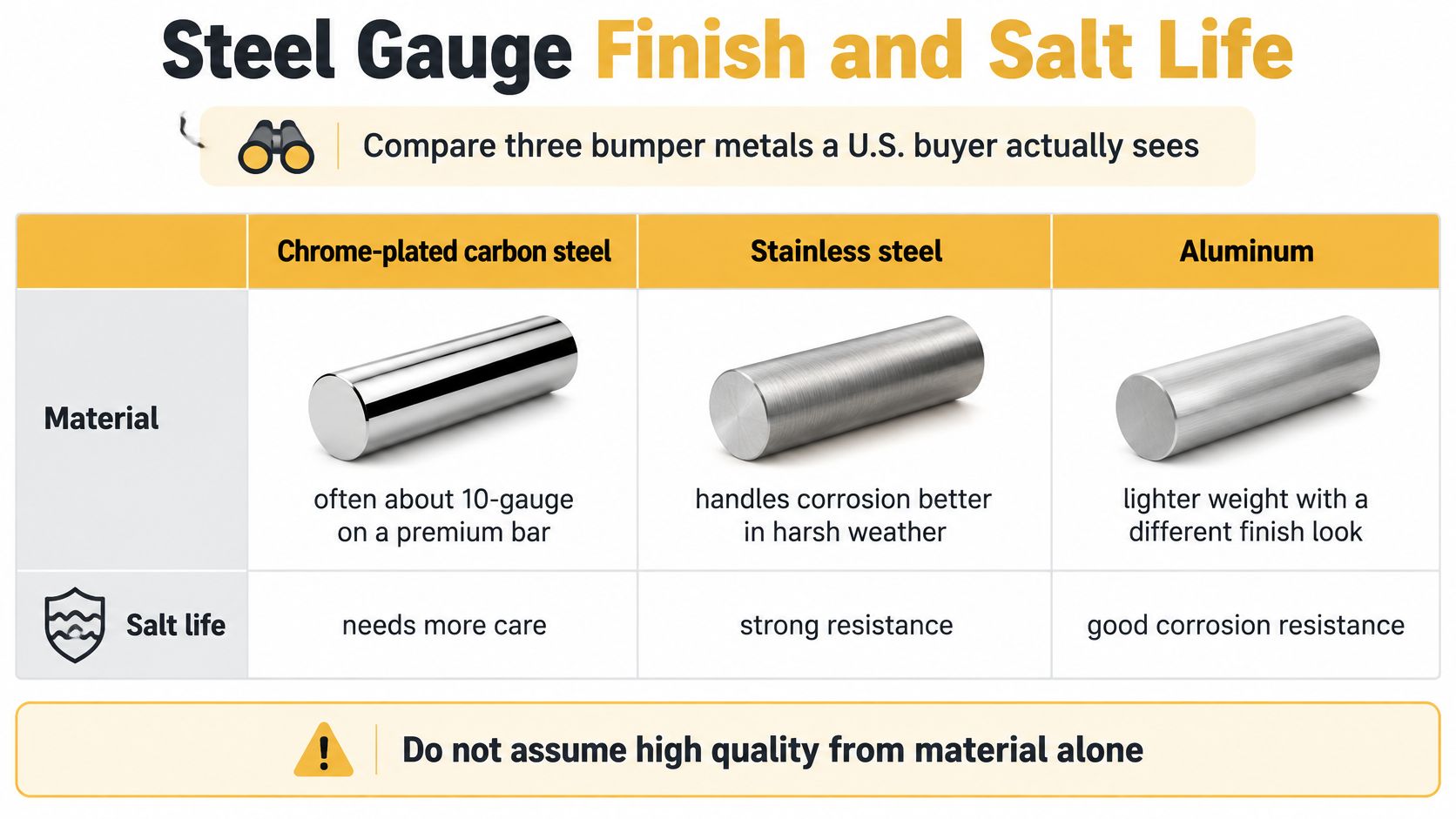
Bumper metals for U.S. Volvo trucks
| Material | Typical build | When the plate gets chipped | Who should choose it |
|---|---|---|---|
| Chrome-plated steel | Chrome plate over steel, triple-layer finish with 35µm nickel | Steel under the chrome can rust where the plate is cut | Owner-operators who wash the truck and want a mirror face |
| Chrome-plated 430 stainless | 430 stainless under chrome, 4-year warranty | Stainless under the chrome slows rust | Rust-belt fleets that need shine and fewer replacements |
| Chrome-plated 304 stainless | 304 stainless under chrome, 5-year warranty | Best salt resistance of the three | Coastal routes and trucks that sit in winter brine |
What gauge really means at the counter
Galhor lists its chrome bumpers as 10-gauge chrome-plated steel with a triple-layer finish and 35µm nickel. That is a stout sheet at the counter. The wider market is not uniform. In 2026, 4 State Trucks listed Volvo bumpers with steel thicknesses from 16-gauge to 14-gauge and common bumper weights from 85 to 150 pounds. Use those numbers when a listing hides thickness and sells only shine.
Ask for the gauge in writing. Ask what is under the chrome. Ask for the shipping weight. If a seller will not answer those three, keep shopping.
Thicker is not free. A 10-gauge face takes dock taps better than the 14- to 16-gauge bars in the wider market, but it makes the bumper heavier to hang and harder to handle alone. Match the face to how the truck works, not to the lowest gauge number on the page.
Chips, salt, and the metal underneath
Chrome-plated steel gives the deepest mirror when the plate is intact. It also gives rust a path once gravel cuts through. The steel under the chrome has no stainless protection. Touch up chips fast, wash salt off, and it can still be the right face for a washed show truck or a dry-region tractor.
Chrome over 430 stainless costs more and keeps the face alive longer after stone chips. The 430 under the plate resists rust better, so a chip does not bloom the same way. For most rust-belt fleets that still want a mirror, I would start here. The grade-by-grade breakdown in stainless 430 vs 304 helps if you are speccing a multi-truck order.
Chrome over 304 stainless is the salt-belt and coastal pick. It is the most corrosion-resistant of the three and the one worth specifying when the truck lives in winter brine, port air, or chemical plants. You pay more up front. You replace it less.
A plain polished stainless tube guard is a different product. It has no chrome layer to peel, which suits work trucks and gravel yards. It will not give you a smooth mirror bumper face. Do not buy one expecting the other look.
Finish and cutouts
Spec the face for how the truck works. Mirror chrome suits a clean highway tractor. Polished stainless suits a tube guard that gets pressure washed and sent back out. Then lock the cutouts: tow holes, fog holes, and light openings placed for your chassis. A pretty bumper with the tow hole in the wrong spot fails on the first bad night.
A wash routine matters as much as grade. Road brine sits in the seam behind the face and around brackets. Rinse that area, not just the mirror side. A mirror face with salt trapped behind it will not stay a mirror.
Fleet and Owner-Operator Buying Calls
A two-truck owner running a 2012 VNL and a 40-unit fleet with a split nose count don't need the same bar. Buy for your week.
Single tractor, sleeping at truck stops five nights out: the mirror face matters at the fuel island, the tow hole has to be reachable in the dark, and the bumper has to bolt to that exact model year without a drill coming out in a parking lot. Appearance and a correct bolt-on beat a shared parts bin every time.
Fleet: split the spec by front-end generation. The 2004-2017 VNL takes one guard. The 2018-and-up nose with radar takes another, and the listing has to state that the sensor stays clear. Standardize inside a generation, never across both. Anti-rattle hardware pays on trucks headed for a million miles, because loose steel wears brackets until a driver pulls the guard off. For the full cost picture beyond purchase price, our guide to total cost of ownership lays out replacement, downtime, and labor in one view.
Yard and gravel trucks should pick a tube guard that takes hits away from the lights. Show trucks should pick a chrome replacement with the right cutouts and a wash routine behind it.
When a bent bar should not get straightened
Shops lose money and create risk here. A bar gets bent at a dock. Someone heats it, pulls it straight, and sends the truck out. The face looks fine. The mounts may not be.
Volvo collision guidance in the I-CAR summary of Volvo position statements states that bumper repairs may affect properties associated with legal bumper requirements and electronic systems connected to the bumper, and that components with holes or cracks in specified areas should be replaced rather than repaired. The same summary notes that damaged, worn, or deformed collision hardware should be replaced with genuine replacement hardware.
Read that as a foreman. A small bend can hide shifted mounting geometry. It can hide a camera that still looks aimed but isn't. It can leave fasteners stretched or brackets cracked at the frame interface. Welding over that doesn't restore the original behavior, and a heavier-looking bar that sits past the truck's original profile still fails a roadside check.
Document the hit with photos, inspect brackets at the frame interface, and run the sensor and camera checks from the fitment walk-through before the truck leaves the bay. Verify fastener condition. Read the Volvo body-builder or service instructions for that truck before anyone heats, drills, welds, or plates over a crack. If the damaged area falls under a replace instruction, replace it. Predictable deformation, correct mounting, legal clearance, and working electronics matter more than a straight-looking face.
Don't weld first and ask later. On a Volvo front end, the repair decision is a safety and legal decision, not just a bodywork decision.
Three one-line picks
- Salt-belt fleet: 304 chrome bolt-on specced for that exact year, not a universal bar.
- Single show truck: Mirror chrome replacement with the right tow, fog, and light cutouts.
- Wildlife or radar truck: Only a guard whose listing says the sensor stays clear.
How to Install a Volvo Bumper Guard
Book the bay before you pick up a wrench. In 2026, PartStop stated that semi-truck bumpers generally require 6-10 fasteners for removal and typically take one to two hours to replace with hand tools. That's hand-tool time only. It doesn't include a sensor scan, rusted hardware, or fixing a bent bracket you find underneath.
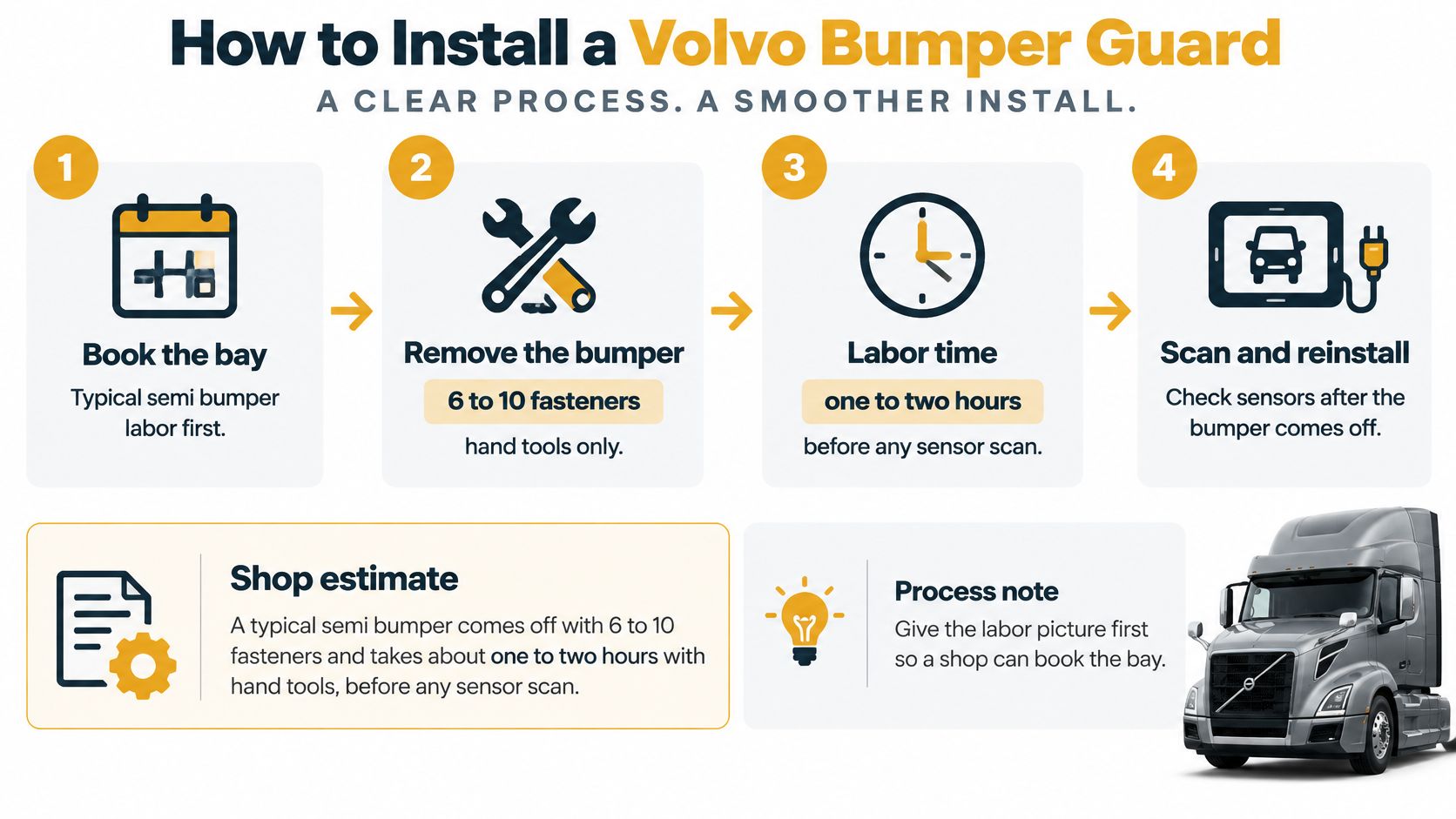
A guard near 110 lb is not a one-person lift. Plan a second tech or a transmission jack. Dropping a chrome face on concrete turns a two hour job into a reorder.
Ten steps in order
- Park on level ground, chock the wheels, and disconnect the batteries if lamp plugs will be opened. No surprises from a rolling truck or a live harness.
- Photograph the wiring, tow openings, and bracket holes. Phone photos beat memory during reassembly.
- Support the bumper so it can't drop. Set the jack or stands before the last bolt comes out.
- Remove the 6 to 10 fasteners and unplug the lights. Bag the hardware by side so nothing gets mixed or lost.
- Lower the old bar and check the frame brackets for cracks, bends, and oval holes. Replace damaged collision hardware instead of reusing it.
- Hang the new guard on the factory points. A direct-fit VNL bumper should line up without drilling or cutting.
- Start every bolt by hand before tightening any of them. Alignment is won or lost at this step.
- Align headlights, sensor openings, and tow holes. Sight down both sides and check gaps before final torque.
- Torque the hardware to spec and tug-test the bar. It should feel like part of the frame, not bolted-on luggage.
- Scan for codes if the truck has radar or a camera and follow the VIN-specific Volvo procedure before release. Don't dispatch on an unscanned front end.
If a kit needs new holes to fit, stop. That is not a direct fit, and drilled holes are where alignment and legal profile start to wander.
Universal kits cause most install headaches. The tube ends up a half inch off, the tow hole hides behind steel, or the guard sits far enough out to draw attention at inspection. A bracket built for your chassis and year avoids all three.
Close the job on paper. Record the added front weight if the tractor dispatches near its steer axle limit. Note any sensors checked and codes cleared. The next tech, and the next inspector, both work better with that record than with a guess.
Order a Bolt-On That Matches the Truck
If your truck is a Volvo VNL from 2004 through 2017 and the job is a mirror chrome replacement, order the bolt-on built for that nose. Our Chrome bumper for Volvo VNL (2004–2017) is built from 10-gauge chrome-plated steel with a mirror-polished finish. It's a direct bolt-on fit that needs no drilling or cutting, sold individually, with tow, fog, and light cutouts set by your configuration.
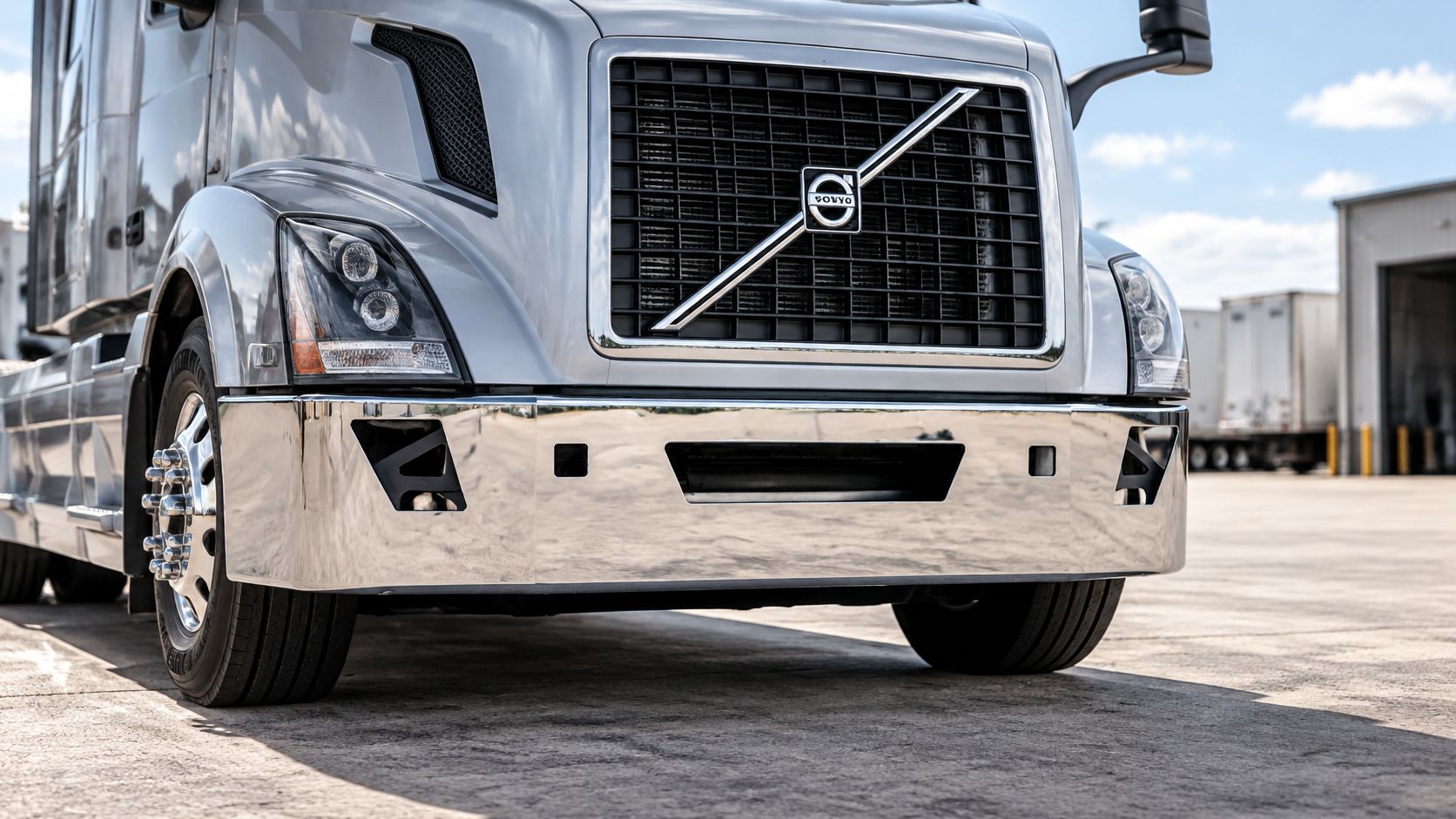
The finish uses a triple-layer hexavalent chrome process with 35 microns of nickel for a deep shine. The VNL bumper is listed from $919.99. Customer Ulises gave it a 5-star review: "The bumper is very well made and it looks awesome on my truck."
Use the 3D configurator at galhor.com to set brand, model, year, style, light and tow cutouts, and finish before you pay. Pick the metal from your route, carbon steel for a washed show truck, 430 or 304 stainless for salt. A heavier bar is not the safer buy if it hangs past the bumper line or stacks weight on a steer axle that already runs near its limit. Spec the guard to the truck you run.
In-stock 430 and 304 stainless flat bumpers ship within 48 hours. Made-to-order carbon steel typically ships in 4 to 6 weeks by LTL freight, processed and supported from Magnolia, Texas. A truck sitting dead needs the stainless shelf stock. A truck that can wait gets the full range of style and cutout choices in a made-to-order build. Set your specs in the configurator, and the bumper that shows up bolts on like it belongs there.
Galhor Inc. builds direct bolt-on chrome bumpers for Volvo, Peterbilt, Kenworth, and Freightliner Class 8 trucks, with carbon steel, 430 stainless, and 304 stainless options you can spec by model, year, style, and cutouts in the online configurator. If your Volvo needs a guard or replacement bumper that fits the truck you run, visit Galhor Inc. and build it to your chassis before you order.