
What Is Hexavalent Chrome? Uses, Plating and Safety
November 14, 2026 · Francisco Hornelas

Hexavalent chrome is chromium in the +6 oxidation state, written Cr(VI), and it is the form of chromium that U.S. workplace rules hold to 5 micrograms per cubic meter of air as an 8-hour average. The name describes chemistry. It says nothing about how thick a chrome layer is, how bright it shines, or how long a bumper lasts through a winter of road salt.
So which question does the word answer when you see it in a product listing or hear it in a shop? Rarely the one the buyer is asking. A driver wants to know whether the chrome on a Peterbilt 389 bumper will pit after two seasons. A shop manager wants to know whether a grinding job needs a respirator. Those are separate questions, and "hexavalent" sits on top of both without answering either.
That's where the confusion starts. The same term gets used as a quality badge on one page and as a hazard warning on the next. Both uses are real. They're just aimed at different people.
Table of Contents
- Hexavalent Chrome Explained in Plain Terms
- Where Hexavalent Chrome Shows Up on Your Truck
- How Hexavalent Chrome Plating Works Step by Step
- Exposure Limits That Protect Workers
- Working Safely Around Chrome and Welding
- Confirm the Process Before You Buy
Hexavalent Chrome Explained in Plain Terms
The name sounds like lab jargon. It's a headcount. Hexavalent counts electrons: every atom inside a compound sits at an oxidation state, which is bookkeeping for how many electrons it has handed off or taken on. Chromium can sit at more than one of those counts, and at +6 it's hexavalent, because hexa means six.
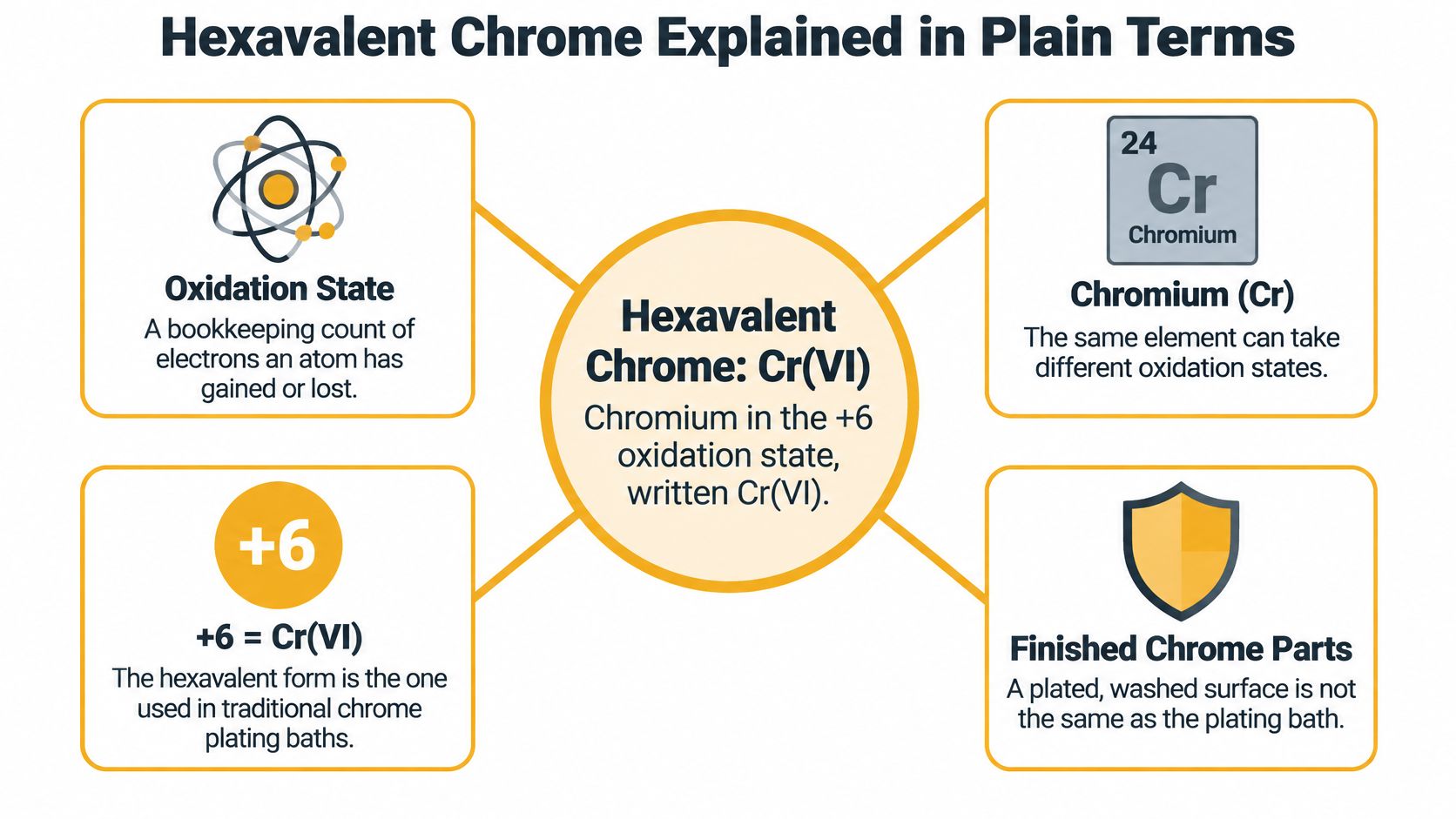
The same metal at a different count acts like a different substance. The National Institute of Environmental Health Sciences defines hexavalent chromium as a group of chromium compounds in which chromium has a +6 oxidation state, and draws a hard line between it and trivalent chromium, Cr(III), whose chemical and toxicological behavior differs substantially. Same element on the periodic table. Different behavior in a bath, in the air, and in a lung.
| Feature | Trivalent chromium Cr(III) | Hexavalent chromium Cr(VI) |
|---|---|---|
| Oxidation state | +3 | +6 |
| Toxicity profile | Differs substantially from Cr(VI) | Inhaled form is a known human lung carcinogen |
| Typical uses | Some alternative plating and pigment work | Traditional chrome plating baths, pigments, leather tanning |
What the word does and doesn't buy you
Cr(VI) earned its place in manufacturing because it does certain jobs well. The same federal overview lists electroplating, stainless-steel production, leather tanning, textile manufacturing and wood preservation among the major use areas, with corrosion prevention, metal finishing and pigments among the commercial applications.
What the term doesn't do is rate the finished part. Layer thickness, reflectivity, nickel build, adhesion and service life are engineering results that come out of a plating line. None of them are printed in the word hexavalent.
The distinction that matters: Cr(VI) is a process chemical that lives in the plating bath. The mirror finish on a finished bumper is the engineered coating that comes out of that process. One is a workplace exposure question. The other is a product question.
Answering what is hexavalent chrome takes one sentence: it's chromium at a +6 oxidation count, and it tells you about the process, not the product.
Where Hexavalent Chrome Shows Up on Your Truck
Walk the lot. A chrome bumper on a Kenworth W900, the grille surround on a Peterbilt, step boxes, mirror brackets, the polished stainless on a Freightliner Cascadia or an International. Every one of those surfaces came off a finishing line somewhere, and the chemistry behind it belonged to the shop that ran that line, not to the person who bolts the part on. Plated steel gets its corrosion resistance from the layers under the chrome, which is why nickel build matters more to durability than the shine on top.
Then a job turns a finished part back into a chemistry question. Say an owner-operator picks up a used bumper bracket at a roadside shop and cuts it down to fit. The wheel throws a fine dust off the old coating. If that coating carries chromium, the dust is the exposure, and nothing about the part looked dangerous sitting on the ground.
Workers run into Cr(VI) in four kinds of work:
- Operating a chrome-plating bath: an agitated, heated tank throws mist, and the person leaning over it breathes it.
- Handling chromate-containing coatings or pigments: dry handling and sanding send fine particles airborne.
- Spraying paints: overspray from chromate pigments hangs in the air of a booth with weak airflow.
- Welding or cutting chromium-containing metal: heat and abrasion turn a solid surface into fume and dust.
Shop test: if a job involves a plating tank, a chromate coating, a paint spray, or heat and abrasion on chrome metal, treat Cr(VI) as a possible exposure until you've checked the coating and set up controls.
The part on the truck stays a part. The dust and mist are what need managing.
How Hexavalent Chrome Plating Works Step by Step
A chrome finish isn't sprayed on or dipped once. It's built in layers, and most of what you pay for sits under the bright surface. Here's the sequence a plating line runs, and where it goes wrong.
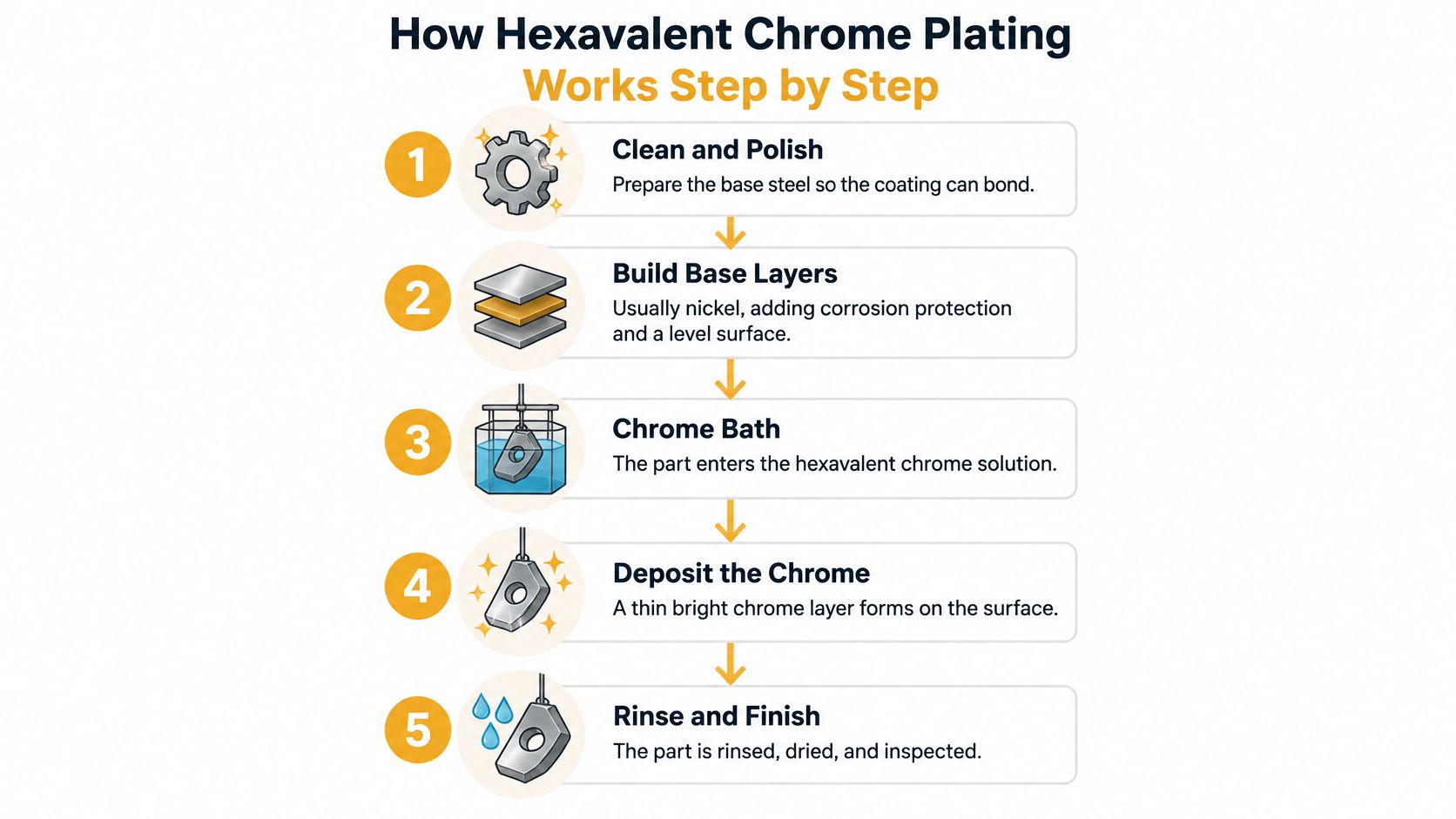
- Clean and polish the base steel. Grease, scale or a scratch left on the steel shows through every layer above it. The common slip is skipping a rinse between cleaning stages, which leaves a film that stops the first layer from bonding.
- Build the base layers, usually nickel. Nickel provides the corrosion protection and gives the chrome a level, bright surface to sit on. A thin or uneven nickel layer is the most common reason a part pits early, even when the chrome on top looks fine.
- Hang the part in the chromic-acid bath. The part goes into a solution carrying Cr(VI), and current passes through it so chromium deposits on the surface. Where the part hangs and how it faces the anode decides which areas get coverage.
- Control current density, temperature and agitation. These settings decide how even and how bright the deposit lands. Push current too high on an edge and you get a burnt, dull patch; run the bath cold and the deposit goes hazy.
- Rinse the part and treat the spent bath as hazardous waste. Residue left in a crevice dries into a dull streak. The spent chemistry and rinse water carry chromium and go to a permitted waste stream under local rules, not down a drain.
- Inspect before it ships. A good inspector checks coverage at edges, pits, haze and brightness under consistent light. A part that leaves with a thin edge will be the one that corrodes first in service.
A decorative line that stacks copper, nickel and chrome is what the trade calls triple chrome plating, and the extra layers exist for adhesion and corrosion protection rather than extra shine. Bubbling and splashing in the tank are also why the bath needs local exhaust ventilation: an agitated chromic-acid solution puts mist in the air, and that mist is what a worker inhales.
You can read a finish without a lab. A sound job looks bright and even from every angle, with no dull patches, no pinprick pits along the edges, and no blue or yellow haze where the part hung.
Exposure Limits That Protect Workers
The concern with Cr(VI) is inhalation. The EPA's final toxicological review classifies inhaled Cr(VI) as a known human carcinogen, based on consistent evidence that exposure causes lung cancer in humans plus supporting animal evidence, as recorded in the EPA IRIS toxicological review summary. Reported effects also include nasal and sinus cancers, kidney and liver damage, nasal and skin irritation or ulceration, and eye injury.
That is why the numbers below are so small. They're written in micrograms, and one microgram is a millionth of a gram.
The limits a shop works against
OSHA's 2006 standard set the permissible exposure limit at 5 µg/m³ as an 8-hour time-weighted average. The same EPA summary records that as roughly a 95% reduction from the prior 52 µg/m³ Cr(VI)-equivalent limit.
| Limit | Value (µg/m³ of air) | What It Means |
|---|---|---|
| OSHA permissible exposure limit (2006) | 5 | Legal 8-hour average limit |
| OSHA action level | 2.5 | Triggers monitoring and compliance duties |
| NIOSH recommended exposure limit | 0.2 | Protective target, lower than OSHA |
| Prior Cr(VI)-equivalent limit | 52 | Replaced by the 2006 standard |
The NIOSH figure is worth understanding as a distinction, not a rule. It recommends 0.2 µg/m³ as an 8-hour average across a 40-hour week, which is a health-protective target rather than an enforceable legal limit. On its own list, NIOSH names electroplating, welding and painting as trades where workers may meet high airborne concentrations.
How the limit got to 5
- 1971: OSHA adopted a general-industry ceiling of 100 µg/m³ measured as chromic acid, plus a comparable 100 µg/m³ 8-hour limit in construction.
- 1993: labor and public-interest groups petitioned OSHA to cut the limit to 0.5 µg/m³.
- 2006: the standard landed at 5 µg/m³, and OSHA estimated that about 1 million U.S. workers were regularly exposed across industries during the rulemaking.
Once air monitoring reaches the action level, the duties start: monitor again on schedule, control the source, and protect the people doing the work.
Working Safely Around Chrome and Welding
An intact, washed, finished chrome surface is not the same thing as a plating bath. Bolting a bumper onto a Peterbilt 389, hauling it across the yard or wiping it down with a rag is ordinary handling. The answer changes when the surface stops being a surface and becomes dust or fume.
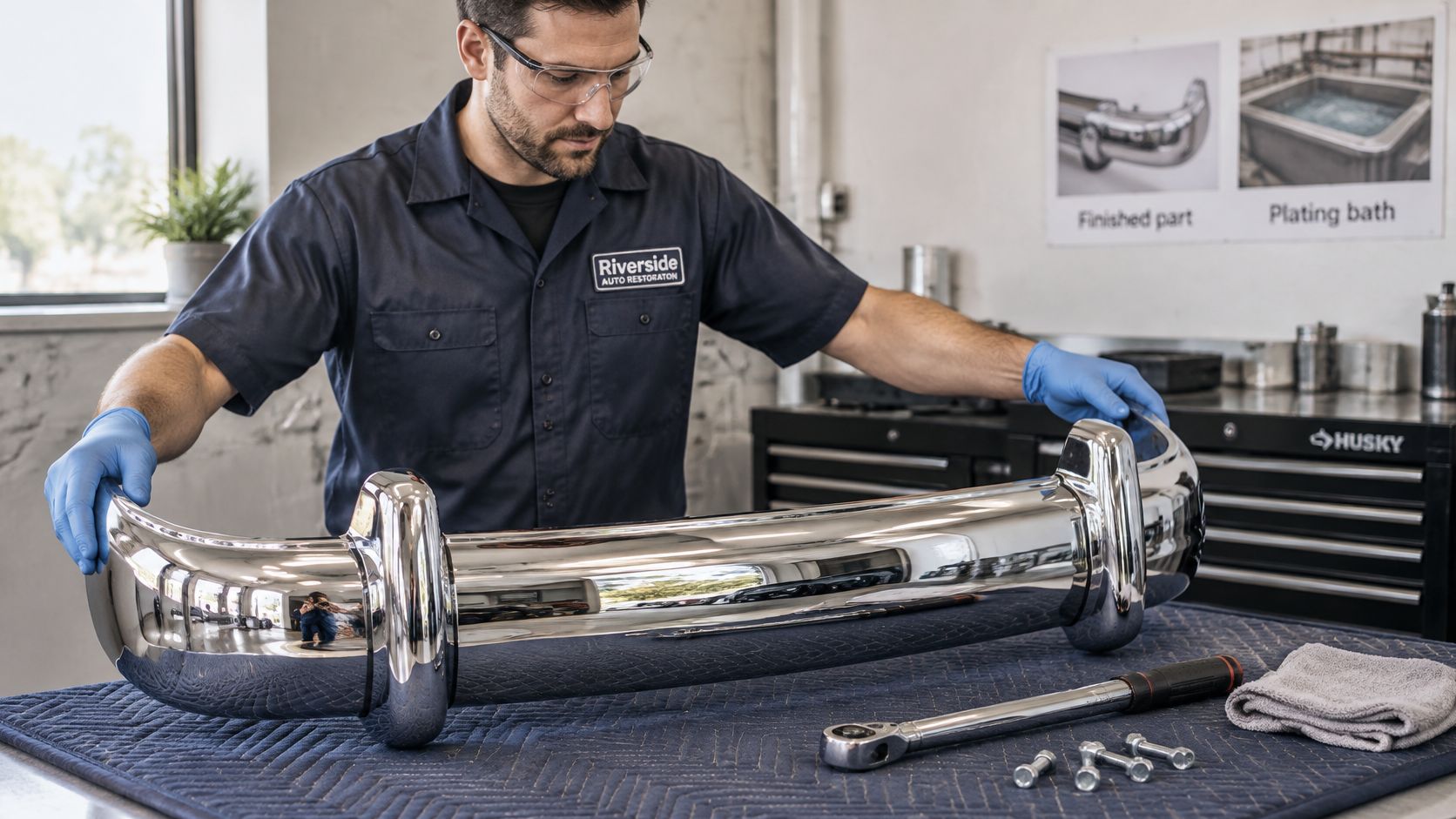
Two scenes show the split. In the first, a fleet shop grinds bumper mounts before a weld repair on a Cascadia. In the second, an owner-operator cuts a plated bracket down in a driveway with a cutoff wheel and no ventilation. Both turn a solid coating into airborne particles, and OSHA's Cr(VI) chemical data treats grinding, abrasive blasting, welding and torch cutting as a different exposure scenario from handling a finished part, one that calls for task-specific ventilation, respiratory protection, housekeeping and exposure assessment.
For fleets, chrome shops and service centers, the controls are the same six moves every time:
- Assume the coating carries chromium before you cut it. Ask the supplier or check the spec, and treat an unknown plated part as chromium-bearing until you know otherwise.
- Put local exhaust ventilation at the cut. A pickup hood at the wheel catches dust at the source instead of letting it drift across the bay.
- Wear respiratory protection and protective clothing where the task calls for it. Fit matters here: a mask that leaks at the cheek seals nothing.
- Clean up wet or with a HEPA vacuum. Dry sweeping and compressed air just move the dust from the floor into the air you're standing in.
- Wash hands and forearms before eating, and keep work clothes out of the cab. Chromium dust travels on fabric and skin.
- Bag and label contaminated dust and waste. It goes into a marked container, not the general shop trash.
Practical rule: the finished part is safe to handle, and the job that cuts it is not. Match the controls to the task, not to the part.
The OSHA standard covers employees, so an owner-operator doing the same cutting alone in a driveway should run the same checklist. Nobody is checking, which is exactly why the habits matter.
Confirm the Process Before You Buy
Everything above turns into four questions you can ask any bumper or plating supplier. Ask in writing and keep the answer.
- Which chrome process do you use, hexavalent or trivalent?
- Does your plating area have ventilation and exposure monitoring?
- Does your finish follow OEM specifications?
- What nickel thickness sits under the chrome?

A supplier who can name the process, describe the controls and quote a nickel number has a documented system behind the finish. A supplier who answers "premium chrome" to all four has told you something too, just not what you asked. Vague answers are a warning sign about how the part was made and how the shop is run.
Compare quotes on paper. Give each supplier a column, drop the four answers in, and score the one with complete detail above the one with the lowest price. Say a fleet manager is choosing between two quotes for a set of Freightliner bumpers. Quote A is cheaper and answers nothing. Quote B names its bath chemistry, its nickel thickness and its OEM spec. The second column is the one you can defend when a driver asks why the chrome on his truck lasted nine years.
Our chrome finish is a triple-layer hexavalent chrome process with 35 microns of nickel, and our plating follows OEM specifications. If you want to understand why that nickel number decides how the part holds up in a Michigan February, the nickel plating thickness breakdown explains what each layer does.
Galhor Inc. builds chrome bumpers for Freightliner, Kenworth, Peterbilt and Volvo trucks, with a triple-layer hexavalent chrome process and 35 microns of nickel, and every fitment is configured to your brand, model, year and finish. If you're replacing a pitted bumper or spec'ing a fleet order, you can visit Galhor Inc. to build the part for the truck you run and see what ships now versus what's made to order. Order with the process answers in hand, and the chrome you bolt on won't be a guess.