
Chrome Bumper Guard Explained: Materials and Fit
November 24, 2026 · Francisco Hornelas

You pull into a truck stop after a long winter run through the Midwest, walk around the nose of your rig to check your lights, and spot it right away. Road salt has chewed through the bottom edge of your factory bumper, a stone chip near the tow hook is already turning orange, and the whole front end looks tired. Whether you run a Peterbilt, Kenworth, Freightliner, or International, replacing that battered nose with a chrome bumper guard is one of the smartest upgrades you can make for both uptime and pride of ownership.
Most drivers buy on shine alone, then regret it two winters later when cheap plating flakes off or bolt holes don't line up. A sharp finish matters when you pull up to a shipper gate, but knowing what sits underneath that mirror surface is what keeps your truck out of the body shop. You need clear answers on stainless grades, nickel thickness, real fitment checks, and what a front bumper can and can't do in a crash.
Table of Contents
- What Is a Chrome Bumper Guard and Where It Mounts
- The Everyday Hits a Chrome Bumper Guard Absorbs
- Carbon Steel, 430 and 304 Stainless Compared
- Nickel Thickness and Finish Care That Make Chrome Last
- Fitment, Size and Installation Checks for Your Truck
- What a Chrome Bumper Guard Cannot Do for Your Truck
- Order Your Chrome Bumper Guard Today
What Is a Chrome Bumper Guard and Where It Mounts
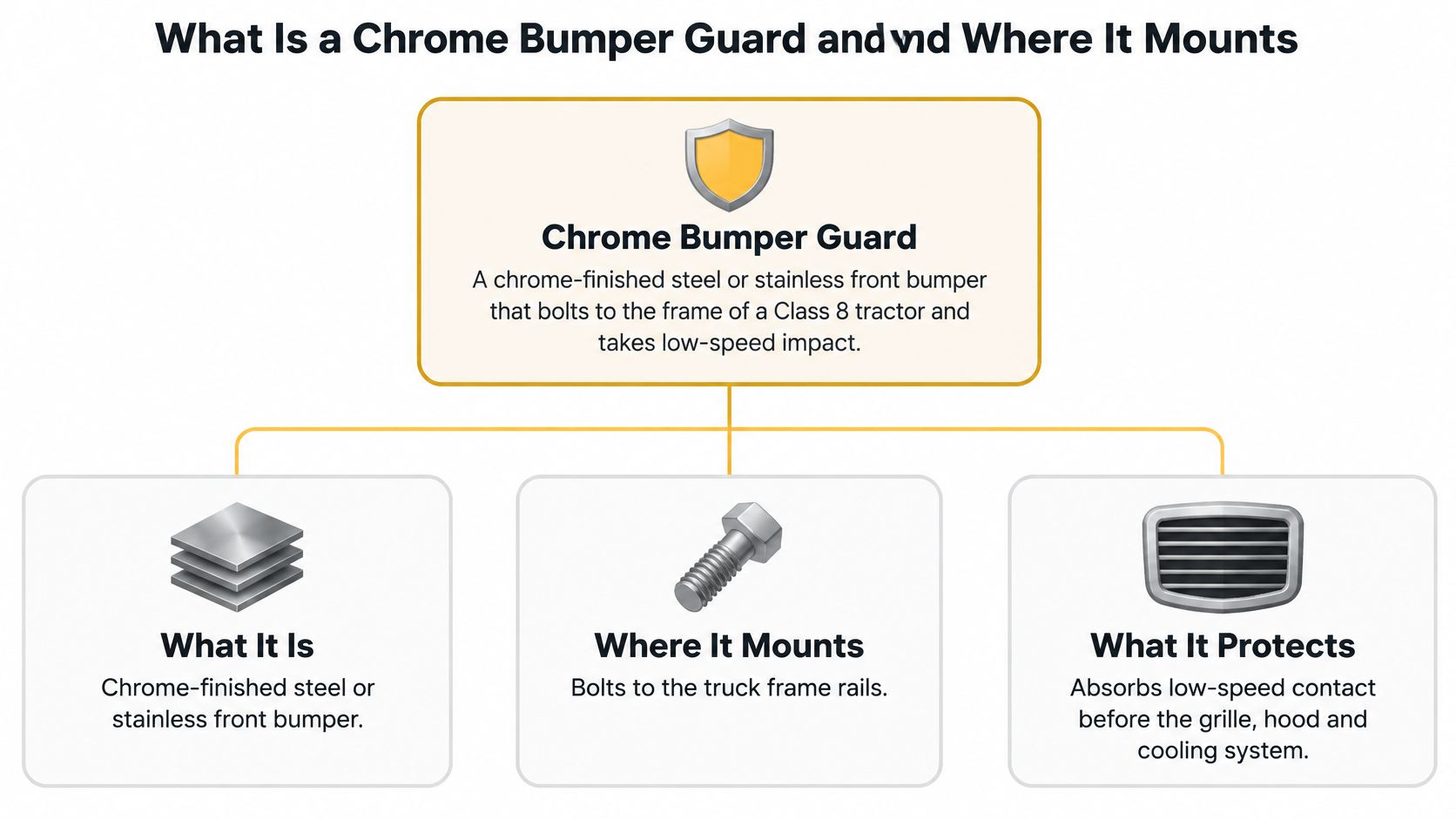
A chrome bumper guard is a chrome-finished steel or stainless front bumper that bolts directly to the frame rails of a Class 8 tractor to absorb low-speed hits from docks, gravel, brush, and road debris. It mounts straight across the nose of your truck below the grille on heavy brackets rather than welds, so a shop can unbolt it and bolt on a replacement after a yard scrape.
Say a driver eases a Peterbilt 389 into a tight shipper yard at dusk and bumps a low steel dock rail at crawling speed. The chrome front bumper takes the knock first, keeping the grille surround, headlights, and radiator intact so the truck stays on the load instead of heading for a tow. That one slow scrape is the whole point of the part: the bumper deforms or scuffs while everything behind it stays straight.
How a Bumper Guard Differs From Other Front Hardware
Owner-operators often mix up three separate pieces of truck protection, even though each one handles a different job on the road.
- Chrome bumper guard: Replaces the stock front bumper at frame-rail height to shield the lower nose, hood edge, and radiator support from minor hits and road grit.
- Grille guard or brush guard: Bolts out in front of the bumper with vertical uprights and bars to protect the hood, grille, and headlights from brush and animal strikes.
- Underride guard: Serves as a regulated rear impact structure on trailers and semitrailers, engineered specifically to stop passenger cars from sliding underneath a trailer deck.
Why Low-Speed Impact Protection Came First
Heavy bumpers earned their place as repair-cost equipment long before chrome became a selling point. The Insurance Institute for Highway Safety began running low-speed barrier crash tests in the late 1960s to cut costly repair bills from minor collisions. On April 9, 1971, the National Highway Traffic Safety Administration followed up with the first federal passenger-car bumper rule under Federal Motor Vehicle Safety Standard 215, protecting headlamps and fuel systems at 5 mph in front impacts and 2.5 mph in rear impacts starting with the 1973 model year, then expanding to 5 mph at both ends for 1974 through 1978 models, as documented in Wiley Online Library's technical history of bumper systems.
Practical takeaway: Heavy-truck front bumpers don't follow passenger-car FMVSS 215 rules, yet that same low-speed engineering goal still drives how they work. Chrome is the finish. The bumper exists to absorb low-speed hits.
A well-built chrome bumper guard handles two jobs in a strict order: protect your front structure first, and make your truck look sharp second. Judging one on shine alone misses the first job entirely, which is why stainless grade and plating thickness tell you more about a bumper than the mirror on top of it.
The Everyday Hits a Chrome Bumper Guard Absorbs
Long-haul trucks take punishment every mile, and almost none of it looks like a dramatic highway wreck. Sitting behind the wheel, you face small, expensive hazards every single week that chew through thin factory plastic or flimsy painted steel.

Four Real-World Scenarios From the Driver Seat
Think about the tight spots you run through between Monday morning dispatch and Friday afternoon drop-off.
- Tight shipper docks and blind corners: You creep into an older distribution yard with narrow lanes and concrete bollards hidden just below your hood line. A steel bumper takes a slow scrape without cracking a fiberglass hood corner or pushing back into the charge-air cooler.
- Gravel kick-up on rural and construction lanes: Running behind an aggregate hauler throws rocks straight at the lowest part of your nose. Thick plated steel shrugs off impacts that chip painted bumpers down to bare metal and shatter fog lamps.
- Tight yard pull-ins and trailer swings: Backing or nosing next to a dropped trailer in a crowded truck stop leaves inches to spare. One bent factory mount or cracked grille frame easily costs you a full day waiting for parts at a body shop.
- Highway animal strikes: A deer stepping onto a dark two-lane road hits the bumper first. Heavy steel can reduce lower-end damage and keep your radiator holding coolant long enough to limp to safety, though a large animal at highway speed can still bend hoods, brackets, and structural parts.
Run a Quick Payback Check Before You Buy
Smart fleet managers don't treat a heavy front bumper as vanity spending. Run this four-step math check on your own rig to see your real return on uptime:
- Pull your last front-end invoice: Write down what the shop charged for parts, paint, and labor on your last minor nose repair.
- Count your parked days: Tally every full day the tractor sat waiting on backordered plastic trim or fiberglass repair.
- Calculate lost haul revenue: Multiply those parked days by what your truck normally grosses per day on the road.
- Compare that total to a steel bumper: Most drivers discover a single avoided shop stay pays for a heavy chrome replacement outright.
Appearance still counts in this business. A mirror-polished bumper signals to shippers, brokers, and DOT inspectors that you take care of your equipment. Keep in mind that chrome shows dents and gouges faster than dark paint, and no bolt-on chrome bumper guard turns your tractor into a crash-rated tank during a major highway collision. The rule of thumb is simple: spend your money protecting the front-end components that cost the most to fix and keep you parked the longest.
Carbon Steel, 430 and 304 Stainless Compared
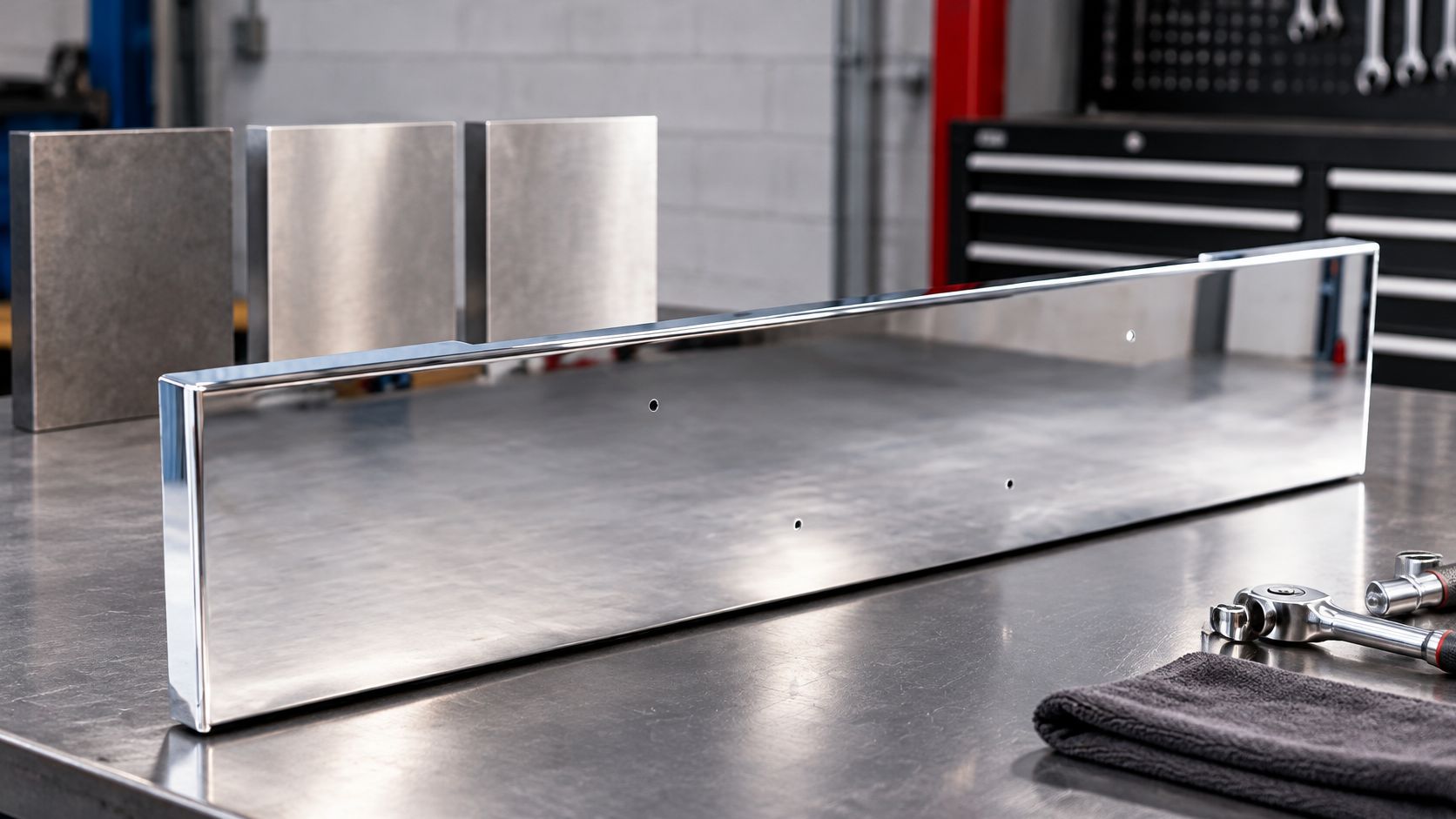
Base metal sets how long your front end stays clean. 304 stainless steel is the top pick for salted winter corridors, coastal freight lanes, and frequent truck washes. 430 stainless steel fits drivers who want a bright polished finish and solid everyday rust resistance at a lower price. Chrome-plated carbon steel makes sense on dry regional runs and tighter budgets, as long as you keep stone chips sealed before moisture gets underneath.
Steel remains the backbone of commercial front ends worldwide. According to Dataintelo's heavy-duty truck bumper market report, steel accounted for roughly $1.55 billion, or 50.7%, of global heavy-duty truck bumper revenue in 2025.
Why Stainless Grades Act Differently in Road Salt
A listing that says "stainless" without naming the alloy tells you nothing about what you are buying. Reid Supply's breakdown of 304 versus 430 stainless steel puts SAE 304 stainless steel at 18% to 20% chromium and 8% to 10.5% nickel, while grade 430 stainless carries about 2% to 4% less chromium and far less nickel.
Chromium creates a thin passive oxide layer on the surface that fights rust, and the extra nickel in 304 helps it survive chloride attacks from winter road brine and harsh wash soaps. Carbon steel has no stainless alloy underneath, so the plating is the only corrosion barrier. Once a stone chip breaks through it, rust starts at the scratch. A 10-gauge Steel chrome bumper, for example, uses a direct bolt-on carbon steel shell with standard or blind mounting and a triple-layer hexavalent chrome finish with 35 microns of nickel, giving dry-climate fleets solid durability with no drilling or cutting needed.
Always ask for the exact stainless grade in writing before you hand over a credit card. The word "stainless" by itself does not tell you whether you are buying 304 or 430.
Base Material Comparison for Chrome Bumper Guards
| Material | Chromium and Nickel Content | Corrosion Resistance | Best Fit |
|---|---|---|---|
| Chrome-plated carbon steel | No stainless base; plating is the only corrosion barrier | Lowest of the three; depends on plating staying intact | Dry regional routes and budget builds |
| Chrome-plated 430 stainless | About 2%–4% less chromium than 304; much lower nickel | Good for normal use; more exposure risk in heavy salt | Polished look where price and appearance matter most |
| Chrome-plated 304 stainless | 18%–20% chromium and 8%–10.5% nickel | Strongest of the three in salt and wash-heavy use | Winter salt routes, coastal lanes and frequent washing |
Match your base metal to the worst stretch of highway your truck runs most often.
Nickel Thickness and Finish Care That Make Chrome Last
A fleet spec that lists only chrome thickness can hide a thin nickel layer, and that matters because the outer shine is very thin. On a plated steel or stainless bumper, three distinct layers work together. The base metal carries impact strength, the nickel layer underneath does the heavy lifting against corrosion, and the ultra-thin chromium flash on top adds mirror shine and resists tarnishing.
Nickel thickness matters far more than seeing "chrome plated" on a spec sheet. According to NIST exposure testing on plated steel coatings, nickel thickness was the single most important factor protecting steel from rust. Those tests found roughly 0.013 mm (0.0005 in) of nickel gave good protection in mild conditions, while roughly 0.025 mm (0.001 in) was recommended for severe exposure, stated in the same finding linked above.
Nickel Layer Benchmarks for Chrome Bumper Guards
| Exposure Level | Nickel Layer Benchmark | What It Means for Your Bumper |
|---|---|---|
| Mild conditions | About 0.013 mm (0.0005 in) | Enough for dry, low-salt routes |
| Severe conditions | About 0.025 mm (0.001 in) | Recommended for winter brine, coastal lanes and wash-heavy fleets |
| Premium chrome spec | Nominal 35 microns (0.035 mm, 0.00138 in) | Above the severe benchmark when the plating is applied correctly |
Chromium deposits are naturally porous, and the NIST exposure testing on plated steel coatings explained that chromium over a nickel barrier produces much lower porosity than chromium plated directly onto bare steel. That is why a properly bonded multilayer system holds up far longer on salted interstates than a single decorative flash. Our guide to triple chrome plating for heavy-duty bumpers explains how multi-stage layering bonds to steel.
Reading Plating Specs Without Falling for Salt-Spray Hype
Do not judge a supplier on one big salt-spray hour number alone. Follow-up NIST accelerated corrosion testing showed that time to first slight rust in a salt-spray cabinet did not consistently match real outdoor performance. The same linked testing found that at roughly 22 °C, a 5.5% sodium-chloride solution took about 72 hours to match the corrosion caused in just 24 hours by a 20% solution.
Winter brine packs into seams and bolt cutouts unlike a lab fog chamber, so ask suppliers for documented specs instead of marketing claims. A plating specification cited in NHTSA investigative files shows how real standards separate coating systems: triple-layer nickel assigns 50% to 70% of total nickel to the semi-bright bottom layer, versus 60% to 80% in double-layer systems, while minimum chromium top-layer thickness sits at 0.3 micrometers on steel and 0.25 micrometers on stainless steel. Consistent supplier testing should reference ASTM B995 for electroplated chromium components alongside general ASTM B117 salt-fog checks, plus physical checks of shell gauge and coverage around mounting holes and bends.
Supplier-Checking Checklist
Use this short checklist when comparing quotes:
- Ask for the nickel layer thickness in writing, not just the word chrome.
- Confirm the stainless grade or carbon steel base, since the finish sits over different substrates.
- Check that chromium thickness and layer structure are listed in the plating spec.
- Confirm salt-fog testing is backed by coating details and physical inspection, not hours alone.
- Look at coverage around mounting holes, bends and cutouts where brine collects.
Simple Maintenance That Doubles Finish Life
Even heavy nickel plating loses the battle if winter brine sits untouched for weeks. Build four quick habits into your weekly walk-around:
- Rinse brine off early: Hose down the front face, backside, and mounting hardware with clean water after every snowstorm or coastal run.
- Skip harsh abrasive polishes: Coarse compounds and stiff pads thin out the chromium flash and leave micro-scratches that trap moisture.
- Inspect stone chips fast: Check around tow cutouts and lower bends every wash, because exposed steel rusts sideways underneath intact plating.
- Watch fastener seams: Catch early orange staining around bolts and brackets right away before corrosion creeps across the face of the bumper.
Set a recurring wash and inspection schedule during winter months, and your finish will look sharp years down the road.
Fitment, Size and Installation Checks for Your Truck
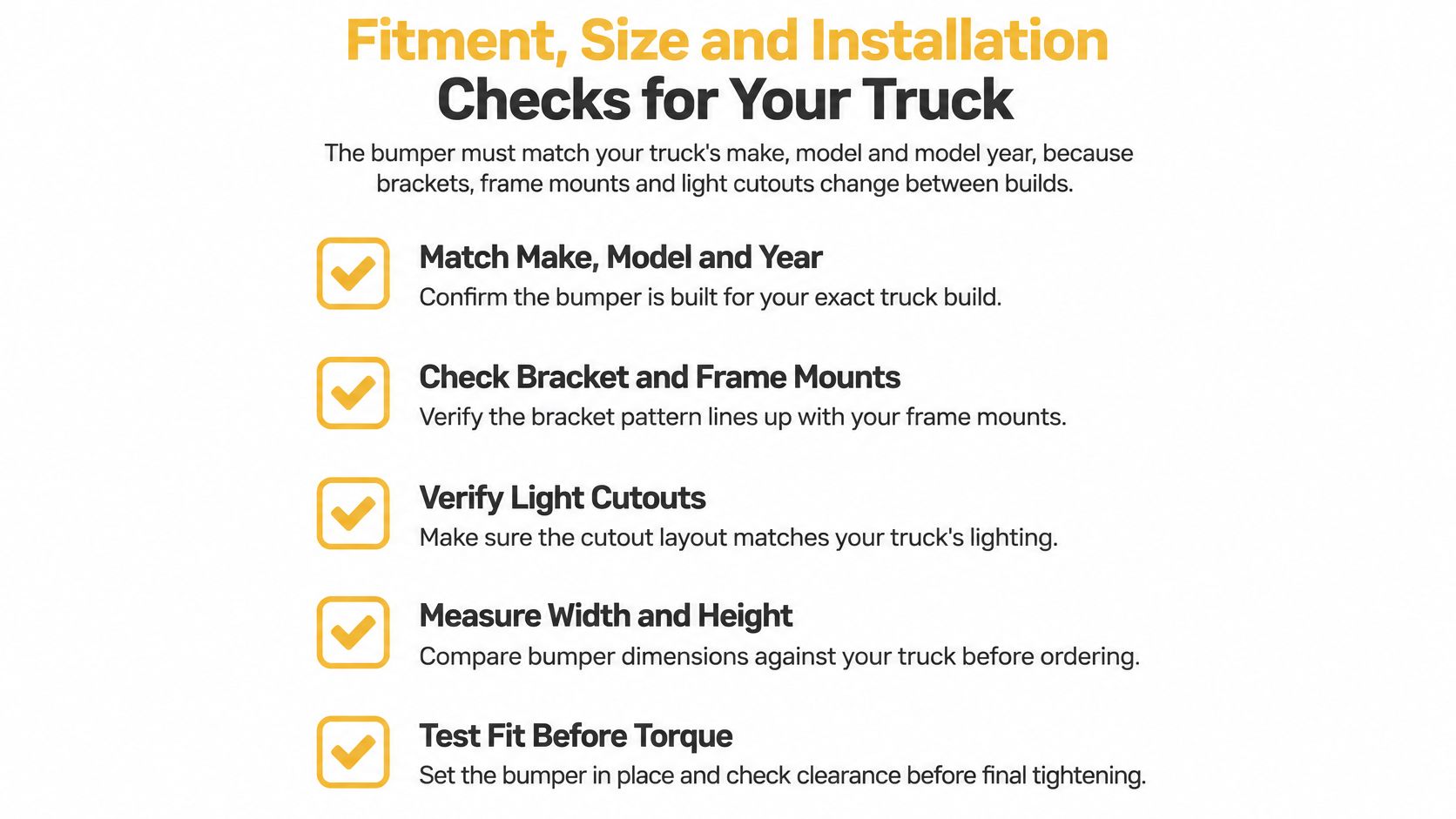
A bumper order lives or dies on one rule: match your truck's exact make, model, and model year. Frame rail spacing, bracket bolt patterns, tow pin locations, and radar sensor openings change between model runs, even on trucks that look identical from twenty feet away. A chrome shell can be beautiful and still sit wrong if the mounting pattern, height, or cutouts belong to another build year.
Review the five-step pre-order checklist below before picking a height or cutout layout.
Fitment Checks by Truck Model
Whether you're shopping for a Peterbilt 389 bumper, a Kenworth W900 chrome bumper, or a replacement for a fleet aero tractor, confirm these model-specific details first. The point is to catch the differences that a catalog photo will not show: mount style, tow access, light openings, and sensor provision.
| Truck | Check First | Confirm Before Ordering |
|---|---|---|
| Peterbilt 389 | Bracket pattern and frame mount points | Light, fog and sensor cutouts for your build year |
| Kenworth W900 | Bumper height and tow point clearance | Standard mount or blind mount for your setup |
| Freightliner Cascadia | Bracket fit to the front frame rails | Cutouts and bumper style for your model year |
| International LT | Mount compatibility with the front frame | Openings for lights, tow hooks and any brush or plow use |
Choosing Bumper Height, Style and Mount Type
Once your frame pattern is locked in, choose the profile that fits the roads you run. An 18 inch drop bumper or standard 18-inch profile suits a clean factory-style stance with generous ground clearance for steep driveways and uneven job sites. A 20-inch bumper provides more front coverage and a more aggressive look than an 18-inch bumper, though you must measure clearance under your hood tilt arc, around front tires at full lock, and above low approach angles.
You also have two key design choices:
- Flat versus drop styling: Flat bumpers keep a straight top and bottom edge for straightforward fleet replacement and clean aerodynamics, while drop bumpers curve lower in the center or ends for a custom long-nose profile.
- Standard mount versus blind mount: Standard mounts use visible chrome carriage bolts through the face of the bumper for fast roadside tightening. Blind mounts hide the fasteners behind the face on interior studs for a smooth, uninterrupted mirror look.
Strong mounting hardware matters just as much as the bumper shell itself. Check out our breakdown of heavy-duty bumper mounting brackets before you pull your old bolts. A direct bolt-on fit depends on the bracket, the frame pattern, and the bumper shell working as one assembly. When one part is off, the chrome face can still look right while the guard sits crooked or stresses the mounts.
Watch this quick walkthrough to see how proper bumper alignment and bracket mounting come together on a Class 8 tractor.
Shop-Floor Installation Notes That Save Hours
Before you tear the old bumper off, lay the new unit on padded sawhorses and confirm the mounting kit includes every bracket and bolt needed for your tractor. Verify that your kit installs as a direct bolt-on with zero frame drilling or cutting required. If drilling becomes part of the plan, stop and recheck the application instead of turning a bolt-on job into a fabrication job.
Always test-fit the bumper loosely with a helper or floor jack before running an impact gun. Open the hood slowly to check swing clearance, confirm tow pin holes line up dead center with your frame receivers, and verify every fog light, marker light, and radar cutout matches your wiring harness. Now check the lower corners, since that is where a small bracket error can show up as a twisted face. Measure, match, test-fit, and only then torque every bolt to spec.
What a Chrome Bumper Guard Cannot Do for Your Truck
A heavier, lower-hanging front bumper can look reassuring from the driver's seat. That appearance does not establish how it will perform in a highway collision. A chrome bumper guard offers protection against everyday minor impacts and finish damage, but its weight and shine do not establish underride compliance.
NHTSA's review of heavy-truck underride regulations describes no federal requirements for front or side underride guards and reports mixed outcomes from lowering a heavy truck's front bumper: reduced passenger-car override came with increased crash loads on the passenger vehicle, potentially increasing injury risk.
Collision geometry involves trade-offs. Treat a lower or heavier front bumper as a component choice, not an automatic safety upgrade.
Where Federal Underride Rules Apply
Federal rear impact guard specifications address a different job from a tractor's decorative front bumper. They define performance requirements for rear guards used on applicable trailers and semitrailers. A bumper listing that quotes those requirements does not establish that a front bumper meets them.
Under 49 CFR 571.223 (FMVSS No. 223), rear guard requirements include at least 100 mm (about 3.94 inches) of projected vertical height, test deflection limited to 125 mm (about 4.92 inches) without losing a load path, and, for qualifying non-hydraulic, non-tanker guards, absorption of at least 20,000 joules within that deflection while maintaining post-test ground clearance of no more than 560 mm (about 22.05 inches) at each support.
The U.S. Department of Transportation Federal Register notice for FMVSS 223 also specifies manufacturer installation procedures and permanent labeling with the maker's name, address, month and year of manufacture, and "DOT."
A Peterbilt or Kenworth front bumper does not become a certified trailer rear guard because its listing mentions that standard. Certification belongs to the applicable guard and its intended installation. Our breakdown of truck bumper safety standards explains the distinction between front protection and rear impact structures.
Three Safety Checks Before Swapping Your Front Bumper
Keep the replacement from interfering with equipment your truck already relies on:
- Clear radar and collision sensors: Confirm that bumper openings leave forward collision warning and adaptive cruise sensors unobstructed. A clean-looking face is no benefit if it blocks their view.
- Keep original tow points accessible: Leave factory recovery pins and tow hooks accessible. Do not cover or weaken the points a wrecker needs.
- Verify state and local height rules: Check applicable commercial vehicle rules before a lower drop bumper changes ground clearance or light mounting height.
Common Questions Drivers Ask About Chrome Bumpers
Does a replacement chrome bumper satisfy DOT underride rules?
A replacement front bumper does not satisfy rear underride requirements. Those requirements address rear impact guards on applicable trailers and semitrailers.
Will switching to a chrome stainless bumper stop all rust?
Stainless steel still needs cleaning after road-brine exposure. Judge corrosion resistance by the stainless grade and nickel thickness, rather than the word chrome alone. A mirror finish describes appearance, not immunity to corrosion.
Do I need to drill my frame rails to mount a heavy replacement bumper?
A correctly specified direct bolt-on bumper uses the tractor's existing factory mounting holes and matching brackets. If the holes do not line up, resolve the fitment mismatch before modifying the frame.
Order Your Chrome Bumper Guard Today
A chrome bumper guard is a working part, so order it like one. Match the base metal to the routes you run, then match the bumper to the exact tractor in your yard. Choose 304 stainless for winter salt and frequent washes, 430 stainless for balanced everyday value, or carbon steel for dry regional lanes. Confirm make, model, build year, bumper height, mount style, and every light or sensor cutout. Keep the impact limit clear: this is low-speed protection and finish durability, not a crash-rated underride guard.
Galhor Inc. sells direct bolt-on chrome bumpers individually for Freightliner, Peterbilt, Kenworth, and Volvo Class 8 tractors, with support handled from Magnolia, Texas. The plating benchmark worth checking is the triple-layer chrome finish with 35µm nickel, because the word chrome alone says little about corrosion resistance. Base options include chrome-plated carbon steel, chrome-plated stainless steel 430, and chrome-plated stainless steel 304. Other bumper models also offer a premium option of 3 mm stainless steel 304 or 430.
Compare Spec Sheets and Plan Your Install Window
When you compare quotes from chrome shops or online sellers, put plating specs, base alloy, warranty length, and mount details side by side instead of shopping on headline price alone. A cheap bumper with vague plating details may look bright on delivery day and still be a poor value if the alloy, nickel build, or cutouts do not match the job.
Use the 3D configurator at Galhor Inc. to set your exact truck brand, model, year, style, light and sensor cutouts, and finish before you order. That is the point where a buyer should slow down. A direct bolt-on fit depends on the details, not the polished face of the bumper. Bumpers on the bumper page are listed from $874.99 to $1,679.99 each, so comparing like for like matters.
Plan the shop appointment around lead time:
- Stock stainless 430 and 304 flat bumpers are pre-chromed and laser-cut to the customer's spec before dispatch, then ship within 48 hours via LTL freight.
- Custom-configured carbon steel bumpers typically ship in 4 to 6 weeks.
- The Premium bumper, made of chrome stainless steel 304, carries a 5-year warranty. The Standard bumper, made of chrome stainless steel 430, carries a 4-year warranty. The Economy bumper, made of chrome-plated carbon steel, carries a 2-year warranty.
If a comparable chrome bumper is found at a lower price within 7 days of purchase, Galhor beats it by 5% on carbon and 304 bumpers and gives a free material upgrade on 430 bumpers. After a documented road incident, replacement bumpers get 15% off for carbon, 20% off for 430, and 25% off for 304.
Order when the spec is right: correct fitment, correct cutouts, correct alloy, and a finish built around a real nickel benchmark. That gives the truck a bumper chosen for highway work instead of shelf appeal.