

24.5 Semi Wheels: A Practical Guide for Class 8 Owners
You're at the parts counter with a W900 on the other side of the glass, comparing a 24.5 setup with a 22.5 set. The 22.5 wheels promise easier roadside service and lower rolling resistance. The 24.5 semi wheels look better suited to the heavy work on your schedule. The right answer isn't based on appearance or what another truck in the yard runs. It comes down to axle position, tire size, load rating, road surface, and the cost of keeping the truck moving.
Table of Contents
- Why 24.5 Semi Wheels Still Matter on Class 8 Trucks
- What 24.5 Semi Wheels Actually Are
- Comparing 24.5 and 22.5 Semi Wheels
- Matching Tires to 24.5 Semi Wheels
- Steel Versus Aluminum 24.5 Semi Wheels
- Fitment and Maintenance for 24.5 Semi Wheels
- The Future of 24.5 Semi Wheels in North American Fleets
- Quick Decision Guide and Common Questions on 24.5 Semi Wheels
Why 24.5 Semi Wheels Still Matter on Class 8 Trucks
The driver at the counter has a familiar problem. His Kenworth W900 pulls heavy equipment into rough yards, but it also spends time on paved highways. He wants the stance of a 24.5 setup without buying a wheel and tire combination that creates clearance or service problems.
The practical answer is simple. 24.5 semi wheels remain a duty-cycle choice, not obsolete inventory. Wheel suppliers still describe 24.5 as a common commercial-truck format, and the size is used across steer, drive, and trailer positions on heavy-duty equipment. A current 24.5 x 8.25 wheel listing shows an 8,030-pound rating at 130 psi, while a steel version lists 7,400 pounds at 120 psi. Those figures come from the listed wheel specifications at A1 Truck Wheels.
Where the larger wheel earns its place
A 24.5 setup makes the most sense when the truck works beyond clean highway linehaul:
- Heavy-haul tractors carrying concentrated axle loads.
- Logging trucks dealing with uneven surfaces, debris, and repeated low-speed impacts.
- Oilfield equipment operating across unimproved roads and work pads.
- Vocational mixers and dump trucks that trade pavement comfort for payload and durability.
- Specialty trailers and lowboys where tire clearance and load envelope matter more than minimum tare weight.
The larger tire packages commonly paired with this wheel can carry substantial single-tire loads. That doesn't mean a 24.5 wheel automatically increases legal axle capacity. The axle, tire, suspension, hubs, brakes, and rated vehicle limits still control the application.
Counter rule: Choose 24.5 because the truck's work requires its tire and load envelope. Don't choose it only because the wheel looks taller.
The format also has history behind it. Modern trucking moved from spoke-style and Dayton-type systems toward hub-piloted Budd-style wheels. A trucking history account describes Dayton wheels as “ancient history” in modern trucking and says that “nearly every truck” now uses the Budd-style architecture. It also records 24.5 aluminum Alcoa Budd wheels appearing on a Freightliner FLC120 by the early-to-mid 1990s. That background is covered in this trucking wheel history.
The result is a long-running commercial standard across Class 8 tractors, trailers, buses, and heavy-duty recreational vehicles. The next question is fitment, because a wheel that carries the load still has to seat correctly on the hub.
What 24.5 Semi Wheels Actually Are
The 24.5-inch measurement is the nominal rim diameter, measured at the tire bead seats. It isn't the outside diameter of the complete wheel and tire. That distinction matters because tire overall diameter changes with the tire size mounted on the rim.
Most modern tubeless 24.5 wheels used on North American Class 8 equipment are 8.25 inches wide. A common hub-piloted specification uses 10 holes, a 285.75 mm bolt circle, and a bore around 220 mm. One supplier listing identifies the 24.5 x 8.25 format with a 220 mm bore, while other commercial specifications use a center-bore measurement around 220.9 mm. Always match the supplier's exact drawing to the truck's hub before ordering. The wheel specifications and fitment notes are shown by Buy Truck Wheels.
Read the data card in this order
| Specification | Common Value | What It Means |
|---|---|---|
| Nominal rim diameter | 24.5 inches | Bead-seat diameter for the approved tire |
| Rim width | 8.25 inches | Common width for many 24.5 radial tire fitments |
| Bolt pattern | 10 x 285.75 mm | Ten mounting holes on the stated bolt circle |
| Center bore | Around 220 mm | Must match the hub pilot and wheel seating surface |
| Construction | Steel or aluminum | Changes weight, corrosion behavior, and service handling |
| Pressure and load | Application-specific | Must meet or exceed the tire and axle requirement |
Hub-piloted mounting
A hub-piloted wheel centers on the raised pilot section of the hub. The flange nuts clamp the wheel against the hub, while the pilot carries the centering function. That differs from older stud-piloted systems, where the wheel centers through the inner cone surfaces of the nuts and the stud holes.
Use the correct two-piece flange nuts for a hub-piloted wheel. Don't mix a stud-piloted nut with a hub-piloted wheel, and don't assume the same nut works across every truck just because the thread appears similar. Check stud length, thread condition, pilot-pad condition, and the wheel manufacturer's nut specification.
Before mounting, confirm:
- Brake clearance: The wheel must clear the drum, disc, caliper, and any balance weights.
- Hub geometry: The bore and pilot diameter must seat flush without forcing the wheel.
- Valve and TPMS clearance: Sensor bodies and valve stems can contact the rim or brake components if the package is wrong.
- Offset and dual spacing: Drive and trailer duals need proper sidewall and hardware clearance.
- Load rating: The wheel rating must meet the axle position and tire requirement.
A clean spec sheet gives you the diameter, width, bolt circle, bore, offset, load rating, and approved mounting hardware. If one of those items is missing, stop and ask for the engineering drawing before putting the truck on the lift.
Comparing 24.5 and 22.5 Semi Wheels
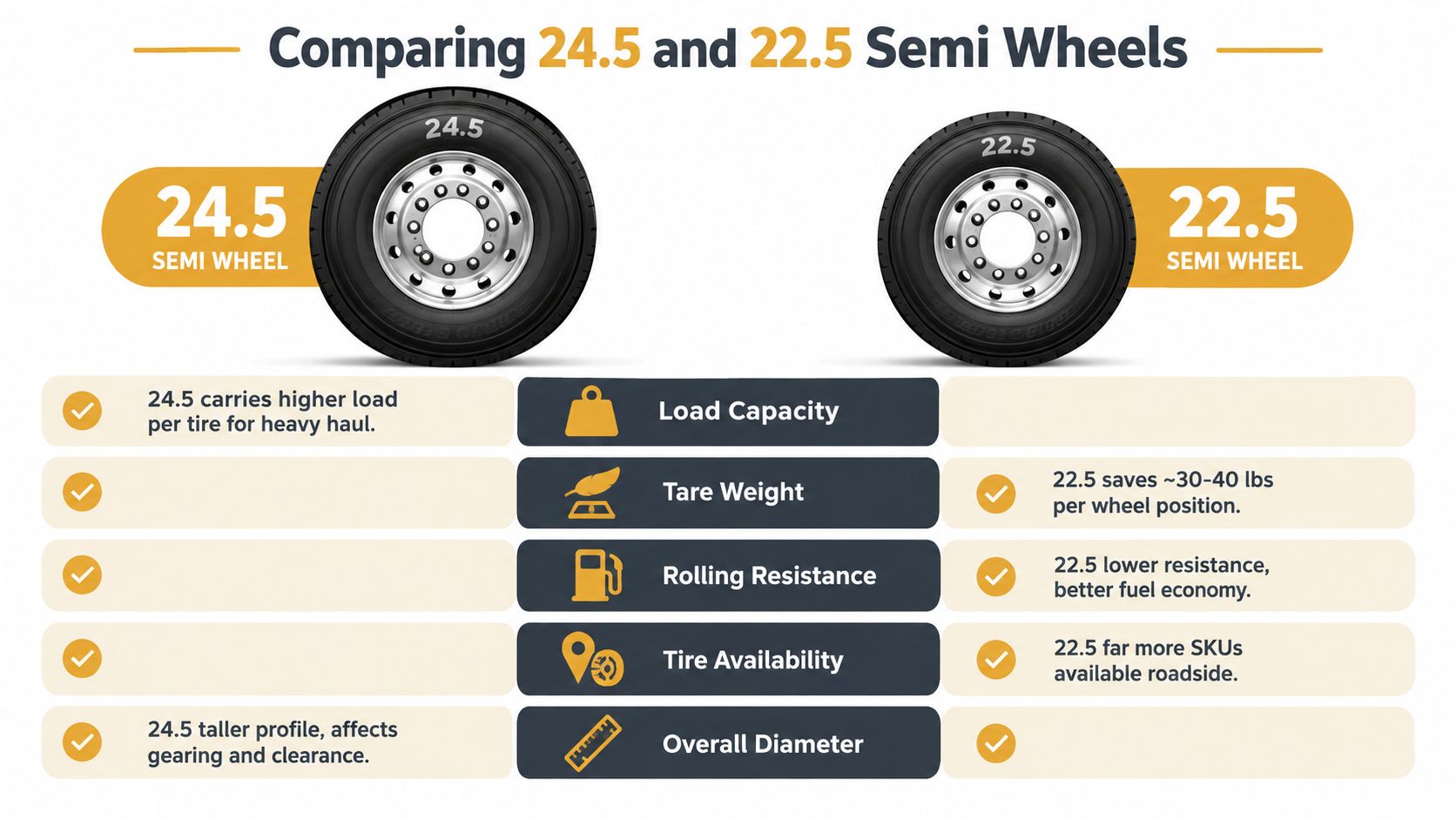
The 24.5 versus 22.5 decision moves money through several systems at once. A taller 24.5 tire can provide a larger load envelope and deeper-tread options for severe work. A 22.5 package usually reduces wheel-position weight, offers broader roadside tire selection, and supports the low-rolling-resistance combinations used by many highway fleets.
The trade-off at the parts counter
| Factor | 24.5 semi wheels | 22.5 semi wheels |
|---|---|---|
| Load envelope | Strong fit for heavy and vocational work | Common fit for highway and regional fleets |
| Tare weight | Typically heavier as a complete package | Lower weight is a common reason fleets specify them |
| Fuel strategy | Depends heavily on tire design and inflation | Often favored for low-rolling-resistance linehaul packages |
| Roadside availability | Common, but fewer choices than 22.5 in many areas | Broad replacement-tire and wheel coverage |
| Visual stance | Taller, fuller sidewall appearance | Lower profile and more fleet-oriented appearance |
| Older formats | More modern than legacy 20-inch systems | Dominant in many current highway applications |
The 24.5 platform accepts common heavy-duty sizes such as 11R24.5, and that tire is listed at about 43.5 inches overall diameter with a single load rating up to 7,160 pounds at 120 psi. The 22.5 choice can make more sense for a lightweight regional tractor, an LTL operation, or a linehaul truck where fuel consumption and roadside SKU coverage dominate the decision. Tire information for the 11R24.5 fitment is published by Hankook Tire data.
A 24.5 wheel can also make sense for a driver who values a taller stance and a deeper commercial tire, but appearance doesn't pay for an incorrect axle package. The same principle applies to exterior parts. For example, the Steel chrome bumper is a separate fitment decision, built from 10-gauge chrome-plated steel with a mirror-polished finish and direct bolt-on installation. It won't solve a wheel clearance problem, and a wheel choice won't replace the need for a properly fitted bumper.
Practical rule: If the truck spends its life on smooth pavement and every pound matters, start with 22.5. If it earns revenue through heavy loads, rough yards, and severe service, price 24.5 before assuming the smaller wheel is cheaper.
Fuel savings aren't determined by diameter alone. Industry material points to optimized wheel and tire combinations, TPMS, and inflation discipline as part of the fuel strategy, with reported savings of roughly 1.5% to 3% from optimized setups and 2% to 3% from certain 24.5 low-profile conversions compared with standard 11R24.5 tires, as documented in NHTSA heavy-duty fuel-efficiency material. Treat those figures as setup-specific, not as a guarantee for every truck.
Matching Tires to 24.5 Semi Wheels
A 24.5 wheel isn't a universal tire shelf. The tire's approved rim width, load range, inflation pressure, tread, overall diameter, and axle position all have to agree. Start with the tire manufacturer's fitment chart, then confirm the wheel supplier's approved range.
The most common highway reference is 11R24.5 on an 8.25-inch rim. Published data lists the 11R24.5 at about 43.5 inches overall diameter, with a single load rating up to 7,160 pounds at 120 psi. A 285/75R24.5 is smaller, about 41.8 inches overall diameter, and is listed around 6,175 pounds single at 120 psi in the same tire data source. That difference is about 1.7 inches in rolling diameter, enough to affect ride height, gearing, speedometer calibration, and clearance.
| Tire Size | Rim Width | Load Range | Steer | Drive | Trailer |
|---|---|---|---|---|---|
| 11R24.5 | Commonly 8.25 inches | Verify approved range | Common | Common | Common |
| 12R24.5 | Confirm manufacturer chart | Verify approved range | Application-specific | Heavy-duty applications | Application-specific |
| 275/80R24.5 | Confirm approved chart | Verify approved range | Common on approved setups | Possible where specified | Possible where specified |
| 285/75R24.5 | Commonly matched to approved 8.25-inch fitment | Verify approved range | Common on approved setups | Possible where specified | Possible where specified |
| 445/50R24.5 | Wider rim required by tire maker | Verify approved range | Not a normal steer choice | Super-single applications | Super-single applications |
Match the tire to the axle
Use the tire manufacturer's load table for single or dual service. A drive axle running dual tires doesn't automatically permit the same load rating as a super-single. The sidewall must identify the approved load range and pressure, and the wheel must carry at least the required load at that pressure.
Ply markings such as G, H, and J are part of the selection conversation, but they aren't a substitute for the tire's actual load table. Steer tires need the correct single-tire rating and rim approval. Drive tires need traction, casing strength, and dual spacing. Trailer tires need the proper trailer service designation and clearance.
Check the manufacturer's recommended cold inflation pressure for the actual axle load. Don't reduce pressure because the ride feels harsh, and don't inflate beyond the wheel or tire limit. Regroovable casings can make sense in applications that accumulate heavy tread wear and have a controlled casing inspection program, but the casing must be marked and approved for regrooving.
Before ordering, verify overall diameter and section width against frame rails, fuel-tank brackets, suspension parts, brake hardware, and mudflap brackets. The semi-truck tire size guide can help organize the sidewall information, but the final check belongs to the tire and wheel manufacturer's fitment documents.
Steel Versus Aluminum 24.5 Semi Wheels
Steel and aluminum 24.5 wheels can both work well. The better material depends on how the truck earns its miles, how often wheels get handled, and whether weight reduction pays back in the operation.
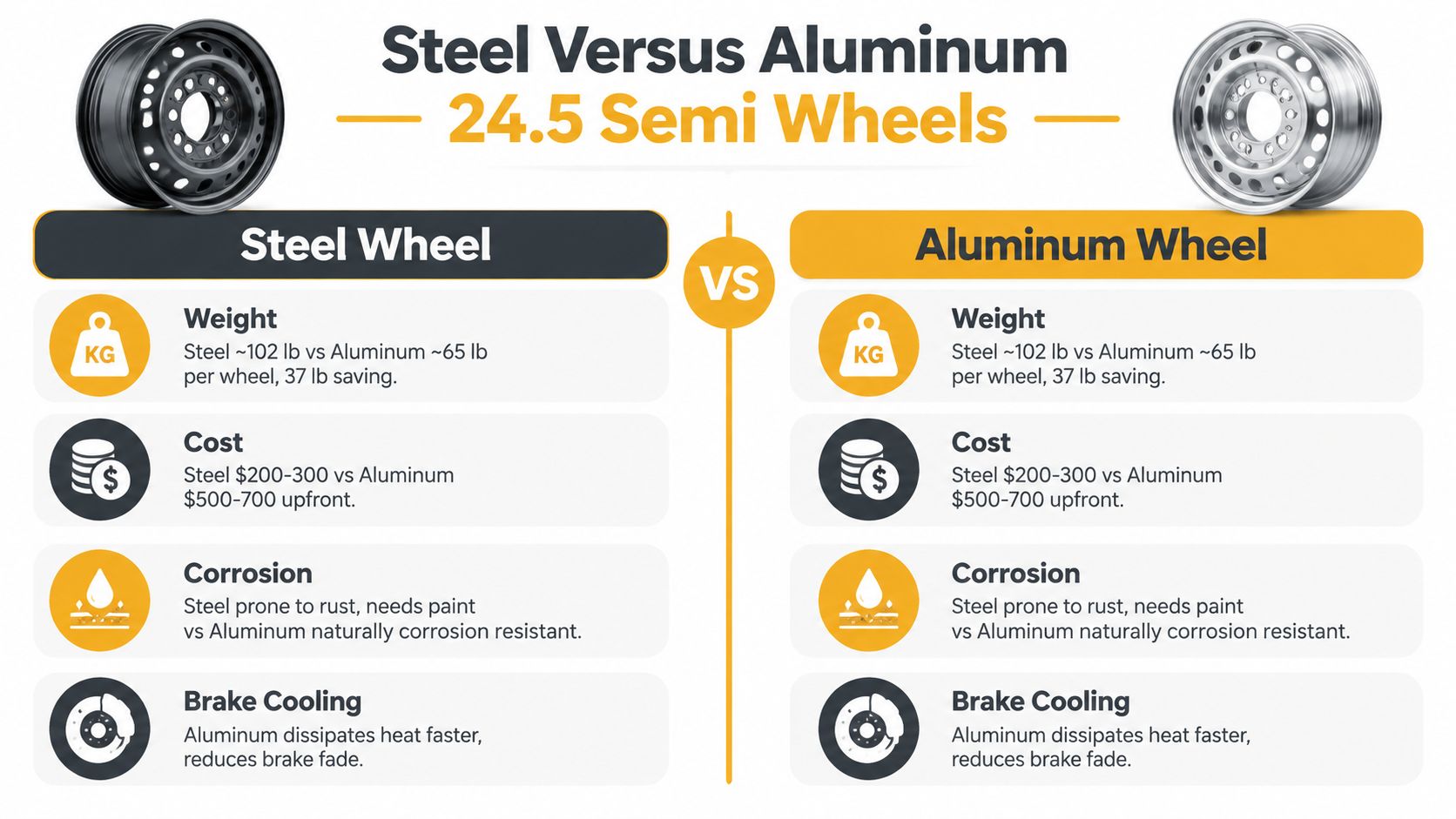
The cited 24.5 x 8.25 examples show steel at about 7,400 pounds at 120 psi and aluminum at about 8,030 pounds at 130 psi for their stated wheel specifications, but don't compare load numbers without comparing the exact products. The important operating difference is mass. Based on the cited examples, switching from steel to aluminum can reduce unsprung mass by roughly 20 to 30 pounds per wheel, while preserving the required load envelope when the aluminum wheel is properly rated. Those specifications are listed by A1 Truck Wheels.
Steel fits abuse and budget control
Steel is the straightforward choice for trucks that see loading docks, aggregate yards, winter brine, and frequent tire changes. It costs less to replace in many operations, and a painted steel wheel can keep working after cosmetic damage that would bother an appearance-focused owner.
The trade-off is corrosion. Salt and moisture attack damaged paint, the rim flange, and the disc pockets. A steel wheel needs inspection and coating attention before rust affects the bead seat or mounting surface.
Aluminum saves weight and handles heat
Forged aluminum wheels are lighter and can make tire service easier for the technician. Their lower rotational mass can also reduce rotational inertia. Aluminum conducts heat away from the wheel and hub area more readily than steel, which can help the brake system manage heat on long grades. It won't fix an overloaded brake, dragging component, or poor adjustment.
Aluminum resists ordinary corrosion better than bare steel, but winter chloride still creates problems. Pitting, damaged finish, and corrosion around studs can shorten service life if the wheel is washed poorly or ignored. A polished or treated finish looks sharp, but it still needs cleaning practices that don't grind road grit into the surface.
Shop judgment: Choose steel for severe regional freight and repeated abuse. Choose aluminum when long-haul weight, manual handling, brake heat, and appearance justify the added purchase cost.
For long-haul fleets, bulk haulers, and owner-operators who protect their equipment, the weight reduction can support the business case. For a dump truck that drags mud and salt through every season, steel may deliver the better return. Galhor's aluminum wheels for semi trucks are part of that broader material decision, but the wheel still has to match the hub, tire, and axle position.
Fitment and Maintenance for 24.5 Semi Wheels
A correct wheel can fail early if the hub face is dirty, the studs are damaged, or the nuts aren't torqued correctly. Fitment starts before the wheel leaves the tire machine.
Inspect the hub pilot pads for raised rust, burrs, and debris. Check hub runout, stud threads, stud length, and the condition of the flange-nut seats. A wheel must sit flush on the pilot pads. If it rocks by hand, don't pull it flat with the nuts.
Mounting sequence
- Clean the contact surfaces. Remove scale from the hub pilot and wheel mounting face without removing metal from the fit surfaces.
- Place the wheel squarely. Confirm the pilot engages fully and the valve stem or TPMS sensor has clearance.
- Install the correct flange nuts by hand. Cross-threading a nut or forcing it with an impact can damage the stud.
- Torque in a star pattern. Use a calibrated torque wrench and the truck or wheel manufacturer's specification. The common procedure called for in the provided maintenance guide is 450 to 500 foot-pounds for the stated hub-piloted application, as shown in the required installation visual below.
- Recheck after service. Inspect the lug seating after 50 to 100 miles, then follow the fleet's preventive-maintenance schedule and the wheel maker's instructions.
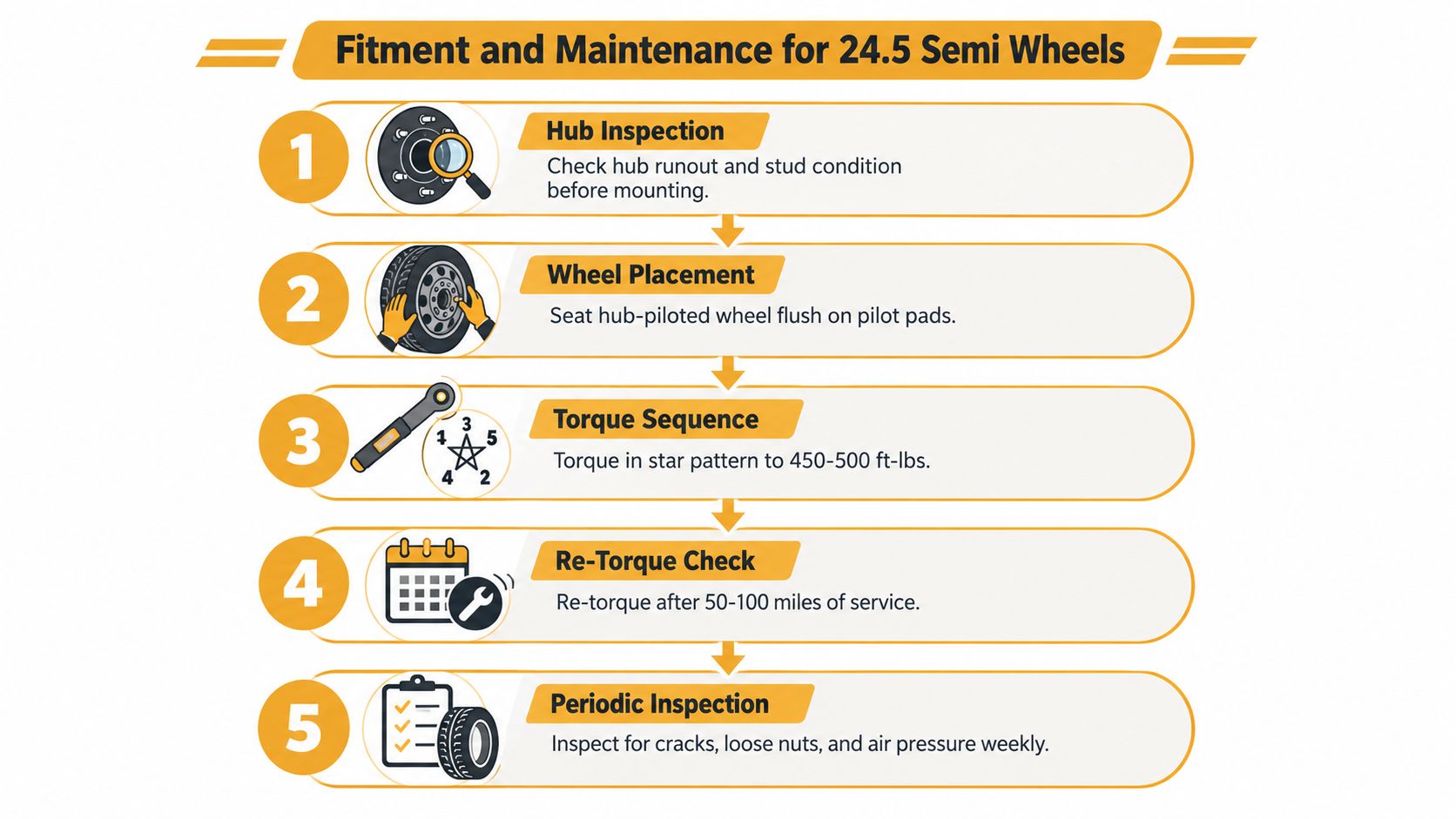
The wheel maker's torque specification controls if it differs from a general shop practice. Never use an impact wrench as the final torque tool. After the first service check, look for shiny movement marks around the nuts, fretting at the hub face, or a stud that appears to be walking in the hole.
Keep checks tied to the PM schedule
At each inspection, look through the hand holes for flange cracks, damage around the rim, and corrosion in the disc-mounting pockets. Check for loose nuts, valve-stem damage, uneven tread wear, and pressure loss. A walking stud may show polished metal or rust dust before it shears.
Use a checklist at every preventive-maintenance visit rather than relying only on mileage. Store spare aluminum wheels off wet steel chocks and keep dissimilar metals from sitting together in trapped moisture. Clean the mounting surfaces before storage and protect the wheel from impact damage during loading.
The following video gives a visual reference for wheel installation and maintenance:
For appearance-focused equipment, the semi-truck wheel polishing guide covers finish care. Polishing can improve presentation, but it doesn't replace torque checks, pressure checks, or crack inspection.
The Future of 24.5 Semi Wheels in North American Fleets
The claim that 24.5 wheels are disappearing is too broad. Major tire makers continue production and report ongoing demand for the size, while the sharper decline is concentrated in low-profile 24.5 applications as some fleets move toward 22.5 for fuel efficiency. That distinction is documented in the Wheels Industry Trends Report.
A vocational truck doesn't face the same priorities as a linehaul tractor. A refuse truck, mixer, oilfield unit, logger, or oversized-load tractor may spend more time on broken pavement, job sites, grades, and high-torque starts. In those conditions, tire casing, tread depth, clearance, and load range matter more than the lowest possible rolling resistance.
Duty cycles that still justify 24.5
| Duty Cycle | 24.5 Advantage | Typical Load Range |
|---|---|---|
| Oilfield service | Strong heavy-duty tire options and rough-road clearance | Verify H or J requirement |
| Logging | Better fit for severe surfaces and high-impact work | Verify H or J requirement |
| Refuse | Durable tire envelope for repeated stops and debris exposure | Application-specific |
| Ready-mix | Suits vocational chassis and work-site access | Application-specific |
| Oversized-load escort and heavy haul | Supports high-load tire packages and tall stance | Verify axle and tire ratings |
| Northern winter fleets | Works with established 11R24.5 service patterns | Verify tire and wheel ratings |
Current Class 8 applications from manufacturers such as Kenworth, Peterbilt, Freightliner, and Western Star still include vocational configurations where 24.5 remains a logical specification. The wheel size doesn't create capacity by itself. The complete vehicle build, including axles, suspension, brakes, hubs, tires, and legal ratings, has to support the work.
The pressure toward 22.5 is real. Low-rolling-resistance tires, lighter wheels, lower tare weight, and broader roadside supply make 22.5 attractive for highway fleets. EPA efficiency planning and fleet cost-per-mile models strengthen that argument, especially where trucks run predictable pavement routes.
That doesn't make 24.5 a dying standard. It makes the market more selective. The future is coexistence, not replacement. Linehaul will keep favoring efficient 22.5 combinations, while severe-duty and specialty operators continue buying 24.5 when the load, terrain, and clearance justify it.
Quick Decision Guide and Common Questions on 24.5 Semi Wheels
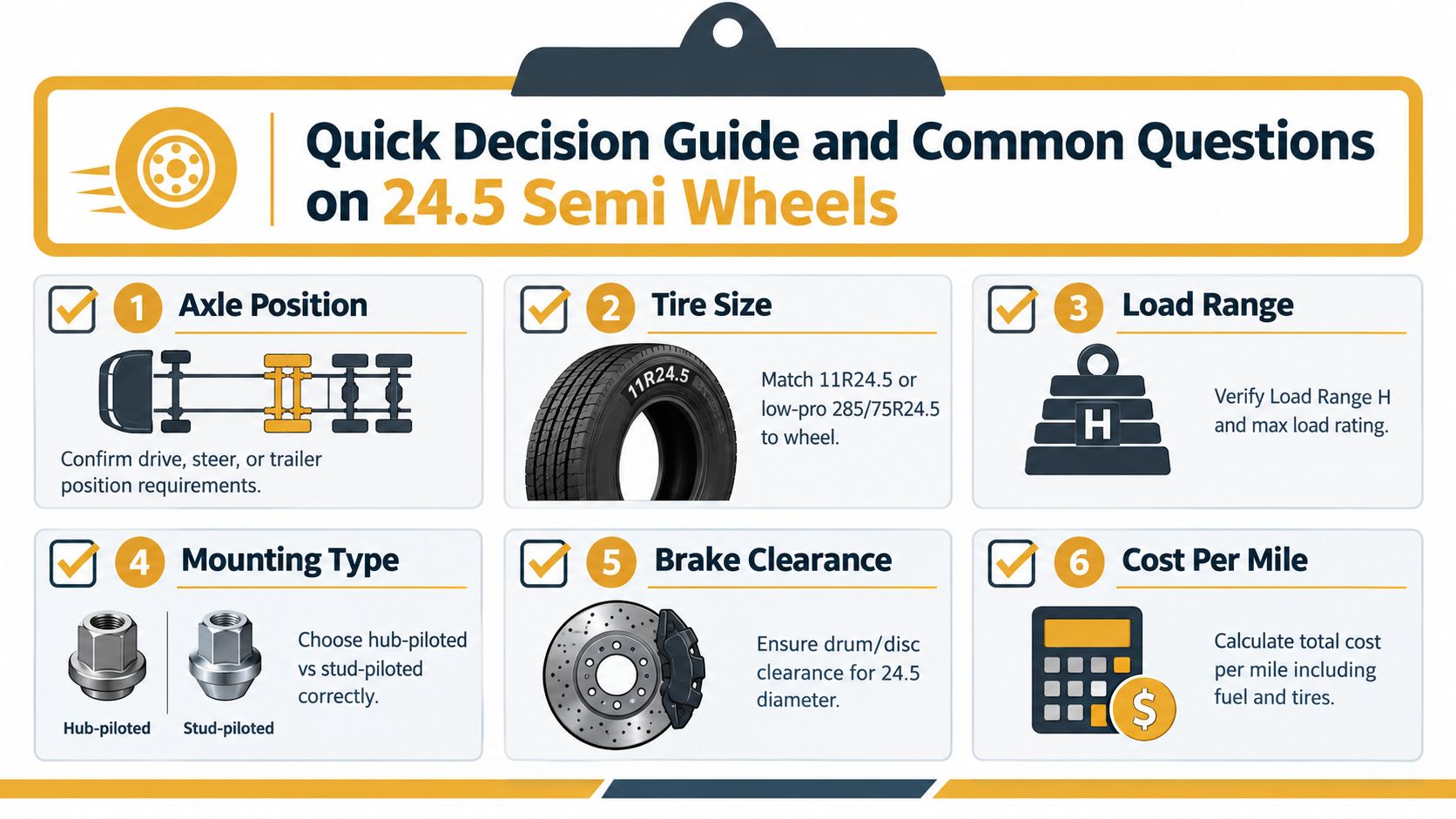
Run this checklist before you order. A wheel that looks right in a catalog can still fail the truck's actual fitment.
- Axle position: Is the wheel for steer, drive, trailer, or a super-single application?
- Tire size: Does the tire match the approved rim width and overall diameter?
- Load rating: Does the wheel meet the axle and tire requirement at the stated pressure?
- Mounting type: Is the truck hub-piloted or stud-piloted?
- Brake clearance: Will the wheel clear drums, discs, calipers, sensors, and balance weights?
- Operating cost: Do the tire life, fuel strategy, weight, service access, and replacement plan support the choice?
Questions fleet managers ask
Can 22.5 brake drums and 24.5 rims interchange?
Not automatically. Drum, hub, wheel offset, and brake clearance must be checked as a complete assembly. Never assume diameter interchangeability from the wheel alone.
What is the fuel-economy difference per hour?
There isn't a reliable universal hourly figure. Fuel use depends on tire construction, inflation, speed, axle ratio, load, route, and maintenance. The cited industry material reports setup-specific savings, not a guarantee for every truck.
Will 24.5 wheels void a steer-axle warranty?
That depends on the truck maker's approved configuration, axle rating, tire specification, and warranty terms. Check the build sheet and manufacturer documentation before changing the steer package.
How do 24.5 tires affect scrape height on a lowboy deck?
Overall tire diameter and section width change clearance. Compare the mounted tire dimensions with the deck, suspension, frame rails, and mudflap hardware before ordering.
Where can you source replacements when OEM channels run short?
Use a commercial wheel supplier that can confirm bolt circle, bore, offset, load rating, mounting type, and position fitment. Aftermarket availability can help, but the engineering data still controls the purchase.
Choose 24.5 when load and duty demand it. Choose 22.5 when route efficiency, weight, and roadside availability rule.
Galhor Inc. offers configurable direct bolt-on chrome bumpers for Peterbilt, Kenworth, Freightliner, and Volvo Class 8 trucks, with chrome-plated carbon steel, 430 stainless steel, and 304 stainless steel options. Visit Galhor Inc. to select the truck model, year, style, cutouts, and finish, then arrange the right bumper for long hauls, harsh weather, and working-road service.