

Aftermarket Truck Parts Online: Buyer's Guide
About 15% of fleet parts orders now come online, and online purchasing is no longer experimental. It's still fragmented enough that accurate fitment data and fast fulfillment can decide whether a repair gets finished today or turns into another expensive delay.
Your truck is sitting on the shoulder along I-40 in Texas, the front bumper is damaged, and the next load is already scheduled. You open a laptop and search for aftermarket truck parts online. Dozens of listings appear, each promising heavy-duty construction, perfect fitment, and fast shipping. Some show only a polished photo. Others list a part number without explaining the mount pattern, material, thickness, or cutouts.
That confusion costs owner-operators real money. A bumper that looks right may need drilling. A cheap chrome finish may start peeling after harsh weather. A poorly packed LTL shipment may arrive with a bent corner before it ever reaches the shop.
The right online purchase can still save time and expand your choices. You need to judge the seller and the part by evidence, not by a product photo or the lowest price.
Table of Contents
- Why Buying Aftermarket Truck Parts Online Makes Sense Now
- How to Verify Fitment Before You Order
- Choosing the Right Material for Your Bumper
- Understanding Warranties and Return Policies
- Shipping and Handling Premium Bumpers Safely
- Trusted Suppliers and What Sets Them Apart
- Common Mistakes to Avoid When Buying Online
Why Buying Aftermarket Truck Parts Online Makes Sense Now
Online truck parts have moved far beyond emergency marketplace purchases. Tracked retailers in the heavy-duty truck parts and components segment recorded about $92 million in aggregate online sales in 2025, with a projected 0-5% revenue increase in 2026, according to truck parts and components market data. Fleets previously ordered only 12% of their parts online in an earlier market survey, with that share expected to reach 15% within three years.
That combination tells you where the market stands. Digital ordering is financially important, but it hasn't removed the practical problems that come with Class 8 parts. Sellers still compete on catalog accuracy, available inventory, fitment detail, and fulfillment speed. A supplier that answers a fitment question quickly can be more valuable than one with a slightly lower advertised price.
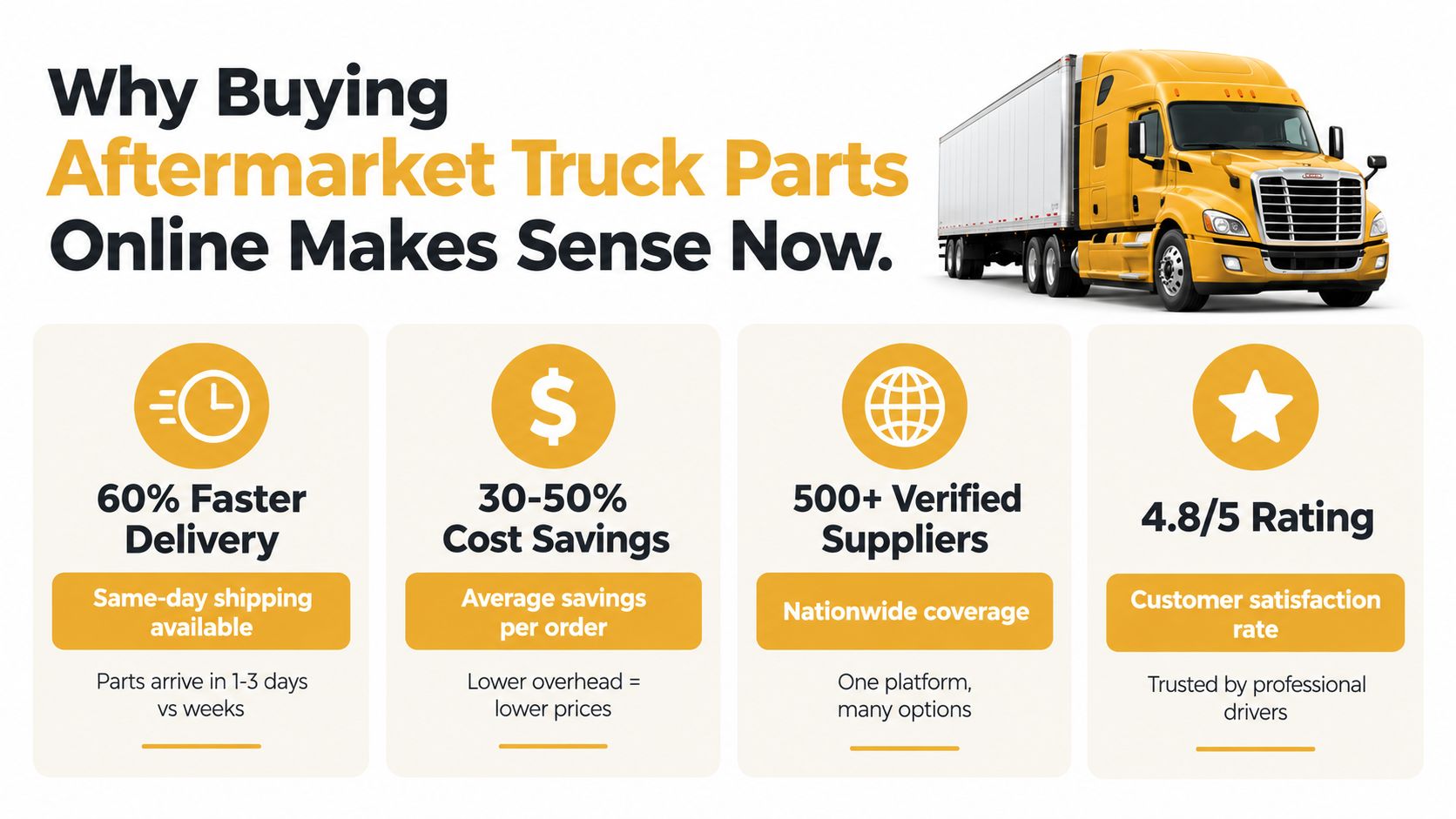
What online buying does better
A good online catalog lets you compare a Peterbilt 389 bumper, a Kenworth W900 chrome bumper, or an 18 inch drop bumper without driving between several dealers. You can review finish options, mounting details, cutouts, material choices, and delivery terms from one location.
Online buying also works well for fleet maintenance teams. A manager can send the same product page to a purchasing department, maintenance lead, and driver before placing an order. That shared record reduces confusion over which part was approved.
The channel remains fragmented, though. One market summary placed the independent aftermarket service channel, including specialty suppliers, regional distributors, and internet retailers, at 37.6% of a $25.3 billion market in 2025. It also identified online distribution as the fastest-growing channel at a projected 6.2% CAGR for 2026-2034, compared with 3.8% for offline channels, as reported in this heavy-duty truck aftermarket market summary.
Practical rule: Use online catalogs to widen your choices, but treat fitment, material specifications, and freight handling as purchase requirements, not optional details.
How to Verify Fitment Before You Order
Fitment should be confirmed before you compare chrome finishes. A bumper listing that says “fits Peterbilt” is incomplete because Peterbilt 389, Peterbilt 379, and Kenworth W900 bumpers aren't interchangeable just because the trucks look similar.
A direct-fit bumper should match the truck's exact model, mounting style, and openings. A true bolt-on installation should line up with the existing mounts and cutouts without drilling or cutting. That matters during a roadside repair, but it also matters in a shop. Extra fabrication adds labor, delays the truck, and can weaken the finished installation.
Start with the truck, not the product photo
Collect the truck details before opening a shopping cart.
- Record the VIN. Give the seller the vehicle identification number when the catalog supports VIN checks. It provides a stronger starting point than a broad make-and-model filter.
- Write down the exact model and year. A Peterbilt 389 bumper and Peterbilt 379 bumper may have different mounting arrangements. Do the same for a Kenworth W900, Freightliner Cascadia, or International LT.
- Find the OEM part number. Remove the damaged part if practical and read its identification mark, or ask your parts department to confirm the number. Aftermarket cross-references can be complex, so don't assume a similar-looking number is equivalent.
- Compare the mount pattern. Check bracket location, bolt holes, frame relationship, and bumper width. Ask for a technical drawing or clear rear-side photos if the listing doesn't show these details.
- Verify every cutout. Confirm openings for headlights, fog lights, tow hooks, sensors, license plates, and grille components. A polished bumper is useless if the lighting package doesn't match.
A 3D product configurator can make this process easier by letting you select the truck brand, model, year, style, cutouts, and finish. You can see why buying with a 3D configurator improves online shopping, but you should still verify the final configuration with the seller when the truck has swapped parts or custom modifications.
Never order a Class 8 bumper from a single front-view photo. The rear mount, openings, and frame fit decide whether it bolts on.
Choosing the Right Material for Your Bumper
Bumper material determines how the part handles road salt, moisture, stone impact, and long exposure to weather. The common choices are chrome-plated carbon steel, chrome-plated 430 stainless steel, and chrome-plated 304 stainless steel.
Bare metal will surface-rust without a protective finish. Stainless steel offers the strongest corrosion resistance for coastal routes and salt-exposed operations, but not every stainless grade performs the same way. 304 stainless generally resists pitting and chloride exposure better than 430 stainless, which makes it the stronger choice when road salt is the main corrosion threat, as explained in this bumper material guidance.
Bumper Material Comparison
| Material | Corrosion Resistance | Best For | Price Tier |
|---|---|---|---|
| Chrome-plated carbon steel | Depends heavily on surface preparation, plating, and care | Buyers focused on initial cost or a made-to-order design | Value |
| Chrome-plated 430 stainless steel | Better than bare carbon steel, but less resistant to chloride-driven pitting than 304 | General highway use and appearance-focused upgrades | Mid-range |
| Chrome-plated 304 stainless steel | Strongest resistance of these options to coastal moisture, salt, and chloride exposure | Northern salt-belt routes, coastal fleets, and long-term use | Premium |
Match the grade to the route
A truck that stays in dry desert service faces a different corrosion load than one that runs through winter salt corridors. Carbon steel can make sense when the buyer accepts more maintenance and a lower purchase tier. It's a poor choice if the bumper will see heavy salt exposure and the owner expects a mirror finish to remain easy to maintain.
430 stainless can be a practical middle ground. It provides stainless construction and a polished appearance, but buyers should understand that 304 is better suited to chloride-heavy environments.
304 stainless is an austenitic alloy with 18-19.5% chromium and 8.0-10.5% nickel, and its listed ultimate tensile strength is 73,200 psi, according to this 304 stainless bumper material reference. Those properties support its use as a premium option for hard-use Class 8 bumpers, especially where corrosion resistance matters as much as impact strength.
Material isn't the only durability factor. Ask about steel thickness, reinforcement, weld quality, plating preparation, and the finish process. A thin bumper with attractive chrome may not deliver the same long-term value as a properly supported bumper built for repeated vibration and harsh road conditions.
Understanding Warranties and Return Policies
A warranty doesn't repair a poor fit. It does show whether the supplier expects its product to perform and has a process for handling defects. For a premium bumper, read the written warranty before ordering, not after a corner arrives damaged or the chrome starts separating.
A limited manufacturer warranty usually covers defects in materials or workmanship. It may exclude collision damage, improper installation, corrosion caused by neglect, modifications, normal wear, or damage caused during freight. Those exclusions aren't automatically unreasonable, but the supplier should state them in plain language.
Read the warranty like a maintenance manager
Look for four answers:
- Coverage: Does the policy cover manufacturing defects in the steel, welds, plating, and finish?
- Remedy: Will the company repair the bumper, replace it, or offer only a partial credit?
- Freight: Who pays to return a defective or damaged part?
- Support: Can you reach a U.S.-based support team that understands Class 8 fitment?
A return policy should explain the inspection period, packaging requirements, restocking charges, and treatment of made-to-order products. A seller that hides those terms behind a generic marketplace page creates risk for the buyer.
You should also distinguish between a freight claim and a manufacturing claim. A dent in the outer corner may have happened during transit. Chrome failure around a weld may be a production issue. Photograph the packaging and part before installation so the seller has useful evidence.
For a practical reference, review the supplier's warranty claim process before you purchase. Responsive support, clear claim steps, and written coverage are more valuable than a vague promise that the product is “guaranteed.”
Before placing the order: Save the product page, fitment details, warranty terms, and return instructions as a PDF or screenshot.
A supplier that manufactures or engineers its own products can often answer technical questions more directly than a generic reseller. That doesn't make every factory-direct part suitable, but it gives you a clear point of contact when the truck has an unusual configuration.
Shipping and Handling Premium Bumpers Safely
LTL freight can damage a bumper even when the product left the warehouse in perfect condition. Shifting or unstable loads create dents, scratches, and flex damage, especially when a long body panel is laid flat without enough support.
Ask the seller how the bumper is packed before you buy. The carrier should receive a stable load with the part protected from contact with other freight. Body panels and bumpers should be positioned on edge rather than flat, with blocking, bracing, edge protectors, and shrink-wrap. A standard 48x40 pallet helps reduce flex and protects the finish, according to this bumper freight packaging guidance.
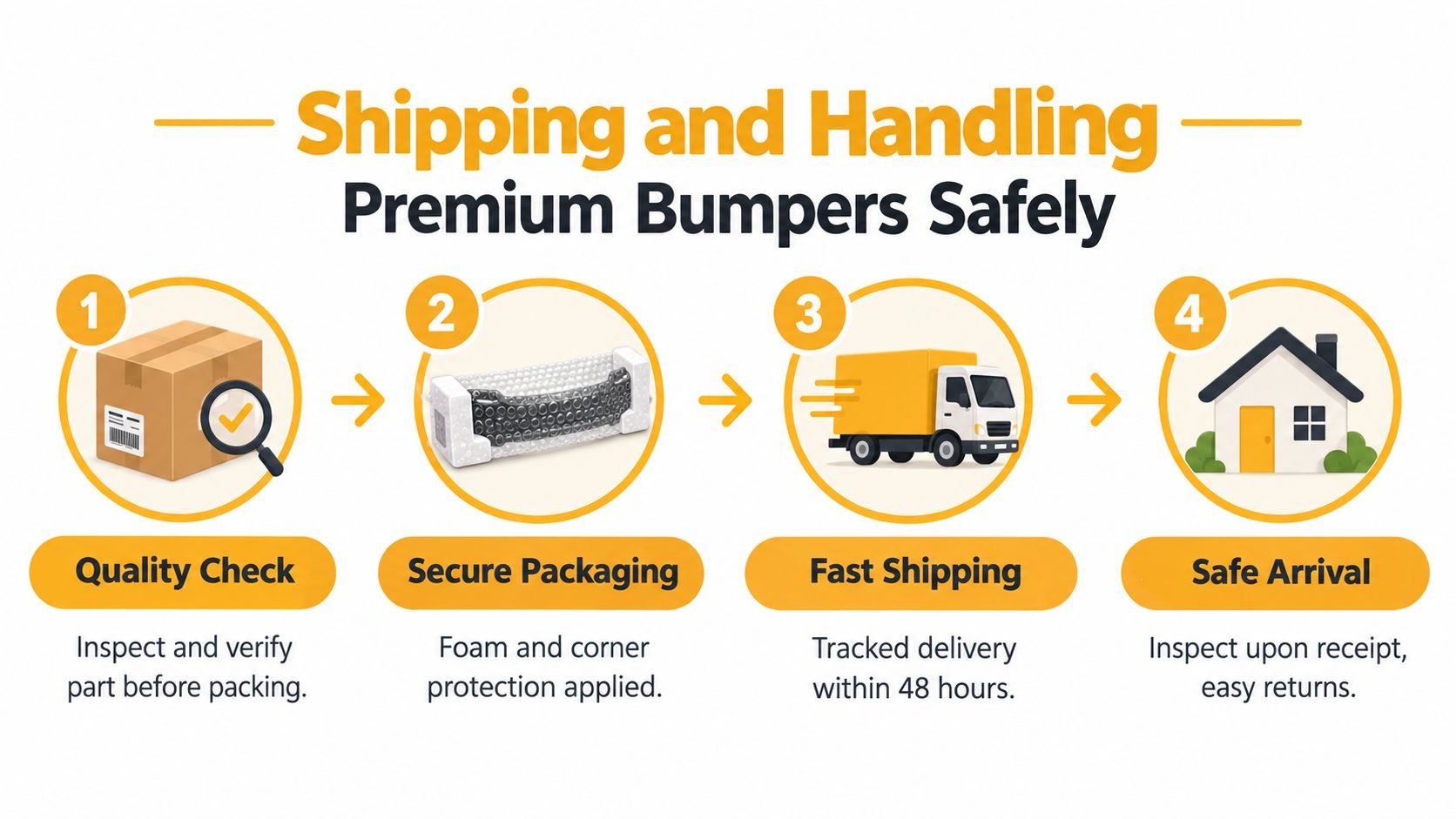
Protect the order at each stage
Before dispatch, confirm that the warehouse checked the part against the order. The team should verify model, cutouts, finish, and visible surface condition before wrapping it.
During packing, corner protection matters as much as surface wrap. A bumper can avoid scratches and still arrive bent if the pallet lets it flex or the load shifts during handling.
At delivery, inspect the crate, wrap, pallet, and bumper before signing. Photograph dents, torn packaging, exposed chrome, broken braces, and pallet damage. Write the damage on the delivery receipt and contact the seller promptly.
If you're unfamiliar with freight terms, this guide to LTL freight shipping for truck parts explains why packaging and delivery inspection matter.
Plan for the actual production schedule
In-stock products and made-to-order bumpers follow different timelines. Stainless steel flat bumpers may ship within 48 hours when available, while made-to-order carbon steel units typically take 4-6 weeks, based on the manufacturer information supplied for this guide. Confirm current availability before ordering, especially when the truck is down or a collision repair has a fixed appointment.
Don't choose a custom bumper for an emergency replacement unless the production schedule works for the load plan. A standard in-stock part with verified fitment may protect uptime better than a more elaborate design that keeps the truck parked.
Trusted Suppliers and What Sets Them Apart
The supplier should be able to explain the part without hiding behind a product photo. For a Class 8 bumper, that means clear material grades, thickness information, mounting details, cutout options, finish specifications, shipping terms, and warranty support.
A trustworthy seller may be a manufacturer, official distributor, or established chrome shop. The business model matters less than the evidence it provides. A drop-ship listing with no technical drawing and no U.S. support creates more risk than a direct seller that answers fitment questions and documents its process.
Use a supplier scorecard
Check these points before you compare final prices:
- Engineering access: Can the seller explain how the bumper mounts and whether it's direct bolt-on?
- Material transparency: Does the listing identify carbon steel, 430 stainless, or 304 stainless?
- Configuration control: Can you choose the truck model, year, style, cutouts, and finish?
- Inventory clarity: Does the seller separate in-stock parts from made-to-order products?
- Freight preparation: Does the warehouse use blocking, bracing, edge protection, and stable pallet loading?
- Warranty support: Are manufacturing defects and freight procedures explained in writing?
- U.S. communication: Can an owner-operator speak with a real support team about a truck-specific question?
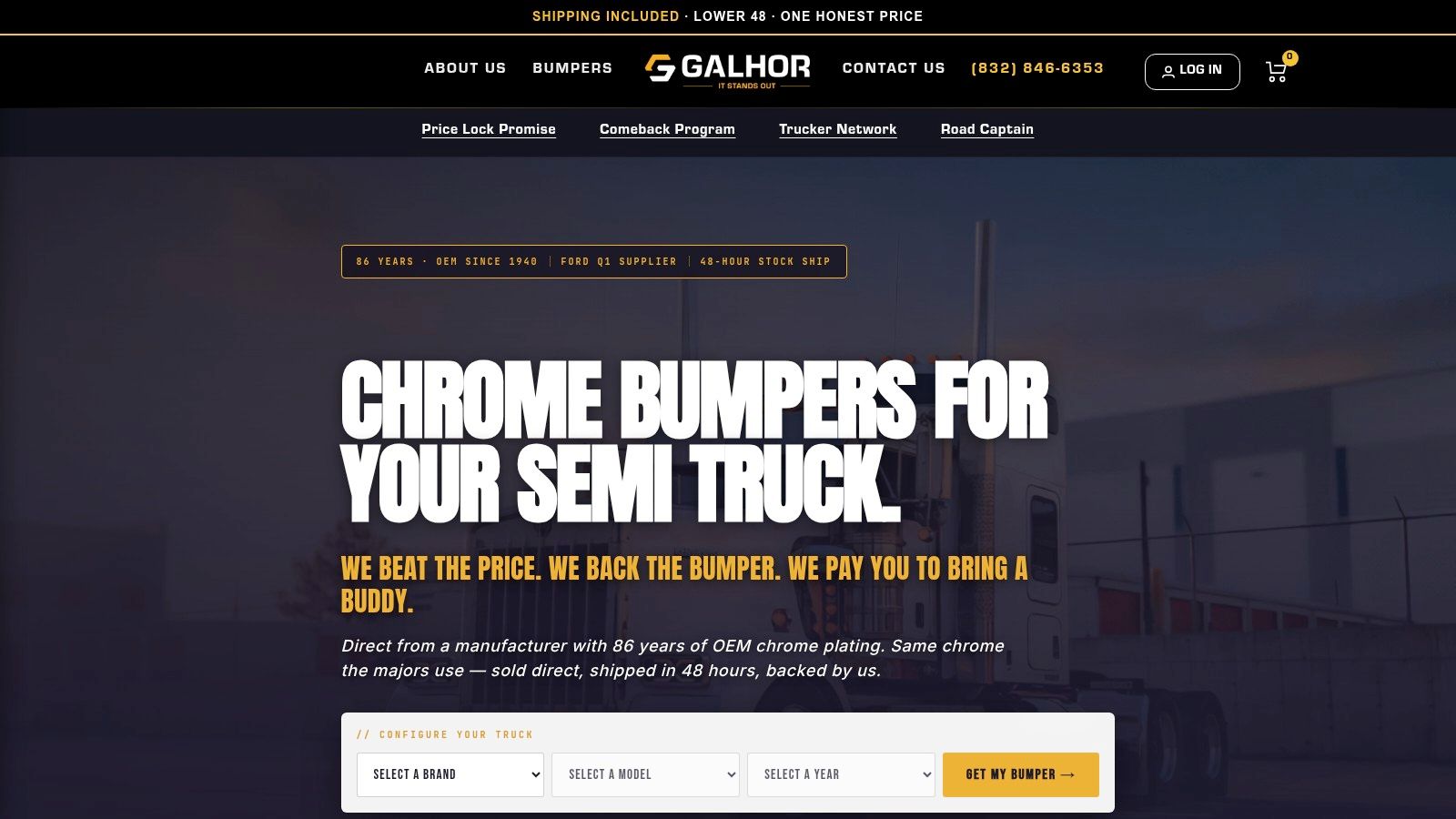
Galhor Inc. is a Texas-based manufacturer and online retailer that uses a 3D configurator for Class 8 bumpers. Buyers can select brand, model, year, style, cutouts, and finish to create a direct bolt-on configuration. Its product range includes chrome-plated carbon steel, chrome-plated 430 stainless steel, and chrome-plated 304 stainless steel, with in-stock stainless steel options that can ship within 48 hours.
Official distributors and chrome shops across the United States can also be useful when they carry documented brands and understand heavy-duty installation. Ask who handles a warranty claim, where support is located, and whether the shop can verify the mount pattern before taking your payment.
Common Mistakes to Avoid When Buying Online
The cheapest bumper is rarely the cheapest repair if it arrives damaged, fails to fit, or needs shop fabrication. Price matters, but it should come after fitment, material, finish, shipping protection, and warranty terms.
The most common mistake is trusting a broad compatibility statement. “Fits Kenworth” doesn't tell you whether the part fits a W900 with your mount style, light cutouts, and license plate opening. The same problem affects Peterbilt, Freightliner, and International trucks, especially when previous owners have changed brackets or front-end components.
Five purchase mistakes that waste money
- Buying from the photo: A front view can hide the wrong bracket or opening. Request rear photos, drawings, and mount details.
- Choosing by price alone: Compare steel grade, thickness, plating, freight packaging, and return terms before deciding.
- Skipping the VIN and OEM number: Use both when possible, then confirm the result with the seller.
- Assuming all chrome is equal: Ask whether the bumper uses chrome-plated carbon steel, 430 stainless, or 304 stainless, and ask how the surface is prepared.
- Ignoring delivery inspection: Photograph the freight before installation and document damage on the delivery receipt.
Online buying also isn't automatically lower quality than dealer buying. Premium manufacturers and established distributors sell directly online, and a detailed digital catalog can provide more configuration information than a generic counter listing. The advantage disappears when the seller won't identify the material, confirm the fit, or explain what happens if the carrier damages the bumper.
For an owner-operator, the best purchase is the one that bolts on correctly, survives the route, arrives protected, and has a clear remedy if something goes wrong. For a fleet, the same standard reduces repeat orders, installation delays, and unnecessary downtime.
Galhor Inc. offers configurable direct bolt-on chrome bumpers for Peterbilt, Kenworth, Freightliner, and other Class 8 trucks, with stainless steel options, documented fitment choices, and shipping support from Texas. Review the available Galhor Inc. configurations, confirm your truck details, and order the bumper that matches your work, finish, and route.