

Big Rig Chrome Accessories: A Buyer's Guide for 2026
You're standing beside a Peterbilt at a truck stop, looking at a bumper that's starting to pit after one hard winter. The replacement options look similar in a catalog, but the prices are far apart. That difference usually comes from material, steel thickness, plating quality, bracket design, and fitment, not just the amount of shine.
This buyer's guide to big rig chrome accessories is for U.S. owner-operators, fleet managers, custom builders, and drivers replacing damaged parts on Peterbilt, Kenworth, Freightliner, or International trucks. The practical rule is simple: choose the part that can handle long hauls, road spray, vibration, and salted roads first. The mirror finish matters, but it comes second.
Table of Contents
- What Big Rig Chrome Accessories Actually Mean
- The Main Chrome Parts on a Class 8 Truck
- How Quality Chrome Plating Is Built
- Carbon Steel vs 430 vs 304 Stainless Compared
- Spec'ing the Right Bumper for Your Truck
- Care and Maintenance for Long-Term Shine
- Why Premium Chrome Pays You Back
What Big Rig Chrome Accessories Actually Mean
A typical shop floor tells the story quickly. A Peterbilt 579 sits on the lift, bumper brackets are laid out beside the frame, and the owner asks why one chrome bumper costs several times more than another. The answer isn't found by comparing photographs. One part may use thinner steel, a lighter plating stack, or brackets that need fabrication. Another may use a heavier base, better corrosion protection, and a direct-fit mounting system.
In trade terms, big rig chrome accessories means exterior brightwork fitted to Class 8 tractors and trailers. The category includes much more than decorative trim:
- Front-end parts: Bumpers, grille shells, grille bars, headlight buckets, bug shields, sun visors, hood ornaments, and fender guards.
- Cab and sleeper trim: Cab-top molding, quarter fenders, door trim, window trim, grab handles, and sleeper panels.
- Mirror and exhaust pieces: Mirror shells, mirror arms, stack covers, rain caps, and related brightwork.
- Fuel and chassis accessories: Fuel-tank bands, tank straps, battery-box covers, step brackets, fifth-wheel covers, axle covers, hub covers, and lug-nut trim.
- Trailer accessories: Tail-light bezels, cargo-control trim, headache-rack rails, and other polished exterior pieces.
The important distinction is that some chrome parts also perform a working function. A bumper may carry tow hooks, reinforcement brackets, or under-ride hardware. A fender guard protects bodywork from road debris. A mirror shell covers a component that must stay aligned and usable in poor weather.
Shop-floor rule: Treat the shine as the final finish, not the main specification.
Owner-operators often build a truck in stages. A fleet may replace an OEM bumper after a minor collision, then add matching tank straps or mirror covers during the next service window. Whether you're ordering a Peterbilt 389 bumper, upgrading a Kenworth W900 chrome bumper, or replacing a Freightliner front end, start with the truck's exact model, year, mounting pattern, material, and thickness.
The broader automotive chrome accessories market was estimated at USD 3.968 billion in 2024 and is projected to reach USD 6.626 billion by 2035, with a 2025 to 2035 CAGR of 4.77%, according to Market Research Future's automotive chrome accessories analysis. That demand includes heavy-vehicle brightwork, where chrome helps owners express identity while protecting and replacing exterior components.
The Main Chrome Parts on a Class 8 Truck
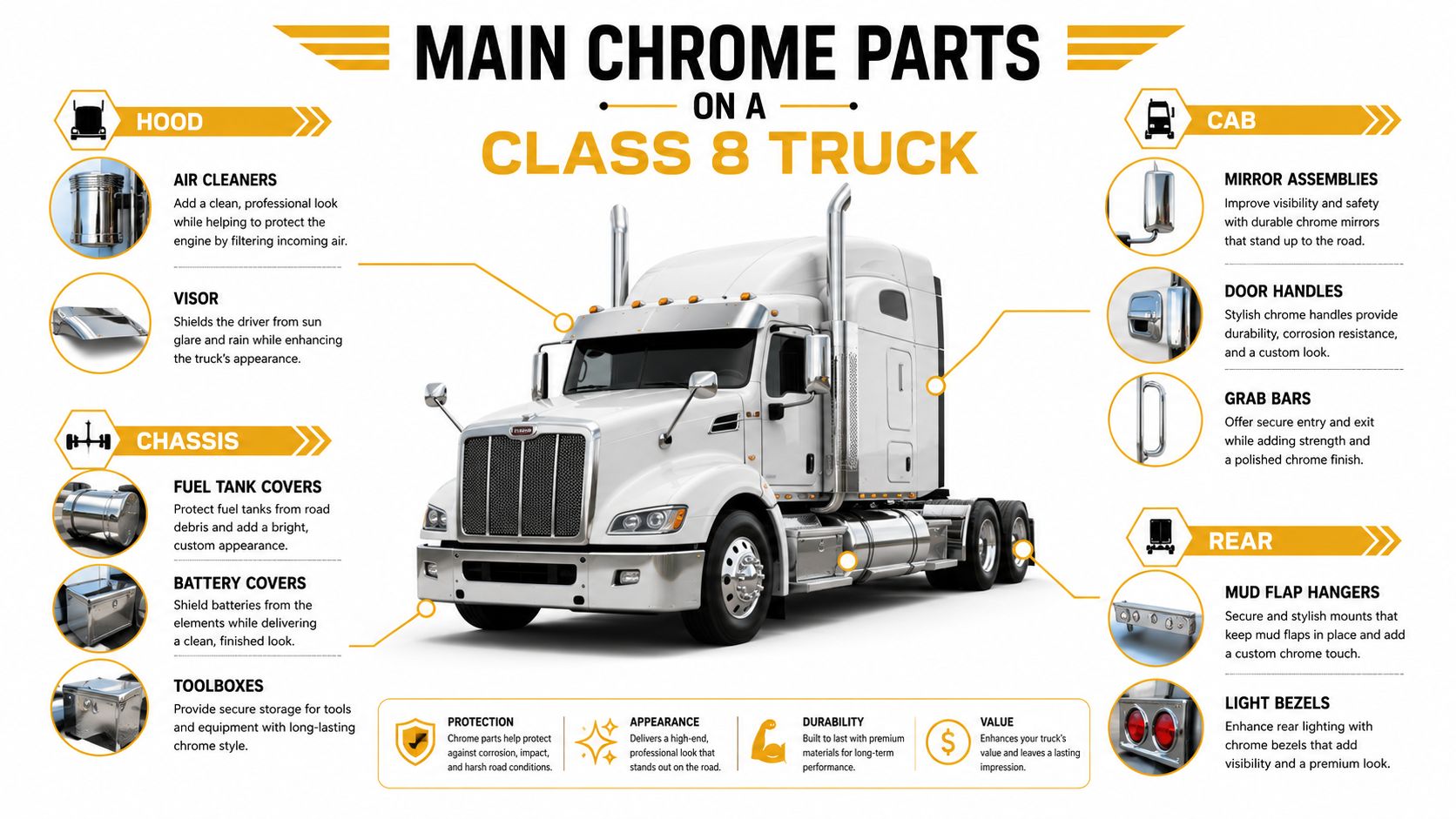
A parts counter works best when you organize the truck by zone. That keeps a full build from turning into a pile of unmatched accessories and helps a damage-replacement order include the brackets, cutouts, and hardware that are easy to overlook.
Front-end brightwork
The bumper takes the most direct abuse from stones, road spray, and low-speed contact. Buyers choose full chrome, polished stainless, drop styles, box ends, or mitered ends based on appearance and clearance. An 18 inch drop bumper and a 20-inch option can look similar in a listing, but their lower edge, brackets, and approach clearance change the truck's stance.
Grille bars and grille shells mount ahead of the radiator and shape the truck's face. Bug shields attach near the hood or grille area and help reduce insect buildup. Headlight buckets, hood ornaments, fender guards, and visor brackets add matching finish while filling gaps between major components.
Cab and sleeper trim
Cab-top moldings, door trim, window trim, and grab handles mount directly to the cab. Quarter fenders sit behind the cab and help control spray around the tractor's rear wheels. These parts are mostly appearance-driven, but loose trim can create vibration noise, rub through paint, or trap moisture against the cab.
Mirrors and stacks
Mirror covers and mirror arms must match the existing assembly. Heated and non-heated mirror shells aren't interchangeable in every configuration, so verify the mirror style before ordering. Stack covers and rain caps add finish around the exhaust system, but they must tolerate heat, moisture, and road contamination.
Fuel tanks and chassis
Fuel-tank bands and straps wrap around the tank and hold the accessory in place. Battery-box covers, step brackets, fifth-wheel covers, axle covers, hub covers, and lug-nut trim sit lower on the truck, where salt and grime collect. Their mounting points matter as much as their finish.
A chrome bumper for Freightliner Classic is listed with 10-gauge chrome-plated steel, a mirror-polished finish, and a 3 mm chrome-plated 304 or 430 stainless option. It offers standard or blind mounting, direct bolt-on installation for the Freightliner Classic, configuration-dependent cutouts, and a triple-layer hexavalent chrome process with 35 microns of nickel.
Trailer-side accessories
Tail-light bezels, cargo-control trim, and headache-rack rails finish the trailer or tractor-trailer connection area. Build a written inventory before ordering. A full truck may need front-end chrome, cab trim, mirror pieces, tank bands, chassis covers, and trailer details, while a collision replacement may require only the bumper, reinforcement, brackets, and lights.
How Quality Chrome Plating Is Built
Chrome plating is a layered system. The chromium you see is usually the thinnest layer, while the nickel underneath provides much of the barrier against corrosion. Decorative chrome is typically about 0.25 to 0.5 micrometers thick, and the nickel underlayer helps keep corrosive agents away from the steel substrate, as explained in this nickel and hard-chrome technical overview.
What each layer does
A proper process starts by cleaning and preparing the base metal. Acid pickling removes scale and contamination, while cleaning improves adhesion. Copper may then be applied as a strike or duplex layer to level small surface irregularities and improve coverage.
Semi-bright and bright nickel layers provide the main barrier protection and create the smooth surface needed for a clean reflection. The final chromium layer adds the familiar blue-white appearance, surface hardness, and resistance to everyday handling. Rinsing and drying finish the process, but they can't correct poor preparation or pits left beneath the plate.
| Layer | Function | Typical Thickness | Failure if Shortcut |
|---|---|---|---|
| Copper | Levels the surface and improves coverage | Spec depends on the plating system | Pits and uneven areas remain visible |
| Nickel | Creates the main corrosion barrier and smooth finish | Ask for the measured nickel value | Rust reaches the base metal sooner |
| Decorative chrome | Adds color, hardness, and mirror appearance | About 0.25 to 0.5 µm | Finish wears or loses protection at defects |
For a buyer, the useful questions concern total plating thickness, nickel thickness, and salt-spray performance. A GM nickel-chromium specification uses total plate thickness of 20.0 to 25.0 micrometers and corrosion-resistance targets from 16 to 44 hours, depending on the plate code, according to the GMW 15613-2020 technical standard. The same technical literature notes that properly executed nickel-chrome plating can show no visible corrosion after more than 2,000 hours in some harsh-environment tests.
Those figures aren't a promise that every bumper will survive every route. They show why the supplier's process and documentation matter. Ask whether the number refers to total plate or nickel alone, and ask which salt-spray method was used.
Red flags include thin or undisclosed nickel, no copper where the process requires it, polished-over pits, and missing test documentation. A bright part can still be poorly plated. Look for a supplier willing to identify the base material, finish process, thickness, mounting method, and warranty terms.
For a process-level explanation of preparation, copper, nickel, and chromium, review Galhor's chrome plating process guide.
Carbon Steel vs 430 vs 304 Stainless Compared
A bumper's base material determines what happens after a stone chip, scratch, or failed plating spot. Chrome-plated carbon steel provides the traditional heavy-duty feel, but its corrosion protection depends on the plating remaining intact. Once damage exposes the steel, orange rust can spread from the defect and work beneath the surrounding finish.
430 stainless steel takes a different approach. It contains about 16 to 18% chromium and no nickel, while 304 stainless steel commonly contains about 18% chromium and 8% nickel, according to this 430 versus 304 composition comparison. Chromium supports a passive oxide layer. Nickel gives 304 better resistance in demanding, chloride-rich service. For a closer grade-by-grade explanation, see this 430 versus 304 stainless steel guide.
Route conditions should drive the specification. A regional truck with limited winter-salt exposure may work well with 430 or properly plated steel. A coastal truck or northern unit that spends much of the season in wet brine puts more pressure on the material and finish.
| Material | Corrosion Resistance | Weight | Relative Cost | Best Fit On Truck |
|---|---|---|---|---|
| Chrome-plated carbon steel | Depends heavily on plating integrity | Heavy-duty feel | Lower | Traditional bumpers and budget-conscious replacements |
| 430 stainless steel | Better than plated steel, but below 304 in harsh chloride exposure | Moderate | Mid-range | Bug shields, fender trim, lighter panels, and practical upgrades |
| 304 stainless steel | Strongest of the three for outdoor salt and weather exposure | Moderate | Higher | Premium bumpers, mirror parts, and exhaust-related brightwork |
Grade 304 has a minimum chromium content of 18%, while 430 has about 17% chromium, as outlined in this stainless-grade comparison. Alloy content is only part of the result. Forming, weld quality, surface preparation, and polishing also affect how the finished part handles service.
Match material to service
Choose chrome-plated carbon steel when purchase cost and traditional appearance matter most, provided the truck can receive regular inspections. Choose 430 when you want stainless corrosion resistance at a lower material cost than 304. Choose 304 when road salt, coastal air, and long outdoor exposure make pitting, replacement labor, or downtime more expensive than the initial purchase.
304 contains nickel and generally resists corrosion better than 430, a ferritic grade without nickel, according to ThyssenKrupp Materials' comparison. The practical decision is not just which option costs less today. Match the grade to the truck's route, wash schedule, exposure, and the cost of taking that Class 8 unit out of service.
Spec'ing the Right Bumper for Your Truck
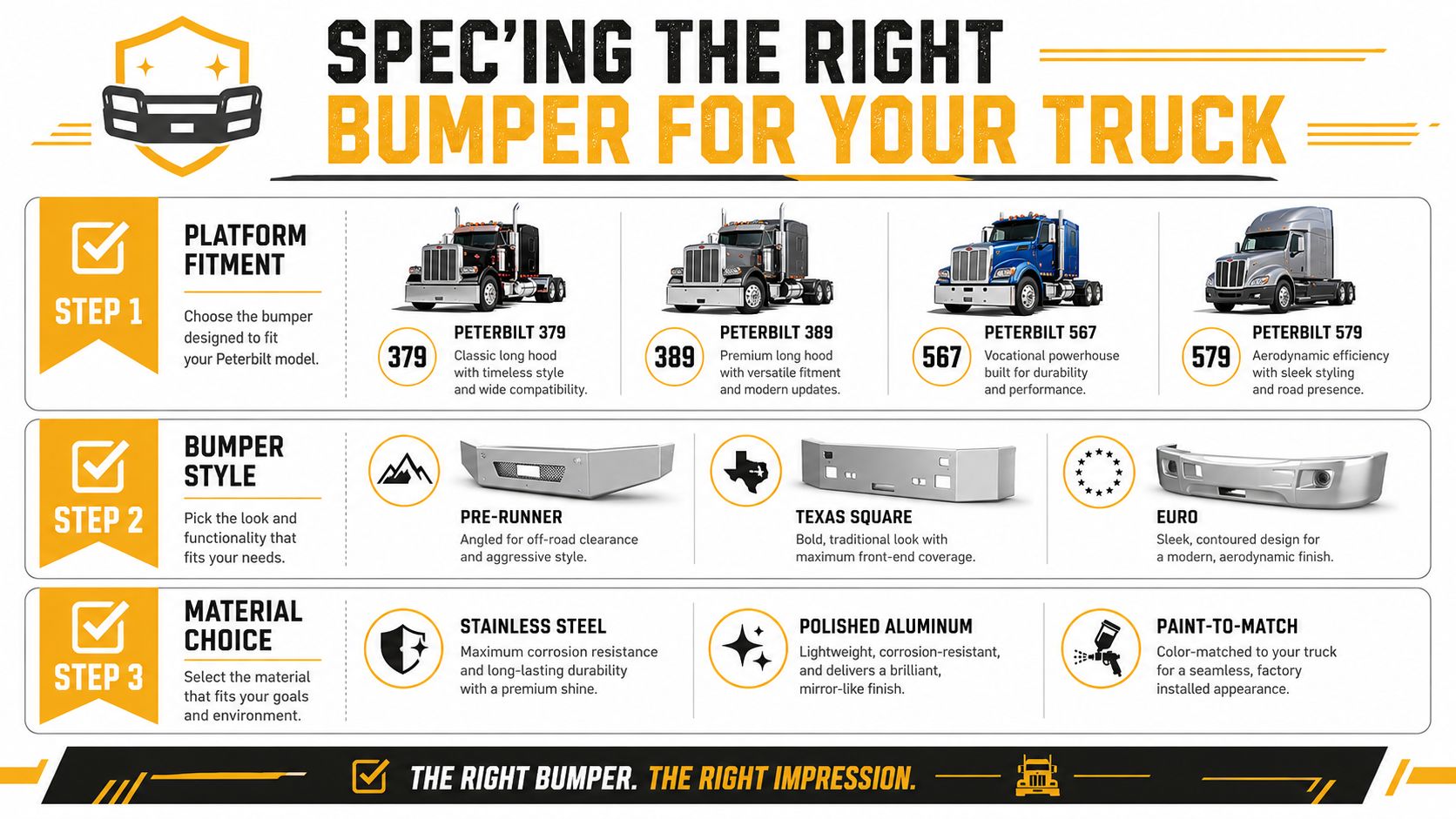
A bumper order starts with platform fitment, not style. A Peterbilt 379 bumper won't automatically fit a 389, and a Peterbilt 567 or 579 uses its own bracket geometry. Kenworth W900, T680, and T880 parts can share design cues without sharing mounting dimensions.
Freightliner Cascadia and Coronado bumpers aren't interchangeable by appearance alone. International LT and ProStar also require their own mounting checks. Before you buy, send the supplier the truck's make, model, year, bumper style, mount type, light cutouts, and a clear photo of the existing brackets when possible.
Start with the mounting system
A direct bolt-on bumper may reuse factory reinforcement brackets, while another aftermarket design may require a complete bracket kit. Don't assume the bumper includes every mounting component. Confirm whether the order is for the shell only, a standard mount, a blind mount, or a bumper and bracket package.
The lower edge also matters. Common U.S. truck-bumper listings include 18-inch and 20-inch box-end or mitered-end styles, so confirm the measurement, end shape, and frame relationship before selecting an 18 inch drop bumper, according to this RoadWorks bumper fitment listing.
Choose the working style
Full chrome gives the classic show-truck appearance. Chrome-on-stainless can make sense when you want stainless as the base material with a bright plated surface. Set-back and extended designs change approach clearance and front-end stance. Tow and non-tow versions differ in how they accommodate towing hardware.
Check these options before placing the order:
- Light cutouts: Verify fog-light openings, headlight openings, and any OEM-style air-intake screens.
- End profile: Compare box ends, mitered ends, Texas Square, Pre-Runner, and Euro styles against the truck's existing body lines.
- Material: Select chrome-plated carbon steel, 430 stainless, or 304 stainless based on route exposure and budget.
- Thickness: Confirm the steel gauge or stainless thickness, not just the word heavy-duty.
- Bracket reuse: Ask whether factory reinforcement brackets must be reused or whether the supplier provides new hardware.
Use a semi-truck bumper fitment guide to organize the questions before calling the parts desk. Also verify applicable federal and state bumper-height and protrusion requirements with your carrier's compliance process. A bumper that looks right can still create an inspection problem if it sits too low, extends too far, or blocks required equipment.
Care and Maintenance for Long-Term Shine
Chrome lasts longer when the driver removes salt and road film before they can sit on the surface. A working truck doesn't need a complicated detailing program, but it does need a routine that fits fuel stops, winter routes, and long days behind the wheel.
A repeatable maintenance routine
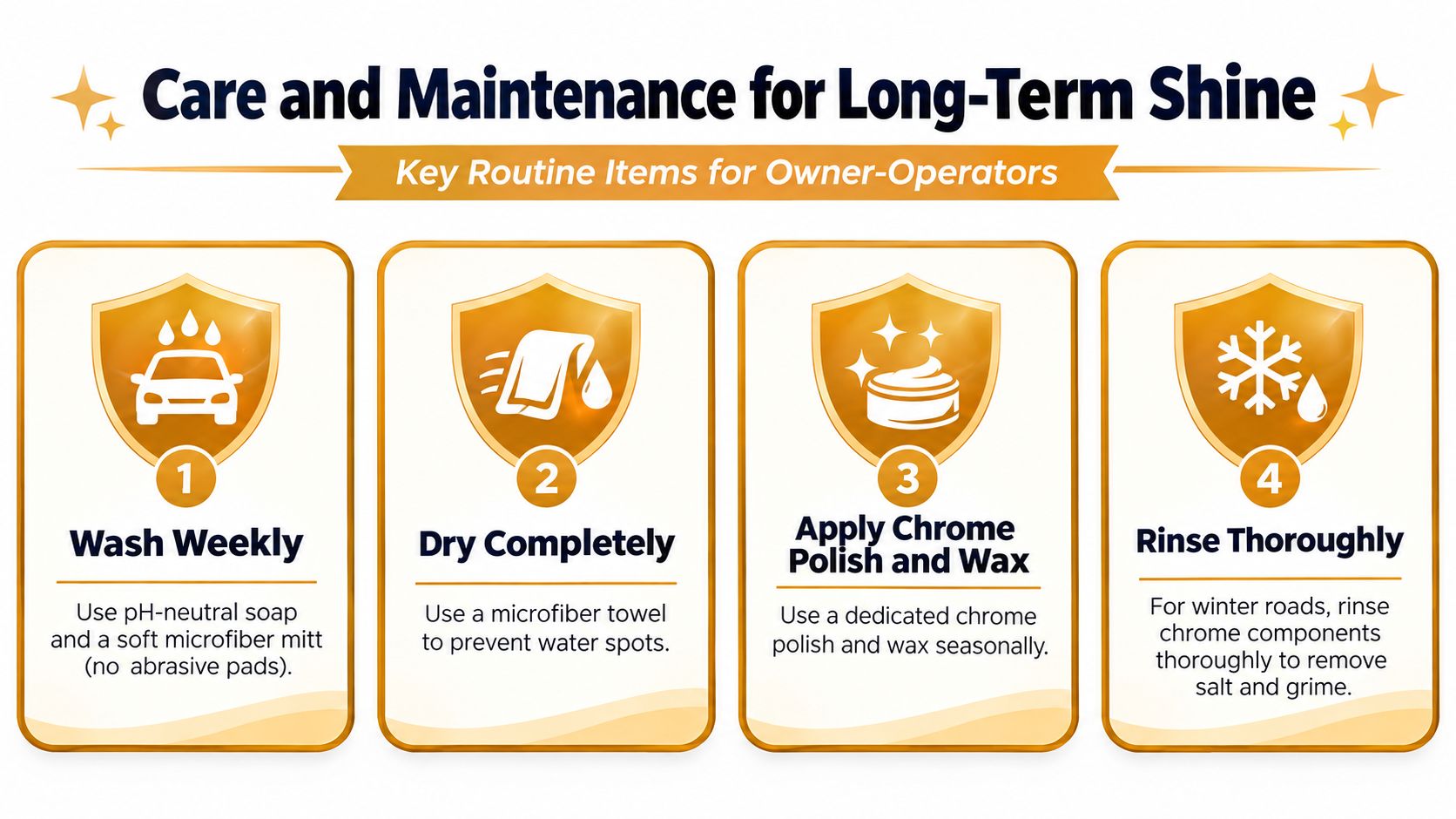
Wash the chrome at least weekly with pH-neutral soap and a soft microfiber mitt. Don't use an abrasive pad, and don't wipe dry salt across the surface because grit can scratch the finish.
Dry every seam, edge, bracket, and recessed area with a clean microfiber towel. Water left behind a bumper or around mounting hardware can keep road contaminants active against the metal.
- At fuel stops: Keep quick detailer and clean wipes in the cab for fresh bug splatter and road film.
- Within 24 hours: Remove bug residue, tree sap, and brake dust before acids or iron particles can stain the finish.
- Monthly: Use a non-abrasive polish to maintain a smooth surface, then apply a dedicated chrome or metal sealant after washing and drying.
- Quarterly: Inspect mounting bolts and brackets for movement, looseness, or rubbing that can damage the finish through vibration.
Winter trouble spots
Saltwater reaches the lower valance, fog-light buckets, bumper brackets, wheel areas, steps, and mirror brackets first. Rinse those areas whenever practical after heavy exposure, and let the parts cool before cleaning exhaust accessories.
Deep pitting and peeling aren't polishing problems. Once the plating has failed beneath the surface, aggressive buffing can remove more finish without restoring the missing protection. Replace the part or have it professionally evaluated when corrosion has gone below surface staining.
Why Premium Chrome Pays You Back
A premium bumper should be evaluated as a cost-per-mile and uptime decision, not a vanity purchase. The cheaper part may save money at checkout, but a poor fit can add installation labor, a thin finish can require earlier replacement, and a weak bracket setup can create vibration damage during every haul.
The commercial ecosystem is already large. One 2026 estimate placed the global truck accessories market at USD 26.54599 billion, with a projection of USD 49.19196 billion by 2035 and a 7.1% CAGR, according to Research Reports World's truck accessories market coverage. A separate commercial-vehicle accessories analysis valued that broader market at USD 95.7 billion in 2024, with the truck segment projected to reach USD 58.6 billion by 2030, as summarized by South Florida Reporter's truck-accessory market discussion. Those figures point to sustained spending on replacement, protection, utility, and appearance parts. They don't eliminate the need to compare specifications.
What separates a serious supplier
Look for clear answers on:
- Material certification: The supplier should identify carbon steel, 430 stainless, or 304 stainless.
- Thickness: The listing should state steel gauge or stainless thickness.
- Plating disclosure: Ask for nickel thickness and the plating process, not only “chrome finish.”
- Fitment: Confirm model, year, mount type, cutouts, and bracket requirements.
- Warranty: Read whether coverage addresses defects in workmanship and materials.
- Freight timing: Align delivery with a scheduled down day, especially for a fleet truck.
Galhor Inc. offers configurable chrome bumpers for Peterbilt, Kenworth, Freightliner, and Volvo Class 8 applications through a 3D configurator. Buyers select the brand, model, year, style, cutouts, and finish, with material options that include chrome-plated carbon steel, 430 stainless, and 304 stainless. The company states that in-stock stainless flat bumpers can ship within 48 hours, while made-to-order carbon steel units typically ship in 4 to 6 weeks, so confirm current timing before scheduling installation.
For an owner-operator, reliable fitment can turn a planned shop visit into a same-day installation instead of a fabrication project. For a fleet, repeatable specifications and clear warranty support make purchasing easier across multiple trucks. Fast shipping across the United States also matters when a collision replacement is holding up a truck's return to service.
Choose the bumper that matches the route, the truck, and the maintenance plan. Then request a quote, confirm fitment with the parts desk, and schedule delivery before the next planned down day.
If you're replacing a damaged bumper or building out a Peterbilt, Kenworth, Freightliner, or Volvo, visit Galhor Inc. to configure a direct-bolt-on chrome bumper by truck model, year, style, cutouts, finish, and material. Request fitment confirmation and shipping timing before ordering so your upgrade arrives ready for the shop, not waiting on a missing bracket or wrong mounting pattern.