

Chrome Shop Truck Parts Guide to Bumpers and Finishes
You're parked at a truck stop, looking at a front bumper that's taken too many hits from gravel, weather, and tight docks. Maybe the chrome is peeling. Maybe rust is creeping in around the edges. Maybe the truck still runs hard, but the front end makes your Peterbilt 389 bumper or Kenworth W900 chrome bumper search feel urgent instead of optional.
That's where Chrome Shop Truck Parts stop being just dress-up parts. A bumper affects how your truck looks at a shipper, how it holds up through winter, how often you have to replace it, and how much downtime you eat when the wrong part doesn't fit. For owner-operators and fleet managers, that's money.
Buyers get tripped up. They search for an 18 inch drop bumper, a Freightliner replacement, or a stainless upgrade, then get hit with vague claims like “premium finish” or “high quality steel.” That doesn't help when you need to know the material, the finish stack, the fitment, and whether the part will survive road salt and hard miles.
Table of Contents
- Introduction to Chrome Shop Truck Parts for Owner Operators
- What a Chrome Shop Really Offers Beyond the Shine
- Materials and Finishes That Determine Bumper Durability
- How to Evaluate and Choose the Right Chrome Shop Truck Parts
- Direct Bolt On Configurable Bumpers and the Installation Process
- Choosing a Reliable Chrome Shop and Understanding Shipping and Compliance
- Upgrade Your Truck Today With Confidence
Introduction to Chrome Shop Truck Parts for Owner Operators
If you're shopping chrome shop truck parts right now, you're probably trying to solve one of three problems. Your current bumper is damaged, the front of the truck looks tired, or you want a cleaner, more professional look before the next load goes out.
For a working truck, a bumper is not just cosmetic. It takes road spray, bugs, wash chemicals, winter grime, and small impacts every week. If the metal and finish aren't right, the bumper can start looking rough long before the truck is ready to come off the road.
Why chrome shop parts matter on working trucks
A lot of drivers think of chrome shops as places for lights, trim, and show-truck extras. That's only part of it. In the U.S. heavy-duty market, aftermarket demand stays strong because these trucks stay in service, get repaired, and get upgraded over time. U.S. aftermarket demand for parts for Class 6-8 trucks, trailers, and container chassis reached USD 31.6 billion in 2019, up 5.7% from the prior year, and another estimate puts the U.S. heavy-duty truck aftermarket at USD 30.5 billion in 2024 with a projection to USD 45.2 billion by 2034 at a 4.1% CAGR. A global estimate places the heavy-duty truck aftermarket at USD 127.4 billion in 2025, projected to reach USD 186.8 billion by 2033 at a 5.2% CAGR (heavy-duty truck aftermarket figures).
That matters because bumpers, trim, mirrors, visors, and other appearance parts sit inside a bigger replacement and upgrade economy. A separate market view of truck accessories estimates USD 24.8 billion in 2025 and USD 26.5 billion in 2026, projected to reach USD 49.2 billion by 2035 at a 7.1% CAGR, while another estimate puts the sector at USD 6.22 billion in 2024, rising to USD 10.54 billion by 2035 (truck accessories market outlook).
Practical rule: If a part sits on the nose of a Class 8 truck, treat it like a wear item and an image item at the same time.
What a smart buyer checks first
Before you order a Peterbilt 389 bumper, a Kenworth W900 chrome bumper, or an 18 inch drop bumper, check these basics:
- Material first: Is it chrome-plated steel, 430 stainless, or 304 stainless?
- Fitment next: Does it match your truck's brand, model, year, and mount style?
- Finish details: Is the finish just described as shiny, or does the seller tell you the plating system?
- Install path: Is it direct bolt-on, or will the shop need to drill, cut, or modify mounts?
Buyers who slow down here usually get the right part the first time.
What a Chrome Shop Really Offers Beyond the Shine
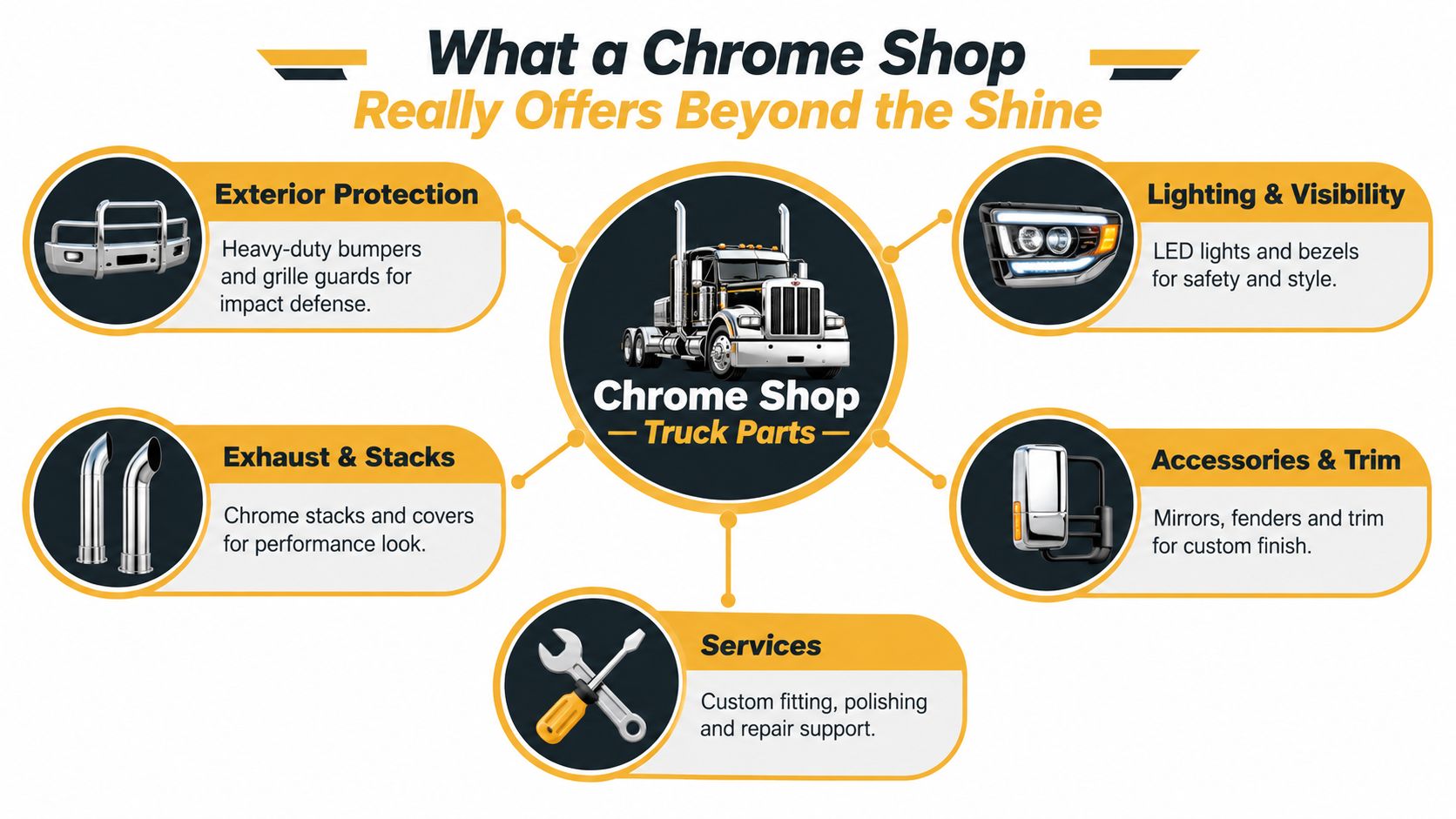
A real chrome shop does more than sell bright parts off a shelf. It usually sits somewhere between a parts counter, a body shop, and a truck appearance specialist.
The main parts categories
Most chrome shop truck parts fall into a few practical groups:
- Front-end protection: Bumpers, drop bumpers, grille guards, and related mounts.
- Visibility parts: Mirror covers, bezels, and lighting trim.
- Cab appearance: Visors, trim pieces, and exterior accents.
- Side and rear accessories: Fenders, brackets, and finishing pieces.
- Exhaust dress parts: Visible covers and polished components on trucks built for style as well as function.
If you own a Freightliner, Peterbilt, Kenworth, or International, the shop should be able to talk in model-specific terms, not just universal terms.
Parts retailer, plating shop, or full-service chrome shop
These are not the same thing.
A parts retailer mainly stocks and ships finished parts. A plating shop works on the finish itself and may re-plate or refinish metal parts. A full-service chrome shop may sell parts, handle custom fitting, repair damaged pieces, polish worn surfaces, and help you match the right bumper to a specific truck.
That difference matters when lead time is tight. A stocked bumper can ship faster. A custom-built or refinished bumper may take longer, but it can solve fit and appearance problems a shelf part can't.
One example is the Chrome bumper for Freightliner Classic, designed and manufactured by Estañadora, owner of Galhor, Inc. Based on the catalog details, it's built from 10-gauge chrome-plated steel with a mirror-polished finish, and it's also available in 3 mm chrome-plated Stainless Steel 304/430 with standard mount and blind mount options.
What services change your buying experience
The best shop for you depends on what problem you're solving.
- Need a fast replacement: Look for stocked inventory, clear fitment notes, and direct bolt-on language.
- Need a cleaner custom look: Ask about cutouts, mount style, and finish choices.
- Need repair support: Some shops can help restore or replace damaged front-end parts instead of forcing a full cosmetic rebuild.
- Need less downtime: Shops with solid catalog details usually save you from ordering the wrong part.
A chrome shop that can't explain fitment, finish, and mount style in plain English is asking you to guess with your money.
Materials and Finishes That Determine Bumper Durability
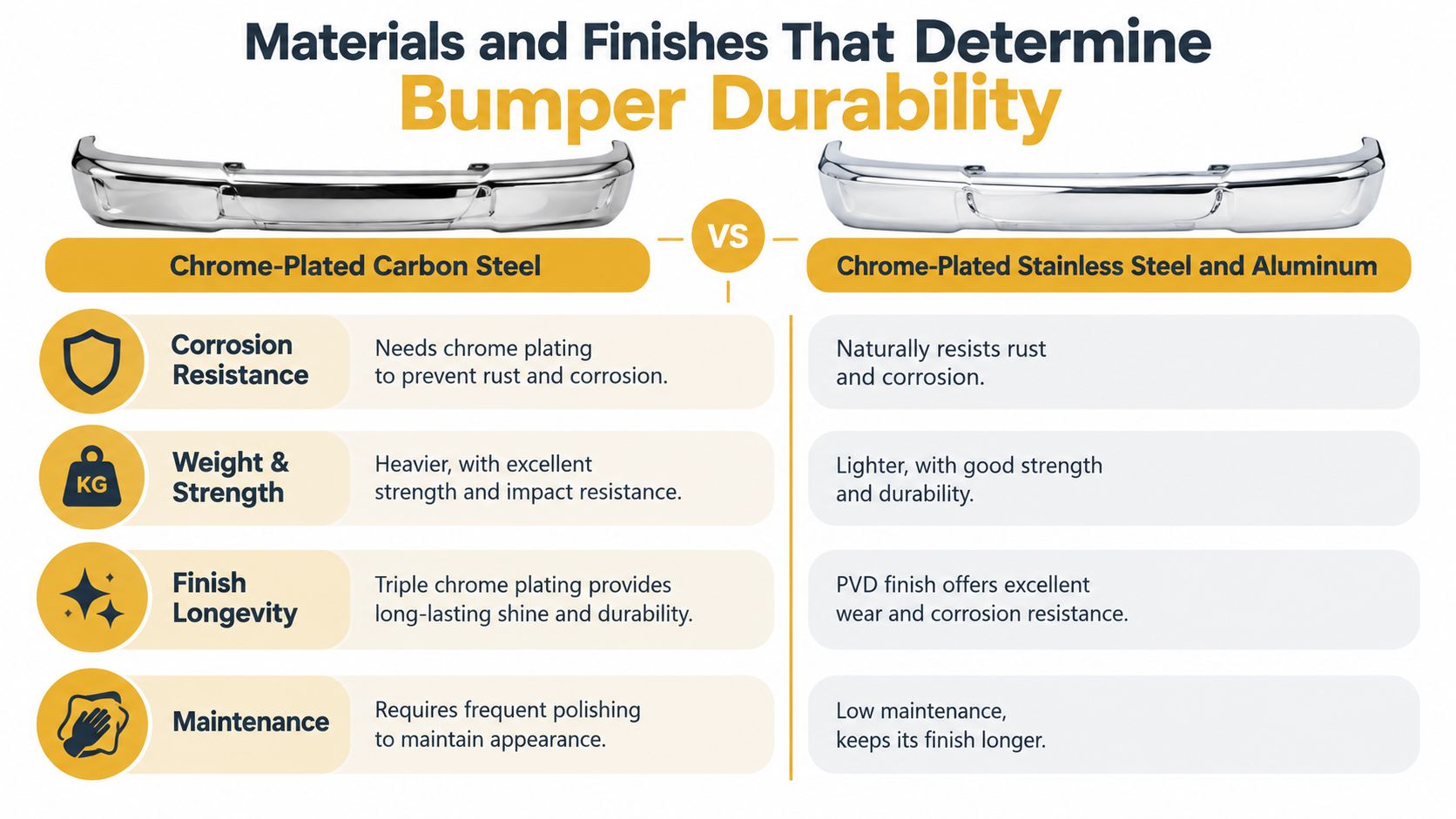
A bumper's life depends on two things. What the bumper is made from, and how the surface finish is built. Buyers often focus on shine first. That's backwards.
Chrome is a finish, not the base metal
Many truck owners get mixed up. Chrome plating is a surface finish. It does not tell you what's underneath. Independent guidance on truck accessories makes that point clearly. Buyers should not assume a chrome-plated part has a stainless base, or that every polished part will age the same in fleet use (guidance on chrome as a finish versus material).
If a seller just says “chrome bumper,” you still need to ask what the substrate is.
Why nickel thickness matters more than the chrome skin
The top chrome layer is very thin. In nickel-chromium systems, industry plating guidance shows about 20 to 25 µm of nickel and only 0.15 to 0.50 µm of chrome can produce 16 to 44 hours in CASS testing, depending on the stack and substrate class. The same technical guidance shows corrosion resistance rises with nickel thickness, and duplex or microporous nickel systems outperform single bright-nickel stacks in 48 and 96 hour CASS testing (nickel-chromium plating guidance).
That's why a bumper with a stronger nickel build usually lasts longer in winter service than one that only looks bright on day one.
Shop-floor advice: When a bumper will live in road salt, ask about the nickel build before you ask how mirror-like the chrome looks.
304 stainless, 430 stainless, and chrome-plated steel
For stainless bumpers and trim, the grade matters.
304 stainless is an 18/8 alloy, with about 18% chromium and 8% nickel, and it protects itself with a passive chromium-oxide film that self-heals when exposed to oxygen and moisture (304 stainless guidance). In plain terms, 304 gives you a stronger all-around corrosion barrier for harsh weather use.
430 stainless is a ferritic stainless. It can resist many common media, and industry data notes its chloride-stress-corrosion cracking resistance at elevated temperatures is better than austenitic 304 and 316 in that specific condition (430 stainless datasheet). But stainless grade guidance also says its resistance to pitting and crevice corrosion is lower than 304, and it's not usually recommended for exterior exposure unless the surface is highly polished or buffed (430 versus 304 grade guidance).
That's why route matters. A truck running in dry regions can often live happily with 430 in visible parts. A truck in snow-belt conditions usually benefits from 304.
Chrome Bumper Material and Finish Comparison for Class 8 Trucks
| Material Option | Corrosion Resistance | Best Use Case | Finish Notes |
|---|---|---|---|
| Chrome-plated carbon steel | Depends heavily on plating stack and nickel build | Trucks where cost and appearance matter, with regular upkeep | Chrome appearance can look strong, but the base metal needs the finish to stay protected |
| Chrome-plated stainless steel 430 | Better base corrosion resistance than carbon steel in many common conditions | Dry or milder routes, appearance upgrades, lower-exposure fleets | Surface still matters, but the substrate adds protection |
| Chrome-plated stainless steel 304 | Strong all-around resistance for harsh atmospheric service | Snow-belt fleets, winter routes, trucks exposed to repeated wash cycles | Best choice when uptime and long-term appearance matter most |
For a closer look at how substrate changes real bumper life, read this comparison of chrome-plated steel vs chrome-plated stainless steel.
How to Evaluate and Choose the Right Chrome Shop Truck Parts
A bumper can look right online and still be wrong for your truck. Smart buying comes down to details you can verify before checkout.
Start with fitment, not finish
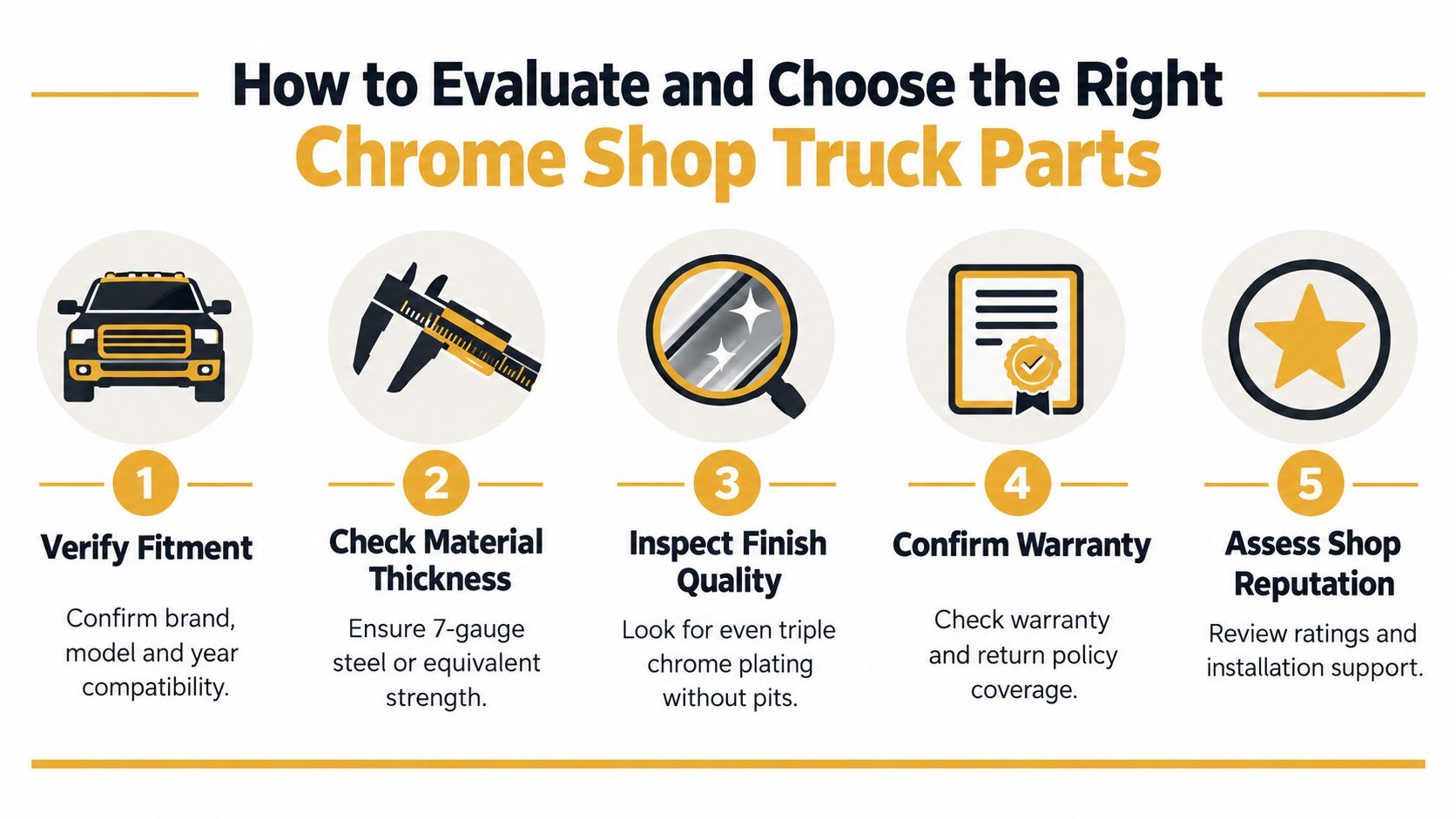
If you drive a Peterbilt 389, Kenworth W900, Freightliner Classic, or an International model, fitment has to match the truck exactly. Brand alone isn't enough. Mount style, cutouts, and bumper shape can change what bolts up cleanly.
Check these points first:
- Truck match: Confirm brand, model, and year.
- Mount style: Standard mount and blind mount are not the same thing.
- Cutout needs: Fog lights, tow holes, and other openings should match your truck setup.
- Direct bolt-on claim: If the seller says no drilling or cutting, that should be stated clearly.
A direct bolt-on bumper saves shop time and lowers the chance of install mistakes.
Read the spec line like a mechanic
You want real specs, not sales talk. If the listing doesn't state the material, gauge, finish type, and installation notes, keep digging or move on.
Look for:
- Material callout: 304 stainless, 430 stainless, or chrome-plated steel.
- Thickness or gauge: A bumper should have a stated thickness, such as 10-gauge steel or a metric stainless thickness.
- Finish details: Mirror polish is useful to know, but plating details tell you more.
- What's included: Bumper only, brackets, or cutouts based on configuration.
- Warranty language: Coverage for defects in workmanship and materials matters.
A short buying checklist that saves downtime
Use this when you compare chrome shop truck parts side by side.
- Ask what metal is under the finish. Don't assume chrome means stainless.
- Match your route to the material. Dry route and snow route trucks don't need the same thing.
- Verify the install notes. Direct bolt-on is different from “universal fit.”
- Check support after the sale. Clear returns, shipping terms, and defect coverage matter when freight damage or fit issues happen.
- Watch for vague wording. “Heavy-duty” means very little without gauge or material details.
If the product page gives you real specs, the seller probably understands working trucks. If it only gives you shiny photos, be careful.
One factual example of a configurable option in this space is Galhor Inc., which offers a 3D configurator for Class 8 bumpers where the buyer selects brand, model, year, style, cutouts, and finish, with products engineered in-house using U.S.-sourced steel and supported from Magnolia, Texas.
Direct Bolt On Configurable Bumpers and the Installation Process
Modern bumper buying is much easier when the seller lets you configure the part around your truck instead of forcing you to guess from a generic menu.
How configurable bumper buying works
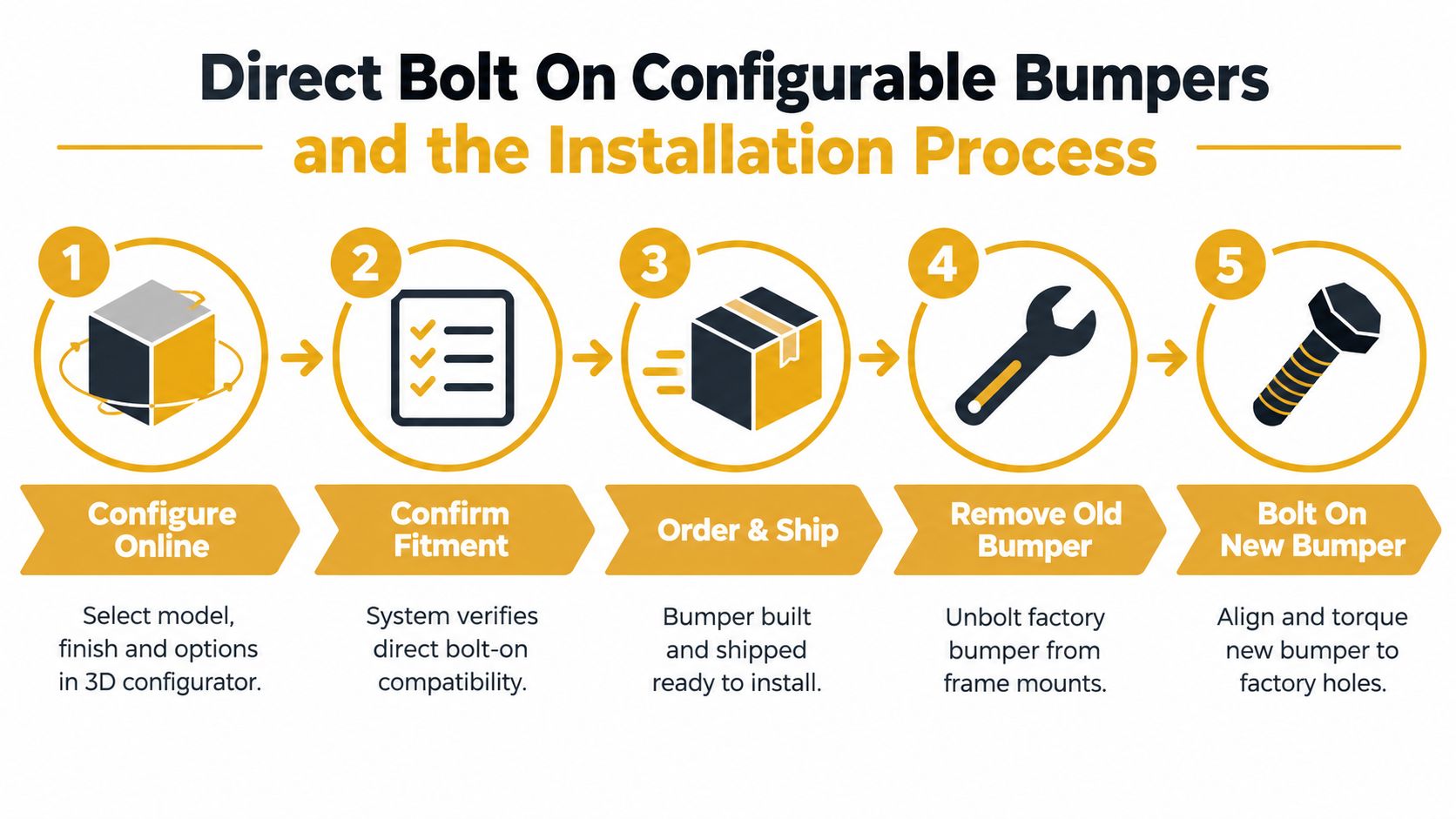
A good configurator lets you choose the truck brand, model, year, style, cutouts, and finish before you place the order. That matters for high-intent parts like a Peterbilt 389 bumper, a Kenworth W900 chrome bumper, or an 18 inch drop bumper, because those buyers usually want a clean fit with less back-and-forth.
This buying model works well for direct bolt-on parts because the fitment is tied to your exact setup. You're not trying to force a close-enough bumper onto factory mounts.
For a practical look at that process, this article on why buying with a 3D configurator is better than traditional online shopping breaks down how configuration reduces guesswork.
What to confirm before you order
Before you click buy, check these items:
- Model-specific fitment: Make sure the bumper is built for your exact truck.
- Cutout layout: Fog light and tow-hole needs should be chosen up front.
- Material choice: Pick based on route and weather, as covered earlier.
- Mounting method: Direct bolt-on should mean factory hole alignment with no drilling or cutting.
- What arrives in the shipment: Know whether you're receiving the bumper only or a fuller install package.
This helps body shops, owner-operators, and fleet maintenance teams avoid delays once the old bumper comes off.
Here's a walk-through of a bumper install setup and process:
Basic install flow on Class 8 trucks
Most direct bolt-on bumper installs follow a simple pattern on Freightliner, Peterbilt, Kenworth, and Volvo trucks:
- Remove the damaged bumper: Unbolt it from the frame mounts and save hardware if the install guide says it can be reused.
- Check the mounting points: Bent brackets, rusted bolts, or collision damage can throw off alignment.
- Test-fit the new bumper: Set it in place before final tightening.
- Align cutouts and edges: Make sure lights, tow holes, and body lines sit correctly.
- Torque it down evenly: Tighten in stages so the bumper sits square.
If the truck took a front-end hit, a body shop should inspect the structure first. A direct bolt-on bumper won't fix bent mounts or hidden frame-end damage.
Choosing a Reliable Chrome Shop and Understanding Shipping and Compliance
The part itself matters. The shop behind it matters just as much.
When you buy heavy bumpers, shipping, regulatory pressure, and supply continuity all affect whether the truck gets back on the road on time.
Why shipping details matter for heavy bumpers
Most heavy truck bumpers move by LTL freight, which means less-than-truckload shipping. In that system, multiple shippers share trailer space, and industry guides commonly define LTL as freight that does not fill a full truckload. Shipments are often around 150 to 15,000 pounds, though minimum weights and pallet limits vary by carrier (LTL freight guide).
That matters because a bumper is not a small-parcel item. You want a seller with clear freight handling, support, and realistic delivery communication across the United States.
Compliance affects availability, not just regulation
Most buyers never ask where the plating work comes from or whether the facility is dealing with environmental pressure. They should.
Recent regulatory coverage shows decorative chrome plating is under tighter pressure in major markets. California's 2023 Chrome Plating ATCM includes a January 1, 2025 notification requirement for operators choosing the 2030 phase-out path, and AQMD proposed additional plating requirements effective January 1, 2026. Canada regulates chromium electroplating and requires emissions controls or closed-tank methods for facilities using 50 kg or more of chromium trioxide per year. EPA is also tracking PFAS-related rulemaking for chrome finishing facilities (chrome plating compliance dates and thresholds).
For truck buyers, the takeaway is simple. Compliance can affect lead times, supply continuity, and long-term availability.
Buy from a shop that can keep supplying the part next year, not just ship one this week.
What to ask the shop before you order
A reliable chrome shop should answer practical questions without dodging.
- Where is order support handled? U.S.-based support can make freight claims and fitment issues easier.
- How is the part shipped? Heavy bumpers need a clear LTL process.
- What defect coverage exists? Warranty language should be easy to find.
- Is the shop specific about materials and finish? Vague copy usually means vague accountability.
- Can they support repeat orders? Fleets need consistency, not one-off luck.
If you want a broader look at how truckers use chrome shops for parts and upgrades, this piece on a truckers chrome shop gives useful context.
Upgrade Your Truck Today With Confidence
The right chrome shop truck parts do more than make the truck look sharp. They protect the front end, reduce repeat replacement, and help you keep a clean, professional rig on the road.
If you're buying a Peterbilt 389 bumper, a Kenworth W900 chrome bumper, or an 18 inch drop bumper, focus on the things that change ownership cost. Check the substrate. Check the finish stack. Match the material to your routes. Confirm direct bolt-on fitment and installation notes before you order.
A smart bumper buy is really a uptime decision. Better material choice means less corrosion trouble. Better fitment means less install headache. Better sourcing means fewer surprises with shipping and future availability.
Order now if your current bumper is costing you time, appearance, or both. Get yours today, and upgrade your truck today with a bumper that fits right, holds up, and keeps working through long hauls and rough weather.
Galhor Inc. manufactures and sells configurable chrome bumpers for Class 8 trucks, including Freightliner, Peterbilt, Kenworth, and Volvo, with material choices in chrome-plated carbon steel, chrome-plated stainless steel 430, and chrome-plated stainless steel 304. If you want a direct bolt-on bumper built around fitment, finish, and real-world durability, visit Galhor Inc. and review the options for your truck.