

Corrosion Resistance Carbon Steel: The Truck Bumper Guide
You buy a sharp new Peterbilt 389 bumper or Kenworth W900 chrome bumper, keep the truck washed, and still start seeing pitting around the lower edge, brackets, or bolt points sooner than you expected. That's where a lot of truck owners get burned. They think the problem is “bad chrome,” when the issue is usually the mix of base metal, plating quality, weather, and how the truck is used.
For U.S. owner-operators, fleet managers, and chrome shop buyers, corrosion resistance carbon steel isn't some lab topic. It decides how long a bumper keeps its look, how often you replace it, and how much downtime you eat. If you run winter freight, coastal lanes, or humid southern routes, bumper material matters just as much as style, drop, and fitment.
A bumper is front-line equipment. It takes road spray, salt, grit, sun, and constant wash cycles. If you're shopping for a Peterbilt 389 bumper, a Kenworth W900 chrome bumper, or an 18 inch drop bumper, you need to know what holds up and what only looks good on day one.
Table of Contents
- Why Bumper Corrosion Costs Truck Owners More Than You Think
- How Carbon Steel Rusts and What the Numbers Mean for Your Truck
- The Environment Factor That Accelerates Rust on Truck Bumpers
- How Chrome Plating and Coatings Protect Carbon Steel Bumpers
- Carbon Steel Chrome vs Stainless Steel Bumpers Which Is Right for You
- Real World Bumper Choices for Different Trucking Environments
- How to Maintain Your Bumper and Maximize Its Service Life
Why Bumper Corrosion Costs Truck Owners More Than You Think
A truck can still pull strong and look well cared for, yet the bumper starts telling a different story. First it's tiny pits in the chrome. Then the lower lip gets rough. After that, rust creeps in around edges, mounts, and places where water sits after a wash or a snow run.
That's common on working trucks. Peterbilt, Kenworth, Freightliner, and International owners see it most on trucks that run long hauls through winter states, industrial corridors, or wet coastal air. The bumper sits low, catches everything off the road, and takes abuse every mile.
It's not just about looks
A rusty bumper hurts more than appearance.
- Resale value: Buyers notice front-end condition fast, especially on a truck that's supposed to look road-ready.
- Brand image: Fleets and owner-operators both know a rough front bumper makes the whole truck look older.
- Hidden damage: Rust often starts where moisture and salt stay trapped, especially at seams, corners, and mounting areas.
- Replacement cycles: Once corrosion gets under the finish, touch-up won't always stop it.
Practical rule: If rust starts from a chip or edge and keeps spreading under the chrome, the problem usually isn't surface dirt. The barrier has been breached.
Why truck bumpers fail early
Most premature failures come from a simple mistake. Buyers focus on shine, drop, and price, but skip the material and finish stack.
Plain carbon steel can work well in truck bumpers, but it needs protection. If the plating is thin, uneven, or damaged in service, the steel underneath starts paying the price. That's why one bumper can stay sharp for years while another starts failing much earlier under the same style of use.
A good bumper choice should answer basic shop-floor questions:
- What is the base material?
- What finish is protecting it?
- How thick and durable is the bumper?
- Is it a direct bolt-on fit for the truck model?
- Does the truck run dry western lanes, salted Midwest roads, or coastal freight?
That's the difference between buying for looks and buying for service life.
How Carbon Steel Rusts and What the Numbers Mean for Your Truck
If you're searching for corrosion resistance carbon steel because you need a bumper that lasts, start with the base metal. Carbon steel rusts because iron reacts with moisture and oxygen. Once that reaction gets going, the steel keeps losing material unless the surface is protected.
Stainless steel behaves differently because chromium in the alloy helps form a protective surface layer. Plain carbon steel doesn't have that built-in defense. That's why bumper finish quality matters so much.
A quick visual makes the risk easy to understand.
What the corrosion rates tell you
A worldwide atmospheric corrosion model published in 2017 found that plain carbon steel commonly corrodes between 5 and 35 micrometers per year in conditions similar to Bogotá, while a subtropical Sichuan study recorded rates from 0.66 to 23.6 micrometers per year. In severe industrial or marine locations, corrosion can exceed 200 micrometers annually, according to ANSI blog coverage of ASTM B633-23 guidance.
Those numbers matter because a truck bumper doesn't live in a calm indoor environment. It lives low to the road, catches chloride spray, and gets hit with moisture over and over. Even losses measured in micrometers add up over the service life of a working truck.
For a plain-English breakdown of the topic, this guide on what corrosion resistance means helps connect the science to parts selection.
What that means when you buy a bumper
When a buyer says, “It's steel, so it should be tough,” that's only half true. Carbon steel is strong, and it's widely used, but strength and corrosion resistance are not the same thing.
A bumper like the Steel chrome bumper uses 10-gauge chrome-plated steel, a mirror-polished finish, and a direct bolt-on installation with no drilling or cutting needed. Its listed finish includes a triple-layer hexavalent chrome process with 35 microns of nickel, which matters because the protective system is doing the hard work, not the bare steel itself.
Later in the life of any bumper, chips, edge wear, and neglected salt buildup are what usually open the door.
The video below shows the corrosion process in a way that's easy to relate back to truck parts and real exposure.
The Environment Factor That Accelerates Rust on Truck Bumpers
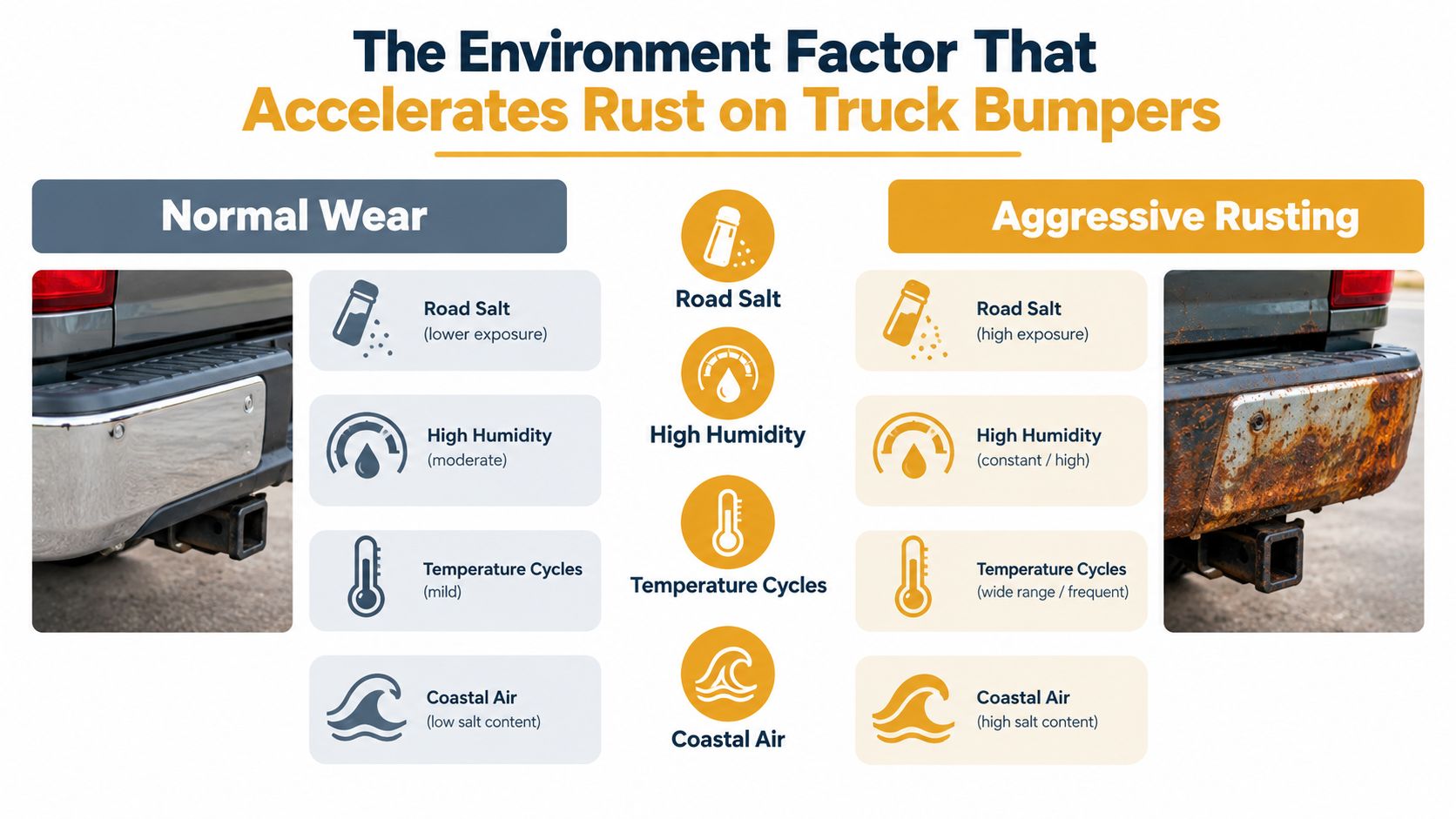
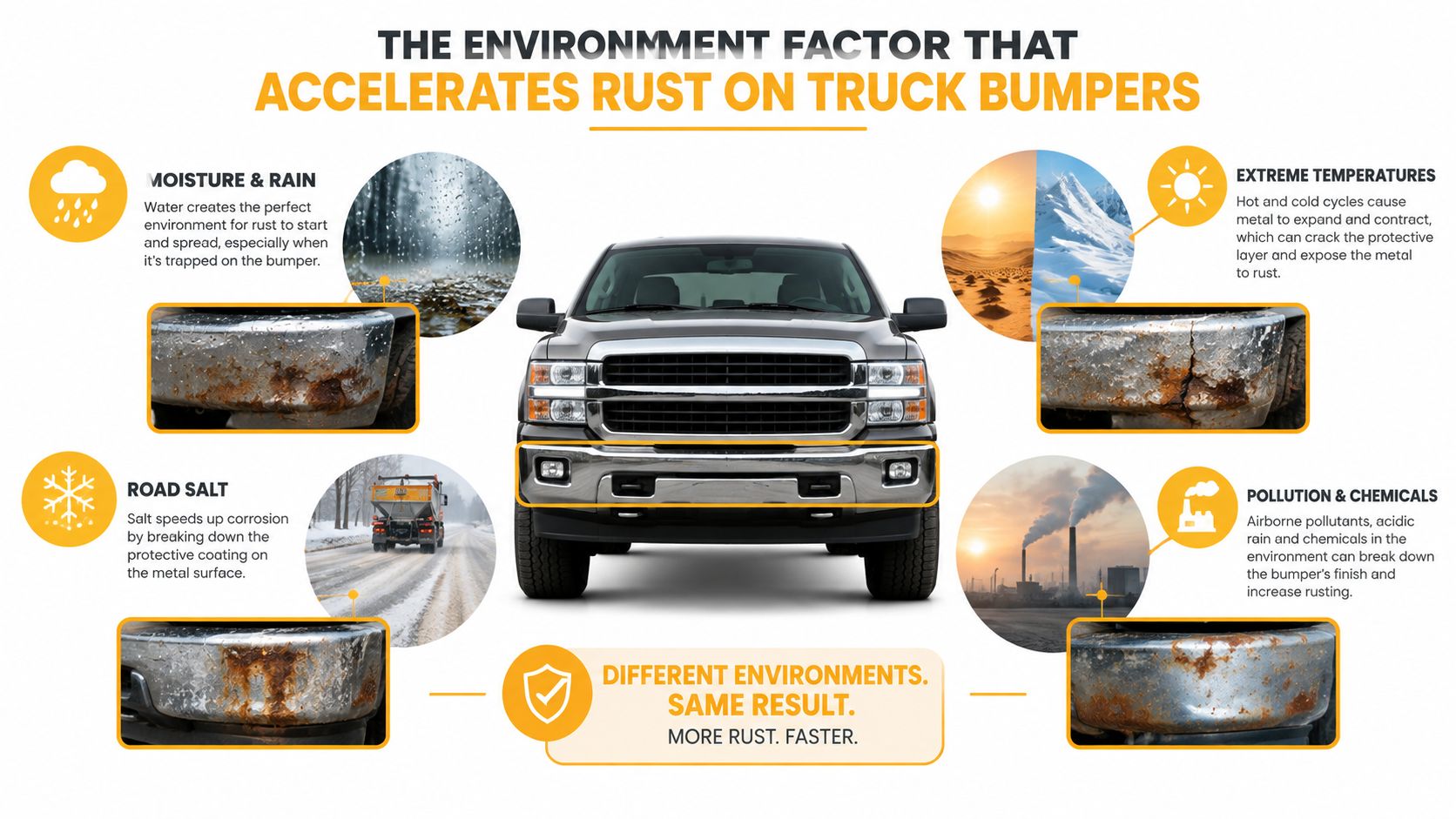
A bumper in Arizona doesn't live the same life as one in Ohio, Louisiana, or New Jersey. Same truck. Same driver habits. Different corrosion risk.
The worst combination for carbon steel is chloride plus moisture. In trucking, that usually means road salt, coastal air, wet slush, or spray that dries and leaves salt behind. Once that residue sits on the bumper, humidity can keep the corrosion cell active even when the truck doesn't look obviously wet.
Salt changes the game fast
A review of marine atmospheric corrosion found that below about 600 milligrams of chloride per square meter per day, corrosion rate rises approximately linearly with salinity. An OSTI study showed that at 80 degrees Celsius, carbon steel corrosion weight gain jumped from 0.02 milligrams per hour at 48 percent relative humidity to 38 milligrams per hour at 88 percent relative humidity when sodium chloride was present, as summarized in this marine atmospheric corrosion review.
That's why a truck can look clean and still corrode hard if salt deposits stay on the surface.
Risk zones truck owners should think about
Here's the practical version.
| Operating environment | Corrosion pressure on bumper | Smart material choice |
|---|---|---|
| Dry Southwest lanes | Lower | Chrome-plated carbon steel often makes sense |
| Midwest winter freight | High | Premium chrome-plated carbon steel or 304 stainless |
| Gulf or Atlantic coastal work | Constant chloride exposure | 304 stainless is usually the safer long-term call |
| Humid industrial corridors | Elevated | Better finish quality becomes critical |
Salt doesn't need standing water to cause trouble. It only needs enough moisture in the air to stay active.
Where rust usually starts first
Truck bumpers rarely fail evenly. Trouble usually begins in the same places:
- Lower edges: They catch direct spray from the road.
- Mounting points: Hardware areas trap moisture and grime.
- Cutouts and corners: Fog light holes and shape transitions are common wear points.
- Chips and scratches: Once the finish opens up, chloride gets to the steel faster.
For fleets, this explains why two trucks on the same yard can age differently. The truck running salted regional routes will usually punish a bumper much harder than the truck running dry interstate lanes.
How Chrome Plating and Coatings Protect Carbon Steel Bumpers
If you want corrosion resistance carbon steel in a real truck bumper, the answer is simple. You don't rely on bare carbon steel. You rely on the protection system over it.
Technical guidance states that carbon steel may be protected from corrosion by painting, plating, or coating, which means the base metal itself is not the corrosion barrier, as explained in this comparative analysis of stainless steel and plated or coated carbon steel.
The three common protection routes
Paint systems
Paint is the budget-minded option. It can work on some parts, but truck bumpers take direct impact from gravel, bugs, wash brushes, and road debris. Once paint chips, the exposed steel becomes a starting point for rust.
Painted bumpers fit some applications, but they usually aren't the first choice for drivers who want chrome style and long-term front-end appearance.
Plating
Chrome-plated carbon steel is the classic heavy-duty truck look. When the plating system is done right, it gives you shine and a barrier against moisture and chloride.
The important part isn't the word “chrome” by itself. It's the full plating stack, including the nickel layer under the chrome and the consistency of the finish. This breakdown of the chrome plating process is useful if you want to understand why some bumpers hold up better than others.
Other coatings
Other coated systems can make sense where appearance is less important than basic protection. Zinc-based approaches can help in some environments, but for most owner-operators shopping a Peterbilt 389 bumper or 18 inch drop bumper, the decision usually comes down to plated carbon steel versus stainless.
What works and what doesn't
A few hard truths from the field:
- Thin or damaged finish fails early: Once road salt gets through, the steel underneath starts rusting.
- Good prep matters: Poor surface prep under plating leads to weak spots.
- Edges matter: Many failures start where the finish is stressed most.
- Maintenance still matters: Even strong chrome systems need washing and inspection.
The finish is the shield. If the shield gets breached and stays dirty, the steel starts losing.
For truck buyers, that means asking about material, thickness, finish system, fitment, and installation. A direct bolt-on bumper with a durable plating stack saves time in the shop and reduces the chance of extra handling damage during install.
Carbon Steel Chrome vs Stainless Steel Bumpers Which Is Right for You
Most bumper buyers narrow it down to two paths. They either want chrome-plated carbon steel for value and classic shine, or they want stainless for stronger built-in corrosion resistance.
The right choice depends on where the truck works, how long you plan to keep it, and how much chloride exposure it sees.
What the stainless grades really mean
Type 304 stainless steel contains about 18 percent chromium and 8 to 10.5 percent nickel, while Type 430 is a ferritic grade with about 16 to 18 percent chromium and no intentional nickel. Multiple sources confirm that 304 has better general and localized corrosion resistance, especially against pitting and crevice attack, according to this Type 304 and Type 430 stainless comparison.
If you want a broader material-level view, this comparison of stainless steel vs carbon steel lines up well with bumper buying decisions.
Side-by-side bumper comparison
| Bumper material | Corrosion behavior | Appearance | Typical use case | Fitment and install notes |
|---|---|---|---|---|
| Chrome-plated carbon steel | Depends heavily on coating quality and maintenance | Classic deep chrome look | Dry to moderate climates, cost-conscious buyers | Often offered as direct bolt-on for specific truck models |
| 430 stainless steel | Better than plain carbon steel, but below 304 | Can still deliver a polished look | Moderate outdoor service where budget matters | Good middle ground when configured for truck-specific fitment |
| 304 stainless steel | Stronger general and localized corrosion resistance | Premium long-term appearance | Coastal, salted, and high-moisture routes | Strong choice for fleets chasing long service life |
How I'd call it for real trucking use
If the truck runs mostly dry western lanes and you want the chrome look without jumping to stainless, a well-finished carbon steel bumper is a practical buy. That's especially true for drivers who wash regularly and stay ahead of chips.
If the truck lives in winter salt, coastal air, or heavy humidity, 304 stainless steel is usually the smarter long-term move. 430 stainless still has outdoor value, but it sits below 304 in corrosion resistance and should be treated as a middle option, not the top one.
For buyers chasing style and function, the decision usually looks like this:
- Choose chrome-plated carbon steel when price, shine, and solid service in moderate conditions matter most.
- Choose 430 stainless when you want a step up from plain steel but don't need the highest corrosion resistance.
- Choose 304 stainless when uptime and rust resistance matter more than the lower upfront cost.
That's the material trade-off behind every Kenworth W900 chrome bumper, Peterbilt 389 bumper, and custom drop bumper order.
Real World Bumper Choices for Different Trucking Environments
A bumper choice gets easier when you match it to the route instead of the catalog photo. The same finish that works fine on a long-haul truck in New Mexico may struggle on a Midwest regional unit that sees salted roads every winter.
Three common buyer profiles
Southwest owner-operator
A truck running dry lanes through Texas, Arizona, New Mexico, and parts of California usually deals with sun, dust, bugs, and normal road wear more than constant salt.
For that truck, a chrome-plated carbon steel bumper often makes sense. It gives you the look most drivers want, and it can deliver good service if the plating is done right and the bumper gets regular washing.
Midwest regional fleet
Buyers need to get serious. Salted roads, slush, freezing and thawing, and repeat winter exposure punish the front end.
For these trucks, I'd lean toward either a premium plated carbon steel bumper with a strong finish system or a 304 stainless upgrade if the unit stays in that duty cycle year after year. Fleets that ignore that difference often end up replacing bumpers sooner than planned.
If your trucks spend winter throwing white salt spray across the front end, buy for chloride exposure first and looks second.
Coastal or Gulf operation
A truck based near the Gulf Coast, the Atlantic seaboard, or other salt-air routes should treat corrosion as a daily operating condition. In that setting, 304 stainless is the safer bet when the budget allows.
Carbon steel can still be used with a strong finish, but the margin for neglect gets smaller. Miss a wash cycle, leave chips unrepaired, and corrosion gets moving faster.
Fast decision guide
Use this simple buying filter:
- Mostly dry routes: Chrome-plated carbon steel is often enough.
- Seasonal winter salt: Step up the finish quality. Consider 304 if the truck stays in service for the long haul.
- Constant coastal or humid salt exposure: 304 stainless usually gives the better return through less replacement and cleaner appearance over time.
- Show truck with real road miles: Don't buy on shine alone. Ask about thickness, base material, finish stack, and direct fit.
Fitment still matters too. A bumper should match the truck model, mount style, and cutout needs so install stays clean and the part doesn't get hacked in the shop to make it work.
How to Maintain Your Bumper and Maximize Its Service Life
Even a strong bumper finish needs help. The drivers who get the longest life from a Peterbilt 389 bumper or Kenworth W900 chrome bumper usually do a few simple things consistently.
Maintenance habits that actually help
- Wash salt off early: After winter runs or coastal trips, rinse the bumper before residue dries and stays put.
- Inspect edges and cutouts: Check lower lips, fog light openings, corners, and mounting areas where failure often begins.
- Protect the finish: A quality wax or sealant adds another barrier between the surface and moisture.
- Fix chips fast: Small damage turns into bigger corrosion once steel gets exposed.
- Add bumper checks to service intervals: Fleets should inspect bumpers during routine maintenance instead of waiting for visible rust spread.
What owners should watch during install
Installation can shorten service life if the shop gets careless.
Make sure the bumper is the right fit for the truck model, whether that's Peterbilt, Kenworth, Freightliner, or International. A true direct bolt-on setup reduces extra drilling, cutting, and handling that can damage the finish before the truck even leaves the bay.
Also check for contact points that can rub, trap grime, or hold water. Those little issues often become corrosion starters later.
A bumper usually doesn't fail all at once. It starts with one damaged spot that didn't get cleaned, sealed, or repaired.
The smart buying mindset
Buy the bumper for the route, not just the photo. If your truck runs dry lanes, a plated carbon steel bumper can be a smart value. If it runs road salt or coastal air every week, spending more for stronger corrosion resistance can save money through fewer replacements and less downtime.
That's the payoff. Better appearance, less surprise rust, and more uptime.
Galhor Inc. builds direct bolt-on Class 8 truck bumpers in chrome-plated carbon steel, chrome-plated 430 stainless steel, and chrome-plated 304 stainless steel, with fitment options for trucks like Peterbilt, Kenworth, Freightliner, and Volvo. If you want a bumper matched to your real operating environment, style, and install needs, visit Galhor Inc. and configure the right one for your truck today.