

Corrosion Resistant Stainless Steel Grades for Truck Bumpers
A lot of truck owners learn this lesson the hard way. You buy a bumper that looks sharp on day one. Then one winter of road salt, slush, and wash bay chemicals takes the shine off. By spring, the face still looks decent from ten feet away, but around the light cutouts, mounting points, and lower edge, you start seeing stains, pits, and rough spots that weren't there before.
That's why corrosion resistant stainless steel grades matter when you're shopping for a Peterbilt 389 bumper, a Kenworth W900 chrome bumper, or an 18 inch drop bumper for a working truck. This isn't just about metal names. It's about how your bumper holds up on long hauls, how often you replace it, how your truck looks at a shipper, and what kind of resale value you protect.
I've seen the same pattern for years in the trucking world. A truck runs dry inland routes and gets away with a lower grade. Another truck runs winter lanes through salted highways, sits in coastal humidity, or sees chemical splash near industrial yards. Same style bumper, very different result. The metal choice changes everything.
Owner-operators usually want three things at once. They want the truck to look right, they want the bumper to last, and they want install headaches kept to a minimum. Fleet buyers want the same thing, just across more units and with less downtime.
The trouble is most grade advice stops at “316 is better than 304” or “304 is better than 430.” That's too simple to help you buy the right bumper. What matters is your real duty cycle. Salt. Heat. Water trapped in seams. Dirt packed around brackets. Truck wash chemicals. Long idle time. Cold starts. All of that decides what wins on the road.
Table of Contents
- Introduction Why Your Bumper Grade Matters on Every Mile
- How Stainless Steel Resists Corrosion in Plain Language
- 304 vs 430 vs 316 What Each Grade Really Offers
- How Chloride Temperature and Crevices Change the Winner
- Cost Formability Weldability and Chrome Finish Trade Offs
- Choosing the Right Grade for Your Truck and Route
- Final Takeaways and Your Next Upgrade
Introduction Why Your Bumper Grade Matters on Every Mile
If you drive a Peterbilt, Kenworth, Freightliner, or International through Midwest winters or Gulf Coast air, your bumper takes abuse every single trip. Salt spray hits the front end first. Moisture sits in corners. Road grime holds contaminants against the metal. A bumper that looked fine in the catalog can start aging fast if the base metal doesn't match the route.
That's why corrosion resistant stainless steel grades belong in the same buying conversation as fitment, finish, and drop size. If you're shopping a Peterbilt 389 bumper or a Kenworth W900 chrome bumper, you're not just choosing style. You're choosing how much corrosion risk you're willing to carry.
What truck owners usually miss
The face of the bumper is easy to check. Trouble often starts in tighter spots.
- Light cutouts: Moisture and salt can sit in edges and seams.
- Mounting areas: Trapped road grime keeps chlorides against the metal.
- Lower corners: These catch spray, slush, and wash water.
- Behind trim and brackets: Tight gaps make corrosion more aggressive.
Practical rule: The harsher the route and the tighter the crevice, the less helpful a simple grade ranking becomes.
A show truck that sees fair weather and regular cleaning can live a very different life than a daily work truck hauling across snow, coastal air, and rough roads. That's why one owner says a lower-cost bumper was “good enough,” while another says the same material was a mistake.
What a better buying decision looks like
A smart bumper choice answers five questions:
- What grade is the base metal?
- How tough is the route?
- Will the truck see road salt or coastal chloride exposure?
- Does the bumper design have cutouts, seams, or places that trap grime?
- Is long-term shine worth paying more up front?
By the end of this guide, you'll have a plain answer for when 430 is enough, when 304 is the right workhorse, when 316 earns its keep, and when even duplex starts to make sense.
How Stainless Steel Resists Corrosion in Plain Language
A truck bumper lives in a rough cycle. It gets wet, dries out, gets hit with road spray, then holds salt and grime in corners and seams. Stainless steel holds up in that cycle because its surface can protect itself, up to a point.
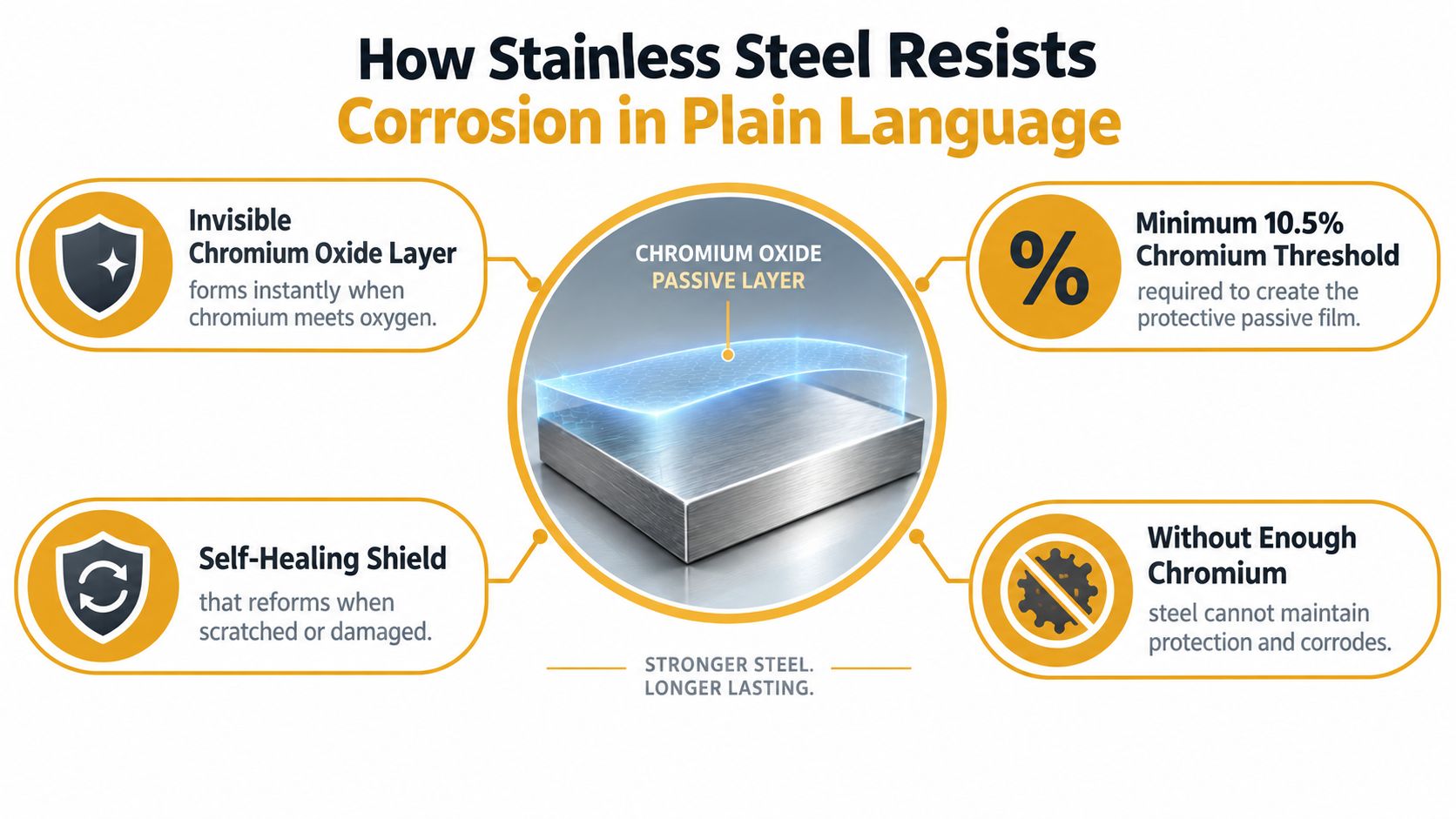
The part doing the work is chromium. When chromium in the steel meets oxygen, it forms a very thin oxide film on the surface. That film works like clear paint you cannot see. If the surface gets scratched, the film can form again as long as oxygen can reach the metal. That basic shield is why stainless behaves differently from plain steel, as explained in this overview of corrosion resistance.
Chromium has to be present in high enough amount for that shield to keep working. If the alloy does not have enough chromium, the surface film breaks down too easily and the steel acts more like ordinary carbon steel.
That does not mean all stainless grades protect the same way.
The recipe changes how stable that surface film stays during real road use. Some grades also include nickel, which helps the metal stay tougher and more corrosion resistant in wet service. Some include molybdenum, which helps when chlorides from road salt or coastal air keep sitting on the surface. In plain shop terms, the protective film is the guard. The alloy mix determines how strong that guard stays when the truck sees salt, heat, wash chemicals, and tight grime traps.
Why stainless grades even exist
Grade numbers are alloy recipes, not marketing labels. They came out of years of stainless development, including early work on chromium and nickel alloys that led to the stainless families still used today, as summarized by ASSDA's stainless history article.
For a truck owner, the useful point is simple. Different families were built for different kinds of abuse. One may do fine on a fair-weather rig. Another earns the extra money when the bumper sees salted highways, long wet runs, or crevices that stay dirty between washes.
Austenitic and ferritic in truck language
You will run into two families right away.
- Austenitic grades: This group includes 304 and 316. These grades use chromium with nickel, and 316 also uses molybdenum. They usually hold their finish better when the truck sees more moisture, chlorides, and time outdoors.
- Ferritic grades: This group includes 430. It uses chromium too, but little to no nickel. It can be a sensible choice when cost matters more and the truck works in a milder environment.
That family difference matters more on the road than it does on a sales sheet. A bumper on a dry regional route may do well with a lower-cost ferritic grade. A bumper that lives in winter brine, slush, and packed grime needs a surface film that stays stable under more abuse.
For contrast, a Steel chrome bumper uses 10-gauge chrome-plated steel, a mirror-polished finish, and a direct bolt-on installation with no drilling or cutting needed. It also uses a triple-layer hexavalent chrome process with 35 microns of nickel. That finish helps appearance, but plating and stainless solve corrosion in different ways. Chrome plating protects by covering the base steel. Stainless protects by forming its own chromium-rich surface film.
Stainless resists corrosion by keeping a thin chromium-oxide film on the surface. The better the grade fits your chloride, temperature, and crevice exposure, the longer that film keeps doing its job.
304 vs 430 vs 316 What Each Grade Really Offers
This is the part most truck buyers want straight. If you're comparing bumper materials, these three grades cover most of the conversation.
The chemistry that changes performance
304 stainless is an austenitic grade with about 18 to 20% chromium and 8 to 10.5% nickel, while 430 stainless is ferritic with about 16 to 18% chromium and no nickel, based on Essentra's grade comparison. Published composition tables also show 304 typically contains roughly 17.5 to 19.5% chromium and 8.0 to 10.5% nickel, while 430 contains about 16.0 to 18.0% chromium and 0 to 0.75% nickel, according to MetalZenith's comparison table.
That nickel gap is a big deal. It's one reason 304 usually holds up better when a truck sees humidity, road salt, and long-term outdoor use.
430 is magnetic because it's ferritic, and its lower nickel content makes it a lower-cost stainless option. But it doesn't match 304 in humid, salty, or chemically harsh conditions, as noted in this 430 vs 304 truck-use comparison.
Stainless Grades at a Glance for Truck Bumpers
| Grade | Chromium and Nickel Content | Key Corrosion Advantage | Best Fit for Truck Use |
|---|---|---|---|
| 430 | 16 to 18% chromium, essentially no nickel | Stainless option for milder conditions | Dry inland routes, appearance-focused trucks with lower chloride exposure |
| 304 | About 18 to 20% chromium, 8 to 10.5% nickel | Better corrosion resistance than 430 in tougher outdoor service | General-purpose workhorse for many owner-operators and fleets |
| 316 | Adds 2 to 3% molybdenum, unlike 304 | Better pitting and crevice resistance in chloride exposure | Coastal service, winter salt routes, harsher chemical exposure |
For buyers who want more background on the workhorse grade, this 304 stainless steel plate guide gives a useful base understanding.
Where 316 pulls ahead
The jump from 304 to 316 matters because 316 contains 2 to 3% molybdenum, while 304 does not. Engineering references describe 316 as having higher resistance to pitting and crevice corrosion in chloride environments. One technical comparison reports typical PREN values of roughly 18 to 20 for 304 versus about 24 to 26 for 316, and says 316 can last roughly 2 to 3 times longer than 304 in salt-spray testing. The same source states 304 showed visible pitting after about 100 to 500 hours in 3 to 5% sodium chloride fog, while 316 often lasted around 500 to 1,000+ hours under comparable conditions, according to this technical comparison PDF.
If your truck lives around chlorides, 316 isn't just “a little better” than 304. It was built for a harder fight.
Fast plain-English summary
- Choose 430 when you want stainless looks at a lower cost and the route is controlled.
- Choose 304 when you want the general-purpose stainless workhorse.
- Choose 316 when chloride exposure is strong enough that pitting risk becomes the issue.
How Chloride Temperature and Crevices Change the Winner
A bumper doesn't fail in a spreadsheet. It fails in the exact spots where salt, moisture, and grime stay put. That's why route conditions matter more than simple “better or worse” grade rankings.
Chloride changes the whole answer
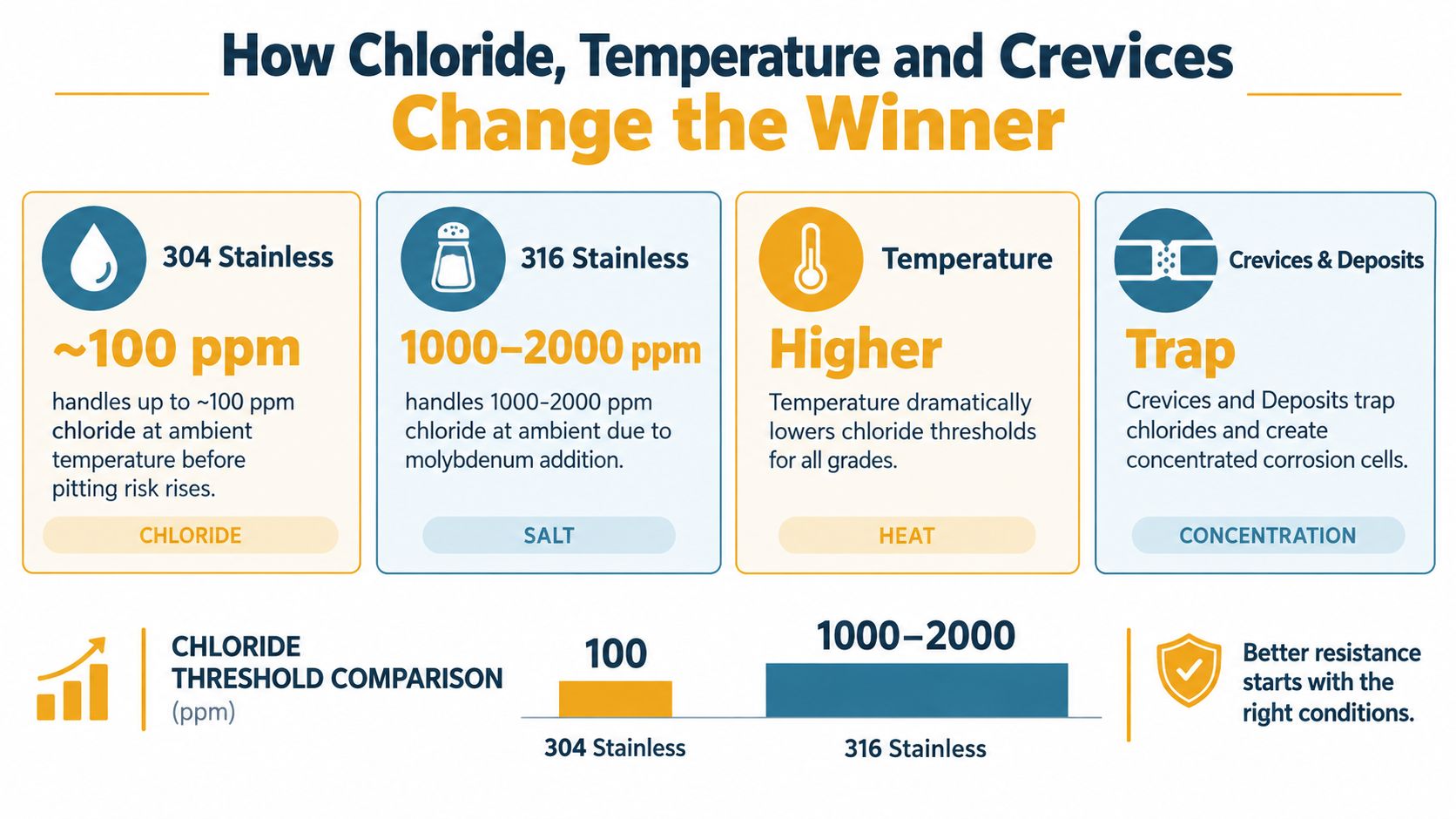
Multiple neutral sources show that 304 is typically cited as suitable only up to about 100 ppm chloride in water, while 316 is often cited around 1000 to 2000 ppm at ambient conditions. The same guidance notes that both can still suffer pitting and crevice corrosion in warm chloride environments, and that PREN gives a more useful comparison: 304 is commonly around 18 to 19, 316 around 24 to 26, and duplex or super-duplex grades climb to the mid-30s and 40s, according to this 316L technical data sheet summary.
For trucking, that means this. A bumper on a dry inland route and a bumper running winter brine aren't facing the same job, even if both are called stainless.
Crevices are where good metal gets tested
The front face of a bumper may wash clean. Tight gaps often don't.
- Behind brackets: Moisture can stay trapped.
- Around fog light openings: Deposits collect and hold salts.
- At seams and folds: Oxygen access is lower, which makes it harder for the protective surface to recover well.
- Under packed road grime: Chlorides stay in contact longer.
That's why a truck owner can look at a bumper and think the alloy “failed early,” when the issue was trapped contamination in a crevice.
Here's a useful visual if you want to see how these conditions stack up in practice.
Heat changes the rules too
A common mistake is assuming stainless is safe no matter how hot and wet the service gets. Standard technical summaries note that even 316 can become vulnerable to stress corrosion cracking above roughly 60°C in chloride-bearing service, as discussed in this AZoM stainless steel review.
Warm, wet chloride exposure is where buyers get fooled. A grade that looks strong on paper can struggle once heat and trapped salt join the fight.
That doesn't mean every truck bumper needs duplex. It means you should upgrade with a reason. If your truck sees moderate exposure, 304 may be enough. If it sees aggressive winter brine, coastal salt, or constant grime-packed seams, moving up the ladder starts making sense fast.
Cost Formability Weldability and Chrome Finish Trade Offs
A bumper isn't just a chemistry choice. It has to be formed, welded, mounted, and kept looking right. That's where truck buyers feel the difference between grades.
Why lower cost doesn't always mean lower value
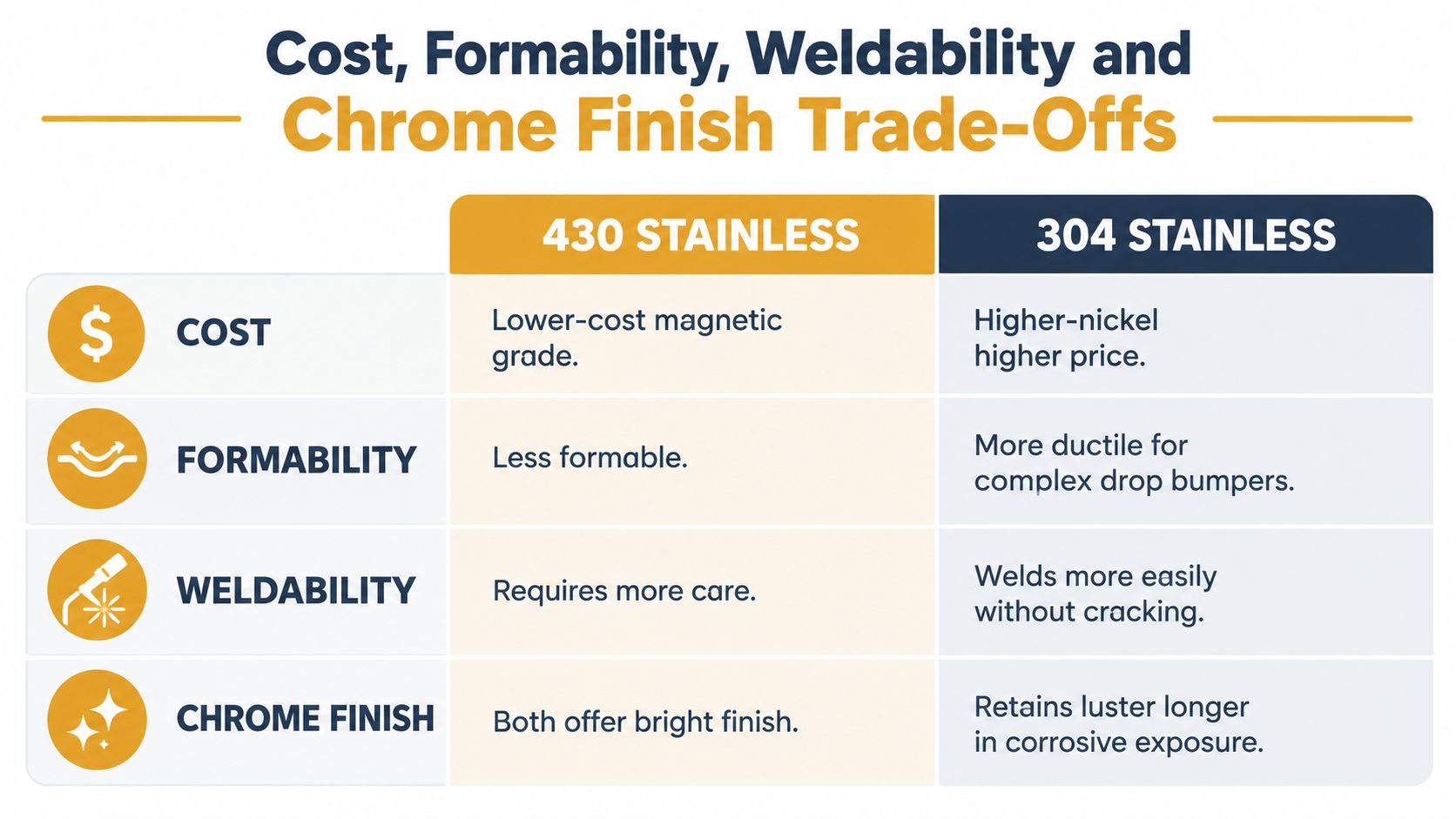
430 often appeals to buyers who want a stainless option without stepping into a higher-nickel grade. That can make sense on trucks with lighter corrosion exposure.
But lower upfront cost only helps if the part fits the route. If a truck runs salted highways, sits in wet yards, or sees heavy wash cycles, a cheaper grade can cost more later through replacement, refinishing, or downtime. That's the heart of total cost of ownership.
Forming and welding matter on real bumpers
Drop bumpers, custom light cutouts, and shaped ends put stress on the metal during manufacturing. In plain shop terms, 304 is usually the easier material when the part needs more forming or more welding care. 430 can still work well, but it calls for tighter control.
That matters if you're buying:
- An 18 inch drop bumper with a more complex shape
- A Freightliner replacement bumper with cutouts
- A Peterbilt 389 bumper where finish and contour both matter
- A Kenworth W900 chrome bumper expected to stay sharp on a working truck
Base metal and chrome finish work together
A strong chrome finish helps. It doesn't erase a poor grade choice.
Galhor's chrome-plated bumper options use a triple-layer hexavalent chrome process with 35 microns of nickel for a deep mirror polish. That finish can support appearance and surface durability, but the base metal still decides how the part behaves if corrosion starts at edges, seams, or damaged spots.
What thickness tells you
Thickness is part of durability too. A bumper built from 10-gauge steel will feel different in service than a thinner part. In the catalog facts provided here, the carbon steel chrome bumper uses 10-gauge chrome-plated steel, and the Freightliner Coronado bumper is available in 11-gauge 430 stainless steel.
That doesn't automatically make one “better” in every use. It means you should judge the whole build:
- Material grade: 430, 304, or another option
- Thickness: what kind of road contact and abuse the bumper may see
- Finish system: polished, chrome-plated, or both
- Fitment: direct bolt-on matters for labor and alignment
- Cutout design: more openings can mean more crevice risk
A bumper can look sharp in a photo and still be the wrong buy for your lane. The route decides whether the savings hold up.
Choosing the Right Grade for Your Truck and Route
Most buyers don't need a metallurgy lecture. They need a clear answer they can use before they order.
A simple decision model
Start with your route, not your budget.
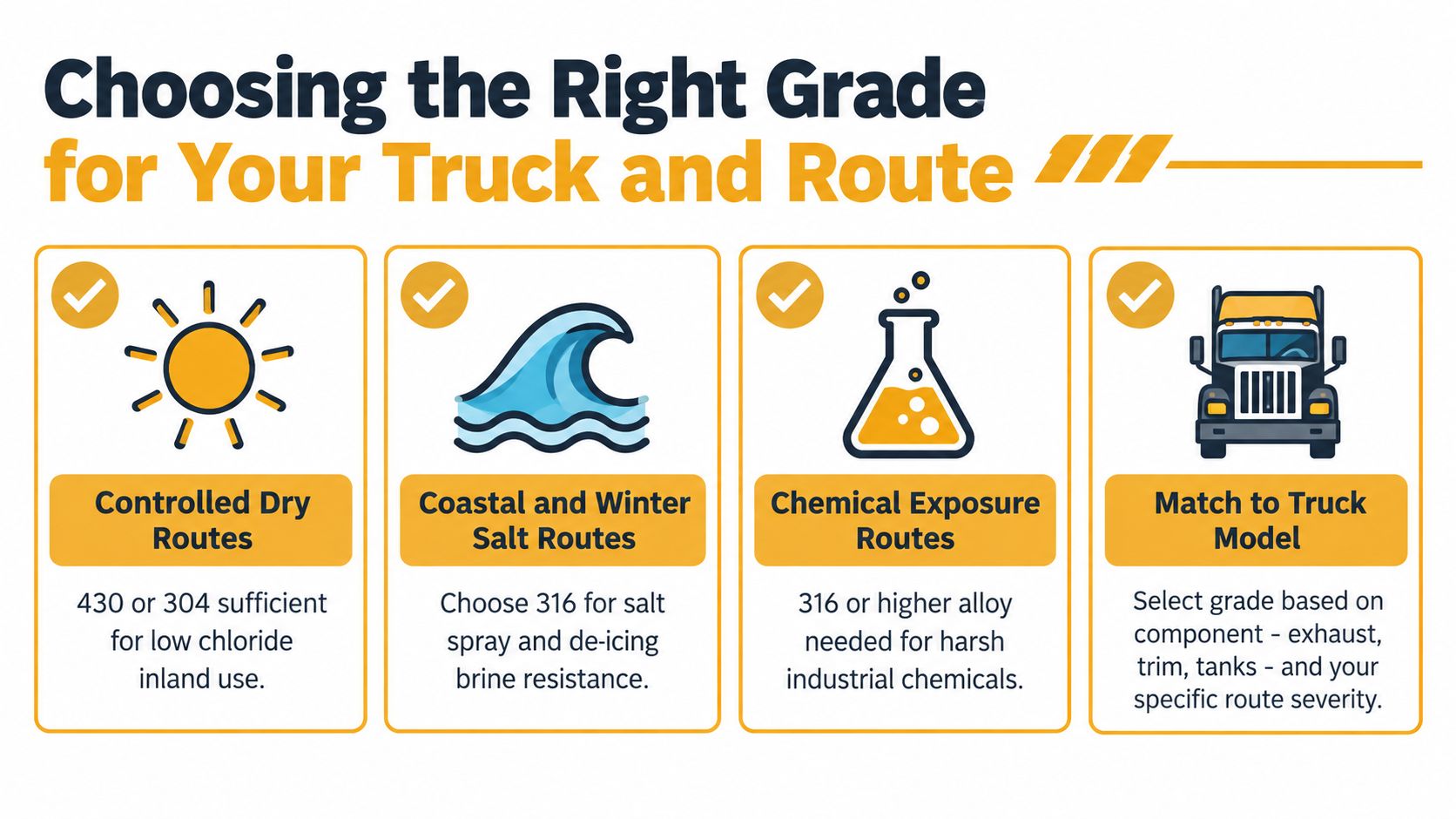
- Dry inland routes: If your truck mostly runs low-chloride conditions and gets cleaned regularly, 430 can be good enough.
- Mixed long-haul work: If the truck sees regular weather, truck washes, and some seasonal salt, 304 is usually the safer all-around call.
- Coastal or winter salt service: If the truck lives in heavy chloride exposure, 316 is the grade that earns attention.
- Extreme duty: If chloride, heat, and trapped contamination stay high for long periods, duplex starts entering the conversation.
Match the grade to the truck and bumper style
A few common examples:
| Truck use | Grade direction | Why it fits |
|---|---|---|
| Peterbilt 389 show and work mix | 304 | Strong appearance retention with broader route flexibility |
| Kenworth W900 on salted winter lanes | 316 if exposure is severe | Better chloride resistance where front-end spray is constant |
| Freightliner Cascadia fleet truck on controlled inland routes | 430 or 304 | Depends on budget, cleaning, and route severity |
| International or vocational truck near coastal or chemical areas | 316 or higher | Better fit when chlorides and contaminants stay high |
Fitment and install still matter
Even the right alloy can turn into a headache if the bumper doesn't fit the truck right.
Look for:
- Direct bolt-on fitment
- Compatibility with your truck model and year
- Cutout options for fog holes and light openings
- Installation that doesn't require drilling or cutting when possible
- Bracket setup that suits the bumper style
One practical example is Galhor Inc., which offers Class 8 truck bumpers for Freightliner, Peterbilt, Kenworth, and Volvo through a configurator that lets buyers choose brand, model, year, style, cutouts, and finish. Its material options include chrome-plated carbon steel, chrome-plated stainless steel 430, and chrome-plated stainless steel 304, with direct bolt-on fitment built around real truck applications.
Quick checklist before you order
Ask yourself these questions:
- Do I run road salt for weeks at a time?
- Does my route include coastal humidity?
- Will the bumper have light cutouts or tight corners that trap grime?
- Am I buying for long-term shine or lowest upfront spend?
- Do I want a polished or chrome finish, and what base grade sits under it?
If you answer yes to the first three, don't buy by looks alone. Buy by exposure.
Final Takeaways and Your Next Upgrade
The right bumper grade isn't about winning a metal debate. It's about matching the metal to the miles.
430 has a place. It works when exposure is controlled and the truck isn't living in chloride-heavy conditions. 304 is the stainless workhorse for many owner-operators because it balances corrosion resistance, appearance, and practical use. 316 starts making real sense when salt, coastal air, and crevice exposure get serious. Duplex belongs in the harshest corner of the conversation, not as an automatic upgrade for every truck.
For U.S. trucking, the smartest buy usually comes down to three things. Know your route. Know where your bumper traps grime and moisture. Know whether you're buying for short-term savings or long-term uptime.
If you're shopping a Peterbilt 389 bumper, a Kenworth W900 chrome bumper, or an 18 inch drop bumper, don't stop at finish and style. Ask what grade is under the shine, how thick the bumper is, whether it fits your truck right, and how it will handle the roads you run.
A good bumper protects more than the front end. It protects your image, your maintenance budget, and your time. Order now if you already know your route is hard on metal. Get yours today if you're tired of replacing bumpers that looked good for one season and quit on the next one. Upgrade your truck today and buy for the miles ahead, not just the day it lands.
Galhor Inc. builds direct bolt-on Class 8 truck bumpers in chrome-plated carbon steel, chrome-plated 430 stainless steel, and chrome-plated 304 stainless steel for real-world trucking routes across the United States. If you want the right material, fitment, finish, and fast shipping tied to how your truck works, visit Galhor Inc. and spec the bumper that fits your truck and your duty cycle.