

Custom Truck Bumper Guide for Class 8 Owners
You're somewhere past the halfway point on I-80, winter grime is packed around the grille, and the bumper that looked fine in the yard now shows rust at every chipped spot. A failed bumper doesn't just hurt the truck's appearance. It can damage lights, delay a load, complicate a collision repair, and reduce what the truck brings at trade-in.
A custom truck bumper should be chosen by route, truck configuration, material, and total cost of ownership. Chrome-plated carbon steel, 430 stainless, and 304 stainless each make sense in the right operation. The wrong choice can leave you paying for polishing, repair, or replacement long after the original order is forgotten.
Table of Contents
- Why the Right Custom Truck Bumper Matters on Long Hauls
- The Three Materials Every Buyer Will See
- Side-by-Side Material Comparison for Heavy-Duty Use
- Fitment, Cutouts, and Direct Bolt-On Reality
- Matching Your Bumper to Real Routes and Fleets
- Pricing, Lead Times, and Long-Term Value
- The Right Pick for Your Truck and Your Wallet
- Bumper Questions Owner-Operators Ask Before They Order
Why the Right Custom Truck Bumper Matters on Long Hauls
A bumper failure on a winter run across I-80 can trigger more than a cosmetic repair. It can damage headlights and grille components, delay a load, add roadside labor, and reduce the truck's trade-in value. Road debris, de-icing chemicals, wet freight corridors, parking impacts, and animal strikes all test the front of a Class 8 truck.
That is why bumper selection belongs in an operating-cost decision, not a shine comparison. Chrome-plated carbon steel, 430 stainless, and 304 stainless carry different purchase prices, corrosion risks, repair requirements, shipping considerations, and lead times. A cheaper bumper can cost more if it needs repeated polishing, repair, or replacement during a busy season.
An owner-operator running a Peterbilt 389 or Kenworth W900 may prioritize a sharp finish at every fuel stop, along with a direct fit that avoids installation delays. A fleet manager ordering for Freightliner Cascadias or Volvo VNL tractors usually needs repeatable fitment, predictable installation, and a finish that stays consistent across multiple trucks. In both cases, order a bumper built for the exact truck configuration rather than forcing a universal part into place.
For a deeper look at the equipment's protective role, read our guide to why you need a good bumper on a semi-truck.
Total cost matters more than showroom shine
Route conditions should set the material priority:
- Winter corridors: Salt and de-icing chemicals require greater corrosion margin. A damaged plated finish deserves particular attention because exposed steel can begin to rust.
- Coastal lanes: Salt air can attack exposed or damaged surfaces quickly, making corrosion resistance and finish maintenance more important.
- Dry western routes: Appearance, upfront cost, and shipping practicality may carry more weight than maximum corrosion resistance.
- Fleet service: Repeatable fit, accessible replacement parts, and repairability can matter more than custom styling.
Shipping can change the final purchase cost. A bumper that is available sooner may reduce truck downtime, while a material or configuration requiring a longer lead time can delay installation and revenue. Confirm availability, production timing, packaging, and freight before comparing quotes.
The bright plated finish also remains part of truck identity. Chrome styling became widely associated with vehicle durability and appearance after the auto industry shifted from nickel to chromium in the late 1920s. The history of plated chrome explains that development.
Choose the custom truck bumper that protects the front end, fits without rework, suits the route, and controls ownership costs over the truck's working life.
The Three Materials Every Buyer Will See
Most Class 8 buyers will compare three construction choices. They don't perform the same way, and the cheapest option isn't automatically the best value.
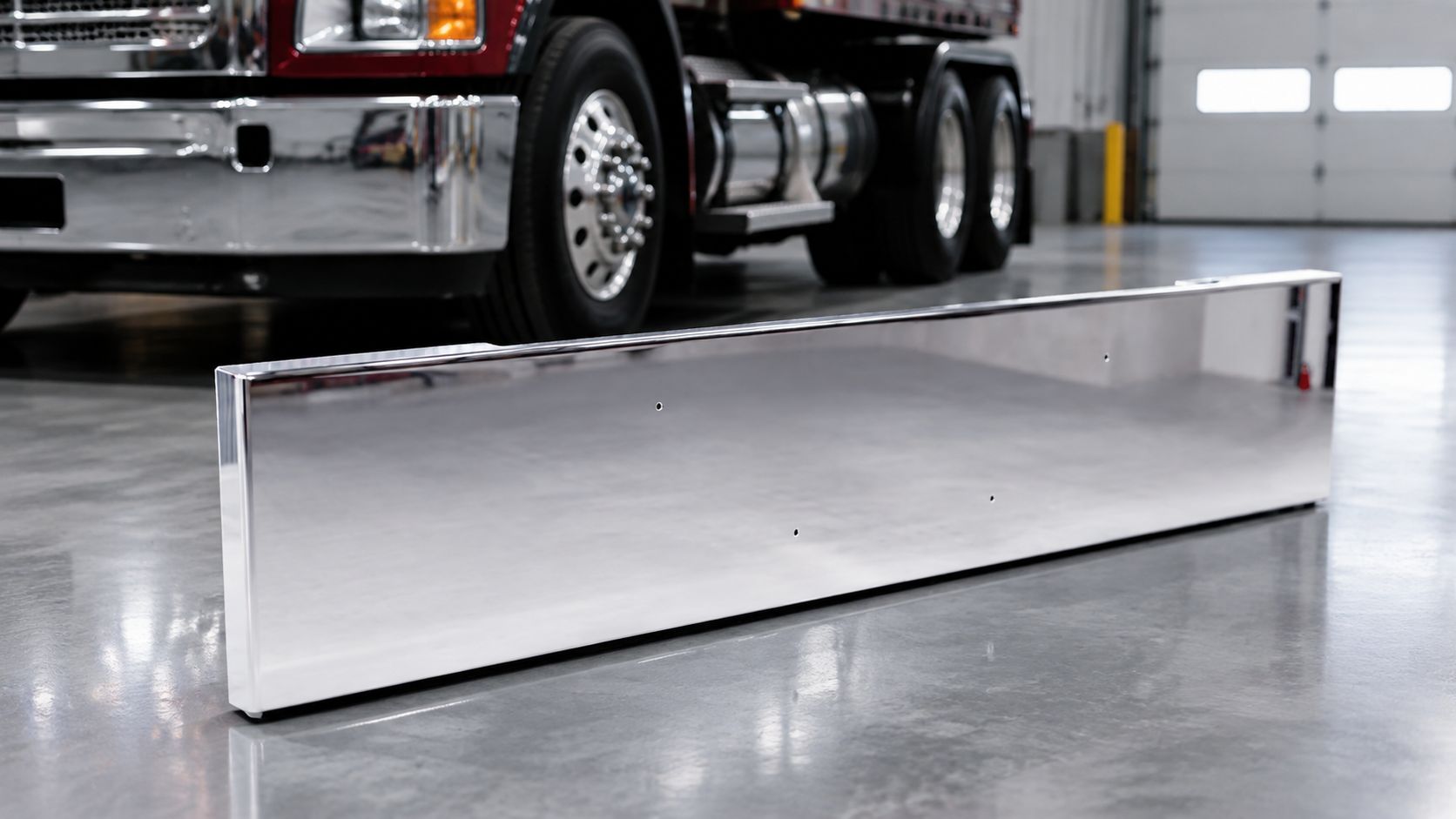
Chrome-plated carbon steel is the traditional heavy-duty choice. It offers a strong steel base and a bright plated finish, usually with nickel beneath the chromium. The nickel layer does most of the corrosion-barrier work in a plated finish. One GM corrosion standard specifies total coating targets around 20.25 to 25.25 micrometers, with nickel at about 20 to 25 micrometers and chrome at only 0.15 to 0.50 micrometers. See the GM nickel-chrome coating standard. If a deep chip reaches the base metal, corrosion can begin at that exposed point.
430 stainless is the budget stainless option. It contains about 16–18% chromium and no nickel, according to stainless comparison data. It performs well in ordinary atmospheric exposure and fresh water, but it has less protection against salt and seawater. It's also magnetic, which can help identify it during inspection.
304 stainless contains about 18–20% chromium and 8–10.5% nickel. That nickel content gives it better corrosion resistance in wet, chemical-heavy, coastal, and winter-salted service. It costs more up front, but it's the material I'd choose when finish retention matters more than the initial invoice.
Three Custom Truck Bumper Materials at a Glance
| Material | Typical Use | Key Trait | Best Fit |
|---|---|---|---|
| Chrome-plated carbon steel | Traditional truck styling and heavy-duty replacement | Strong steel base with bright plated finish | Dry routes, show trucks, value-focused fleets |
| 430 stainless | Budget stainless construction | Good atmospheric performance with less salt resistance | Inland and mostly dry service |
| 304 stainless | High-corrosion-exposure service | Strongest corrosion margin of the three | Coastal lanes and salted winter corridors |
For a concrete construction example, the Steel chrome bumper is made from 10-gauge chrome-plated steel, uses a mirror-polished finish, and supports direct bolt-on installation with standard or blind mounting. Its triple-layer hexavalent chrome process includes 35 microns of nickel, and the product is covered against defects in workmanship and materials.
Read the practical differences between the base metals in this stainless steel and carbon steel comparison. Gauge, reinforcement, mounting design, and surface preparation all affect how the bumper holds up after installation.
Side-by-Side Material Comparison for Heavy-Duty Use
A truck running winter salt through the Northeast needs a different ownership plan from one staying on dry inland lanes. Material choice affects more than appearance. It changes washing frequency, inspection time, repair options, replacement shipping, and how long the truck can remain in service after front-end damage.
Use the route, downtime cost, and maintenance support as the decision framework:
| Operating situation | Practical specification | Ownership effect |
|---|---|---|
| Dry regional or short-haul work | Chrome-plated carbon steel | Lower entry cost and familiar repair methods, with regular checks for chips and exposed steel |
| Inland service with occasional moisture | 430 stainless | Avoids many plating concerns while keeping the purchase below 304 stainless |
| Coastal, Gulf, or heavily salted routes | 304 stainless | Higher initial spend, but fewer finish-related repairs when exposure is persistent |
| Fleet with limited parts support | Material with readily available replacement dimensions | Faster sourcing can matter more than a small material-price difference |
| Truck that must return to work quickly after impact | Properly reinforced design with confirmed mounting layout | Reduces fabrication surprises and installation delays |
The same material can produce very different results when gauge, reinforcement, weld quality, and surface preparation change. Before approving a quote, request those specifications in writing. A heavy bumper with poor support can develop mounting or alignment problems, while a correctly reinforced design can handle service with fewer interruptions.
For buyers comparing stainless grades, independent 430 and 304 corrosion testing data shows a substantial difference in salt-spray performance. Treat that testing as a material comparison, not a promised truck service interval. Washing practices, stone strikes, weld areas, polishing, and trapped road grime still determine what happens on the actual vehicle.
Compare the full ownership bill
A chrome-plated carbon steel bumper may make sense when a fleet has a dependable wash schedule and a local shop that can address chips promptly. The invoice is only one part of the calculation. Add the labor to remove and refinish damaged plating, the truck's time out of service, and freight for a replacement that matches the existing brackets.
430 stainless suits moderate exposure, but it should not be selected because it carries a stainless label. On routes where chloride contact is routine, the lower purchase price can be offset by earlier cosmetic repairs or replacement. Specify the expected service environment before treating it as the middle-ground option.
304 stainless earns its premium when the truck repeatedly sees coastal air, Gulf humidity, or winter treatment. It does not eliminate cleaning or impact damage, yet its wider corrosion margin can protect the finish during long ownership. That matters most for owner-operators who cannot park a truck for repeated refinishing and for fleets standardizing parts across severe routes.
Shipping and lead time also belong in the comparison. A bumper that fits the existing mounting arrangement and uses a commonly supported configuration can return a truck to work faster than a cheaper part requiring corrections. Confirm availability, fabrication timing, freight method, and replacement support before ordering. Select the material that lowers total operating cost for the route, not the one with the lowest line-item price.
Fitment, Cutouts, and Direct Bolt-On Reality
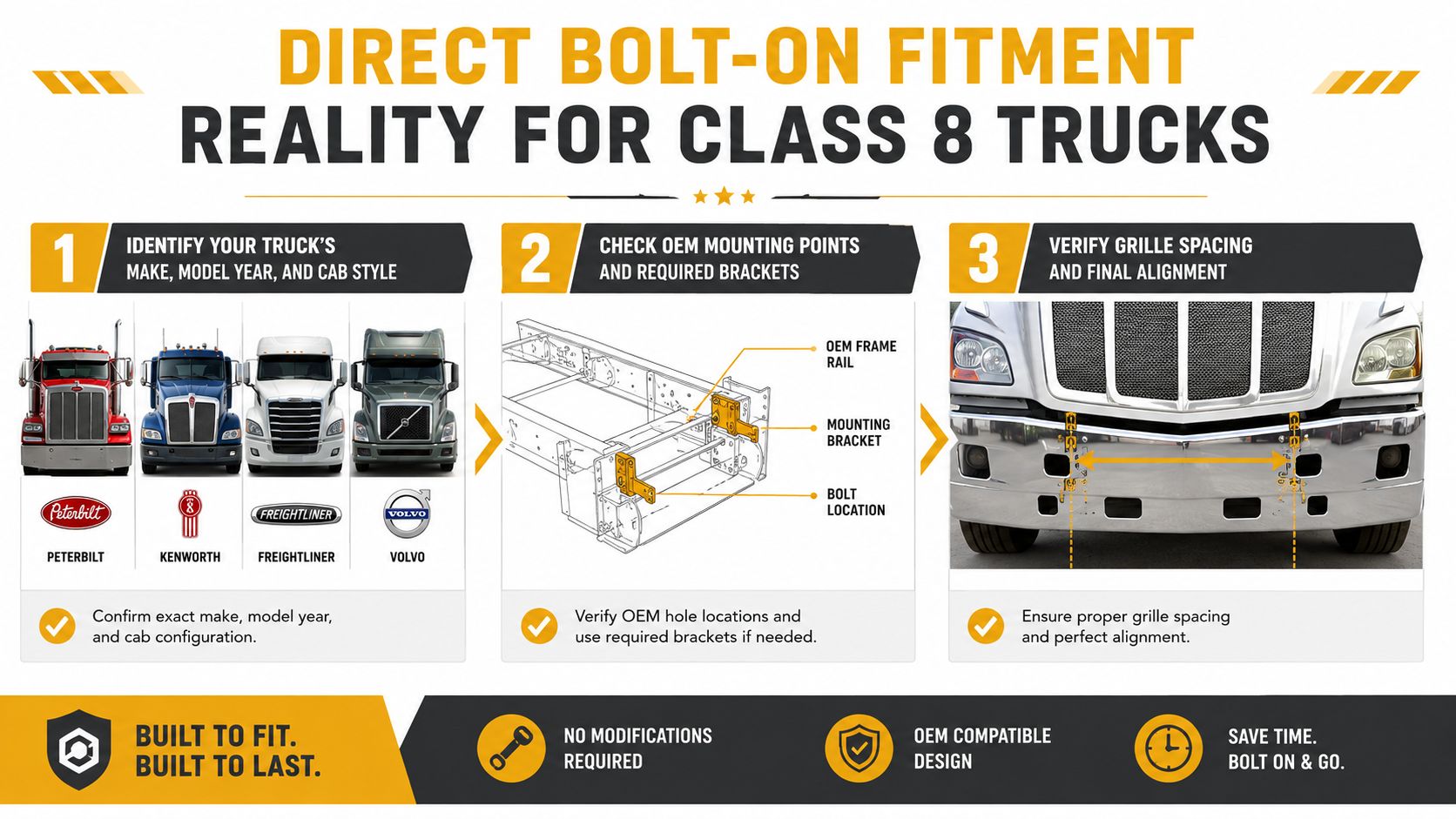
A direct bolt-on bumper uses the truck's factory mounting locations. On a Class 8 Peterbilt, Kenworth, Freightliner, or Volvo, that means the bumper should align with the existing brackets, frame-side hardware, grille spacing, and body profile without welding or drilling the frame.
Model year and cab style matter. A Peterbilt 389 bumper may not fit a different 389 configuration if the grille, brackets, lighting package, or front accessories changed. The same warning applies to a Kenworth W900 chrome bumper, Freightliner Cascadia bumper, or Volvo VNL replacement. Always provide the exact make, model year, cab style, mount style, and requested openings.
Confirm every opening before fabrication
Common bumper specifications include:
- Fog light openings: Confirm the lamp shape and location before ordering.
- Tow hook ports: Make sure the bumper leaves access for recovery hardware.
- Receiver provisions: Verify whether the truck needs a receiver or another towing feature.
- Camera and radar clearance: Modern collision systems need unobstructed paths.
- Air cleaner and DEF brackets: Side and lower cutouts must match the chassis equipment.
- Mount style: Standard and blind mount designs use different visual and hardware layouts.
A 2021 or newer truck with adaptive cruise radar may need different clearance than a 2017 chassis. If the bumper was built for the older configuration, an adapter bracket may solve the mounting problem, but only after the sensor position and signal path are checked. Don't assume a bracket can correct every mismatch.
A shop with two technicians can often complete a straightforward installation in two to four hours, provided the replacement uses the correct holes and the hardware is accessible. Basic hand tools, sockets, torque tools, alignment tools, and a helper are typically enough for a direct replacement. The direct bolt-on installation guide explains why avoiding frame drilling protects repeatability.
Align before tightening
Set the bumper loosely, check grille spacing, confirm both corners sit evenly, and verify light and sensor clearance. Tighten hardware only after the bumper is centered and the cutouts line up. Photograph the original mounting points before removal. Those images help a shop resolve a fitment question without guessing.
Matching Your Bumper to Real Routes and Fleets
A bumper that works on a dry western route may be the wrong purchase for a truck that spends winter crossing the Northeast. The finish has to match the environment, and the material has to match how often the fleet can wash, inspect, and repair it.
A truck moving through Wyoming, Montana, and the Midwest on I-80, I-90, or I-94 faces road salt, de-icing chemicals, freezing moisture, and debris. Chrome-plated carbon steel remains popular for its traditional appearance and steel strength, but damaged plating needs prompt attention. 430 stainless can work for inland service when exposure is controlled. For repeated salt exposure, 304 gives you more protection against finish loss.
Coastal routes create a different problem. I-95 service through Florida, Gulf states, and the Pacific Northwest exposes the front end to humid air, wet roads, and salt. 430 is a lower-grade decorative stainless for this duty. Technical data says 430's strongest corrosion performance is in atmospheric exposure and fresh water, and it isn't recommended for most salts or seawater. The 430 stainless technical sheet supports that limitation.
Corridor and Fleet Material Match-Up
| Primary Route / Fleet Type | Recommended Material | Why It Fits |
|---|---|---|
| I-80, I-90, and I-94 winter work | 304 stainless for severe exposure, chrome with strict maintenance | Salt exposure makes corrosion resistance a priority |
| Florida, Gulf, and Pacific Northwest coastal lanes | 304 stainless | Nickel-bearing stainless provides more corrosion margin |
| Southwest dry heat corridors | Chrome-plated carbon steel or 430 stainless | Lower chloride exposure makes finish maintenance easier |
| Show truck on southern or dry western routes | Chrome-plated carbon steel | Traditional mirror appearance and lower initial spend |
| Dedicated refrigerated fleet on I-75 | 430 or 304, based on salt exposure | Impact resistance and manageable maintenance matter |
| Small fleet with varied lanes | 430 stainless or 304 for severe routes | Balanced choice depends on exposure and service capacity |
An owner-operator building a show truck may accept regular polishing to keep chrome sharp. A refrigerated fleet needs a bumper that survives loading areas, parking lots, and repeated service without creating avoidable downtime. Fleet managers should standardize the material by route group, not force every tractor into one specification.
Pricing, Lead Times, and Long-Term Value
A bumper can look affordable until freight, installation, polishing, and downtime enter the calculation. A Peterbilt 389 bumper with fog light cutouts and blind mounting is a different job from a flat bumper for another chassis. Gauge, material, finish, cutouts, freight dimensions, and production status all affect the final price.
Lead time also depends on the build. Made-to-order fabrication, polishing capacity, plating stages, material sourcing, and shipping schedules can move independently. Request a written production window tied to your truck, options, and delivery location. Do not base a purchase decision on a catalog photo or generic promise.
Pricing, Lead Time, and Service Life by Material
| Material | Typical Price Range (USD) | Lead Time | Expected Service Years |
|---|---|---|---|
| Chrome-plated carbon steel | Configuration-specific quote required | Made-to-order builds can take 4 to 6 weeks | Depends on route, plating condition, and maintenance |
| 430 stainless | Configuration-specific quote required | In-stock flat bumpers can ship within 48 hours | Depends on salt exposure, finish, and cleaning |
| 304 stainless | Configuration-specific quote required | In-stock flat bumpers can ship within 48 hours | Depends on exposure, finish, and maintenance |
Those lead times affect total ownership cost. A 430 or 304 bumper available from stock can keep a truck from waiting weeks for fabrication. Chrome-plated carbon steel may cost less at purchase, but a made-to-order build can delay installation and freight planning. Confirm stock status, crate dimensions, carrier service, and whether the quoted window starts after payment or after final design approval.
Extra cutouts, polished mirror work, powder coat, special brackets, blind mounting, and sensor provisions can change both price and production time. Require each option to appear as a separate line item so two quotes can be compared without hidden differences.
Calculate your total operating cost
Use this checklist:
- Purchase cost: Include the bumper, options, freight, and installation.
- Maintenance: Budget for cleaning, polishing, inspection, and refinishing.
- Downtime: Account for lost operating time if corrosion or impact removes the truck from service.
- Replacement risk: Ask how chips, bends, or a failed finish will be handled.
- Resale condition: A straight, clean bumper supports the truck's presentation.
Plated systems can produce a deep mirror finish through layered nickel and chromium construction. Decorative chrome systems may also use micro-porous or triple-layer nickel-chrome structures for improved corrosion performance. Industry testing references ASTM B456 targets of 22 hours of CASS or 32 hours of Corrodkote with no substrate corrosion for SC4 systems, and 16 hours for SC3 systems, as described in this nickel-chrome corrosion testing document. Treat those controlled test targets as finish comparisons, not promises of road service life.
A sound quote states the exact configuration, ship date, mounting method, freight terms, and warranty coverage. That documentation is more useful than an unsupported service-life promise.
The Right Pick for Your Truck and Your Wallet
My recommendation is simple.
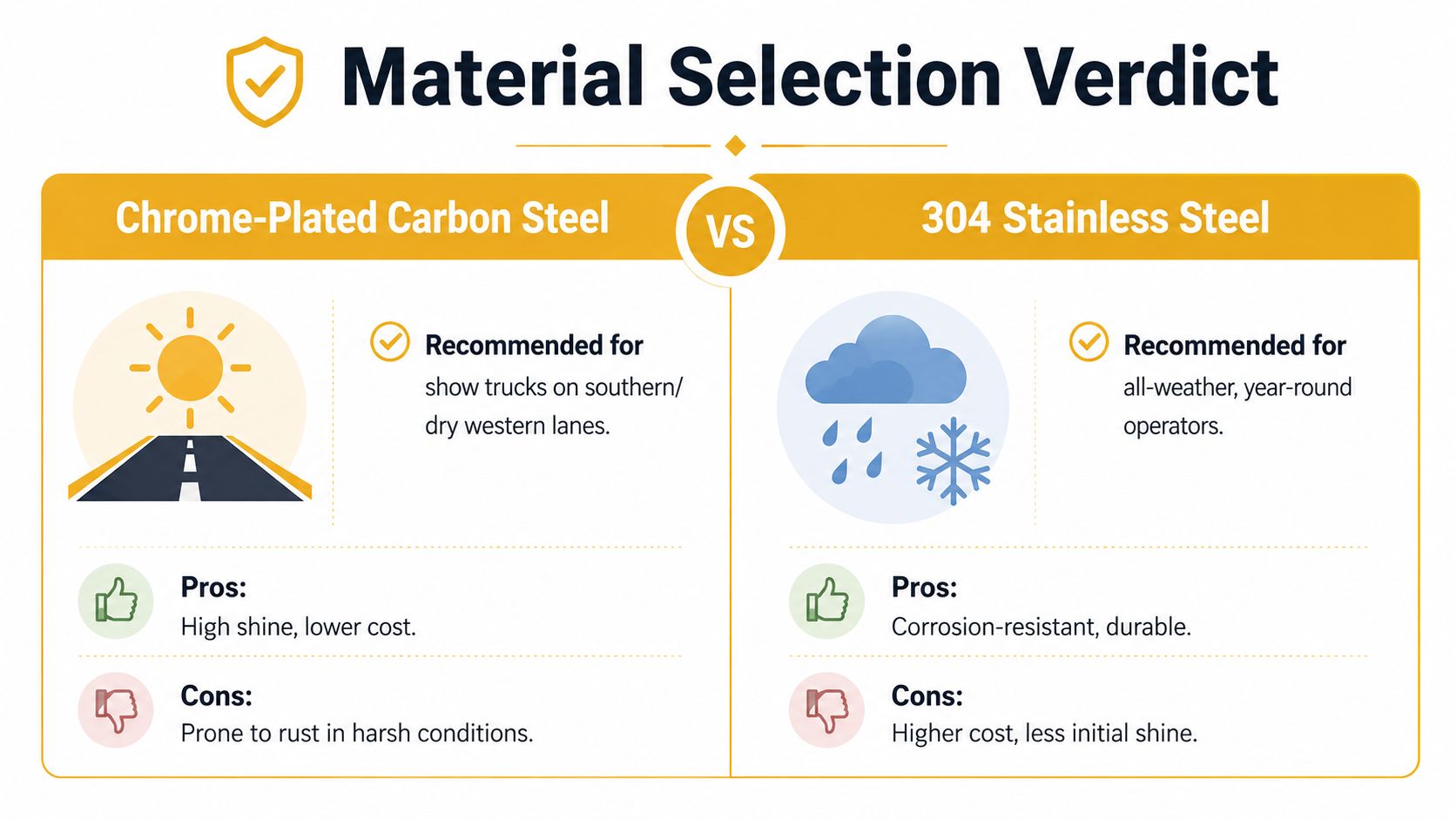
Choose chrome-plated carbon steel for a show truck working mostly through southern or dry western lanes. It gives you the traditional truck-stop mirror look and a strong steel base without forcing a severe-route buyer to pay for corrosion protection they may not need. Plan on disciplined cleaning and a replacement strategy if the truck's duty cycle changes.
Choose 430 stainless for an owner-operator running mixed freight through inland Midwest and mid-Atlantic routes with manageable salt exposure. It's the sensible middle option when you want stainless construction but don't operate in constant coastal or winter chemical exposure. Keep the surface clean, inspect scratches, and don't treat it like 304.
Choose 304 stainless for salted Northeast and Northwest winter corridors, coastal fleets, and year-round all-weather work. Its chromium and nickel composition gives it the strongest corrosion position among these three materials. The higher upfront cost is easier to defend when a failed finish would create repeated maintenance, downtime, or a poor trade-in presentation.
Don't order from a front-view photo alone. Measure the current bumper, confirm the truck's make, model year, cab style, mount style, and all cutouts. Then submit those specifications to the shop and request a quoted lead time and freight estimate.
The cheapest bumper is the one that fits once, survives your route, and doesn't send the truck back to the shop.
For Peterbilt 389, Kenworth W900, Freightliner, and Volvo applications, direct fitment is part of the value. A bumper that requires drilling, shimming, or sensor rework can erase the benefit of customization before the first load leaves the yard.
Bumper Questions Owner-Operators Ask Before They Order
Is the custom bumper legal on my truck?
A custom bumper still has to work with applicable federal and state requirements. Federal bumper standards are included in 49 U.S.C. §32502, and state rules can set specific height and construction limits. Ohio, for example, lists different front and rear bumper-height limits by vehicle type and weight, including separate limits for trucks across stated GVWR ranges. Maryland also has requirements for heavier trucks over 10,000 pounds GVWR when rear clearance exceeds 30 inches, including a permanent rear bumper or metal frame with specified width, height, and heavy-gauge steel conditions. Review the federal bumper standards and confirm state requirements before changing height, width, lighting, or rear clearance.
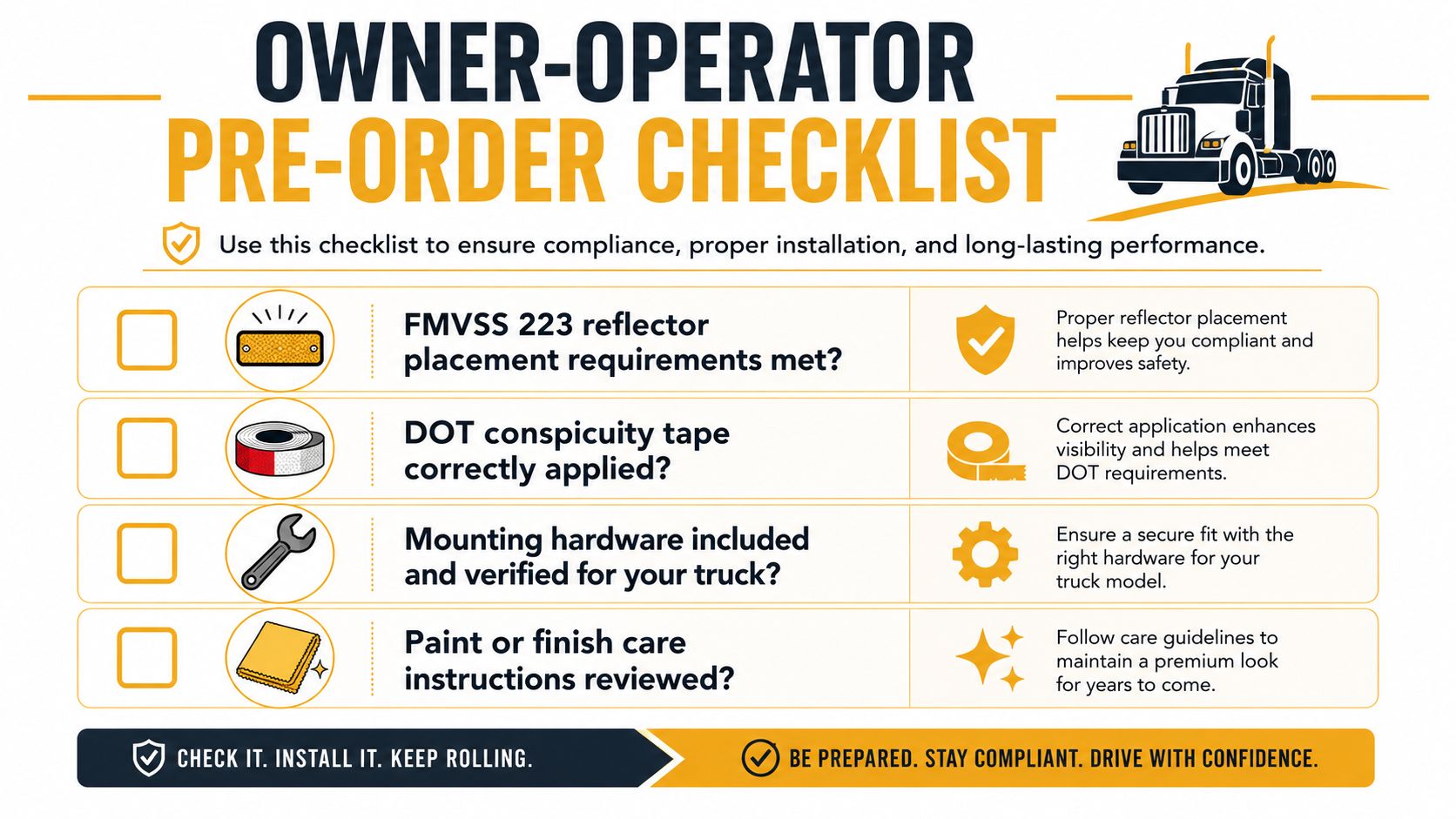
Lighting and conspicuity equipment need equal attention. Check FMVSS 223 reflector placement, DOT conspicuity tape placement on the bumper face, license-plate visibility, and clearance for required lamps. A bumper shop can build the openings, but the operator remains responsible for confirming the finished truck meets the rules that apply to its operation.
Will it interfere with radar or cameras?
Collision mitigation radar behind the grille needs the correct field of view and mounting position. Confirm sensor clearance, harness pass-throughs, and adapter brackets before fabrication. A bumper made for an older chassis may not be suitable for a newer truck with adaptive cruise hardware without a verified bracket solution.
How long does installation take?
A straightforward direct bolt-on replacement usually takes two to three hours with hand tools and a helper when the parts and mounting points match. Current production should include the required sensor pass-throughs when specified, but verify this on the order before shipment. No frame drilling should be necessary for a properly matched listed application.
How should I care for the finish?
Wash 430 and 304 stainless with soap and water, then remove road film before it dries. Use non-abrasive chrome polish on plated carbon steel. Salt and chemical residue should not sit on any bumper, especially around chips, seams, fasteners, and cutouts.
What should I do when the bumper arrives?
Inspect the crate and bumper before signing for freight. Photograph any visible damage, record it with the carrier, and contact the seller promptly. Register the warranty, retain the order details, and photograph the original mounting points before removing the factory bumper. Those images give the shop a clear reference if a fitment issue needs troubleshooting within one business day.
A custom truck bumper should arrive ready for the truck you operate, not the truck shown in a generic catalog image. Confirm the material, thickness, finish, mounting points, cutouts, sensor clearance, warranty, freight process, and production schedule before you place the order.
Galhor Inc. offers configurable direct bolt-on chrome and stainless bumpers for Peterbilt, Kenworth, Freightliner, and Volvo Class 8 trucks, with model, year, style, cutout, and finish selections supported through its ordering process. Visit Galhor Inc. with your truck specifications to request the right configuration, quoted lead time, and freight details for your next custom truck bumper.