

Drop Visors for Peterbilt: A Buyer's Guide for 2026
You're westbound with the sun dropping straight across the windshield. Glare bounces off the dash, your neck is tired from working around the light, and the forward-facing camera has a washed-out view of the road. That's when a drop visor for a Peterbilt earns its keep. It creates a shaded area above the windshield, helping manage harsh sunlight during long hauls instead of serving as decoration alone.
The right visor isn't the biggest one on the catalog page. It's the one that matches your Peterbilt cab geometry, windshield shape, mirror package, roof height, and route. A deep drop may look sharp at a truck show but create clearance, wiper, or visibility problems on a working tractor. Use the comparison below as a starting point, then verify the cab before ordering.
| Peterbilt use case | Practical visor direction | Main reason |
|---|---|---|
| 579 day cab and regional work | Moderate drop with clean mounting | Keeps the profile neat while preserving visibility and mirror clearance |
| 379 or 389 long-haul sleeper | Full drop matched to the windshield curve | Adds shade and suits the classic cab profile |
| 567 vocational truck | Heavy-duty half-drop or exterior mount | Leaves room for work lights, racks, and jobsite equipment |
| Show truck | Deeper or more sculpted profile, only after clearance checks | Prioritizes appearance, but fitment still controls the choice |
Table of Contents
- Why Peterbilt Owners Add Drop Visors
- Drop Visor Types and How They Mount
- Matching Drop Depth, Cab, and Windshield
- Stainless 304 vs 430 vs Chrome-Plated Steel
- Measuring and Verifying Fitment Before You Order
- Visibility Rules and When a Deeper Drop Backfires
- Choosing the Right Drop Visor for Your Peterbilt
Why Peterbilt Owners Add Drop Visors
A low sun can turn a clear road into a shifting band of glare. The light reflects from the hood and dashboard, slips under sunglasses, and forces a driver to change posture just to keep the lane ahead in view. A well-matched visor shades the upper windshield and reduces the amount of direct light entering the cab.
That matters on long duty cycles. The automotive sun visor market was estimated at USD 2.60 billion in 2024 and projected to reach USD 3.98 billion by 2031, with a 6.28% CAGR over that period, according to the automotive sun visor market estimate. The same source describes commercial-vehicle visor adoption at 78%, with 9 million trucks, buses, and vans fitted with visors in 2023, and reports that 65% of heavy-duty truck visors featured extendable functionality. Those figures show that sun control is a normal part of commercial-vehicle equipment, not a strange custom add-on.
Shade is useful only when the visor fits
A drop visor should create a shaded pocket without taking away the view you need at the top of the windshield. It also needs enough space around the mirror arms, mirror heads, wipers, clearance lights, antennas, and roof accessories. A visor that vibrates, blocks equipment, or forces you to look through a narrow slot isn't doing its job.
Peterbilt trucks sit inside the Class 8 heavy-truck segment, where drivers spend long hours on exposed routes and face glare, weather, road spray, and constant vibration. That makes the visor a practical comfort and visibility component. It can also give a 379, 389, 567, or 579 a more finished exterior profile when the depth follows the cab instead of overpowering it.
Shop rule: Choose the shallowest visor that solves the glare problem and clears every piece of hardware. More drop isn't automatically more protection.
Start with the cab, not the truck-show photo
Before comparing polished stainless against chrome-plated steel, identify the Peterbilt model, roof style, windshield setup, and mirror mounting style. Current catalog listings show Peterbilt visor drops ranging from 7.5 inches to 20 inches across 567 and 579 applications, with other heavy-duty options listed at 14-inch, 15.5-inch, 16-inch, and 18-inch drops depending on configuration. See the Peterbilt 567 and 579 visor fitment listings for the range of variables buyers must match.
A clean fit protects more than appearance. It helps prevent movement at the brackets, keeps the visor aligned with the windshield, and reduces the chance that a style upgrade becomes a daily nuisance.
Drop Visor Types and How They Mount
The drop is the vertical face that hangs below the roof line. A shallow drop gives a restrained profile and usually leaves more room around mirrors and wipers. A deeper drop creates a stronger custom look and more shade, but it demands closer checking of the windshield, mirror position, and route conditions. Buy the depth that clears the truck, not the depth that looks largest in a product photo.
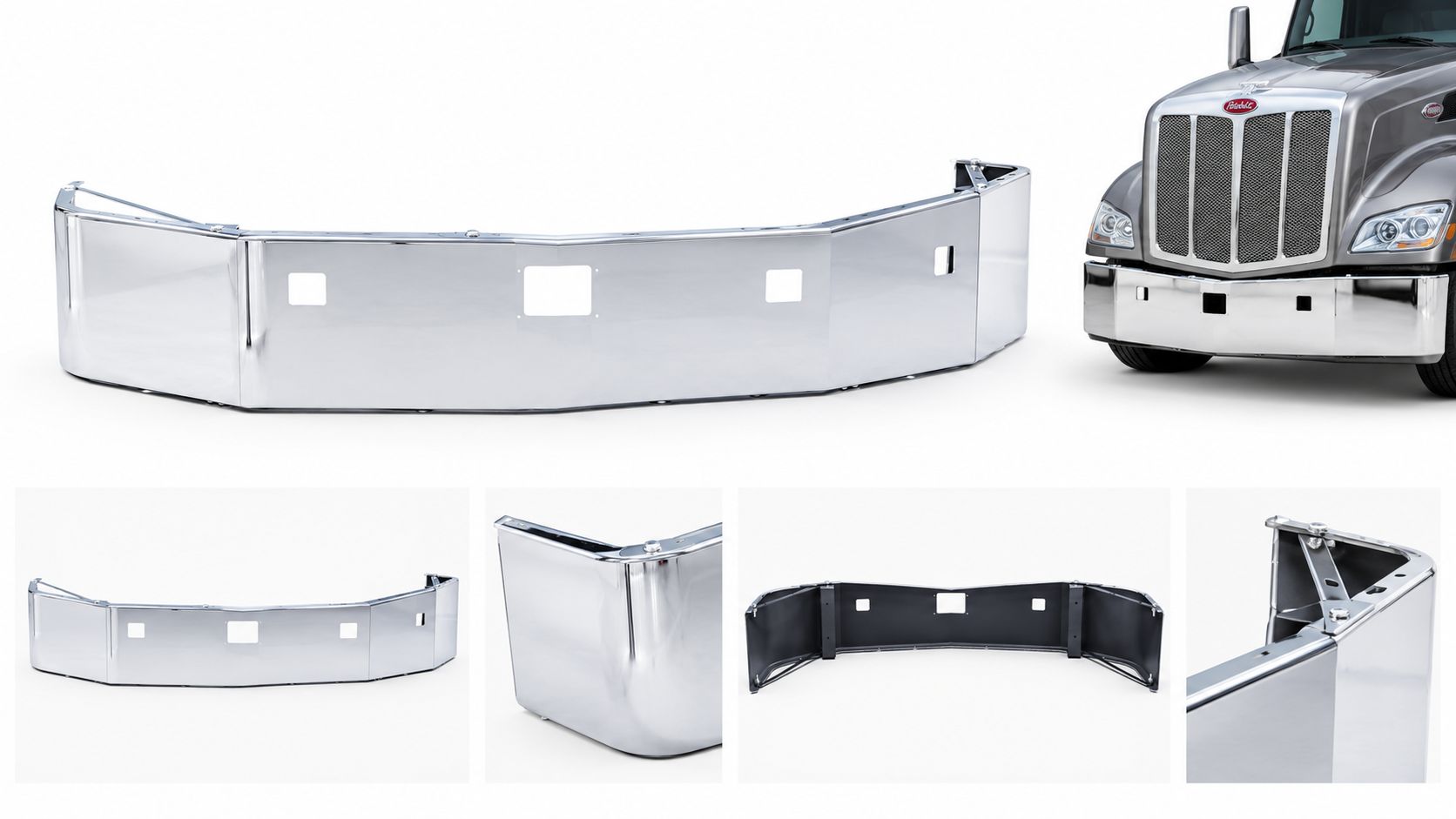
A blind-mount visor hides its clamps or brackets behind the visor skin. You don't see a row of exposed bolts across the front, so the truck gets a smoother appearance. Blind mounting is a strong choice for a clean custom build, but it still needs a solid bracket layout and accurate cab measurements. Skip a blind-mount design if the seller can't explain how it attaches to your specific roof and windshield setup.
A curved outer edge follows the radius of the windshield and often looks deeper without extending as far into the driver's view. A flat-cut edge has a straighter lower line and is common on work trucks and fleet builds. Choose curved for a classic 379 or 389 appearance when the windshield supports it. Choose flat when easy service, a simple profile, and equipment clearance matter more.
Mounting architecture controls the result
Many Peterbilt visors bolt to factory cab or OEM visor mounts with brackets and hardware. That can make installation cleaner because the installer uses the truck's existing structure instead of guessing where to drill. Some older and newer cab configurations differ, so a listing that says “Peterbilt visor” without naming the cab style isn't enough.
On some 379 and 389 installations, a roof-rail spreader plate helps distribute the load across the cab structure. A 579 has a slimmer A-pillar and a different overall cab shape, so a bracket designed for an older classic cab shouldn't be treated as interchangeable.
For a related exterior fitment example, the Chrome bumper for Peterbilt 579 (2012+) uses 10-gauge chrome-plated steel, offers 11-gauge 430 stainless steel, includes a Gauge-7 mounting bracket, and is designed for direct bolt-on installation without drilling or cutting. Its mirror-polished finish uses a triple-layer hexavalent chrome process with 35 microns of nickel. That bumper is a separate component, but the same lesson applies to visor buying: material, bracket design, cutouts, and direct fitment should be stated clearly.
| Style | Mount Method | Best Fit |
|---|---|---|
| Blind-mount drop visor | Hidden brackets attached to factory or dedicated mounting points | Custom Peterbilt builds where a smooth face matters |
| Flat-edge visor | Brackets with a straighter lower profile | Fleet and vocational trucks that need a simple, serviceable shape |
| Curved-edge visor | Cab-matched brackets following windshield radius | 379 and 389 owners seeking a classic profile |
| Exterior heavy-duty visor | Reinforced external brackets and broader support | Trucks carrying work lights, racks, or other roof equipment |
Matching Drop Depth, Cab, and Windshield
Drop depth must follow the windshield and roof profile. A 579 day cab usually benefits from a controlled, moderate look because its cab lines and mirror position leave less room for an aggressive visor. A 379 or 389 sleeper can carry a fuller profile when the visor follows the curved windshield and the mirror arms remain clear.
Catalog options make the problem clear. Peterbilt 567 and 579 applications can range from 7.5 inches to 20 inches, while some heavy-duty listings offer 14-inch, 15.5-inch, 16-inch, and 18-inch drops for different cab and windshield configurations, as shown in this Peterbilt drop visor listing. Those are not universal choices. They represent different fitments.
Compare the practical profiles
A shallow visor works well when the truck runs regional routes, enters tight yards, or carries equipment above the windshield. It leaves more room for mirror movement and keeps the driver's forward view open. The trade-off is a less dramatic exterior profile and less shade at extreme sun angles.
A mid-depth visor is the workhorse choice for many long-haul sleepers. It provides a stronger sun shield without pushing the lower edge too far into the windshield area. A curved design helps. The curve can make the visor look more substantial while keeping its actual intrusion controlled.
A deep visor belongs on a build where the owner has verified the full setup. Mirror housings, heated mirror heads, wiper travel, clearance lights, antennas, and roof accessories all compete for space. If the truck spends its life on ordinary freight routes rather than parked at shows, excessive depth is often a poor trade.
The Peterbilt 379 drop visor fitment guide is useful when comparing classic-cab geometry and mounting considerations.
| Drop Depth | Best Cab Match | Trade-Off |
|---|---|---|
| Shallow drop | 579 day cab or equipment-heavy truck | Cleaner clearance, less aggressive styling |
| Moderate drop | 579 sleeper or mixed-use 567 | Balanced shade, appearance, and hardware room |
| Full drop | 379 or 389 sleeper with verified curved fitment | Stronger custom look, tighter clearance |
| Extra-deep drop | Show-focused build with tested hardware | Maximum visual impact, highest risk of interference |
Roof height changes the answer
Low-roof and high-roof cabs don't present the same windshield angle or roof crown. A visor can sit correctly on one and leave gaps, stress points, or an awkward lower edge on another. Windshield count matters too. A two-piece flat windshield and a one-piece curved windshield call for different visor geometry and bracket positioning.
Don't order from the model name alone. Confirm the roof height, windshield type, mirror location, and desired finish. A polished stainless visor may suit a custom 389, while a painted or restrained stainless profile may make more sense for a fleet 579 that needs a consistent OEM-style appearance.
Stainless 304 vs 430 vs Chrome-Plated Steel
Material choice decides how a visor handles salt, moisture, washing, polishing, and daily road abuse. Shop buyers usually compare 304 stainless steel, 430 stainless steel, and chrome-plated carbon steel. The right answer depends on climate and upkeep, not just the shine under showroom lights.
304 stainless is the premium corrosion-focused choice. It's an austenitic grade commonly selected when corrosion resistance matters most. It makes sense for trucks that run through salted northern roads, wet coastal areas, and changing weather where moisture can sit around brackets and seams. The trade-offs are higher material cost and more weight than a lighter alternative.
430 stainless is the value stainless option. Independent material data identifies 430 as a 17% chromium ferritic stainless steel used widely for decorative trim, while 304 is an austenitic grade chosen for stronger corrosion resistance. Read the 430 stainless material information before assuming every polished stainless panel behaves the same way.
Chrome-plated carbon steel delivers the deepest mirror appearance when new and can be a sensible choice for a dry-climate truck or a budget-conscious custom build. The weak points are scratches, bolt holes, lower return bends, and areas where water remains trapped. Once corrosion gets under the plating, the finish needs more than a routine polish.
Match material to the route
A truck that crosses the Salt Belt should prioritize corrosion resistance and repair cost. A truck that works in a dry region may put more weight on initial cost and maximum mirror shine. A fleet may also choose a painted visor when consistent OEM appearance matters more than a polished custom finish.
World Stainless lists bumpers among exterior trim applications and identifies AISI 304/304L and AISI 430 as relevant automotive grades in its automotive stainless steel applications guide. The same practical rule applies to visor selection. Use 304 when corrosion resistance leads the decision. Use 430 when appearance and value are the priority. Use chrome-plated steel when the finish and purchase budget matter more than the environment.
| Material | Corrosion Resistance | Weight | Cost | Best For |
|---|---|---|---|---|
| 304 stainless steel | Strongest choice of these options for harsh exposure | Heavier than lighter stainless alternatives | Highest of the three | Salt-belt and coastal long-haul trucks |
| 430 stainless steel | Resists atmospheric corrosion but needs care at exposed areas | Generally lighter than 304 | Middle option | Value-focused owner-operators and custom builds |
| Chrome-plated carbon steel | Depends on intact plating and protected edges | Varies by construction | Usually the budget-oriented choice | Dry routes, show appearance, and controlled upkeep |
For a deeper comparison of the two stainless grades, use this 430 versus 304 stainless steel guide. Don't let a perfect showroom reflection decide a route-weather purchase.
Measuring and Verifying Fitment Before You Order
A parts counter doesn't pull a visor from the shelf based only on “Peterbilt 389.” The counter checks the glass, roof, mirror package, hardware, and accessories first. You should do the same before clicking an order button.
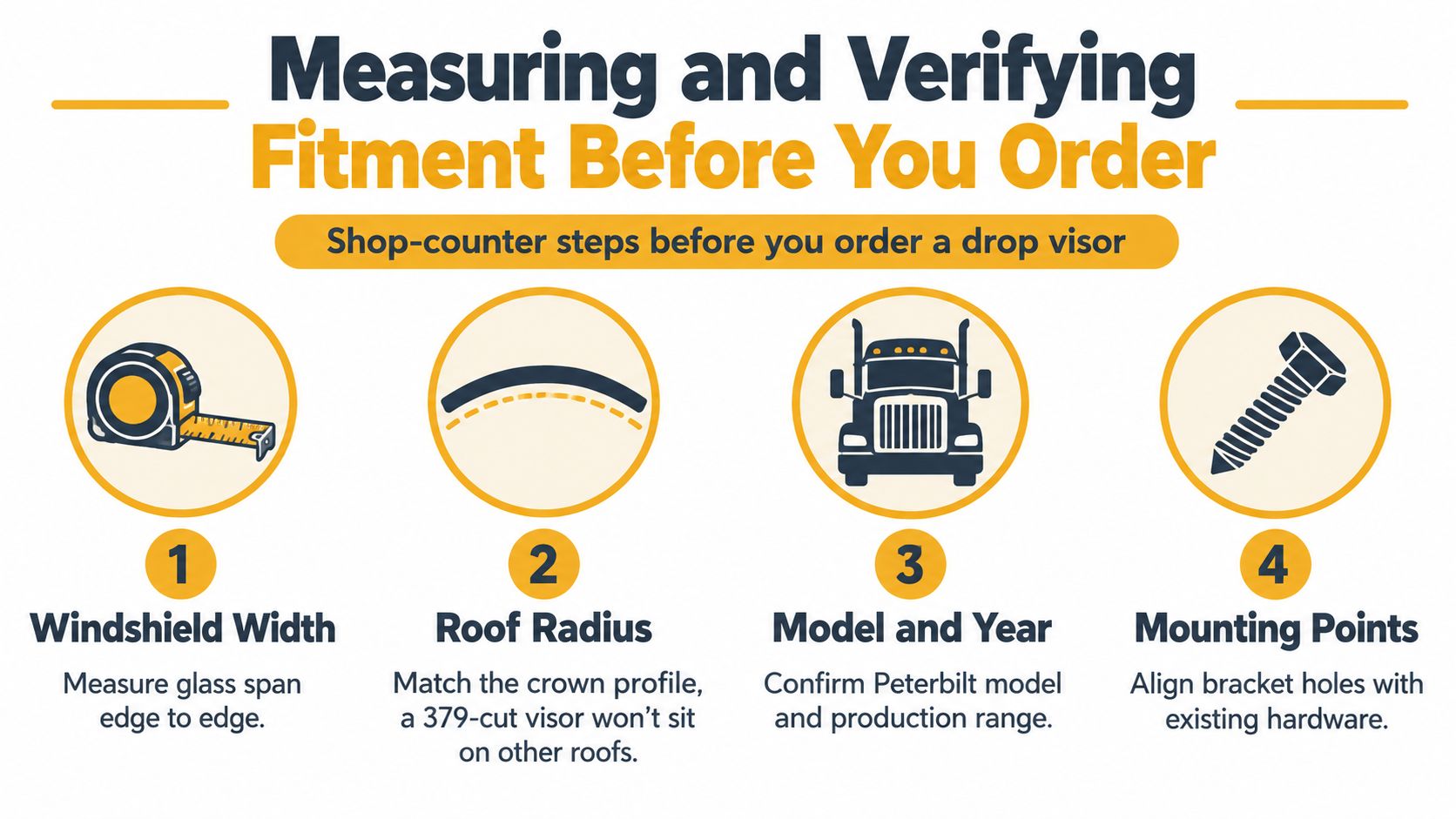
Start with the windshield width and roof radius. Measure the glass span from edge to edge, then study the roof crown where the visor will sit. A visor shaped for a 379 won't necessarily sit flat on a 389 with a different brow. A 567 day cab can also need a different arc than a 579 even when the roofline looks similar from the side.
Check the truck before checking out
Use this order at the truck:
- Confirm model and production range. Record the Peterbilt model, model year, roof style, and windshield configuration. A listing that covers a broad year range may still exclude a special edition or cab revision.
- Inspect the factory hole pattern. Some cabs have usable factory mounting holes. Others need blind-mount brackets. Roof-mounted clearance lights can block or complicate those holes.
- Measure mirror-arm clearance. Measure from the lowest point of the planned visor edge to the closest mirror arm and mirror head through the full range of mirror movement. Use the seller's template, not a guess from a side photo.
- Check door movement. Open each door beyond its normal parked position and watch the visor return near the fender and A-pillar. A return that contacts the door or fender will damage the truck or the visor.
- Tap-test the roof skin. Compare the sound and feel around the mounting area. A thin, repaired, or weakened panel may need reinforcement before drilling or clamping.
The 14-inch-by-35-inch visor halves plus a center bracket used in one documented Peterbilt 379 kit show why larger visors often need multi-point support. See the Peterbilt visor mounting example for the hardware layout and cab distinctions described for different configurations.
For bumper and exterior hardware context, the Peterbilt bumper fitment guide can help you think through factory patterns and direct-fit mounting. A visor still requires its own measurements.
Ask the seller for an installation template before ordering. Confirm the bracket material, fastener grade, reinforcement needs, and whether the kit reuses factory hardware. A few minutes with a tape measure can prevent a return freight bill and a truck sitting in the bay while the correct part is located.
Visibility Rules and When a Deeper Drop Backfires
The deepest visor in the catalog is rarely the best visor for a working Peterbilt. A lower edge can shade the windshield, but it can also reduce the usable view, interfere with equipment, and create a narrow band of bright light that makes glare worse.
NHTSA states that glazing in areas “requisite for driving visibility” must meet a 70% light-transmittance threshold, while a shade band above the windshield may fall outside that requirement. The agency also notes that states can impose their own restrictions on shade bands. Review the NHTSA guidance on visor and windshield visibility, then check the rules for every state where the truck operates.
Visibility problems show up in the cab
A visor may look clear while the truck is parked and still create trouble on the road. Watch for these failure modes:
- Mirror contact: A return or bracket can meet a heated mirror head when the mirror swings or flexes.
- Wiper interference: The lower edge can interrupt the wiper's sweep or leave the blade working in a tight space.
- Narrow glare slot: A very deep drop may leave only a thin bright opening beneath the visor. That can concentrate glare instead of spreading the light across the windshield.
- Inspection concerns: An officer or inspector may view a visor as an obstruction if it covers too much of the windshield or sits outside the acceptable shade-band area.
- Camera washout: A forward-facing camera may lose a clear view when the visor edge, windshield tint, and low sun combine in the same sightline.
A visor should manage sunlight without making the driver search for the road through a smaller window.
Route conditions matter more than show-truck fashion
A driver running east and west through changing sun angles needs a different compromise than a show truck parked most of the day. A regional 579 working in crowded yards benefits from open visibility and mirror clearance. A long-haul 389 may justify a fuller curved visor if the installation leaves the windshield, wipers, and mirrors clear.
Don't assume a deeper drop automatically reduces fatigue. If the driver has to lean forward, change seating position, or work around a blocked upper view, the accessory has failed its main purpose. Have the installer check the view from the normal driver position, with the seat set where the operator drives.
Choosing the Right Drop Visor for Your Peterbilt
Order by model, route, cab, mirror package, and material, in that order. Style comes after those checks. A visor that fits the truck will look better because its lower edge follows the windshield and its brackets sit without forcing the panel into place.
For a regional 579 day cab, choose a moderate half-drop in 430 stainless when you want a polished appearance without paying for the highest corrosion resistance. For an over-the-road 379 or 389, choose a full drop with a curved windshield profile and 304 stainless when the truck regularly sees road salt or wet conditions. For a vocational 567, look for a heavier-gauge half-drop or exterior-mount design that clears work lights, roof equipment, and a headache rack.
Use this shortlist at the counter
| Peterbilt Model | Typical Route | Recommended Drop | Material | Mount Style |
|---|---|---|---|---|
| 579 day cab | Regional freight and frequent yard work | Moderate half-drop | 430 stainless for value and appearance | Cab-matched factory or blind mount |
| 579 sleeper | Mixed regional and long-haul work | Moderate full or curved profile | 430 or 304 based on weather exposure | Factory-compatible bracket mount |
| 379 sleeper | Long-haul and classic custom build | Full drop matched to curved glass | 304 stainless for harsh routes | Reinforced or blind mount with proper support |
| 389 sleeper | Over-the-road freight and custom operation | Full curved drop after clearance checks | 304 for salt and wet climates | Cab-matched reinforced mount |
| 567 vocational | Worksite, regional, and equipment-heavy use | Heavy-duty half-drop | 430 or 304 based on exposure | Exterior or reinforced mount |
Confirm these details before purchase
- VIN and model year: Use the VIN or build record when the seller requests it. Broad year-range claims can miss cab revisions and special editions.
- Cab style: State day cab, sleeper, low roof, or high roof. These details affect the arc and lower edge.
- Windshield setup: Confirm whether the truck uses a two-piece flat windshield or a one-piece curved windshield.
- Mirror model and mount: Identify door-mounted or cab-mounted mirrors, then check the arm and head position at the visor's lowest point.
- Roof accessories: List clearance lights, antennas, work lights, racks, and cameras before selecting the drop.
- Mounting points: Ask whether the visor uses factory holes, blind-mount brackets, a spreader plate, or new drilling.
- Material and finish: Pick 304, 430, painted, or chrome-plated steel based on the route. Confirm whether the surface is polished, brushed, or chrome finished.
- Hardware grade: Ask what fasteners and brackets are included, and whether the hardware suits the cab structure.
- State rules: Check shade-band and windshield-obstruction rules for every state on the planned route.
- Install template: Request a paper or digital template before the order is finalized.
The same fitment discipline applies when you're matching the visor to a Peterbilt 389 bumper, Peterbilt 579 bumper, Kenworth W900 chrome bumper, or an 18-inch drop bumper. A direct bolt-on part is valuable only when its holes, cutouts, brackets, and truck configuration match. One Peterbilt bumper fitment example lists 378 and 379 coverage for 2007 to 2017 and says its pre-drilled holes align with factory hardware, as shown in this Peterbilt 378 and 379 bumper fitment example. The lesson is simple. Verify the pattern before you pay for freight.
For owner-operators, the best visor is the one that reduces glare, survives the route, and doesn't create a second repair job. For fleets, it's the one that can be specified by cab and mirror package without confusing “fits Peterbilt” language. For enthusiasts, it's the one that delivers the aggressive profile while keeping the truck legal and usable.
Choose your Peterbilt visor by cab geometry, mirror clearance, material, and route conditions, not by drop depth alone. Visit Galhor Inc. to review configurable direct bolt-on chrome and stainless truck exterior parts, then request fitment details and an installation template before ordering your matched setup.