

Fleet Truck Parts: A Practical Guide for U.S. Operators
Saturday morning, the phone rings before the parts counter opens. A regional hauler's Kenworth T680 is parked with a cracked bumper and a twisted hood latch after the driver ended a shift against a concrete barrier. The load must roll in six hours, but the truck can't leave until someone finds the right bumper, verifies the brackets, and gets the repair finished.
That's what fleet truck parts mean in real U.S. trucking. A missing body panel can stop a truck just as effectively as failed brakes, a dead alternator, or a damaged air line. The result can be a reassigned driver, a missed delivery window, and a contract problem that costs more than the part itself.
This guide is written from the shop-floor view. The goal isn't to build a decorative parts list. It's to help owner-operators, fleet managers, and maintenance teams choose parts that fit, survive real road conditions, ship quickly, and keep Peterbilt, Kenworth, Freightliner, and International trucks working.
Table of Contents
- Why Fleet Truck Parts Decide Whether a Truck Hauls Tomorrow
- The Core Categories of Fleet Truck Parts Explained
- How Duty Cycle Changes the Life of the Same Part
- Choosing the Right Material for Body and Bumper Parts
- Fitment, Thickness, and Finish on Real U.S. Trucks
- Sourcing, Lead Times, and the New Parts Inventory Playbook
- Total Cost of Ownership and Why the Cheaper Part Costs More
- Planning for the Parts Categories That Still Bite Fleets
Why Fleet Truck Parts Decide Whether a Truck Hauls Tomorrow
The first mistake is treating bumpers, fenders, mirrors, and windshields as cosmetic pieces. A bumper can protect mounting points, lighting openings, tow holes, and front-end alignment. A damaged hood latch or bent bracket can keep a truck out of service even when the engine and transmission are fine.
The same problem appears with brake shoes. A driver may report noise or pulling during a pre-trip inspection, and the truck can quickly move from “needs service” to “can't dispatch.” The foreman then has to find the correct part, confirm availability, arrange labor, and decide whether another truck can cover the load.
One failed part creates several jobs
A sidelined truck creates a chain reaction:
- The driver gets reassigned: Another tractor may need to be located, fueled, and inspected.
- The load gets delayed: A replacement driver or truck still has to reach the freight.
- The shop loses capacity: Emergency work displaces planned preventive maintenance.
- The parts bill grows: Expedited freight, substitute parts, and extra labor can all enter the repair.
- The customer relationship takes a hit: A missed delivery can matter more than the original component failure.
Body and collision parts deserve special attention because their lead times can be unpredictable. Industry coverage identifies fenders, windshields, and other body parts as categories that can delay truck readiness, even though many fleet guides focus almost entirely on filters, brakes, and belts. Recent truck repair coverage explains why body components can sideline a truck just like mechanical parts.
Shop rule: If a part can stop dispatch, track it as an uptime asset, not as an accessory.
The right question at the parts counter
Don't ask only, “What's the price?” Ask whether the part matches the truck's exact year, model, cutouts, bracket geometry, material, and finish. Ask whether it's physically in stock, how it will ship, and whether the installation needs drilling, cutting, or bracket changes.
A direct-fit bumper may cost more than a generic piece, but avoiding fabrication can save a truck from sitting while a technician modifies steel in the yard. That's the practical difference between buying a component and buying a return-to-service solution.
The Core Categories of Fleet Truck Parts Explained
A fleet parts room works best when it groups components by the way the shop uses them. The parts counter doesn't need an engineering diagram to know which items can stop a truck today. It needs a clear view of what wears, what fails without warning, and what takes the longest to replace.
Five buckets that matter in the yard
Powertrain parts include engine sensors, belts, hoses, starters, turbochargers, transmission components, clutches, driveshafts, and universal joints. A failed belt or hose can stop a truck immediately. Turbochargers, EGR valves, and certain pumps can create longer sourcing problems when the right configuration isn't available.
Brake parts include linings, shoes, drums, rotors, calipers, slack adjusters, chambers, springs, and air-system hardware. Brake jobs become urgent when inspection findings show heat damage, uneven wear, air leaks, or a dragging condition.
Electrical parts cover batteries, alternators, starters, sensors, wiring harnesses, lighting, and electronic control components. Harnesses and electronics can be difficult to diagnose and harder to source when a truck uses a specific configuration.
Suspension and steering parts include shocks, springs, bushings, kingpins, drag links, tie-rod ends, and air springs. These parts often wear gradually, but a loose or damaged steering component can make the truck unsafe to dispatch.
Body and collision parts include bumpers, fenders, hoods, grilles, mirrors, headlamp assemblies, windshield assemblies, and mounting hardware. Collision parts are especially important because a small exterior repair can still block road readiness.
For a broader component reference, see this heavy-duty truck parts guide.
| Category | Key Parts | What Usually Sidelines the Truck |
|---|---|---|
| Powertrain | Belts, hoses, turbochargers, clutches | Overheating, loss of power, driveline failure |
| Brake system | Linings, drums, rotors, chambers | Unsafe stopping, air leaks, uneven wear |
| Electrical | Batteries, alternators, harnesses, sensors | No-start condition, warning faults, lighting failure |
| Suspension and steering | Shocks, springs, bushings, kingpins | Poor handling, tire wear, unsafe looseness |
| Body and collision | Bumpers, hoods, fenders, mirrors | Collision damage, poor road readiness, blocked lights |
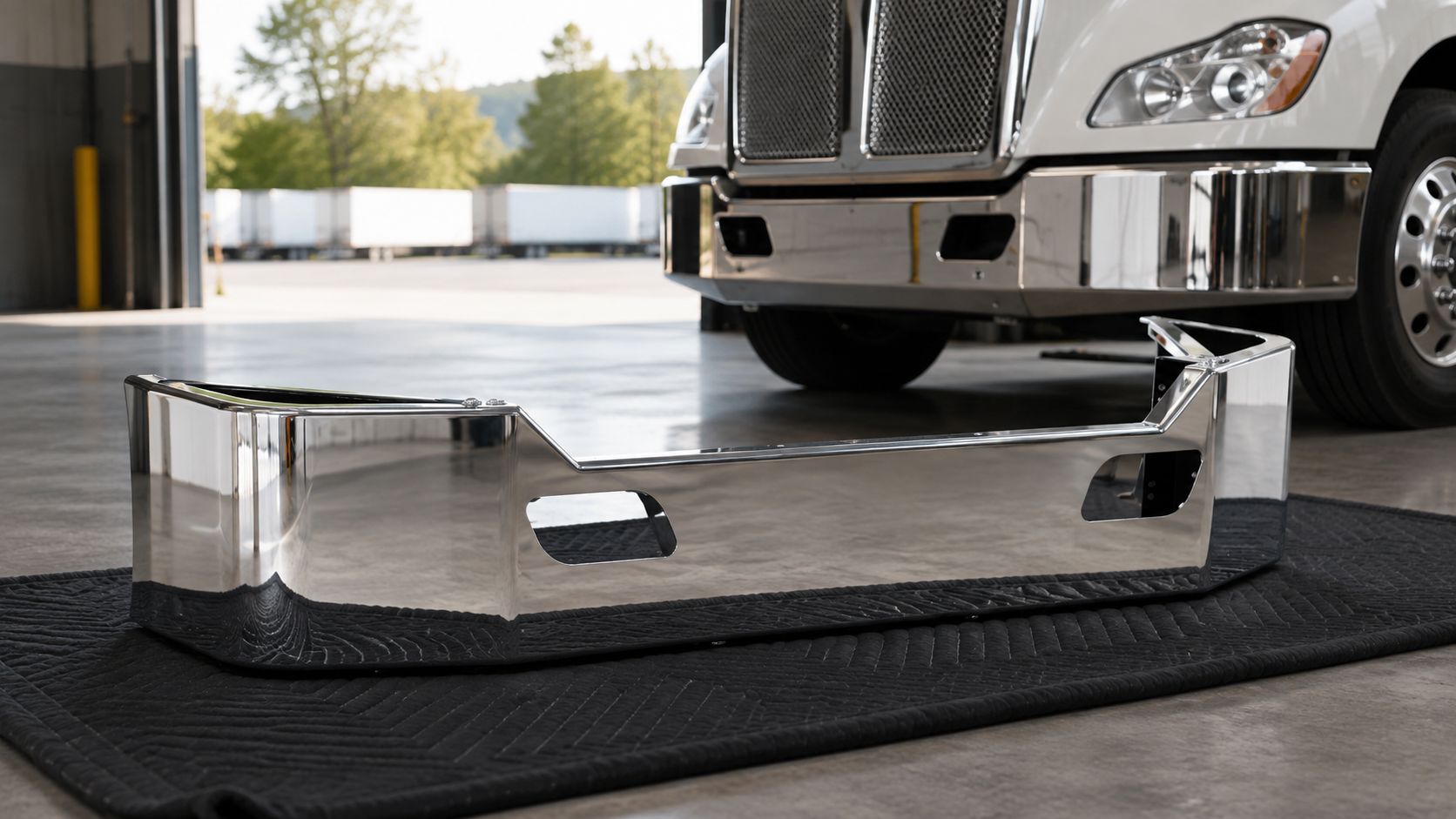
For a truck needing exact model coverage, the Chrome bumper for Kenworth T680 (2008–2017) uses 10-gauge chrome-plated steel with a mirror-polished finish, with an 11-gauge 430 stainless steel option. It uses a Gauge-7 mounting bracket, direct bolt-on installation, and configuration-based cutouts for tow holes, fog holes, and light openings. The finish uses a triple-layer hexavalent chrome process with 35 microns of nickel, and the bumper is sold individually with warranty coverage for workmanship and material defects.
How Duty Cycle Changes the Life of the Same Part
A brake lining doesn't know whether it belongs to a long-haul tractor or a vocational truck. It only responds to the work demanded from it. Stop frequency, terrain, load, heat input, and axle loading determine how much friction material each brake must absorb.
That's why mileage ranges vary sharply. Class 8 fleet trucks in long-haul work commonly reach about 250,000 to 350,000 miles on brake linings, while regional or mixed-use service commonly reaches about 150,000 to 250,000 miles. Vocational or city-duty service commonly reaches about 75,000 to 150,000 miles, according to technical guidance on heavy-duty brake shoe life.
Compare the work, not just the truck
The same bumper also sees different abuse in different operations. A highway tractor mainly faces weather, road debris, and occasional contact. A regional truck may make frequent dock approaches, tight turns, and yard movements. A vocational truck can face construction sites, uneven surfaces, repeated impacts, and heavy contamination.
| Duty Cycle | Typical Annual Miles | Brake Lining Life (miles) | What This Means for Spec |
|---|---|---|---|
| Long-haul | Varies by operation | 250,000–350,000 | Prioritize highway durability, corrosion control, and long inspection intervals |
| Regional or mixed-use | Varies by operation | 150,000–250,000 | Balance stop-cycle wear, frequent inspections, and easy replacement |
| Vocational or city duty | Varies by operation | 75,000–150,000 | Prioritize heat management, robust hardware, and close wear tracking |
The mileage figures describe brake lining life, not a promise for every truck. Measure lining thickness at the center of the shoe, not at the tapered edge. Replace shoes in matched axle sets, inspect drums at every reline, and renew hardware during replacement.
Practical inspection point: Seized bushings, weak springs, and out-of-spec adjusters can create dragging brakes and abnormal wear. Replacing the lining without correcting the hardware only resets the clock temporarily.
A regional fleet that ignores stop frequency will under-spec its maintenance plan. A long-haul fleet that buys the heaviest part for every position may tie up money without gaining useful service life. Duty cycle should drive friction material, bracket strength, inspection timing, and finish selection.
Choosing the Right Material for Body and Bumper Parts
The quote sheet usually presents three practical choices: 304 stainless steel, 430 stainless steel, and chrome-plated carbon steel. They can look similar across a truck stop parking lot, but they don't behave the same after winter salt, stone damage, and repeated washing.
304 stainless is often selected when corrosion resistance matters more than the lowest purchase price. It's austenitic stainless steel with chromium and nickel, and its corrosion resistance is less dependent on keeping a perfect polish. That makes it a strong choice for fleets that expect scratches, road debris, and long service in wet or salted regions.
Where 430 stainless fits
430 is a 17% chromium ferritic stainless steel used for decorative trim. Its corrosion resistance is rated good in atmosphere, fresh water, steam, many petroleum products, and organic materials, according to the Carpenter Technology 430 stainless datasheet.
The surface matters. Grade 430 reaches maximum corrosion resistance when highly polished or buffed. Its pitting and crevice corrosion resistance is described as close to Grade 304 in general service, but the 430 stainless guidance from Penn Stainless warns that seawater resistance is restricted and salt-spray resistance is only moderate.
Chrome-plated carbon steel can deliver a bright, traditional truck-show appearance. It usually costs less than a stainless alternative, but the protection depends on surface preparation, plating quality, and the bond beneath the chrome. Welds, edges, and damaged areas deserve close inspection because corrosion can begin where the coating is weakest.
| Material | Corrosion Mechanism | Chloride Tolerance | Repairability | Typical Fleet Use |
|---|---|---|---|---|
| 304 stainless | Surface contamination and localized corrosion | Strong general resistance | Can be repaired and refinished by a qualified shop | Salt-heavy routes, long service plans, premium replacements |
| 430 stainless | Surface-dependent corrosion and chloride attack | Moderate in salt spray, better in general service | Repair depends on damage and finish | Decorative trim, polished bumpers, controlled exposure |
| Chrome-plated carbon steel | Plating damage exposes underlying steel | Depends on coating integrity | Plating damage may require replacement or refinishing | Appearance-focused builds and cost-controlled replacements |
For a deeper material comparison, review stainless steel versus carbon steel for truck applications.
Road salt accelerates rust because it increases the conductivity of moisture films on steel, speeding electrochemical corrosion. Wash and dry the underbody after salting events, use targeted anti-corrosion sprays, and consider galvanized or stainless hardware in vulnerable areas. Fleet maintenance guidance on busting rust and corrosion supports selecting corrosion-resistant materials before the part reaches the truck.
Fitment, Thickness, and Finish on Real U.S. Trucks
A bumper that looks right in a product photo can still fail at the truck. The fix is a fitment check that starts with the exact make, model, year, bumper style, cutouts, mounting holes, and bracket geometry. Published fitment listings cover specific applications such as Freightliner Cascadia 2008–2017, Freightliner M2 100 from 2002 to present, Peterbilt 359, 379, 388, 389, 567, Kenworth W900L, W900B, W990, and International 9900i. That model-level coverage reflects how buyers order heavy-duty bumpers. Published heavy-duty bumper fitment data shows why “universal” is usually the wrong starting point.
Use the truck as the final template
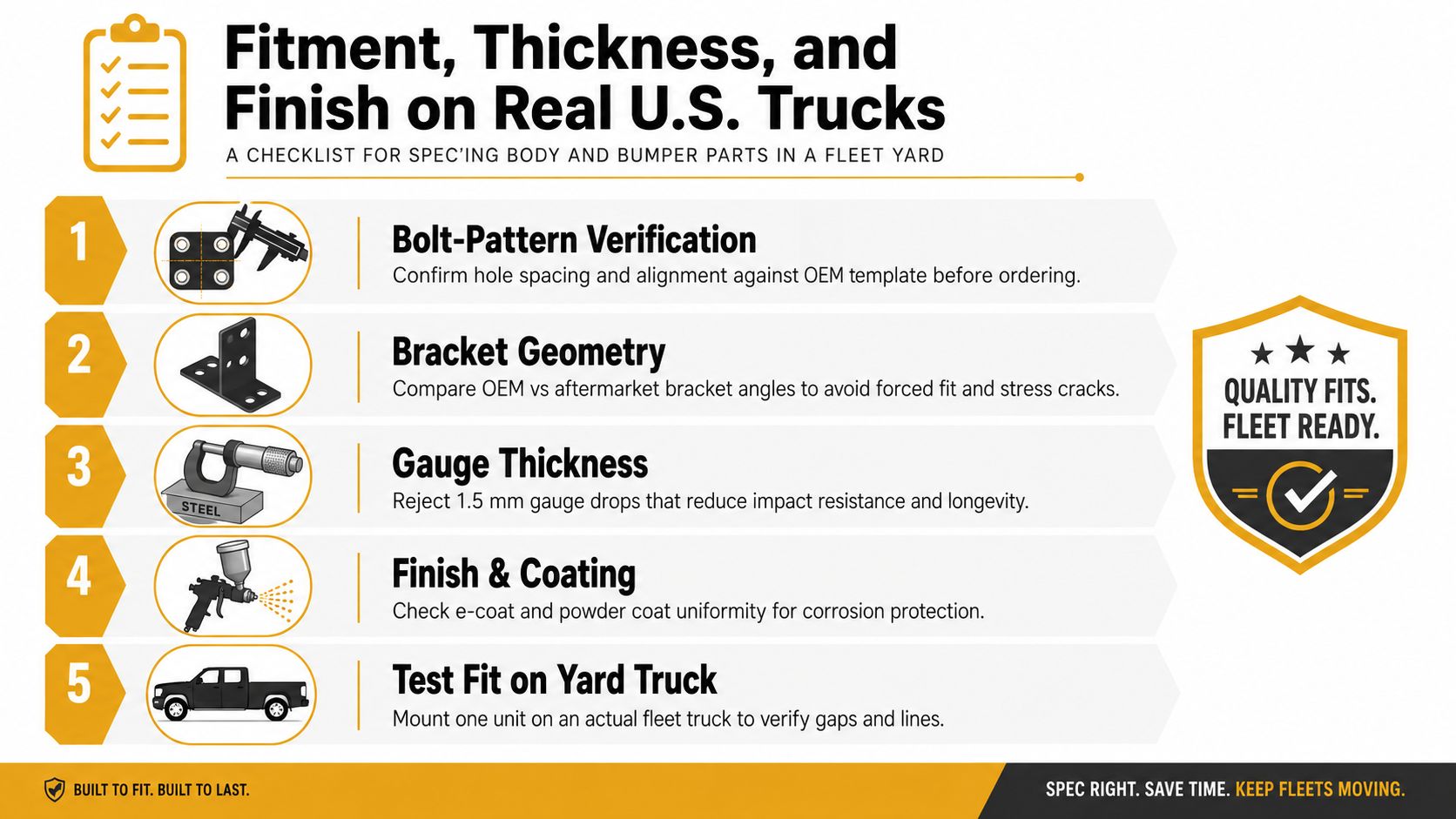
Verify bolt spacing against the truck or an OEM template before ordering. Compare aftermarket bracket angles with the original brackets. A forced fit can preload the steel, distort panel gaps, or stress welds.
Gauge matters too. A thinner replacement may save money on paper but offer less impact resistance and less stiffness. Don't accept a 1.5 mm gauge drop without understanding how it changes the bumper's strength and fit.
Model-specific checks prevent expensive returns:
- Western Star 49X: Confirm bumper mounting points and front-end accessory clearance.
- Freightliner Cascadia: Check headlight surround alignment and deck-area clearances.
- Peterbilt 579: Verify sleeper extender panel alignment and side-gap consistency.
- Kenworth T680: Check fuel-tank fairing gaps and the relationship between the bumper and surrounding panels.
Finish inspection should cover polish uniformity, weld blending, coating coverage, and exposed edges. A hand-polished weld can reduce places where salt and moisture collect, but it can't rescue a poor bracket design or incorrect fitment.
Before dispatching the part, confirm:
- The exact truck year and model.
- Bolt pattern and bracket angle.
- Steel gauge and material grade.
- Cutouts for lights, tow points, sensors, and fog lamps.
- Installation method, including whether drilling or cutting is required.
- Panel gaps after a test fit on an actual fleet truck.
Sourcing, Lead Times, and the New Parts Inventory Playbook
Parts planning has changed because uptime pressure remains high while availability is uneven. Fleets are using mobile repair, predictive maintenance, tighter planning, larger inventories, remanufactured parts, and aftermarket alternatives. Yet industry coverage of maintenance and uptime planning still identifies electronics, windshields, fenders, turbochargers, EGR valves, and certain pumps as pain points.
Put cash where downtime risk is highest
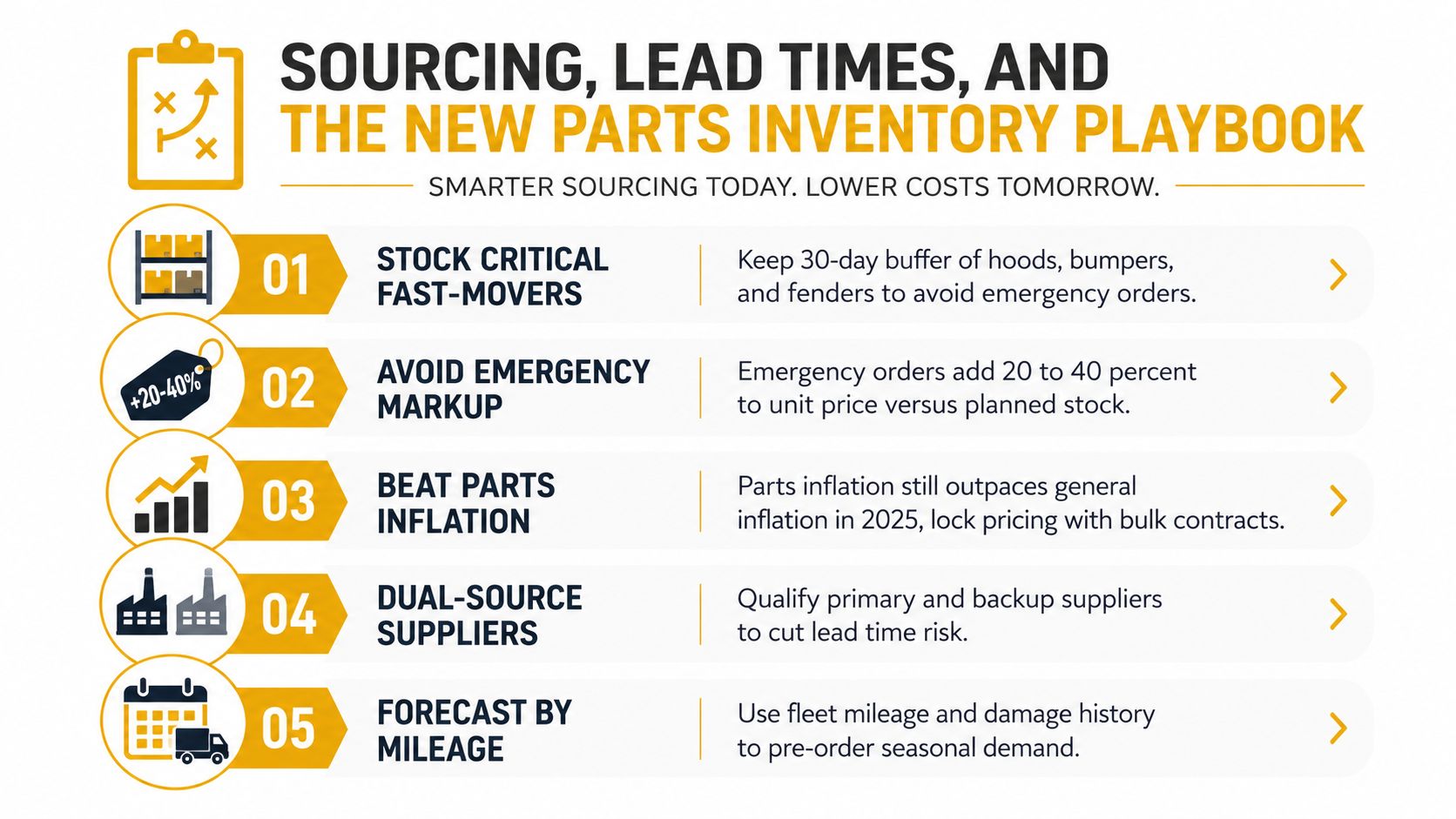
Safety stock makes sense for parts that are expensive to source, likely to cause a dispatch failure, and difficult to predict. A collision-prone bumper, hood, fender, or headlamp assembly deserves a different stocking decision from a common filter that local suppliers can deliver quickly.
The danger is overstocking every slow-moving component. Excess inventory consumes cash, takes storage space, and can become obsolete when a fleet changes truck models. Use three questions for each critical SKU:
- Can this part stop dispatch? If yes, give it a higher priority.
- Can a supplier confirm physical stock? A quoted lead time means little if the distributor is waiting on another warehouse.
- Can two suppliers provide the exact fitment? Dual sourcing protects the fleet when one channel fails.
Parts costs rose 3.7% year over year through Q4 2025, while maintenance represented 27% of lifecycle costs, up from 19% in 2020, according to 2025 truck repair cost coverage. Those figures make planning important, but they don't justify blindly filling a warehouse.
Freight also matters. One shipping policy states that LTL shipments can take up to 10 days, remote or beyond-point deliveries can add more time, and non-stock parts may take up to 2 weeks to receive. This LTL shipping policy shows why a verified in-stock part with fast U.S. shipping can be a commercial advantage.
Stage critical parts near regional drop yards when routes are spread across the country. Central storage may look efficient, but a part sitting hundreds of miles from the disabled truck can still create a lost shift.
Total Cost of Ownership and Why the Cheaper Part Costs More
Unit price is only one line in the maintenance ledger. A bumper that costs less but needs repeated replacement can consume more labor, freight, downtime, and shop capacity than a premium part that stays serviceable.
The right calculation uses the truck's duty cycle, salt exposure, collision history, material, installation time, and expected service life. A regional tractor running frequent dock approaches may punish a bumper differently from a long-haul tractor that spends most of its time on the interstate.
Build the truck-year comparison
Use actual invoices and repair records rather than assumptions. Count the part, freight, labor, lost dispatch time, towing exposure, inspection concerns, and any secondary damage from a loose or corroded component.
| Cost Line Item | Economy Chrome-Plated | Premium 304 Stainless |
|---|---|---|
| Purchase price | Lower initial spend | Higher initial spend |
| Salt exposure | More dependent on plating condition | Better suited to demanding corrosion conditions |
| Replacement frequency | Can increase when coating or steel is damaged | May reduce replacement pressure when properly specified |
| Installation | May be inexpensive if fitment is correct | Same fitment check still required |
| Downtime risk | Higher if replacement sourcing is slow | Lower only when the exact part is available and fits |
| Five-year decision | Depends on replacement and downtime records | Depends on purchase cost, service life, and availability |
A cheap bumper bought twice isn't automatically a bad choice. It becomes a bad choice when the second purchase, freight, labor, and downtime exceed the premium difference. Conversely, an expensive stainless bumper won't create value if it doesn't fit, arrives late, or gets installed with damaged brackets.
The total cost of ownership approach for truck parts is useful because it forces the fleet to measure the whole repair, not just the invoice price.
Maintenance warning: A dollar saved on the part isn't a dollar earned when the truck is parked.
Planning for the Parts Categories That Still Bite Fleets
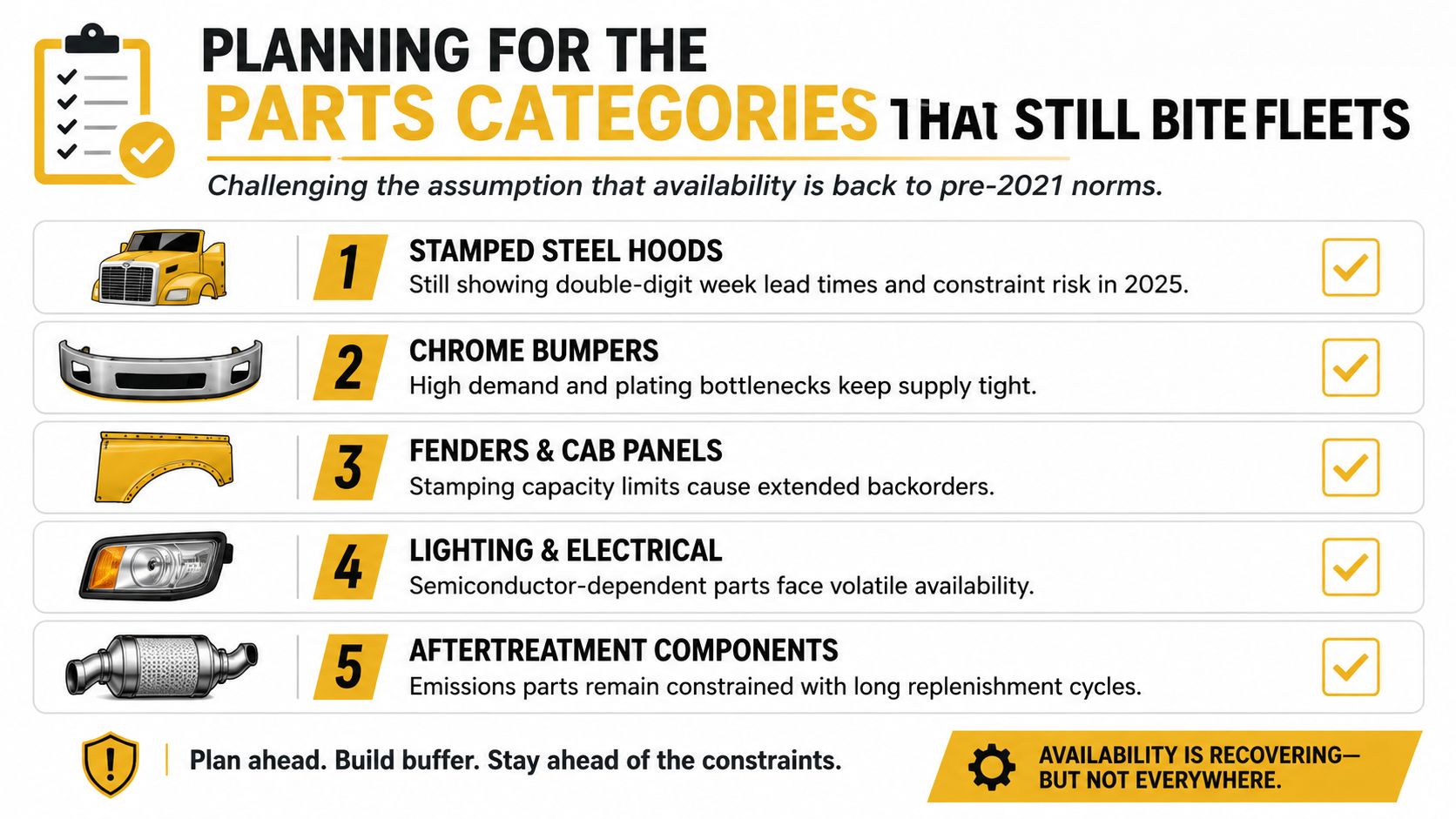
Availability hasn't returned to a uniform normal. Some categories move smoothly, while others still create long waits and emergency sourcing. The current pain points include electronics, windshields, fenders, turbochargers, EGR valves, and certain pumps, as noted in the earlier industry coverage.
Separate shelf stock from supplier promises
Stamped hoods and fenders can be difficult to replace after a collision because they're model-specific and may need matching trim, brackets, lamps, or mounting pieces. Headlamp assemblies can create similar problems when a truck's lighting package or electronic system requires an exact configuration.
Wheel-end parts also need careful review on newer axle configurations. A supplier may quote a short lead time while depending on a cross-shipped unit from another warehouse. Ask for recent fill-rate history, physical-stock confirmation, return terms, and the date the part can leave the facility.
Use this triage:
- Shelf stock: Parts that can stop a truck, have uncertain replenishment, and fit several active fleet units.
- Dual-source agreement: High-cost or model-specific parts where holding every variant would tie up too much cash.
- Just-in-time ordering: Common wear items with predictable demand and dependable local availability.
- Seasonal reserve: Collision and corrosion-prone items before winter travel or periods of severe weather.
- Quarterly review: Update the contingency list whenever fleet composition, route mix, or supplier performance changes.
The practical mistake is treating “availability is normalizing” as permission to stop planning. Stabilization can vary by category, model, and region. A mixed fleet needs a contingency list based on actual damage history and fill-rate performance, not a broad market headline.
Review that list every quarter. Annual budget cycles are too slow for a parts category that can change before the next planning meeting.
Galhor Inc. offers configurable, direct bolt-on chrome bumpers for major Class 8 truck brands, with material choices that include chrome-plated carbon steel, 430 stainless steel, and 304 stainless steel. When a collision or appearance part threatens uptime, review exact fitment, finish, shipping, and warranty details at Galhor Inc., then order the bumper that matches your truck and route.