
Front Bumper and Grill for Trucks: How They Work Together
November 23, 2026 · Francisco Hornelas

You're parked at a fuel island after a long grade, and the chrome still looks sharp. The temperature gauge did not. It climbed while the fan stayed on longer than it should. On a Peterbilt, Kenworth, Freightliner, or International, the front bumper and grill are one system. The bumper takes the hit. The grille feeds the radiator. If either one is bent, blocked, or mounted wrong, cooling, lights, and a roadside inspection can all go bad on the same trip.
A pretty front end that starves the cooling package is not an upgrade. Match airflow, measurements, and material to the routes you run before you order chrome.
Table of Contents
- What the Bumper and Grille Each Do on Your Truck
- How the Bumper and Grille Work as One Front End
- Fitment Checks Before You Order a Replacement
- Chrome Carbon Steel, 430 and 304 Stainless Compared
- When to Repair, Replace or Upgrade Your Front End
- Frequently Asked Questions About Truck Bumpers and Grilles
- Confirm the Fit and Order Your Front End Today
What the Bumper and Grille Each Do on Your Truck
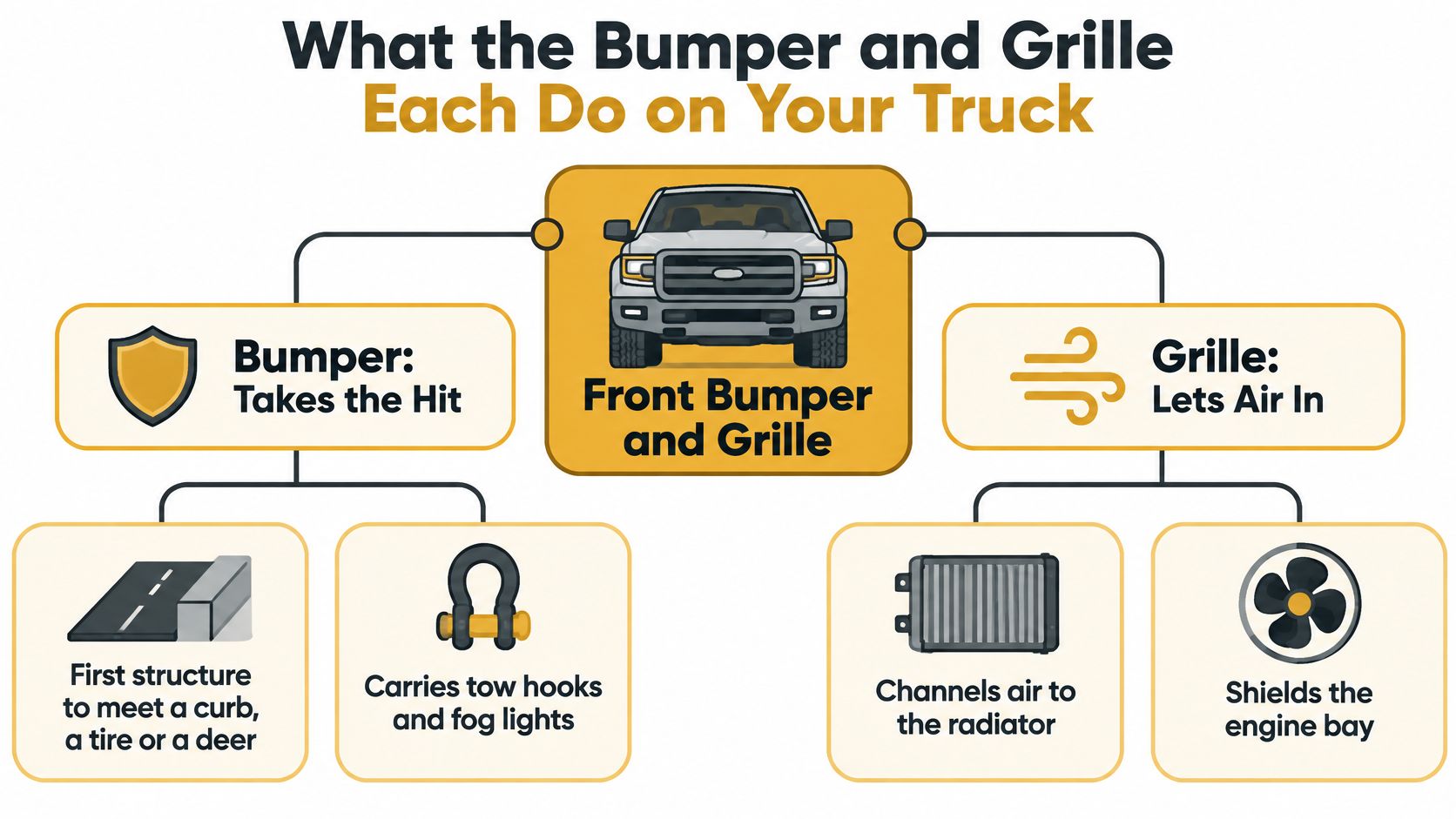
Drivers mix these two parts up because they sit in the same opening. They do different jobs.
The front bumper is the first structure to meet a curb, a blown tire, or a deer. It carries tow hooks, fog light mounts, and the plate bracket, and it bolts to the frame rails through brackets. If a mount loosens, one end sags and the whole face shifts.
The grille is a screen of bars or mesh. It lets air reach the radiator and the charge-air cooler, and it keeps rocks and road debris out of the cooling core. It is not trim. Tear the mesh, and stones go straight into the fins.
These parts share the front-end space, so damage jumps from one to the other. A bent bumper can push a grille bar into the core. On a working truck, both sit ahead of the radiator and the fan, and they do that job every mile.
A four-point check you can run today
Catch a loose mount or torn mesh before it becomes a shutdown or an inspection write-up.
- Look for cracks at bracket points. Hairline cracks near the bolts mean the last impact loaded the mounts, not just the face.
- Look for bars or mesh pushed inward. Inward bars sit closer to the core and can rub fins on the next rough road.
- Look for an uneven gap between bumper and grille. A wider gap on one side usually means a bracket has shifted.
- Check that both parts sit tight to the frame. Grab the bumper at each end. Movement you can feel is a mount problem, not a polish problem.
| Part | Main job | Connects to or protects | Warning sign |
|---|---|---|---|
| Front bumper | Absorbs low-speed impacts and carries tow hooks, fog lights, and plate brackets | Frame rails, mounting brackets, tow points | Cracks near brackets, loose mounts, one end sagging |
| Grille | Lets air reach the cooling package and blocks rocks and debris | Radiator, charge-air cooler, fan shroud | Torn mesh, bent bars, engine running hot under load |
Shop habit: If the gap between bumper and grille is uneven, stop polishing and check the brackets first. Shine will not pull a sagging end back into line.
How the Bumper and Grille Work as One Front End
The bumper and grille share one job: getting air to the cooling package while taking the hits. Air does not care how the chrome looks. It follows the path you leave open, and that path is short.
- Air enters through the grille opening.
- It has to pass through the radiator and the charge-air cooler, not around them.
- The fan pulls it through, and it leaves through the engine compartment.
A front bumper and grill that looks stock from ten feet away can still choke that path with one extra bar, a plate mount, or a gap beside the core.
Air entering the grille can also leak around the cooling module instead of passing through the radiator when the grille-to-heat-exchanger distance and the ducting are a poor match. In the driving condition they modeled, the SAE airflow study on a heavy-duty cab-over truck found a minimum grille opening of 17.5% was required to keep radiator top-tank temperature below the 100 °C target. A grille can keep its open look and still lose flow. Air that sneaks around the seals never crosses the heat exchangers.
What blocks the opening
These add-ons are the usual restrictions:
- Decorative bars and mesh inserts cut the opening even when the shell looks unchanged.
- Brush guards and winch structures sit in the inlet and shove air sideways.
- License-plate mounts parked in the center of the grille block the middle of the core, which is the part that works hardest.
- Extra lights and bumper-mounted accessories steal area and can open a bypass beside the shroud.
A replacement grille has to be judged with the radiator, the charge-air cooler, the fan shroud, and the sealing panels around them. If coolant temperature climbs under load after a front-end change, airflow resistance, blockage, or a sealing gap has changed. That is a measurement, not a guess.
Shrinking the grille to cut drag is a weak bet. A U.S. Department of Energy heavy-vehicle aerodynamic study reported that total drag barely responded to small changes in radiator or grille dimensions, while the shape of the whole truck mattered more. Reducing grille size by itself did not deliver the efficiency gain people expect, because heat rejection and body shape have to be solved together. Bumper height, setback, gaps, and the lower-front transitions move the air under and around the bumper more than a slightly smaller opening does.
On a loaded climb in July heat, the coolant gauge creeps up and the fan runs long after you crest the hill. That pattern often starts at the front, not in the water pump. After any light bar, plate move, or new bumper, do three things: watch coolant temperature under load, look for air leaks around the radiator package, and recheck both once the accessory is on.
Chrome can still look right and breathe. Our semi truck chrome parts guide walks through front-end pieces that have to stay out of the inlet.
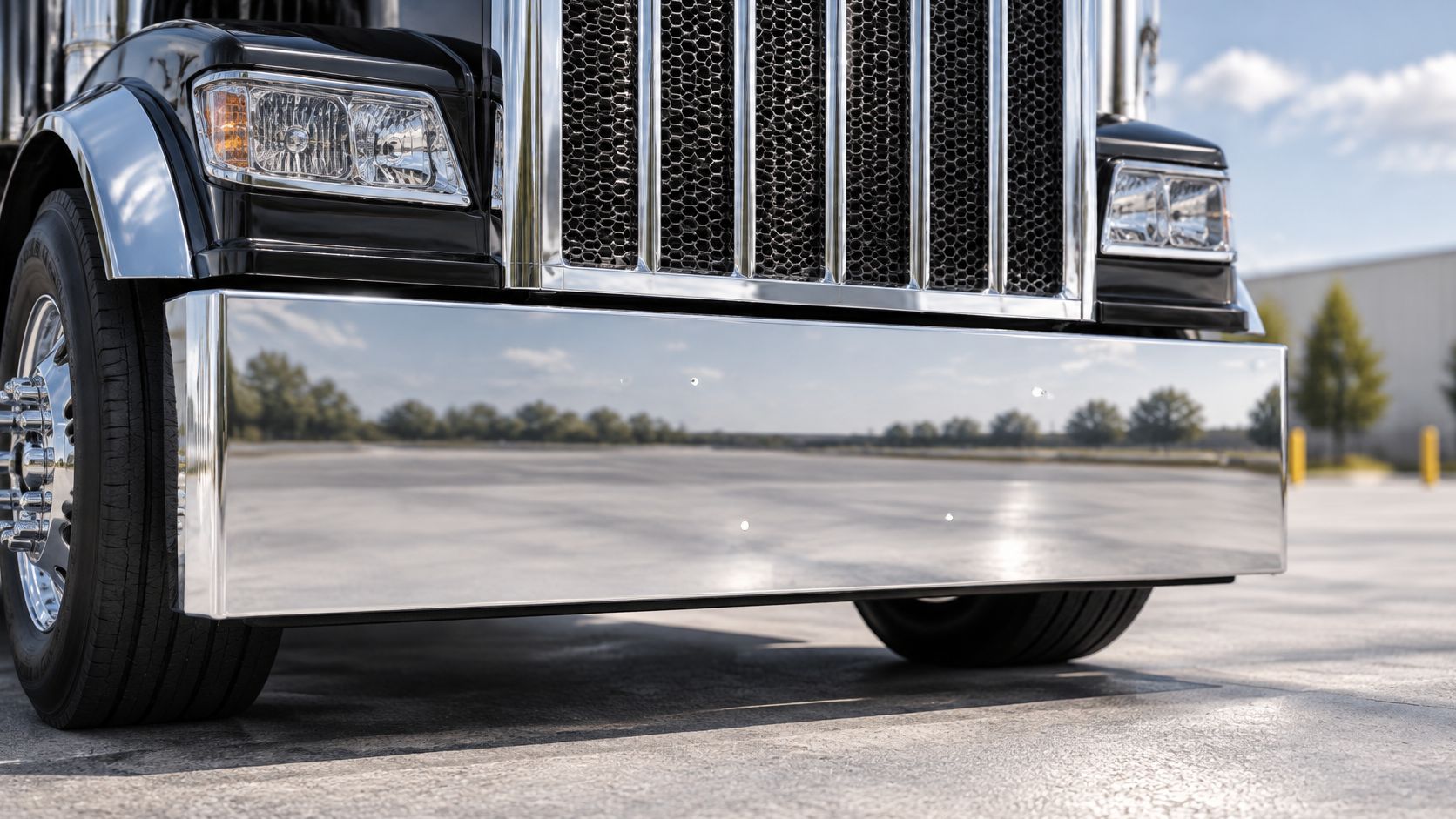
A steel chrome face only helps if the opening behind it stays clear.
Fitment Checks Before You Order a Replacement
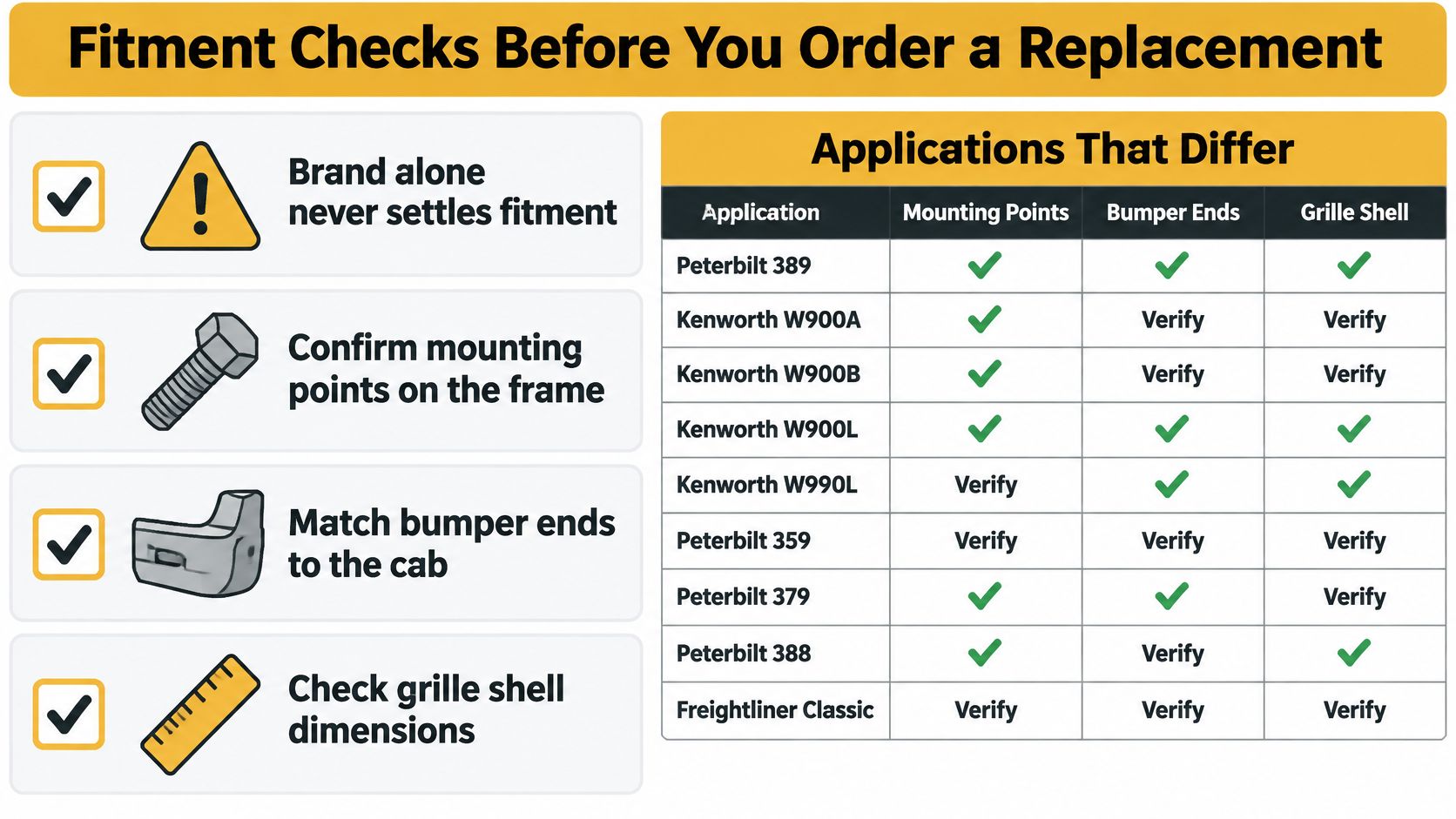
Brand alone does not identify the bumper. The model and year do. A Peterbilt 389 bumper fits one family. A Kenworth W900 chrome bumper has to match the W900 variant sitting in your yard. Frame width, brackets, axle position, hood, grille shape, tow-hook openings, and light cutouts all change by model and by year.
Kenworth W900A, W900B, W900L, and W990L are different applications. So are Peterbilt 359, 379, 388, and 389, and a Freightliner Classic. Order from the exact family, then confirm the chassis in front of you.
Measure before you trust a listing
A published Peterbilt body-builder reference lists an 11.4-inch front-of-bumper-to-front-frame dimension and a 19.6-inch front-axle-to-front-frame dimension. Those two numbers are why a tape measure beats a guess. If your rails or axle sit differently, a bumper that looks right in a photo will load the brackets or hit at full steer.
The same badge can hide more than one bumper. A Freightliner FL-series bumper dimension listing shows FL50, FL60, FL70, FL80, and FL106 applications at 14.2 inches and 21.3 inches, while FL112 applications are listed at 23.5 inches and 25.5 inches. Write the size down off the truck you have, not off the cab name.
| Check | Where to measure or find it | Why it matters |
|---|---|---|
| Brand and exact model | Registration, VIN plate, or door tag | Model families use different brackets and hoods |
| Model year range | Build sheet or dealer records | Mounts and grille shape change between years |
| Frame rail width and thickness | Measure at the bumper mounts | Decides whether the bracket fits without modification |
| Bumper-to-frame and axle-to-frame distances | Chassis measurements or body-builder reference | Confirms the bumper sits in the correct position |
| Mounting-hole spacing and bumper height | Measure the existing bumper | Confirms a true direct bolt-on fit |
| Tow hook, fog light, and grille cutouts | Compare with existing parts | Avoids drilling or field cuts |
| Axle and tire clearance at full steer | Measure with the truck on level ground | Critical for drop bumpers |
On our bumper pages you pick the brand, then the model. Each page lists year ranges, cut-out options, and width fits. Match those to the notes you took before the old bumper came off. You can also configure a bumper at galhor.com, where the 3D configurator walks you through size, style, cutouts, and lighting before you commit.
An 18-inch drop bumper sits lower, so it changes the gap to the road, the frame, and the front tires. Turn the wheel lock to lock on level ground and measure tire and steering clearance before you order. A 20-inch bumper gives more front coverage and a more aggressive look than an 18-inch, and it needs the same clearance check at full steer.
This short walk-through shows how a front end comes apart and where the mounts sit, which is the view you want before you measure.
Write it down, then compare
Before you unbolt anything, record bumper height, overall width, mounting-hole spacing, rail width, rail thickness, and every tow, fog, and light cutout. Compare that sheet to the listing. If the numbers in the listing do not match the numbers on your truck, the part is wrong for the application, whatever the title says.
A steel chrome bumper in this category is built from 10-gauge chrome-plated steel with a triple-layer chrome finish and 35 microns of nickel, sold individually as a direct bolt-on fit.
Brackets do as much work as the bumper face. If the holes do not line up, stop and check bumper mounting brackets against your rail width and hole spacing instead of elongating holes in the yard.
Chrome Carbon Steel, 430 and 304 Stainless Compared
Stainless grades differ in chromium and nickel content, and that changes how the metal lives in salt. Ask for the grade before you pay for shine. Two alloys can carry the same mirror polish and age very differently underneath.
| Material | Key build facts | Corrosion behavior | Best fit |
|---|---|---|---|
| Chrome-plated carbon steel | 10-gauge steel with triple-layer chrome and 35 microns of nickel | Chrome is the shield; a deep chip lets the steel rust | Dry routes and owners who keep the finish intact |
| Chrome-plated 430 stainless | About 16 to 18 percent chromium and no intentional nickel | Good polished look; less margin than 304 in road salt | Appearance-first buyers on mild routes |
| Chrome-plated 304 stainless | About 17.5 to 19.5 percent chromium and 8 to 10.5 percent nickel | Strongest corrosion resistance of the three in salt and wet service | Northern, coastal, and winter salt routes |
Grade notes on 304 and 430 put 304 at about 17.5–19.5% chromium and 8.0–10.5% nickel, and 430 at about 16.0–18.0% chromium with no intentional nickel. Nickel is why 304 holds up better in road salt and wet service. Grade 430 is the lower-cost stainless. It still polishes and still takes chrome, and it fits buyers who want the look on milder routes and will keep up with washes.
What decides the buy
Carbon steel can look identical on day one. The chrome layer, including that nickel undercoat, is the shield. A deep stone chip opens the steel, and winter brine finishes the job. That bumper is a fair choice on dry southern lanes if you touch up chips and do not let salt sit in the seams.
430 is the middle path. You get a stainless base and a lower material cost, with less margin once the truck lives in slush. If the shine is the goal and the miles stay off heavy salt, it can be the right spend.
304 costs more up front because of the nickel. On northern lanes, coastal highways, and trucks that see winter brine every week, that cost shows up later as fewer rust-through replacements. Compare thickness, reinforcement, mount design, and finish quality at the same time. A thin 304 panel with weak brackets still cracks at the bolt holes.
Pick the grade from the worst week on your route. The photo only shows day one. Salt routes favor 304. Dry routes with a wash plan can live with carbon steel or 430.
The same split applies on a Peterbilt, Kenworth, Freightliner, or Volvo. The hood emblem changes nothing about what road salt does to a chipped face.
When to Repair, Replace or Upgrade Your Front End
Three questions sort almost every front-end job.
Is the damage at a stress point? Cracks at bracket holes and a sagging end are structural. A scuff in the chrome is not.
Is airflow or a light affected? Torn mesh, blocked fins, or a lamp pointed at the sky are safety and cooling issues. Polish will not fix them.
Does the frame or a bracket move? If the rail or the bracket has shifted, a new bumper bolted to the old geometry will sag again.
| Sign | Likely cause | Action |
|---|---|---|
| Bent grille bars or torn mesh | Stones, brush, or a deer strike | Replace the grille section if mesh is torn or bars crack |
| Cracked bumper near bracket points | Impact load not spread through the mounts | Replace the bumper and inspect the mounts |
| Bumper sags at one end | Bracket failure or frame shift | Check frame and brackets before fitting any new part |
| Radiator fins bent or blocked behind grille | Debris pushed through the grille opening | Clean and straighten the core, or repair it before the grille goes on |
| Chrome peeling or rust spots | Chip exposure, road salt, and time | Polish if the surface only is affected; replace if steel is rusting through |
| Coolant temperature rising under load | Blocked opening or sealing gap | Clear the opening, check the shroud and seals, and replace damaged parts |
Say you hit a deer at highway speed. Before you roll, look at the grille, the bumper ends, the radiator fins, and every front light. A cover that springs back can still hide a cracked bracket. If the temperature climbs on the next pull, treat that as a blocked opening or a bad seal, not as "it will settle."
Cosmetic chrome usually needs a polish or a spot repair. Cracks at the brackets and a crooked end point to load or mount trouble. Swapping only the shiny skin leaves that trouble in the truck.
In 2025, TruckPartsSuperstore reported the typical cost to replace a truck bumper, parts and labor included, as $500–$2,000. One lost day often costs more than the cheap repair that fails the following week. A short diagnosis, mounts first, then skin, keeps the truck earning.
If the old bumper is already due, this is the moment to step up the material for the route. On salt lanes, 304 can cost more now and cut the next replacement. On dry lanes, carbon steel or 430 with a cared-for finish is often enough. Either way, deal with bent mounts before the new part goes on. More on impact patterns is in our notes on front bumper damage.
Frequently Asked Questions About Truck Bumpers and Grilles
Can I run with the grille removed
On a working truck, the grille stays on. It keeps rocks and road debris off the radiator and the charge-air cooler, and removing it changes how air moves through the cooling package. A short-term temperature drop in cold weather can turn into a stone hole in the core a week later.
Does a drop bumper need extra checks
Yes. The lower profile changes how the bumper sits relative to the road, the frame, and the front tires. Check clearance at full steer on level ground before you order, and again after it is bolted on. An 18-inch drop bumper that clears with the wheels straight can still rub at full lock.
Is chrome better than stainless
Chrome is a finish. The steel under it decides how the bumper lives with road salt. Match 304, 430, or chrome-plated carbon steel to the route, then judge thickness and the mounts.
Why won't a bumper from the same brand fit mine
Fitment follows frame width, bracket position and model year. Hood and grille shape and the cutouts also change by model, so a Kenworth W900A bumper is not a W900L bumper. Start with the exact model and year on the door tag, then measure.
What does the warranty cover
Manufacturing defects in workmanship and materials. Read the warranty terms for the exclusions before you file, and keep in mind that damage from a road incident calls for a replacement decision rather than a warranty claim. After a documented road incident, Galhor discounts the replacement bumper: 15% off for carbon steel, 20% off for 430, and 25% off for 304.
Confirm the Fit and Order Your Front End Today
Run this sequence before you spend the money.
- Confirm brand, exact model, and year from the registration or the VIN plate. "Peterbilt" or "Kenworth" is not enough for a Peterbilt 389 bumper or a Kenworth W900 chrome bumper.
- Measure the frame rails, mounting holes, bumper height, and axle clearance with the checks above. Write them down before the old bumper leaves the truck.
- Choose the material by route. Use 304 for salt and wet service. Use 430 or chrome-plated carbon steel on dry routes if you will keep the finish up.
- Check attachment and protrusion. Under 49 CFR §393.203(e), the front bumper must be present, securely attached, and free from hazardous protrusion beyond the truck's normal boundaries. The rule does not set one width or one drop height for every Class 8 truck. A loose bumper can fail an inspection and become a hazard. Confirm the mounts are tight, the bumper does not stick out in a dangerous way, and the finished job does not interfere with steering, lighting, or required equipment. Give any drop bumper an extra clearance check at the tires.
- Inspect mounts, cutouts, and clearances when the part arrives, before it goes on the rails.
Our bumpers are a direct bolt-on fit. You configure brand, model, style, cutouts, and finish in the 3D configurator. In-stock 304 and 430 flat bumpers ship within 48 hours across the United States. Made-to-order carbon steel typically ships in 4 to 6 weeks. The warranty covers manufacturing defects. Configure the bumper, or check your sheet against the fitment table first, and order with the measurements in hand.
Galhor Inc. builds direct bolt-on chrome bumpers for Class 8 trucks, with 304, 430, and chrome-plated carbon steel so the front bumper and grill can protect the truck and still feed the cooling package. You pick the model, cutouts, and finish for the routes you run, with in-stock stainless options that ship fast across the United States. Visit Galhor Inc. to configure your bumper and order the front end that fits.