

Front Bumper Damage on Class 8 Trucks: A Practical Guide
Front bumper damage on a Class 8 truck is never just a chrome problem. FMCSA crash data showed the front was the initial point of impact in 2,899 fatal large-truck crashes in 2020, or 59.9% of all fatal large-truck crashes that year, and that front-end share stayed high in the prior two years as well (FMCSA crash data). If you run a Peterbilt, Kenworth, Freightliner, or International, that means your bumper is part of the truck's real load path, not just the pretty face on the nose.
Treat front bumper damage like a maintenance decision, a safety decision, and a downtime decision all at once. A bent face can hide damaged brackets, shifted mounts, cracked light cutouts, or sensor trouble behind it. The right move is simple, inspect the structure, judge the material, and replace anything that can't be trusted on the road.
Table of Contents
- Why Front Bumper Damage Is a Daily-Class Event
- The Five Types of Front Bumper Damage Truckers Actually See
- Why a Bent Bumper Is a Safety Problem, Not Just a Cosmetic One
- Repair vs. Replacement and What the Math Really Looks Like
- Chrome-Plated Carbon Steel vs. 430 vs. 304 Stainless Steel
- Fitment, Ground Clearance, and Why Bolt-On Matters
- Preventing the Next Impact and Getting Back on the Road
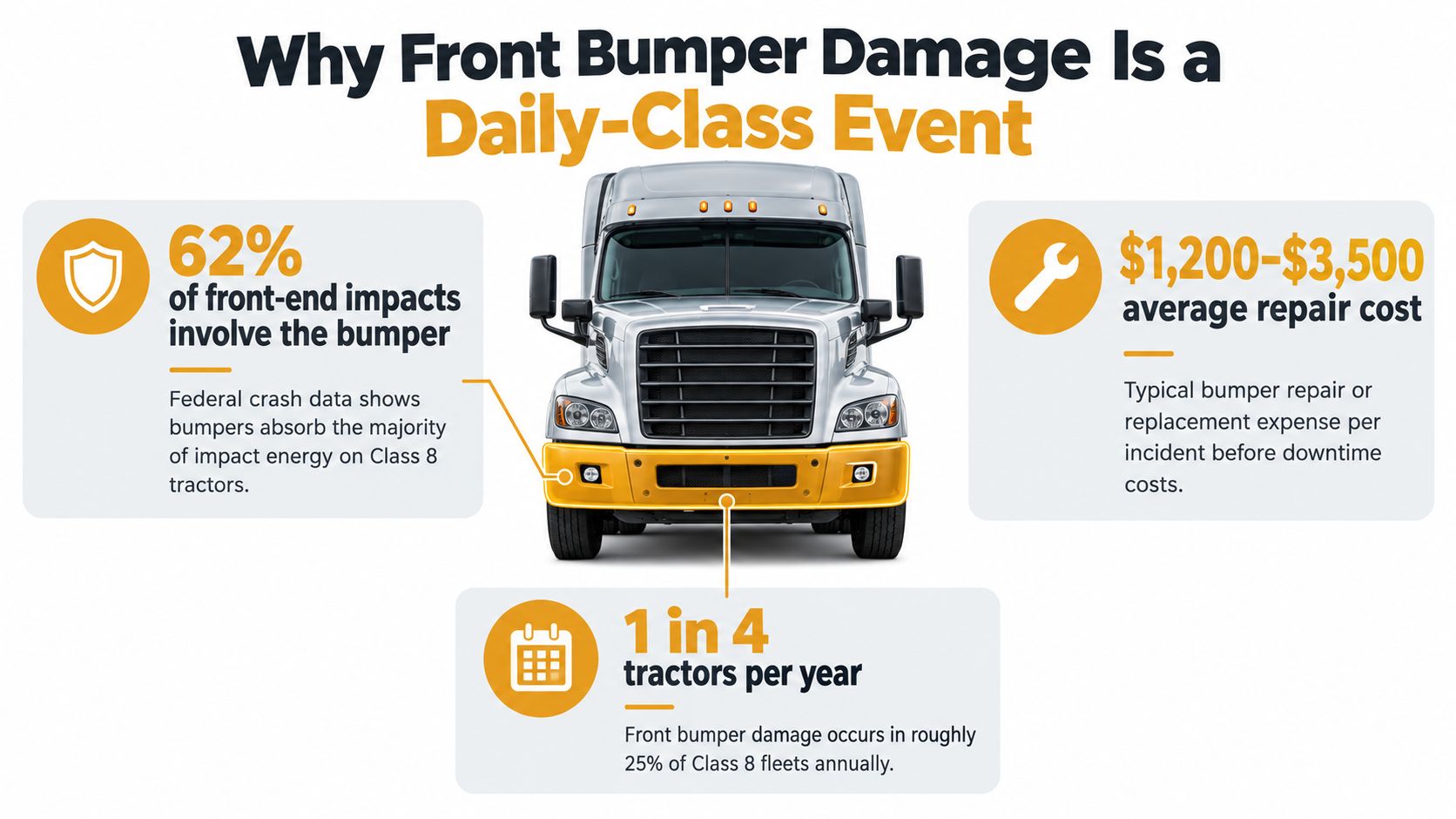
Why Front Bumper Damage Is a Daily-Class Event
A Class 8 bumper lives a hard life. It gets nudged at a dock, clipped in a tight yard, tapped in traffic, and stressed by curb strikes or parking mistakes. Those hits are usually low speed, but they still load the front structure, and that is where the problem starts.
What that means on the yard
A bumper rarely gives up in one clean event. More often, the shell gets pushed, the brackets shift, the lighting cutouts move, or the face takes a set that you can see only when the truck is parked on level ground. The chrome may still shine, but the fit can already be wrong.
Practical rule: If the bumper moved, the load path moved too.
That matters because the front end carries force into frame horns, tow hooks, grille mounts, lighting openings, and forward sensors. A bent face can hide a stretched mount or a shell that no longer sits square. On a Class 8 truck, that is not a cosmetic issue. It is a fitment issue, a sensor issue, and a downtime issue.
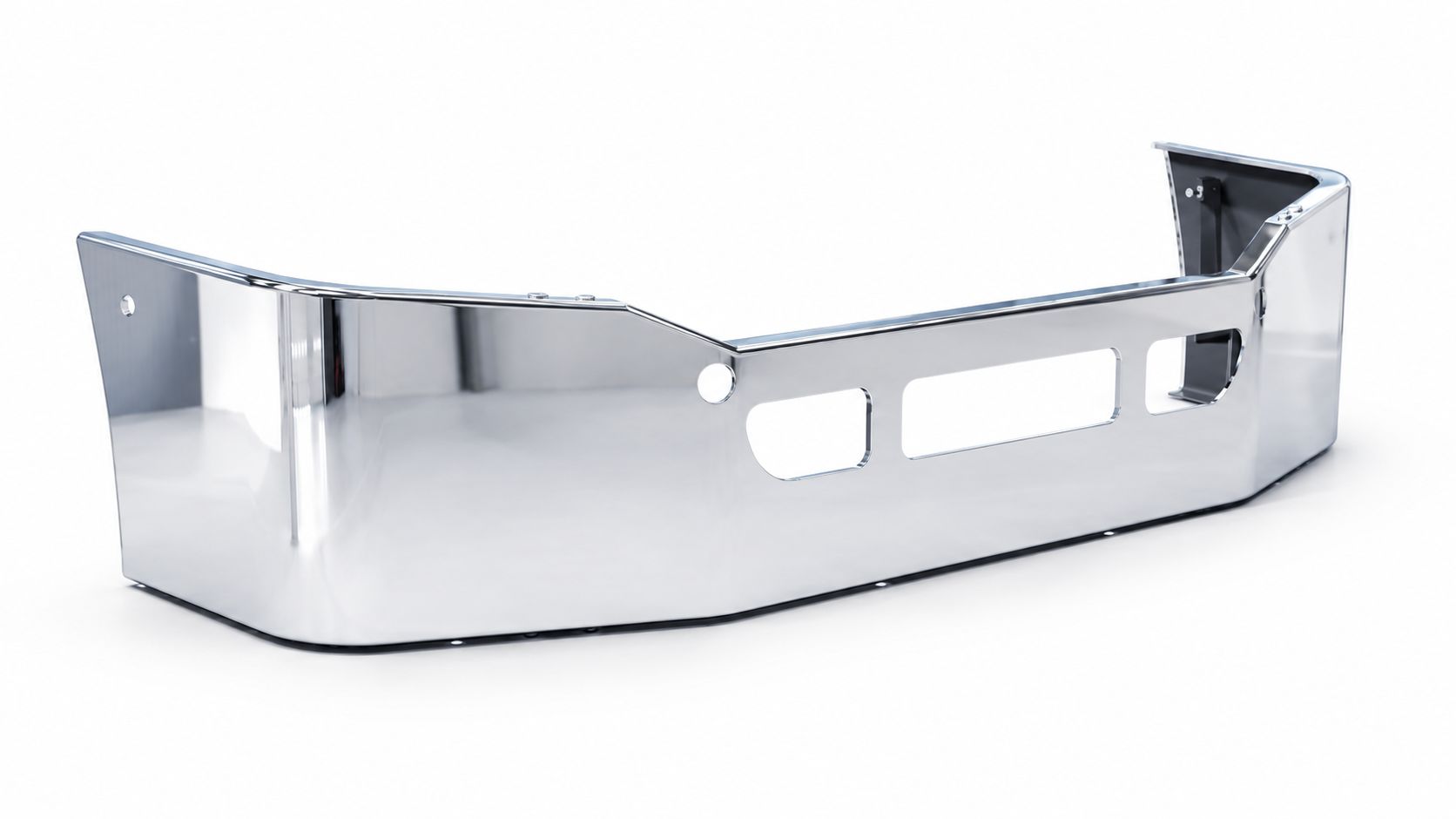
The freightliner Cascadia bumper example makes that concrete. The Chrome bumper for Freightliner Cascadia (2012–2017) ships as a direct bolt-on replacement for the factory brackets, with 10-gauge chrome-plated carbon steel or 11-gauge 430 stainless steel construction. That tells the buyer exactly what matters, the shell material, the factory bracket match, and the fact that a bent bumper can be swapped without drilling or improvising a mount.
The truck-stop takeaway
If the bumper is dented, shifted, or out of line, treat it as front-end damage, not chrome damage. Check the brackets, inspect the mounts, and look at the sensors and lighting openings before you call it good. The cheapest fix is the one that restores the truck to square. Sometimes that means repair. Sometimes it means replacement.
The Five Types of Front Bumper Damage Truckers Actually See
The first mistake is calling every mark a “scratch.” That lumps together damage that can be polished out with damage that means the bumper is no longer square. On a Class 8 truck, the difference decides whether you repair, replace, or tear the front end down for inspection.
Scuffs, peel, and surface-only wear
Scuffs are the easy ones. They usually show up as scraped chrome, paint transfer, or peeling at the edge of the finish. If the bumper face is still straight and the mounting points are tight, the damage may be mostly cosmetic, but the finish still tells you whether road salt and water can get in.
Creases, bows, and folded metal
A shallow crease can sometimes be lived with for a while, but a bumper that's bowed or visibly folded has taken load beyond simple surface contact. Once the metal has a residual set, it's not bouncing all the way back. That matters because a flat face might still look acceptable while the bumper has already lost some of its original shape and fit.
Cracks, split welds, and broken corners
Cracks near the corners or at a welded seam are a hard stop. A cracked bumper shell or split weld means the part is no longer behaving like a single structural piece. If a weld has failed, the next bump can open it further and turn a repairable issue into a roadside problem.
A straight-looking corner can still be junk if the seam is cracked.
Bracket shifts and elongated holes
When the bumper sits a little off-center, don't blame the shell first. Check the brackets, bolt holes, and frame attachment points. Elongated holes, cracked welds, or displaced brackets mean the impact load went into the hardware, and that hardware needs a real inspection before any replacement bumper goes on.
Sensor and light cutout damage
Modern trucks put more than chrome in the bumper zone. Damaged light openings, fog holes, tow-hole cutouts, and sensor mounts can all change how the front end works after a hit. That's why the bumper has to be judged as a system, not as a piece of trim.
If the damage is still only on the skin, that's one bucket. If the bumper no longer sits square, the hardware is suspect. If brackets, holes, or sensor mounts moved, the safe assumption is structural damage until proven otherwise.
Why a Bent Bumper Is a Safety Problem, Not Just a Cosmetic One
A bent bumper should be treated as a load-path issue first. NHTSA's testing for trailer rear-impact guards treats loss of a pre-existing load path as a failure condition, which is a useful reminder that hidden bracket and attachment damage matters even when the visible shell still looks usable (NHTSA TP-223-01). That idea translates well to a truck's front bumper, because the steel, brackets, and frame mounts work together.
What the metal is telling you
Permanent deformation tells the truth. Residual set, wrinkling, local buckling, and displaced fasteners mean the impact energy went past elastic recovery. NHTSA's FMVSS 223 benchmark requires trailer guards to absorb at least 5,650 J through plastic deformation within the first 125 mm of deflection at specified test locations, and to resist forces up to 100,000 N at the central test location without exceeding the deflection limit (NHTSA TP-223-00). Those are not front-bumper rules, but they show the principle clearly, deformation isn't random, it's evidence that the structure took a load.
The part nobody checks fast enough
ADAS can make a light hit turn into a calibration job. Guidance for commercial-truck calibration work says bumper and front-end service can trigger radar calibration because sensors may sit in or behind the bumper, and it notes that a sensor displaced by roughly one degree can materially change detection distance (ADAS calibration guidance). That means a truck can look fine and still be aiming wrong.
A loading-dock bump, a deer strike, or a replacement bumper skin can all become a calibration trigger if brackets, mounts, or ride height changed. No dashboard warning doesn't prove the radar is right.
A quick decision tree
- Surface scuff only: no shift, no crack, no bracket movement, no sensor issue.
- Likely repair candidate: shallow crease, finish damage, but brackets and mounts check out.
- Replace or inspect deeper: shifted bumper, cracked weld, elongated holes, or any sensor or light interference.
If the bumper changed position, the truck changed too. That's the part drivers miss when they call it a dent and keep rolling.
Repair vs. Replacement and What the Math Really Looks Like
The cheap answer is not always the smart answer. Commercial-truck downtime estimates in industry coverage run from about $448 to $760 per vehicle per day, and another estimate puts average breakdown downtime at about $1,200 per truck-hour in 2023 (downtime planning benchmark). Those aren't bumper-specific numbers, but they tell you why a parked tractor gets expensive fast.
Compare the options the right way
| Factor | Repair | Replacement |
|---|---|---|
| Visible damage | Works when the shell is still straight enough | Better when the face is folded, cracked, or shifted |
| Hidden damage risk | Can be fine if brackets and mounts are clean | Safer when the impact reached hardware or sensor areas |
| ADAS calibration | May still be needed if mounts moved | Often needs documented calibration if front sensors are involved |
| Downtime | Lower if parts and labor are simple | Can be lower overall if a direct bolt-on unit is in stock |
| Fit confidence | Depends on whether the original shell is still true | Higher when you replace a damaged unit with the correct match |
For a quick reference on the choice itself, see the comparison at bumper repair vs replacement.
What should drive the decision
Look at more than the bumper price. A low repair quote can turn expensive if the shop needs to strip the front end, calibrate sensors, or discover hidden bracket damage after disassembly. Replacement can be the smarter move if the bumper is bent enough that straightening would leave a poor fit or compromised mounting.
Bottom line: A truck parked two extra days can cost more than the better part.
Insurance deductible, freight time, lead time, and lost revenue all belong in the same conversation. If the truck is a money maker, uptime matters as much as the part itself. If the bumper is damaged but the truck is still earning, the correct answer may be the replacement that gets it back out faster, not the cheapest fix on paper.
Chrome-Plated Carbon Steel vs. 430 vs. 304 Stainless Steel
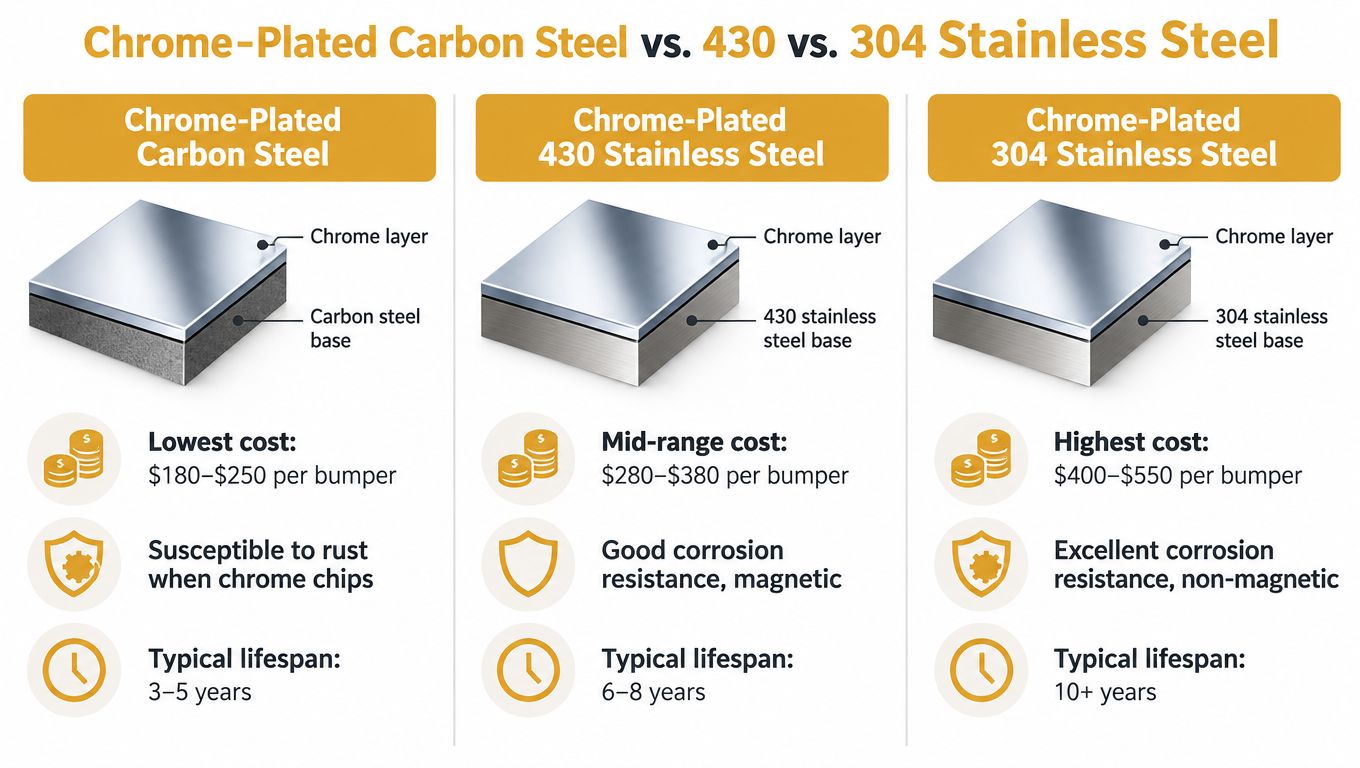
Material choice is where a lot of buyers get caught. Chrome-plated carbon steel can look sharp out of the box, but it's less forgiving when the chrome gets chipped. Chrome-plated 430 stainless steel and 304 stainless steel cost more up front, but they hold up better when the truck lives in salt, slush, and rough weather.
Side-by-side comparison
| Material | Corrosion behavior | Finish | Durability feel | Typical fit for |
|---|---|---|---|---|
| Chrome-plated carbon steel | More vulnerable once the chrome is compromised | Strong mirror look, but finish damage matters fast | Solid for the money, but less forgiving in harsh climates | Show trucks, lighter-duty appearance focus, short-haul use |
| Chrome-plated 430 stainless steel | Better resistance than carbon steel | Mirror-polished, cleaner long-term appearance | Balanced choice for many over-the-road trucks | Mixed fleets, long-haul operators, buyers who want value and durability |
| Chrome-plated 304 stainless steel | Best corrosion resistance of the three | Premium mirror finish that stays cleaner longer | Strong choice when road salt and weather are constant | Northern routes, coastal work, trucks that stay in the element |
For a material deep-dive, the stainless and carbon steel comparison at stainless steel vs carbon steel is worth keeping handy.
What I'd tell a driver at the counter
If you run northern salt, go stainless and don't overthink it. If the truck sees mixed routes and you want a solid balance of looks and durability, 430 stainless is the practical middle ground. If the truck lives in harsh weather and you hate replacing rusted chrome, 304 stainless is the safer long-term play.
Carbon steel still has a place. It makes sense when the truck is a short-haul or show piece and the owner cares more about up-front spend than long-haul corrosion resistance. That's the honest call, and it's the one that avoids buyer remorse later.
Fitment, Ground Clearance, and Why Bolt-On Matters
Fitment is where good bumper shopping turns into bad ordering. NHTSA reported that the average ground clearance of current truck-tractor front bumpers is about 14 inches, and it compared that with the 15.75-inch height used for front underrun protection systems under ECE Regulation 93 (NHTSA truck bumper clearance report). That gap matters when you're choosing a standard bumper, an 18 inch drop bumper, or a lower-profile style.
Measure the truck, not just the badge
A bumper has to match the truck's make, model, and year. Tow-hook openings, frame width, grille clearance, fog-light holes, and headlamp cutouts all need to line up. A Peterbilt 389 won't always take the same front-end setup as a Kenworth W900 just because they're both Class 8 trucks.
- Check the frame width: If the bracket spacing is wrong, the bumper won't sit square.
- Check the openings: Tow holes and light cutouts have to match the truck's layout.
- Check the approach angle: A lower bumper can look cleaner, but it can change clearance on ramps and rough yards.
- Check the suspension and ride height: Front suspension setup affects how the bumper sits after installation.
Why bolt-on beats rework
A direct bolt-on bumper saves time and keeps the front end cleaner. If the part is built for the specific truck, the shop shouldn't have to drill, cut, or chase alignment just to make it fit. Galhor's configurator approach is built around that logic, brand, model, year, cutouts, and finish all need to line up before the bumper ships.
Measure twice, order once. Fitment mistakes are what turn premium bumpers into returns.
For Freightliner owners, a direct-fit option like a Freightliner Cascadia (2012–2017) bumper with the right cutouts and bracket package is exactly the kind of part that avoids rework. That's the standard you want on any Peterbilt, Kenworth, Freightliner, International, or Volvo front end.
Preventing the Next Impact and Getting Back on the Road
A truck stop is not where you want to learn bumper geometry the hard way. Back into a tight dock too fast, clip a post in a crowded yard, or swing wide on a winter chain route, and the bumper pays for it first. The fix is discipline, pre-trip walkarounds, cautious dock approach angles, and parking choices that don't force the nose into the worst possible spot.
For a practical checklist, keep a maintenance routine like the one outlined in this truck maintenance checklist. Then use the damage type to make the call, surface-only issue, structural issue, or sensor-related issue.
Pick the material that matches your route, choose the correct fitment, and get the truck back out with a direct bolt-on bumper that fits the make, model, and year. If you want speed, corrosion resistance, and less guesswork, order the part that's built for the truck you run.
Galhor Inc. builds premium chrome bumpers for Class 8 trucks, including direct bolt-on options for Freightliner, Peterbilt, Kenworth, and Volvo. If you're dealing with front bumper damage and want a bumper that matches the truck, the cutouts, and the finish, visit Galhor Inc. and get the right replacement moving toward your shop.