

Heavy Truck Body Parts Guide for Class 8 Trucks
You're ready for a long haul, but the bumper on your Peterbilt, Kenworth, Freightliner, or International has a bent mount, cracked chrome, or loose hardware. A small body-part problem can turn into a missed appointment, an unexpected shop visit, and a truck that earns nothing while it sits. Choosing the right heavy truck body parts helps protect the front of the truck, preserve its working appearance, and reduce avoidable downtime.
Table of Contents
- Introduction to Heavy Truck Body Parts That Keep You Rolling
- Understanding the Main Types of Heavy Truck Body Parts
- Materials and Finishes That Determine Durability and Shine
- How Corrosion Resistance Protects Your Investment
- Direct Bolt On Fitment Versus Custom Fabrication
- Smart Sourcing Lead Times and Warranty for Fleets and Shops
- Upgrade Your Truck Today With the Right Body Parts
Introduction to Heavy Truck Body Parts That Keep You Rolling
Heavy truck body parts include the exterior components that protect the cab and chassis, support access, manage airflow, and give the truck its finished look. The bumper usually gets the most attention, but fenders, grilles, grille guards, steps, doors, cab panels, brackets, and trim all face road debris, rain, salt, vibration, and daily loading conditions.
For an owner-operator, the right part has to do more than look good in a parking lot. It needs to fit the exact truck, use a material suited to the route, and arrive when the truck is ready for service. A bumper that requires drilling, cutting, or repeated alignment work can cost more in shop time than its lower purchase price suggests.
The market behind these parts is substantial. The global heavy truck parts market has been estimated at about USD 119.7 billion in 2026 and is forecast to reach USD 174.6 billion by 2035, with a 4.3% compound annual growth rate over that period, according to industry market estimates for heavy truck parts. That scale reflects steady demand from original equipment, aftermarket repair, and fleet maintenance channels.
The U.S. and Canadian vocational truck body industry has also been described as a specialized manufacturing space, with about USD 3.7 billion in market value and 310 body fabricators across 14 truck and body segments and 31 subtypes, based on industry research on heavy-duty vocational and work truck bodies. That variety explains why model-specific fitment matters. A Peterbilt 389 bumper, a Kenworth W900 chrome bumper, and a Freightliner Cascadia replacement may look similar in a catalog, but their widths, mounts, cutouts, and contours aren't interchangeable.
This guide focuses on practical buying decisions. You'll learn how to identify the main body parts, compare steel and stainless options, understand corrosion, choose direct bolt-on fitment, and source parts with less risk to your truck's uptime.
Understanding the Main Types of Heavy Truck Body Parts
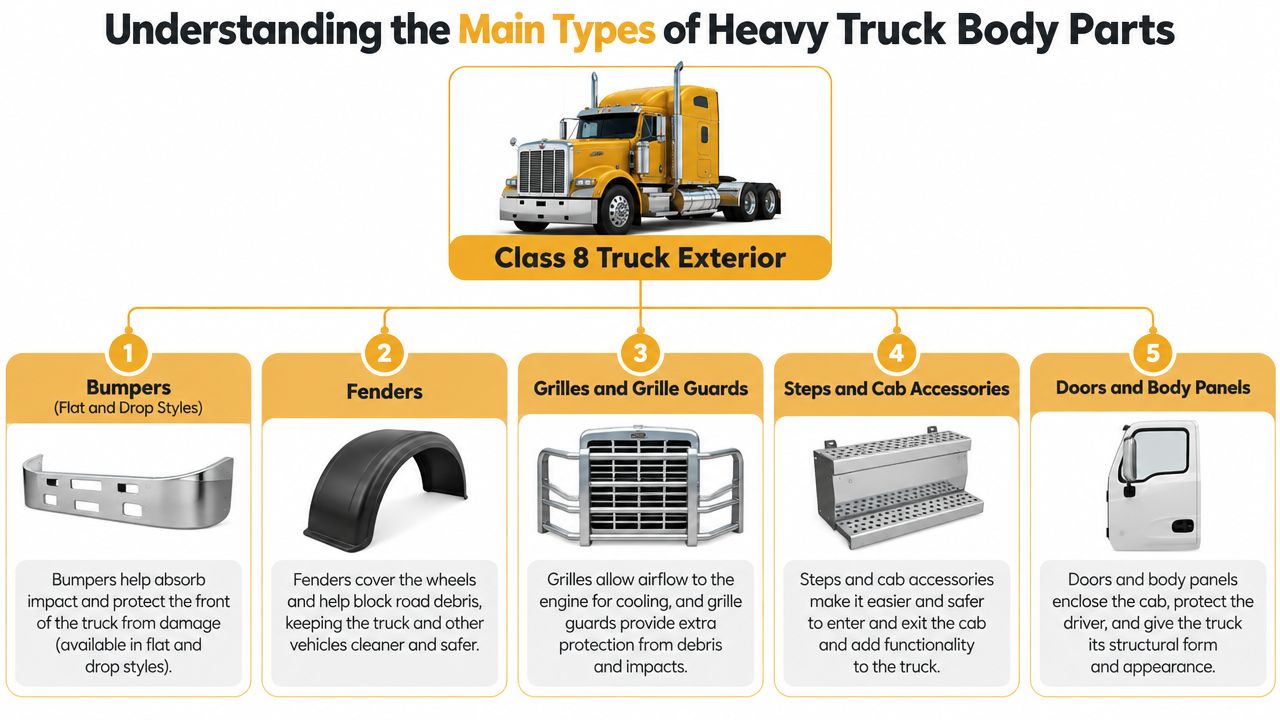
Start at the front of the truck and work outward. Each exterior part has a job, and knowing that job helps you avoid buying a decorative piece when you need a protective component.
Bumpers handle the first hit
A bumper protects the front of the truck from minor contact, flying road debris, and damage around the lower cab area. Flat bumpers give a clean, close-to-factory profile. Drop bumpers extend lower and create a custom appearance, but they also need careful attention to ground clearance, approach angle, and tow points.
Fitment starts with the truck family. A Peterbilt 389 bumper won't automatically fit a Peterbilt 379, and a Kenworth W900 bumper isn't a universal replacement for every Kenworth. Check the model, year, width, mount style, and light or tow-hook cutouts before ordering.
Fenders manage spray and protect the sides
Fenders help shield tires, steps, fuel tanks, and nearby bodywork from water, mud, stones, and winter chemicals. A damaged fender can also leave the truck looking unfinished, even when the mechanical systems are sound. Match the fender to the axle setup, cab style, hood shape, and mounting points.
Grilles and grille guards defend the front
The grille allows airflow to the cooling system while covering the front of the radiator area. A grille guard adds another protective layer for vocational work, rough yards, and routes where branches or debris are common. Don't assume a guard will clear every hood ornament, headlamp, or factory grille surround.
Steps and cab accessories support daily work
Steps take repeated load every time a driver enters or leaves the cab. Their surface, brackets, and mounting hardware need to withstand wet boots, road grime, vibration, and regular use. Related accessories include mirror brackets, battery boxes, fuel tank supports, and exhaust trim.
Doors and panels affect safety and presentation
Doors, hood panels, side panels, and trim close gaps, protect internal parts, and keep the truck's exterior aligned. A panel that sits unevenly may signal bent brackets or hidden collision damage. For a deeper look at component categories and truck applications, review this guide to heavy-duty truck parts.
A Freightliner Classic owner comparing replacement options might consider the Chrome bumper for Freightliner Classic. The listed design uses 10-gauge chrome-plated steel with a mirror-polished finish, with a 3 mm chrome-plated stainless steel 304 or 430 option. It offers standard and blind mounting, direct bolt-on installation for the Freightliner Classic, and configuration-specific cutouts.
Materials and Finishes That Determine Durability and Shine
A bumper's material controls how it handles impact, moisture, road salt, and repeated cleaning. Its finish controls appearance and adds another barrier against the environment. Don't judge either one by the word “premium” alone. Ask for the alloy, thickness, plating process, mount design, and intended use.
Chrome-plated carbon steel is a common choice when strength and a traditional bright finish matter. Carbon steel can provide a solid structure, but the plating system has to stay intact. Stone chips, damaged edges, and trapped moisture can expose the underlying metal.
430 stainless steel offers stainless construction with a chrome-ready surface. It can suit drivers who want a bright finish and added resistance to ordinary road moisture. 304 stainless steel is the stronger choice for salt-heavy regions because it resists magnesium chloride better than coated carbon steel, as explained in guidance on specifying truck bodies to prevent corrosion.
Grade 304 used in heavy-duty truck bumpers contains 18% to 19.5% chromium and 8.0% to 10.5% nickel. One listed source gives the alloy an ultimate tensile strength of 73,200 psi, supporting its use where strength and corrosion resistance are both important, as detailed in this discussion of 304 stainless truck bumpers.
| Material | Corrosion Resistance | Strength and Thickness | Finish and Best Use |
|---|---|---|---|
| Chrome-plated carbon steel | Depends heavily on intact plating and edge protection | Strong bumper structure; thickness must be confirmed by the seller | Bright chrome for standard replacement or custom appearance |
| Chrome-plated stainless steel 430 | Better stainless base than plain carbon steel for many road conditions | Available in heavy-gauge and formed bumper designs | Chrome appearance with stainless construction |
| Chrome-plated stainless steel 304 | Strong resistance in salt-heavy environments when properly designed and maintained | A common premium option in heavy-duty bumper construction | Long-haul, winter-route, and corrosion-conscious applications |
| Polished stainless steel | Resists corrosion without relying on a chrome surface | Thickness and forming still determine impact performance | A natural stainless look, useful for fleets and custom trucks |
Gauge and metric thickness need careful reading. A listing may specify 11-gauge stainless steel, while another may describe a stainless option as 3 mm. Those descriptions aren't interchangeable without checking the actual material and product design.
Chrome also isn't a thick structural layer. Plating guidance describes the chrome layer as extremely thin, typically about 0.25 to 0.8 micrometers, over a nickel undercoat. The nickel does much of the corrosion-protection work, while chrome mainly adds surface hardness and appearance, according to plating guidance on chrome and nickel layers.
For a technical comparison of steel choices, see stainless steel versus carbon steel. Match the material to the truck's route, winter exposure, cleaning habits, desired finish, and replacement budget.
How Corrosion Resistance Protects Your Investment
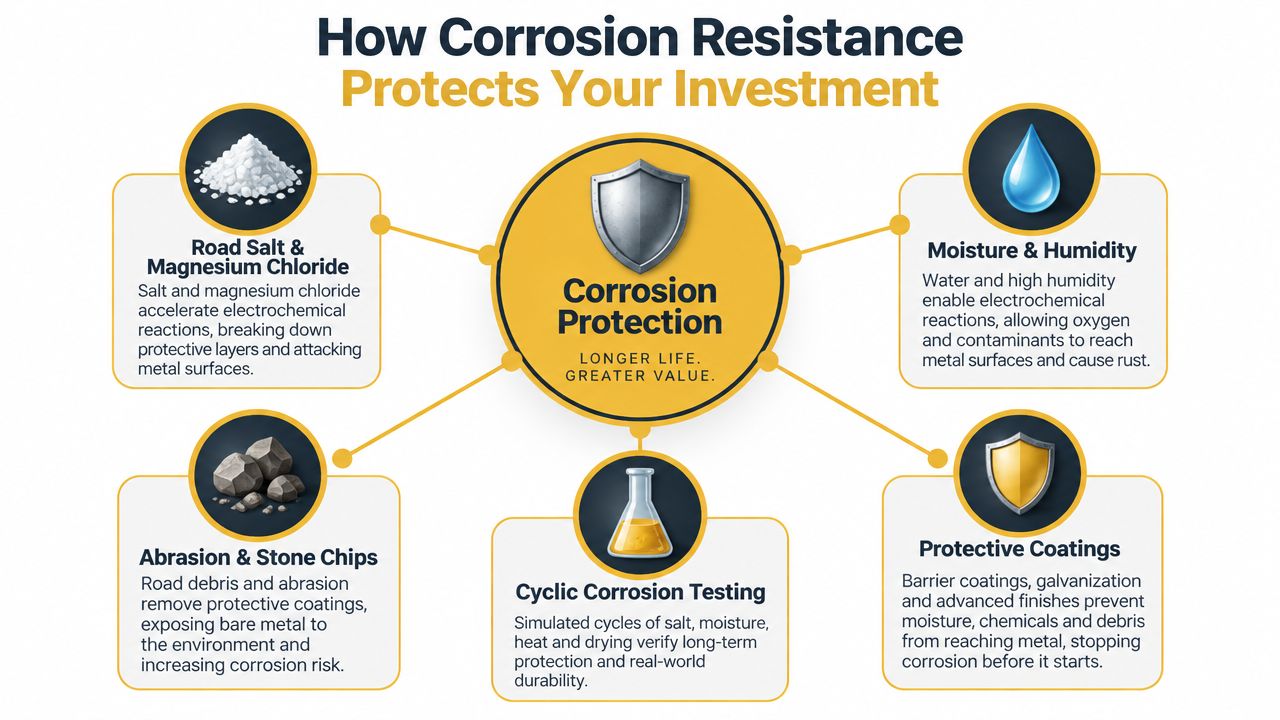
Road salt doesn't need a large opening to start trouble. It can enter scratches, seams, bolt holes, blind cavities, and the contact points between a bumper and its brackets. Magnesium chloride is especially important in salt-heavy regions because it can attack coated carbon steel more aggressively than many owners expect.
Corrosion usually starts when moisture and chemicals reach exposed metal. Abrasion from stones and sand damages the surface, then humidity and road spray keep the area active. A bumper may still look acceptable from the highway side while corrosion grows behind a bracket or around a fastener.
SAE J2721 is a recommended practice for testing corrosion performance on metallic components and assemblies used in medium and heavy trucks, buses, and trailers. Its cyclic exposure combines corrosive chemicals, drying, humidity, and abrasive wear, as described in the SAE J2721 recommended corrosion test method.
Design choices matter as much as the alloy
Good corrosion control begins before plating. A part should let water drain instead of trapping it. Designers should limit crevices and blind holes, especially where brine can sit unseen. They should also avoid direct galvanic contact between dissimilar metals, or isolate those metals when the design requires both.
That advice applies to bumpers, fenders, brackets, trim, and body panels. Stainless steel can be a sensible choice for trucks that run through salted northern states, but stainless alone can't fix a poor drain path or a damaged finish.
Plating needs a protective foundation
Chrome gives a bumper its familiar shine, but it isn't the main barrier. A quality plating system uses a nickel undercoat beneath the thin chrome layer. Some listed bumper specifications use 35 microns of nickel with a triple-layer hexavalent chrome process, a construction described in the product information supplied for Galhor bumpers.
Practical rule: Look at the complete plating system, not just the word “chrome.” Ask what sits below the chrome and how the edges, holes, and mounting areas are finished.
Corrosion resistance protects ROI by reducing the chance that a body-part issue becomes a repeat repair. A durable bumper won't prevent every collision or stone chip, but correct material, sound geometry, proper plating, and regular washing can help keep the truck working and presentable through harsh weather and long hauls.
Direct Bolt On Fitment Versus Custom Fabrication
Direct bolt-on fitment is usually the practical choice for a working truck. The part is built around the original mounting points, truck family, width, cutouts, and bumper profile. That makes it useful for collision replacement, fleet maintenance, and owner-operators who can't leave a truck in a fabrication shop for extended work.
Custom fabrication has a place. A show truck may need a special drop, unusual light openings, a modified grille line, or a one-off bracket. The trade-off is more measuring, cutting, welding, test fitting, and finishing. Those steps can produce a distinct result, but they can also add labor and create alignment issues if the shop doesn't know the exact chassis.
Use fitment details to prevent ordering mistakes
A bumper listing for major U.S. truck brands shows why model details matter. It specifies 11-gauge 304 stainless steel, a 22-inch width, blind mounting, and compatibility with Freightliner, Kenworth, International, and Peterbilt models, as shown in this truck bumper fitment example.
Other stainless bumper applications offer 18-inch, 20-inch, or 22-inch widths in 11-gauge stainless steel, according to this bumper specification sheet. Width changes the truck's stance and clearance, so don't select an 18-inch drop bumper or wider replacement based only on appearance.
Before ordering, confirm:
- Truck identity: Peterbilt 389, Peterbilt 378 or 379, Kenworth W900, Freightliner Classic, Freightliner Cascadia, or International model.
- Mount type: Standard mount and blind mount use different installation approaches.
- Cutouts: Check openings for tow hooks, lights, sensors, and other equipment.
- Clearance: Verify tire, frame, hood, grille, and ground clearance.
- Hardware: Confirm whether the needed brackets and fasteners are included.
For a collision replacement, direct bolt-on usually keeps the repair focused. For a custom build, fabrication may justify the added work when the truck's appearance matters as much as its original fit. Either way, measure the truck and compare the supplier's fitment information before money changes hands.
Smart Sourcing Lead Times and Warranty for Fleets and Shops
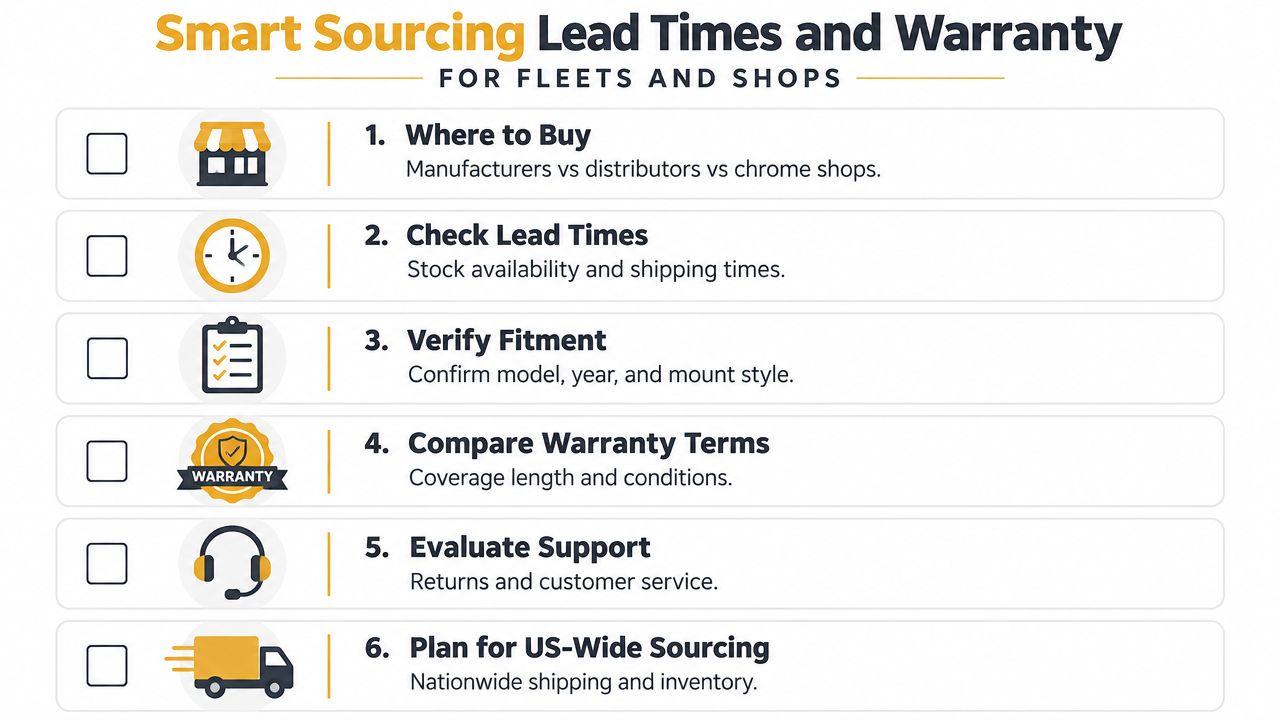
A fast purchase isn't always a smart purchase. Before you order heavy truck body parts, write down the truck model, year, bumper width, mount style, finish, material, cutouts, and delivery location. This prevents a common problem, the right-looking part arriving with the wrong holes or mounting profile.
Check the seller before checking out
Manufacturers can provide direct specifications and configurable fitment. Distributors may offer broader inventory. Chrome shops can help with inspection, finishing, and installation. The right source depends on whether you need a quick replacement, a matched appearance, or a custom build.
Lead time can change the buying decision. In-stock stainless steel 430 and 304 flat bumpers may ship within 48 hours, while made-to-order carbon steel units typically ship in 4 to 6 weeks, based on the publisher's product information. Confirm that timing for the exact configuration, not just the base product.
Before you order: Ask for the material specification, actual thickness, finish details, fitment chart, mount style, cutout layout, shipping method, and warranty terms in writing.
Protect the schedule and the repair budget
LTL freight is common for large bumpers and body panels. Ask how the part is packed, how damage must be documented, and who handles a freight claim. A clear return policy matters if the part arrives damaged or the configuration doesn't match the order.
Warranty language should identify coverage for manufacturing defects in materials and workmanship. It shouldn't be treated as protection against improper installation, collision damage, neglected cleaning, or normal wear unless the written terms say so.
For buyers who want to understand how material sourcing, manufacturing, and order support connect, review supply chain transparency. A Texas-based support team, U.S.-sourced steel, Mexico manufacturing under quality control, and nationwide freight support can make communication easier for U.S. fleets and shops, but buyers should still verify the details for each order.
Use this short procurement checklist:
- Confirm fitment: Match model, year, width, mount, and cutouts.
- Confirm material: Identify carbon steel, 430 stainless, or 304 stainless.
- Confirm finish: Ask whether the surface is chrome-plated or polished stainless.
- Confirm timing: Separate in-stock products from made-to-order units.
- Confirm freight: Understand LTL delivery, inspection, and damage reporting.
- Confirm warranty: Read defect coverage, exclusions, returns, and installation conditions.
Upgrade Your Truck Today With the Right Body Parts
The right body part is a working decision, not just a styling choice. Start with fitment, then choose the material and finish for the truck's route, weather, and appearance goals. A properly matched bumper or panel installs more cleanly, protects the front end, and helps avoid the repeat labor that eats into uptime.
For winter routes, corrosion planning deserves extra attention. For long-haul work, direct bolt-on fitment and dependable shipping matter because every unnecessary shop visit takes the truck away from revenue. For a show truck, a polished finish or an 18-inch, 20-inch, or 22-inch bumper profile can shape the look, but clearance and mounting still come first.
Owner-operators and fleet managers should compare the full specification, not just the photo. Check steel type, gauge or millimeter thickness, plating layers, nickel undercoat, mount style, cutouts, warranty, and delivery timing before placing the order.
Order now when the fitment and material are confirmed. Get yours today if a damaged bumper is holding up a scheduled repair. Choose a configurable direct bolt-on option and upgrade your truck today with a part built for real U.S. roads, harsh weather, and daily use.
Galhor Inc. offers configurable direct bolt-on chrome bumpers for Class 8 Peterbilt, Kenworth, Freightliner, and Volvo trucks, with material, finish, width, mount, and cutout options for working and custom applications. Visit Galhor Inc. to check fitment, review specifications, and order a bumper with U.S.-wide shipping support.