

Kenworth Truck Parts: Your Essential Guide
Is the cheapest Kenworth truck part really the cheapest choice once a backorder, roadside repair, or repeat failure takes your truck out of service? Owner-operators and fleet managers often compare the invoice first. Experienced operators compare fitment, service life, lead time, warranty, and downtime before they place the order.
Kenworth has been building trucks since 1923 and marked its centennial in 2023. The company also reported producing its one-millionth truck over a 91-year period, creating a large installed base that still needs collision, maintenance, restoration, and appearance parts across North America and other markets. Kenworth's history helps explain why the parts decision matters. A long-running truck platform can keep earning, but only when replacement components match the job.
Table of Contents
- Keeping Kenworth Trucks on the Road: Downtime, Fitment, and Lead Time
- Critical Systems That Define Kenworth Performance
- Navigating OEM Versus Aftermarket Choices
- Choosing Bumper Materials for Maximum Longevity
- Ensuring Perfect Fitment and Installation
- Maximizing Your Investment and Uptime
Keeping Kenworth Trucks on the Road: Downtime, Fitment, and Lead Time
What does a failed part cost when the truck is parked beside an interstate? The invoice is only one piece. A replacement must arrive on time, fit without fabrication, and survive long hauls, winter salt, rough yards, and repeated loading. Fitment, service life, lead time, warranty, and downtime determine the true cost.
A front-end repair shows the trade-off clearly. One bumper may cost less, but its mounting holes require modification. Another costs more and includes the correct bracket and cutouts. The cheaper option can become more expensive after shop labor, schedule delays, and the risk of a poor fit. The higher-priced part may protect the next run because the installation plan is known before delivery.
A long production history makes fitment more important
Kenworth's history gives owners broad model support, but that range also creates ordering risk. A current T680, a classic W900, and an older T800 may all appear under “Kenworth bumper” in a catalog. Their model years, chassis layouts, lighting openings, tow-hole locations, and mounting systems can still differ.
Kenworth reported a 15.8% Class 8 retail sales market share in the U.S. and Canada in 2020, along with 11.7% for medium-duty vehicles, according to Kenworth's 2020 Class 8 and medium-duty market share figures. A broad service ecosystem gives buyers more sourcing options, but it does not confirm that a part suits one specific truck.
Practical rule: Treat every part order as a fitment decision first and a price decision second.
Production activity also points to a wide parts pipeline. Kenworth tractor-trailer production in Mexico reached 12,189 units in 2024, compared with 11,449 in 2023, while 57.5% of 2024 output was exported, according to the 2024 Mexican Kenworth production figures. Buyers may have several suppliers to choose from, yet each option still requires verification of configuration, availability, and delivery timing.
Parts planning protects uptime
Maintenance teams should identify part numbers before a failure forces a rushed order. Record the truck's model, year, chassis configuration, engine, steering setup, bumper style, light openings, and common wear items. Group those items by how a wrong choice affects the operation:
- Safety-critical parts: Brakes, steering, suspension, wheel-end, and structural components require exact specifications and careful inspection.
- High-wear parts: Filters, bushings, brake hardware, belts, hoses, and service components should match the duty cycle and allow practical replacement access.
- Appearance parts: Bumpers, trim, brackets, and polished accessories should balance corrosion resistance, fit, maintenance, and professional appearance.
A Kenworth is a business asset, not just a truck. The right Kenworth truck parts keep it working through changing weather, freight demands, and a long service life. The wrong part can turn a small repair into lost revenue and another trip to the shop.
Critical Systems That Define Kenworth Performance
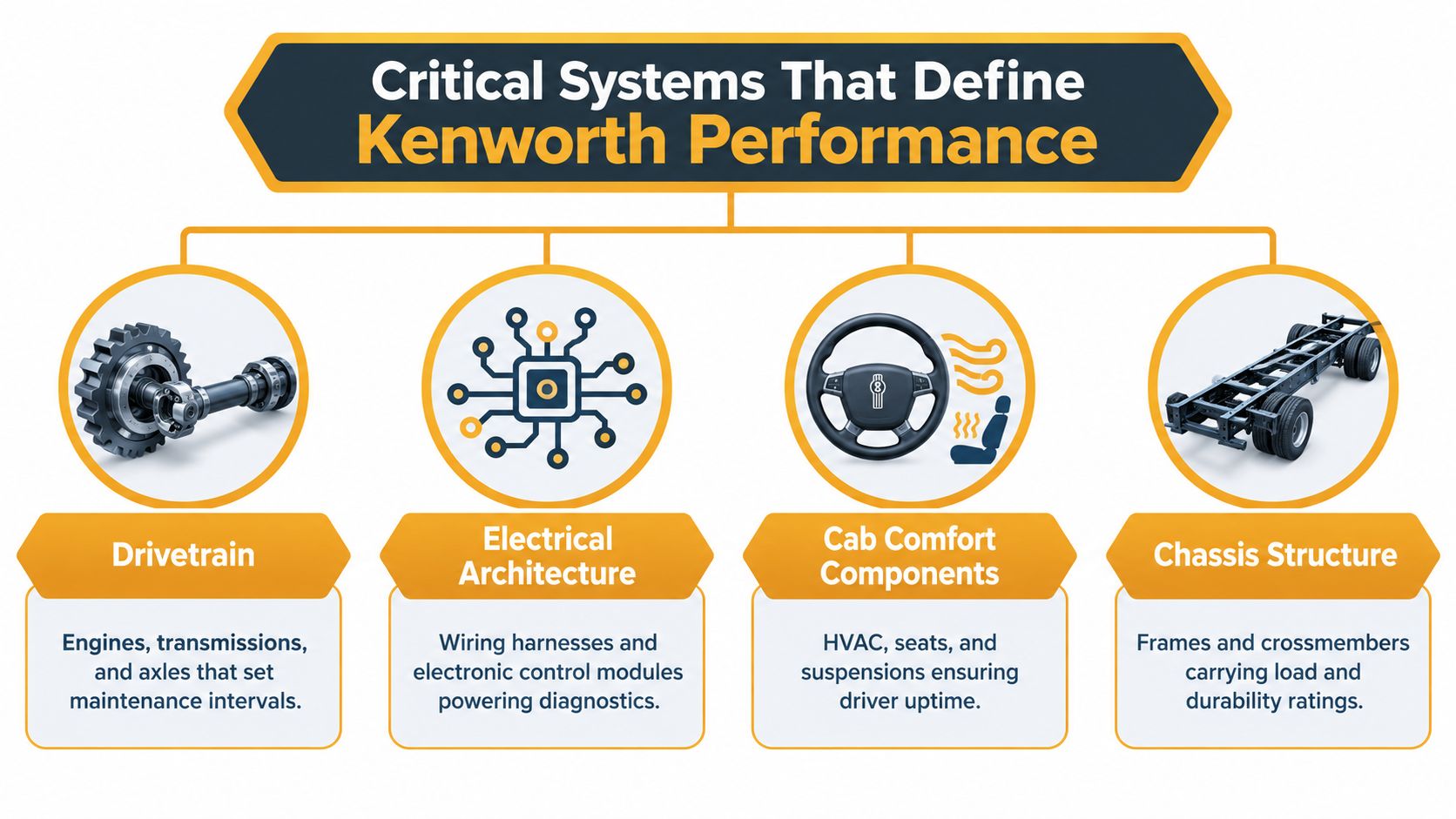
A heavy-duty truck works like a body with separate systems that depend on one another. The drivetrain supplies force, the electrical network controls information, the cab keeps the driver functional, and the chassis carries the load. A weak component in one area can create symptoms somewhere else, which is why random replacement often wastes money.
Drivetrain wear starts with maintenance discipline
The engine, transmission, driveshaft, differentials, and axles carry the highest continuous load. Watch for fluid leaks, driveline vibration, abnormal gear noise, rising temperatures, and changes in power delivery. Those symptoms don't always identify one failed part, so a proper inspection should come before ordering expensive components.
The same logic applies to steering and front-end parts. Kenworth's operator manual lists front brake camshaft lubrication at 10,000 to 15,000 miles unless the truck has LMS, when the interval extends to 120,000 miles. Tie-rod ends, drag links, steering gearbox trunnions, and brake treadle points also fall in the 10,000 to 15,000-mile lubrication range. Kenworth's operator manual also specifies changing power-steering reservoir fluid and filter twice per year after summer and winter.
Missed grease service can increase play at loaded articulation points. That play can affect steering feel, alignment, and tire wear, so a small service omission can turn into a larger operating expense.
Electrical architecture needs diagnosis, not guessing
Wiring harnesses, sensors, control modules, batteries, grounds, and connectors keep modern Kenworth systems communicating. Corrosion at a connector can imitate a failed sensor. A damaged harness can create intermittent faults that disappear when the truck reaches the shop. Replacing modules without checking power, ground, and harness condition is an expensive way to chase a problem.
Cab comfort affects driver performance
HVAC controls, blower motors, heater valves, seats, bunk components, door seals, and cab suspension parts receive less attention than engines, but they still affect uptime. A driver who can't stay warm, cool, rested, and comfortable is working in a less controlled environment. Check leaks, vibration, worn cushions, weak airflow, and loose mounting points before small cab problems become trip-ending failures.
Chassis structure carries every mistake
Frames, crossmembers, suspension mounts, bumper brackets, and body attachments take abuse from loading, uneven yards, snow, and collision contact. Inspect cracks, bent brackets, elongated mounting holes, corrosion, and evidence of previous repairs. A bumper can look straight while its brackets or frame attachments aren't.
For a model-specific example, the Chrome bumper for Kenworth T680 (2008–2017) uses 10-gauge chrome-plated steel with a mirror-polished finish, with an 11-gauge 430 stainless steel option. It includes a Gauge-7 mounting bracket, configuration-based tow, fog, and light cutouts, and a direct bolt-on installation without drilling or cutting.
This video provides another visual reference for truck parts and exterior fitment:
Navigating OEM Versus Aftermarket Choices
OEM and aftermarket parts aren't automatically good or bad. The correct choice depends on what the component does, how failure affects the truck, how quickly you need it, and whether the replacement matches the original operating demands.
For brakes, steering, suspension, wheel-end, electronic controls, and powertrain components, exact specifications matter more than a low invoice. An OEM part or a trusted equivalent with documented compatibility can be the safer route when a failure could affect control, compliance, or a loaded truck's ability to stop.
Aftermarket parts make more sense when the application is well understood and the maker provides clear material, dimensions, mounting, and warranty information. Exterior bumpers are a good example. A properly engineered aftermarket bumper can offer a different material or finish while still using the truck's intended mounting points. A poorly matched bumper can create extra labor and compromise alignment.
Use the application to set the sourcing standard
Fleet managers should separate the purchase decision from brand loyalty. Ask what happens if the part fails, how difficult it is to inspect, whether the truck can be repaired locally, and whether a warranty claim will help or delay the operation.
| Application | Recommended Source | Primary Benefit |
|---|---|---|
| Steering, brakes, and wheel-end components | OEM or documented equivalent | Controlled specifications and safety focus |
| Powertrain sensors and electronic modules | OEM or verified compatible supplier | Correct communication and diagnostic performance |
| Filters, belts, hoses, and routine service items | OEM, TRP, or trusted aftermarket | Availability matched with known service requirements |
| Structural brackets and collision-related parts | Exact-fit OEM or engineered aftermarket | Correct load path and installation |
| Bumpers and exterior appearance parts | OEM or fitment-specific aftermarket | Material, finish, style, and replacement flexibility |
| Trim and noncritical cosmetic pieces | Trusted aftermarket | More styling and material choices |
Kenworth's dealer materials describe genuine parts, TRP aftermarket parts, and all-makes support across 490 North American locations, while authorized-dealer replacement parts commonly carry a one-year, unlimited-mileage warranty, according to Kenworth dealer FAQ information. Warranty terms still need to be checked for the exact part and seller.
Compare total cost, not just the ticket
A low-cost part can become expensive if it arrives late, needs modification, fails early, or forces a second repair visit. A higher-cost component can be the better purchase when it reduces shop time and avoids a roadside event. That doesn't mean every OEM part is the right answer. It means the buyer should price the complete repair, including freight, labor, downtime exposure, and replacement risk.
Under supply pressure, availability can matter as much as material. Kenworth Parts and Service emphasizes online ordering, stock visibility, pricing, and order notifications. Those tools help, but they don't replace fitment verification. A part in stock is still the wrong part if it doesn't match the truck.
Choosing Bumper Materials for Maximum Longevity
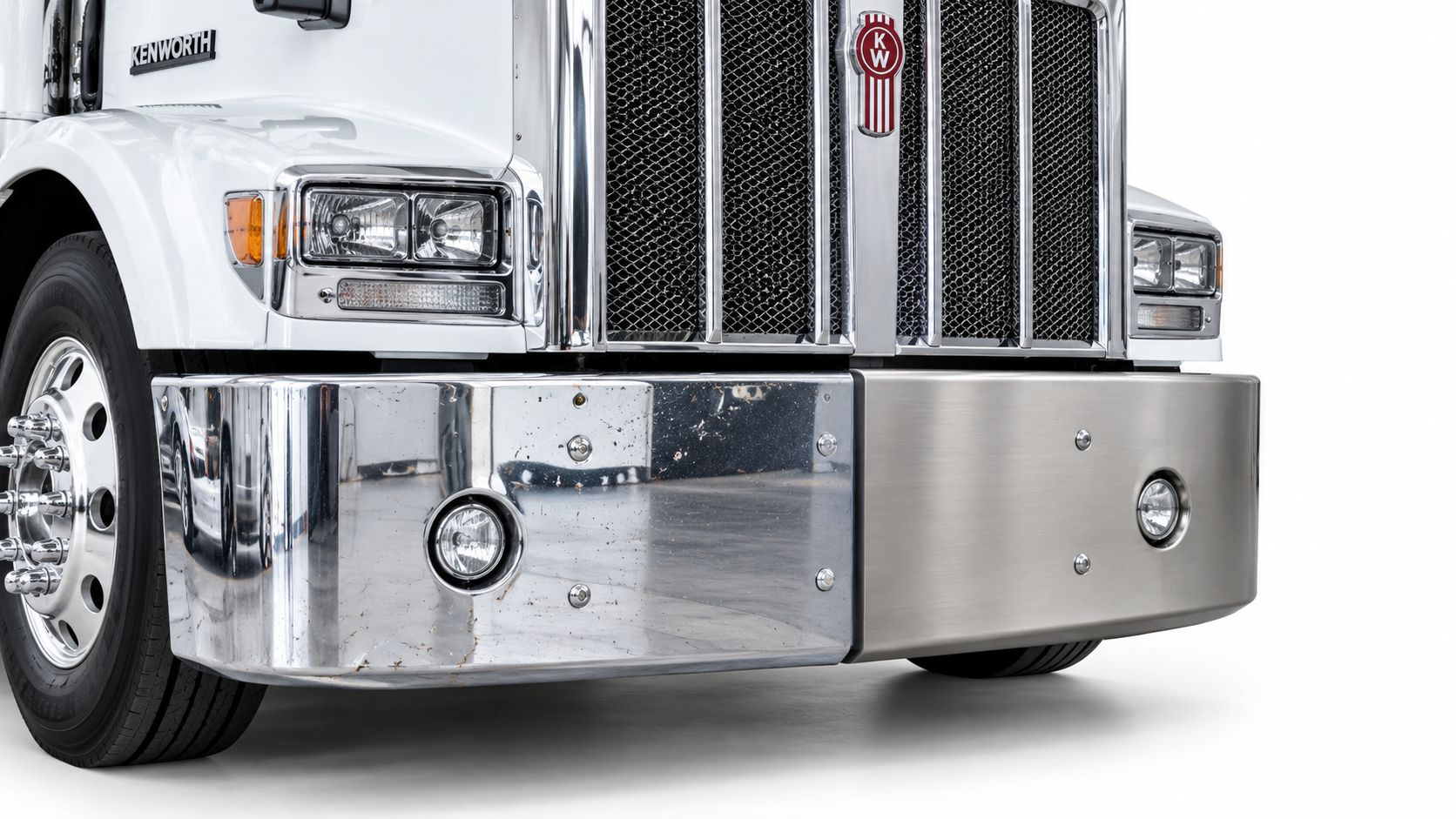
A bumper takes direct punishment from road debris, winter chemicals, loading docks, wash chemicals, and minor contact. It also sits at eye level for every customer, driver, and fellow trucker who sees the rig. The right choice has to protect the front end while holding its appearance through real hauling conditions.
Chrome-plated steel
Chrome-plated steel gives a familiar mirror finish and strong visual presence. It works well for owner-operators who maintain the truck closely and want a classic appearance, including a Kenworth W900 chrome bumper, a Peterbilt 389 bumper, or an 18 inch drop bumper configured for the truck.
The weak point is exposed plating. Independent parts guidance recommends polishing chrome parts every 2 to 4 weeks to reduce pitting and rust, especially where winter road salt is common. 4 State Trucks' Kenworth parts guidance also describes stainless-steel options as lasting 10 or more years with minimal maintenance. Those figures apply to the cited guidance, not to every bumper in every operating environment.
Chrome can also suffer when the bumper bends. Wiley Metal explains that chrome plating can crack under bending, allowing moisture beneath the finish and starting corrosion. A light polish won't repair a cracked plated surface.
Stainless steel choices
Stainless steel offers a different maintenance profile. Scratched stainless can form a new oxide layer, which helps it resist corrosion over time. The exact grade still matters. A 430 stainless steel option can provide a corrosion-resistant exterior material, while 304 stainless steel is another premium option used in heavy-duty bumper construction. Buyers should confirm the actual grade, thickness, finish, bracket design, and warranty instead of accepting “stainless” as a complete specification.
Clad construction is another approach. Hendrickson's bumper comparison explains that a clad bumper uses a stainless outer layer that is much thicker than the stainless surface found on chrome-plated or painted bumpers. That thicker outer layer helps resist rust and corrosion more effectively than a plated or painted finish.
Match the material to the route
Use this practical test before ordering:
- Salt-heavy winter routes: Stainless can reduce polishing and corrosion attention when the truck regularly sees chloride exposure.
- Show-quality appearance: Chrome delivers a traditional mirror look, but it requires consistent cleaning and inspection.
- Frequent minor contact: Verify thickness, bracket strength, and repair expectations. Finish alone doesn't determine impact durability.
- Mixed-weather long haul: Choose the material that fits the cleaning schedule your operation can maintain.
- Custom front ends: Confirm whether the bumper supports your fog lights, tow holes, grille, brackets, and drop style.
A bumper's thickness and mounting system matter as much as its finish. A heavy-looking face can still fail if the brackets don't align or the mounting points have been altered. For more detail on finish and construction choices, review chrome-plated steel versus chrome-plated stainless steel.
Ensuring Perfect Fitment and Installation
“Fits Kenworth” isn't enough information to approve a bumper order. Kenworth bumper coverage spans different families and year ranges, including W900 from 1987 to present, T800 from 1986 to present, T600 and T660 from 1985 to 2017, and T680 from 2013 to present in one published category. The model coverage reference shows why the truck family and year span must be part of the order.
W900 buyers face the same issue. Many replacement bumpers are built around factory mounting points and width for W900B and W900L models, but fit can still change with model year, chassis setup, and previous modifications. W900 bumper fitment guidance is useful, but your truck's actual configuration remains the final check.
Verify before you buy
Use a simple inspection routine:
- Record the truck identity. Write down model, model year, axle position, chassis configuration, and any front-end changes.
- Photograph the existing bumper. Capture the front, rear, brackets, tow openings, fog lights, and lighting arrangement.
- Measure mounting points. Check width, bolt spacing, bracket location, and clearance around lights and tow equipment.
- Confirm cutouts. A bumper may match the model but still lack the openings your truck needs.
- Check modifications. Look for drilled holes, relocated lights, custom grille work, altered brackets, or previous collision repairs.
- Review installation requirements. A direct bolt-on part can save fabrication time, but only when the truck still has the intended mounting structure.
Direct bolt-on is a labor decision
Direct bolt-on installation isn't just a convenience. It can reduce cutting, drilling, alignment problems, and time in the bay. It also makes a future replacement easier because the truck retains a known mounting arrangement.
Before installation, inspect the frame horns and brackets for bends, cracks, corrosion, and damaged threads. Compare the new bumper against the old one before removing hardware. Keep the truck supported safely, use the correct lifting method, and don't force bolts into misaligned holes. If the bumper needs unexpected fabrication, stop and resolve the fitment issue rather than hiding it with oversized holes.
For a practical installation sequence, use this bumper installation guide. The guide should support the shop's safety procedure, not replace the manufacturer's instructions or a qualified technician's judgment.
Maximizing Your Investment and Uptime
What does a parts purchase really cost when the truck is waiting in the yard? The invoice matters, but so do freight, installation time, repeat failures, and lost revenue while the unit is down.
Start with the failure risk. Steering and braking components deserve a higher verification standard than trim. A bumper running on salted winter routes needs corrosion resistance and repairability, while a show-focused truck may prioritize finish. A part that ships quickly can still delay the job if it needs drilling, fabrication, or unexpected bracket work.
Reliable parts access helps reduce downtime, but it depends on accurate information. Give the supplier the VIN, model, chassis configuration, existing options, and intended use before ordering. That information improves the chance of finding a suitable replacement or identifying a backorder substitute without guessing.
The lowest invoice is only one line in the repair cost.
Use this total cost of ownership approach to compare purchase price, freight, labor, maintenance, service life, warranty coverage, and the cost of removing the truck from service. Record fitment details, dependable suppliers, material choices, and replacement timing. Those notes make the next repair faster and help fleet managers set practical specifications.
Owner-operators should choose parts that fit the truck, suit the route, and avoid unnecessary shop work. Fleet managers can standardize proven specifications, while allowing changes for different duty cycles. The right choice protects uptime, safety, appearance, and long-term operating cost across North American freight routes.
Galhor Inc. offers configurable chrome bumpers for Kenworth, Peterbilt, Freightliner, and Volvo Class 8 trucks. Options include material, finish, cutouts, model, and year for direct-fit installation. Review configurations at Galhor Inc., verify the truck details, and match the bumper to its working conditions.