
LTL Freight Shipping Rates Explained for Truckers
September 26, 2026 · Francisco Hornelas

LTL shipping typically runs $150 to $900 per pallet, depending on distance, weight, freight class, and accessorial charges. A standard shipment can look affordable at quote time, then cost much more after reclassification, fuel, liftgate service, or delivery changes reach the invoice.
You've seen the pattern. A bumper, steel part, or pallet of truck components leaves the shop with a clean quote. The shipment moves through the carrier network, and the final bill comes back higher than expected. The carrier may have measured a different footprint, assigned a higher class, or found that the receiver needed equipment that wasn't listed.
That's why LTL freight shipping rates need to be judged from the full shipment details, not from the linehaul number alone. The national working range is $150 to $900 per pallet, with the final amount shaped by distance, weight, and accessorial charges, as shown in Warp's LTL rate benchmark.
Owner-operators and fleet managers can control more of this bill than they think. Accurate dimensions, honest freight class, tight packaging, and a confirmed dock often matter more than chasing the lowest advertised quote.
Table of Contents
- Why LTL Freight Shipping Rates Confuse So Many Truckers
- What LTL Freight Is and How It Is Priced
- Freight Class and Density Explained
- Accessorial Charges That Inflate Your Invoice
- How Carriers Actually Calculate Your Rate
- What LTL Rates Look Like in 2026
- How to Reduce Your LTL Shipping Costs
Why LTL Freight Shipping Rates Confuse So Many Truckers
A Magnolia, Texas shop ships one Freightliner Classic bumper to a body shop with no dock. The quote assumes dock-to-dock service. The invoice adds a $125 liftgate charge and a $75 residential fee. Neither charge reflects the bumper's weight or linehaul distance. Both come from delivery conditions that were missing from the booking details.
LTL freight shipping rates are built from several inputs, including linehaul, fuel, freight class, distance, negotiated discounts, and accessorial services. A wrong dimension, incomplete freight description, or missed delivery requirement can change the final bill even when the original quote looked reasonable.
Misclassification creates another common problem. A 48 x 40 x 42 inch pallet of chrome bumpers weighing 620 lb has a density of about 12.4 lb per cubic foot. That density places it in class 85 rather than the class 70 shown on the quote, creating a difference of roughly $90 on a typical lane. The part itself did not change. The measured space and resulting class did.
Truck parts often create this risk because their shape and packaging work against simple weight-based assumptions. A chrome bumper can be heavy but compact, while protective packaging can increase the pallet's footprint. A repair yard, residence, school, or construction site may also require a liftgate, appointment, inside delivery, or redelivery.
Practical rule: Treat the quote as a calculation based on reported facts, not as a guaranteed price detached from the shipment details.
A reliable review starts with five questions:
- What is the actual weight? Include the pallet and all packaging.
- What space does it occupy? Measure the outside dimensions of the loaded shipment.
- What class applies? Density and commodity details can change the rating.
- Where is it going? Confirm whether the destination has a commercial dock.
- What services are required? List liftgate, appointment, inside delivery, and redelivery needs before pickup.
Warp's 2026 benchmark provides current market context, but it cannot account for missing shipment details. Accurate measurements, an honest class, tight packaging, and confirmed delivery access give owner-operators and fleet managers a better chance of receiving a usable invoice.
What LTL Freight Is and How It Is Priced
LTL means less-than-truckload. Your shipment shares trailer and terminal space with freight from other customers instead of taking the entire trailer. Most carriers treat LTL as freight weighing roughly 150 pounds to 10,000 to 15,000 pounds, according to Ella Audit's LTL shipping guide.
A pallet of truck bumpers, suspension parts, or boxed shop equipment usually fits this model. The carrier groups shipments moving through similar lanes, loads them through a terminal network, and charges based on the space, weight, handling needs, and route involved.
Why weight breaks matter
Carriers use weight breaks to price shipments more accurately. Published guides commonly use these ranges:
- Under 500 lb
- 500 to 999 lb
- 1,000 to 1,999 lb
- 2,000 to 4,999 lb
- 5,000 to 9,999 lb
- 10,000 lb and above
Those breaks don't mean a heavier shipment always costs more per pound. They mean the carrier's pricing table can change when the shipment crosses a threshold. A few extra pounds may move the freight into another bracket, especially when the original quote was close to the boundary.
Think of a shared trailer like a pizza split among several customers. You aren't paying for the whole pizza, but you are paying for your slice of space, weight, handling, and travel. A compact steel part may use less trailer volume than a large, light item, even if both sit on one pallet.
The guide to freight delivery can help buyers understand why pallet preparation and receiving conditions matter before booking.
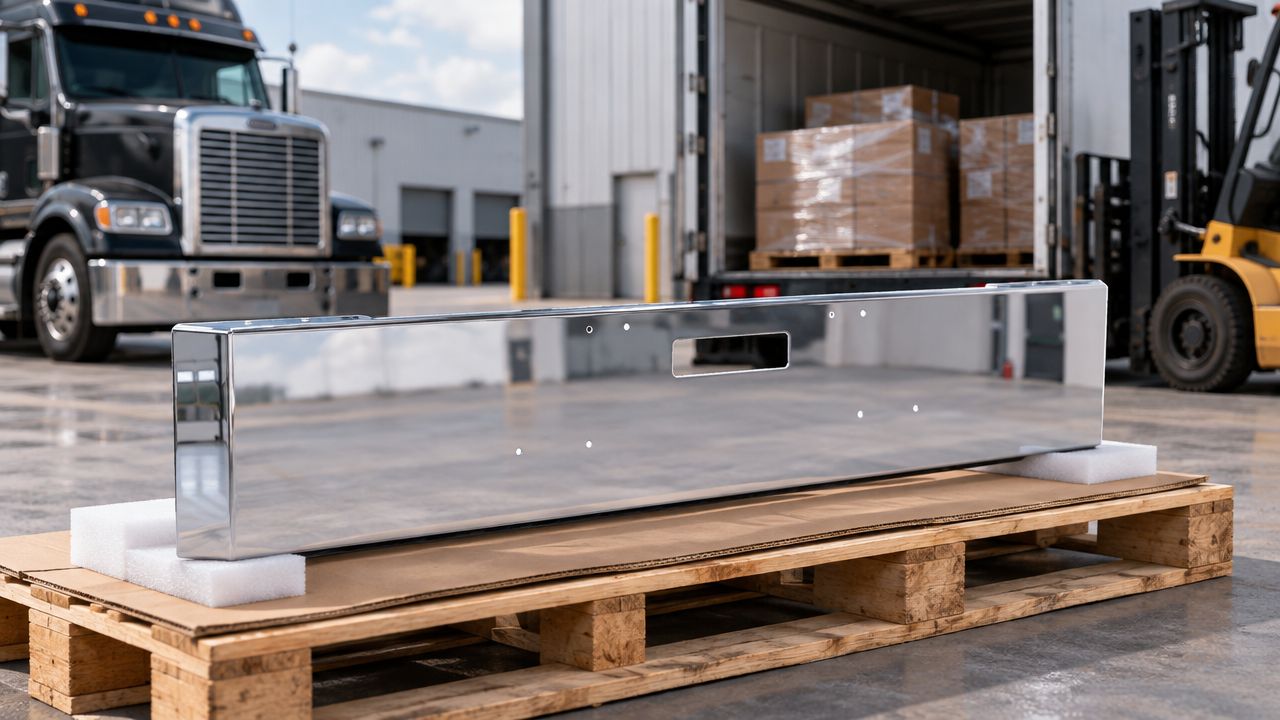
A Chrome bumper for Freightliner Classic illustrates the type of heavy-duty part commonly prepared for LTL transport. The catalog description lists 10-gauge chrome-plated steel with a mirror-polished finish, or 3 mm chrome-plated stainless steel 304 or 430, with standard or blind mount options and direct bolt-on installation for Freightliner Classic models.
What to record before requesting a quote
Write down the loaded pallet's length, width, height, gross weight, freight description, origin, destination, ready date, and handling requirements. Measure the shipment after wrapping and securing it, not while the part is still sitting loose in the shop.
That information gives the carrier a usable rating profile. Without it, the quote is only a rough estimate, and rough estimates are where invoice adjustments start.
Freight Class and Density Explained
Freight class is the pricing input that causes the most trouble for parts shippers. The NMFC system uses class to describe how freight occupies space and how difficult or risky it is to move. Dense, compact freight usually falls into a lower class, while bulky, lightweight freight moves into a higher class.
For truck parts, that difference matters. A pallet of compact steel components may use trailer space efficiently. A large pallet with lightweight plastic panels, loose packaging, or awkward dimensions may consume more room for each pound and receive a higher class.
The density calculation is straightforward:
Density in lb/ft³ = shipment weight in pounds ÷ shipment volume in cubic feet
Use the full outside dimensions of the loaded pallet. Include the pallet, crate, protective material, and any overhang. A carrier measures what it must handle, not just the product listed on the purchase order.
NMFC density reference
| Freight Class | Density (lb/ft³) | Typical Freight | Relative Cost |
|---|---|---|---|
| 50 | 50+ | Very dense steel or compact industrial parts | Lower |
| 70 | 15 to 22.5 | Moderately dense boxed or assembled freight | Low to moderate |
| 150 | 6 to 7 | Lighter, less compact equipment or components | Higher |
| 500 | Less than 1 | Extremely bulky, lightweight freight | Highest |
These density ranges are documented in the NMFC freight class and density guide. The table isn't a substitute for confirming the specific commodity classification, but it shows why two one-pallet shipments can receive very different quotes.
A practical check before booking
Measure the pallet footprint and height. Multiply those dimensions to get cubic volume, then divide gross weight by that volume. Compare the result with the class used on the quote.
Don't understate the class to force a cheaper number. The carrier may inspect, reweigh, or reclassify the freight after pickup. That adjustment can erase any saving and create a billing dispute.
Before signing the BOL, verify the class against the loaded pallet, not the bare part.
Packaging can change the result. A bumper protected by a crate may arrive safely, but the crate adds dimensions and weight. The right approach is to protect the part while keeping the package compact, stable, and easy to handle.
Accessorial Charges That Inflate Your Invoice
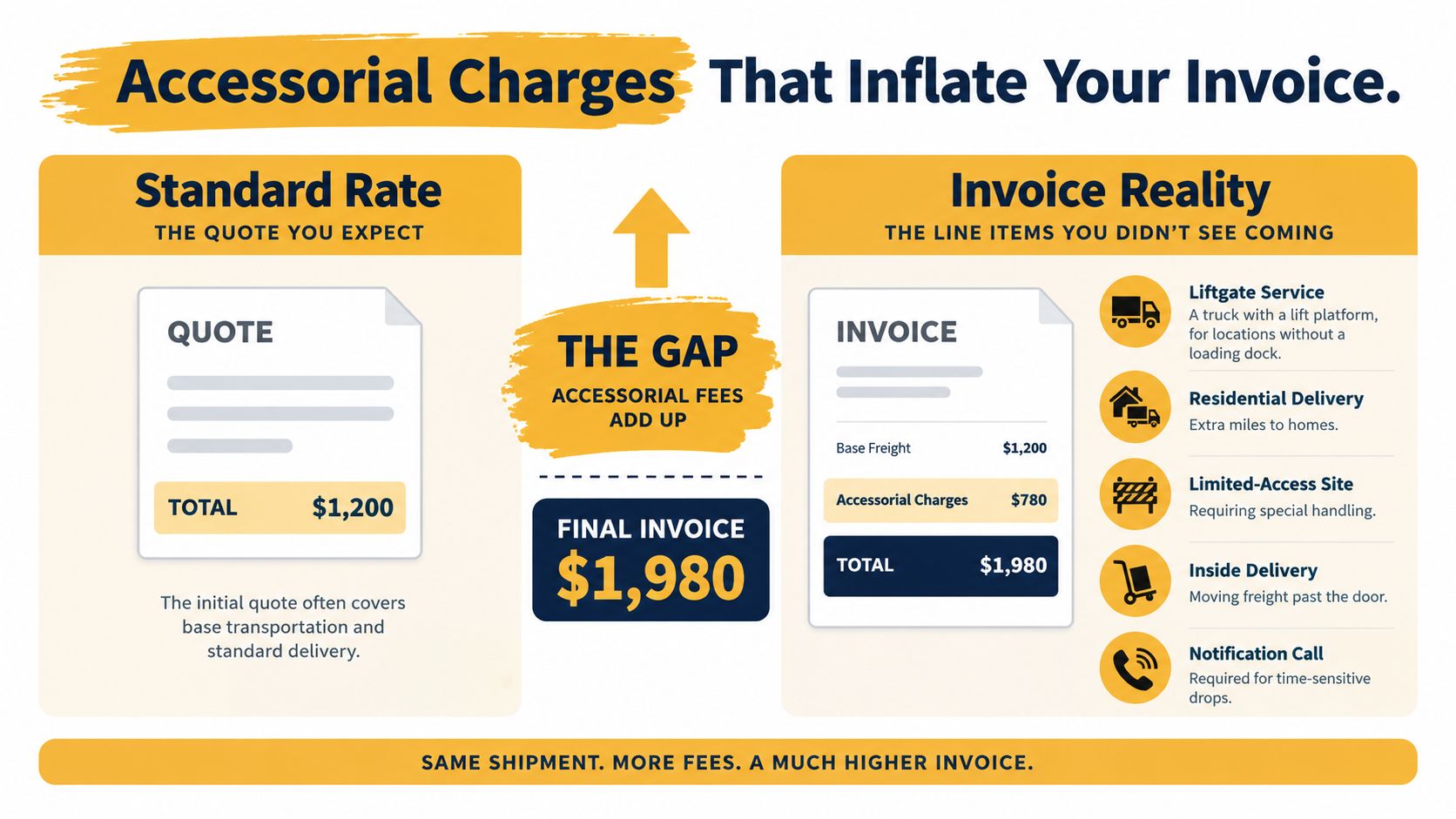
Accessorials cover services outside standard dock-to-dock pickup and delivery. They're the main reason a quote can look reasonable while the invoice tells a different story.
Common charges include liftgate service, residential delivery, limited-access delivery, inside delivery, appointment delivery, detention, and redelivery. A 2026 industry guide estimates that accessorials can add 15% to 40% to the base freight plus fuel surcharge total, as reported by LanePilot Technologies.
Where the extra charges start
A residence usually doesn't have a commercial dock or forklift. The carrier may need a liftgate to lower a pallet from the trailer. A school, construction site, military facility, or industrial location with restricted access may require special routing or delivery handling.
Inside delivery is another common trap. Standard freight service normally ends at the receiving dock or truck side. If the driver must move the pallet through a doorway, across a building, or into a service bay, the shipment may need an inside delivery service.
Appointment delivery can apply when the receiver won't accept freight without a scheduled time. Redelivery can appear when nobody is available, the dock is blocked, or the receiving party wasn't ready.
| Delivery condition | Possible service charge |
|---|---|
| No dock or forklift | Liftgate |
| Home or residential address | Residential delivery |
| School, jobsite, or restricted facility | Limited access |
| Freight moved beyond the dock | Inside delivery |
| Receiver requires a scheduled arrival | Appointment delivery |
| First attempt fails | Redelivery |
The charge isn't automatically wrong. The problem is failing to disclose the condition at quote time. If the carrier arrives and discovers a different delivery requirement, the driver still has to complete the work or return the freight.
Confirm both ends of the shipment
Ask the shipper and receiver:
- Is there a working dock?
- Is a forklift available at pickup and delivery?
- Is the address commercial, residential, or a jobsite?
- Does the receiver require an appointment?
- Can the driver reach the dock without restricted access?
- Will anyone be available during the delivery window?
Record those answers on the quote request and BOL. A phone call before booking is cheaper than discovering a liftgate or redelivery charge after the shipment moves.
How Carriers Actually Calculate Your Rate
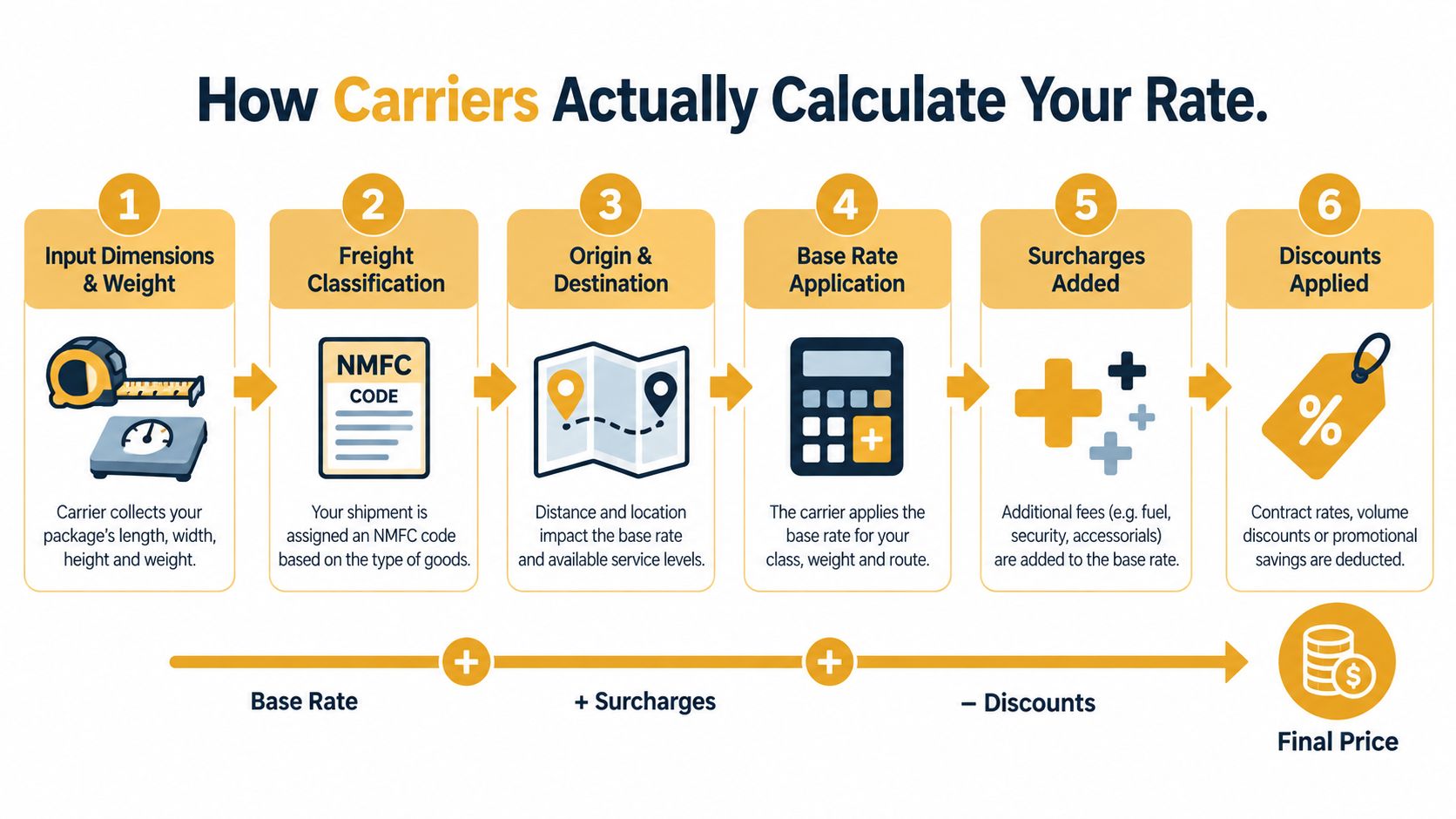
Carriers start with the physical shipment, not the product's retail value. They use dimensions and weight, freight classification, origin and destination, surcharges, and discounts. FedEx Freight's shipping guidance also identifies addresses, total weight, ready date, and special handling needs as key information for a rate request.
The rating sequence
- Measure and weigh the shipment. Use the secured pallet or crate, including packaging.
- Assign the freight class. Use the commodity description and density information.
- Enter origin and destination. Full addresses help identify the correct lane and delivery conditions.
- Apply the base rate. The carrier calculates the transportation charge for the lane and shipment profile.
- Add surcharges. Fuel and other applicable charges can sit on top of the base transportation amount.
- Apply discounts. Contract terms, carrier agreements, or negotiated pricing may reduce the published charge.
A quote is only as accurate as the details behind it.
A request that says “one pallet of truck parts” leaves too much open. The carrier doesn't know whether the pallet weighs a few hundred pounds or far more, whether it needs a liftgate, or whether the part is packaged in a way that changes its dimensions.
Build a quote packet
Keep one standard template for every shipment. Include the exact pickup and delivery addresses, contact names, total weight, dimensions, freight description, class, ready date, appointment needs, and equipment requirements.
For fleet managers, this creates a repeatable process across locations. For owner-operators, it reduces the chance that a rushed parts order gets rated from incomplete information. Save the quote, BOL, delivery receipt, and final invoice together so you can identify the cause of any adjustment.
What LTL Rates Look Like in 2026
A one-pallet shipment can look inexpensive until the invoice reflects its actual class, lane, and handling requirements. For a defined benchmark, CH Robinson's 2026 North America LTL market update reports a $587 national average for a standard one-pallet, 500-pound, class 70 shipment across 3,233 lanes and 36 carriers, with a $517 median.
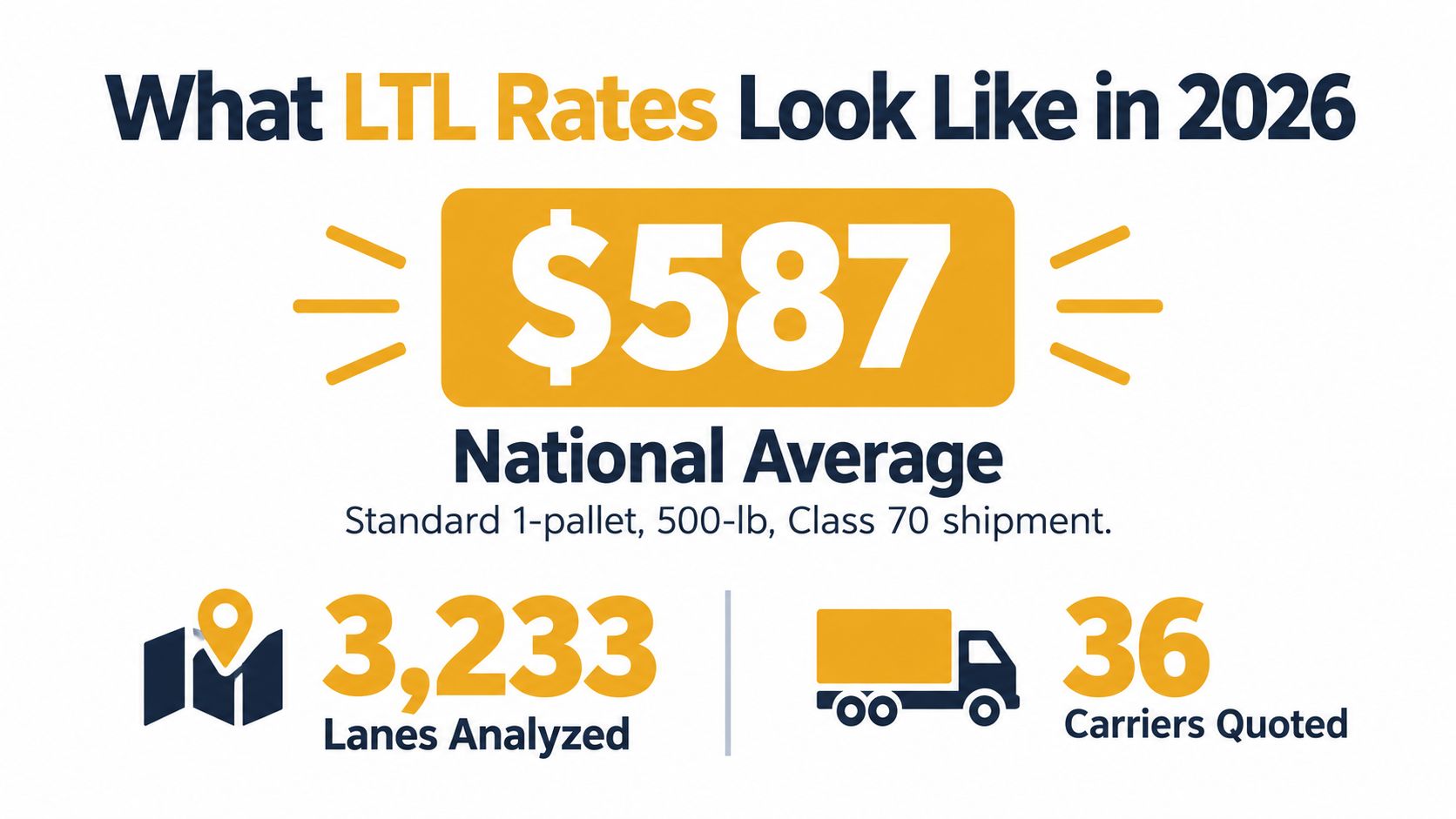
Use those figures as a comparison point, not a guaranteed quote. A different weight, freight class, lane, discount, or accessorial can move the invoice well above or below the benchmark. Liftgate service, appointments, limited access, and reclassification are common reasons a real shipment departs from a standard profile.
| Benchmark | What it tells you |
|---|---|
| $587 average | National average for the defined standard shipment |
| $517 median | Middle result in that benchmark |
| 3,233 lanes | Broad lane sample |
| 36 carriers | Multiple carrier quotes in the comparison |
Pricing pressure remains high. The LTL Producer Price Index, which includes total shipper-paid LTL prices and fuel, rose 19.6% year over year in Q2 2026. The update also referenced average 2025 general rate increases around 5.9%, while other 2026 outlooks called for 3% to 5% increases.
Fleet managers should review lane history before renewing contracts. Older quotes may not reflect current base rates or surcharge pass-throughs. Owner-operators ordering replacement parts should compare the delivered cost, because a low product price can lose its advantage after freight, packaging, and receiving requirements are included.
A bumper shipment needs the same scrutiny as any other LTL load. Review truck bumper replacement cost considerations alongside the freight charge and delivery conditions.
If your quote differs sharply from the benchmark, check the class, dimensions, accessorials, lane, and discount before blaming the carrier.
How to Reduce Your LTL Shipping Costs
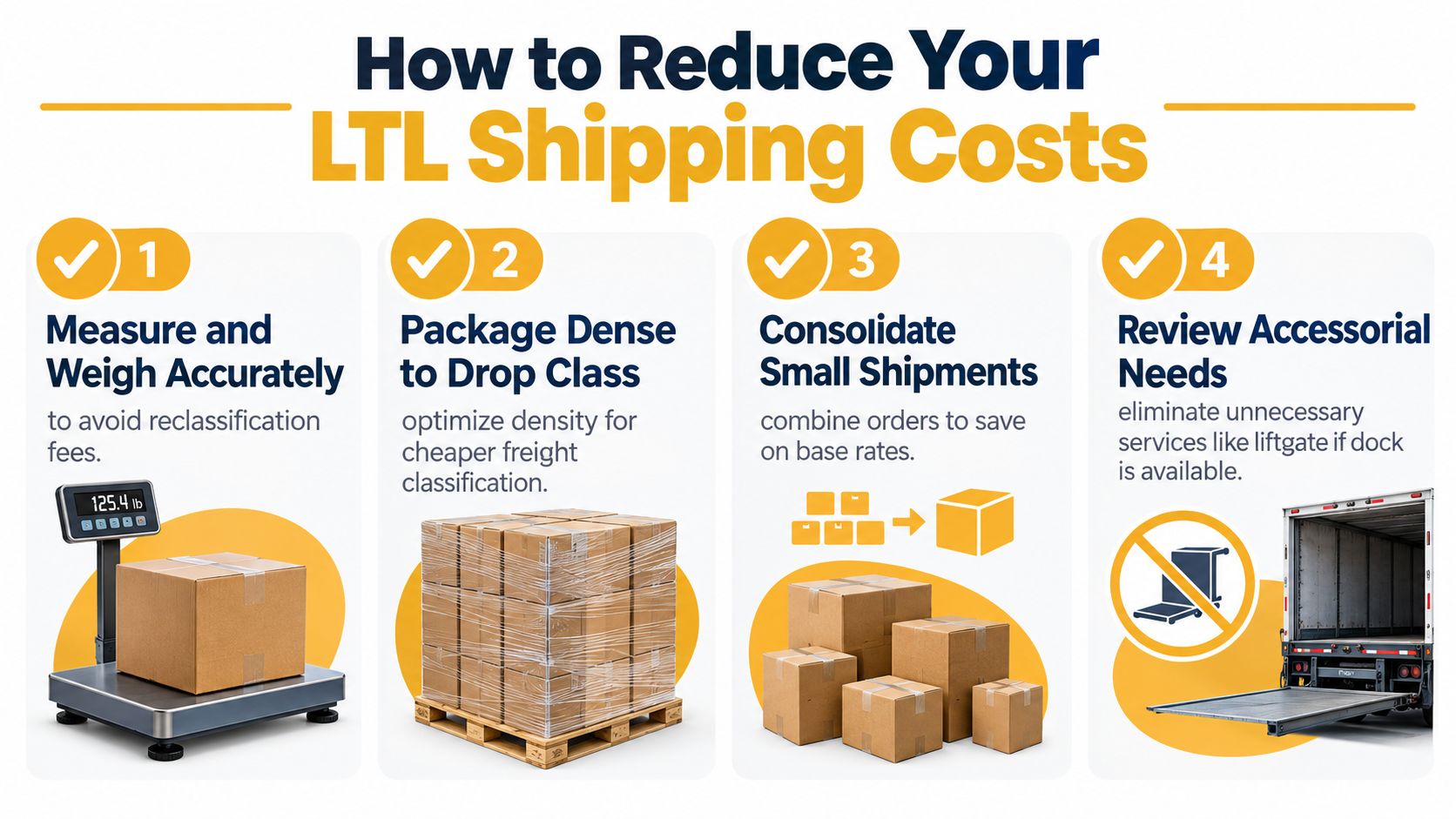
The best savings usually come from better shipment data, not from arguing over a quote after pickup. Accurate measurements prevent reclassification. Compact packaging improves density. Clear delivery instructions prevent avoidable service charges.
Start with the freight itself
Measure and weigh accurately. Record gross weight after palletizing. Measure the outside length, width, and height, including braces, wrap, and protective material.
Package for density. Keep the load tight and stable. Don't build a tall, loose package around a compact steel part when a shorter, secure configuration will protect it.
Consolidate when it makes sense. Several small shipments may create repeated minimum charges and separate pickup events. Combining orders on fewer pallets can improve the shipment profile, provided the added weight or dimensions don't push the freight into an unfavorable break.
Review the class before pickup. A density calculation can expose a mismatch between the physical shipment and the class on the quote. If the commodity has handling or liability rules beyond density, confirm the classification with the carrier or freight specialist.
Remove avoidable delivery charges
Confirm dock access at both ends. If a commercial receiver has a working dock and forklift, don't request a liftgate by habit. If the destination is a residence, school, construction site, or restricted facility, list that condition before the carrier prices the move.
Compare the quote with the 2026 benchmark profile, but don't compare unlike shipments. A one-pallet class 70 shipment isn't a fair match for a bulky class 150 load with inside delivery.
For shipment instructions, review Galhor's shipping information before ordering a heavy truck part. The useful details are the same ones that protect any LTL shipment, clear delivery expectations, correct addresses, and a receiving plan.
Pre-booking checklist
- Confirm weight: Include pallet and packaging.
- Confirm dimensions: Measure the secured load.
- Verify class: Check density and commodity requirements.
- Describe the freight: Avoid vague labels.
- Check the dock: Confirm forklift and liftgate needs.
- List special services: Include appointments, inside delivery, or limited access.
- Save the paperwork: Keep the quote, BOL, proof of delivery, and invoice together.
Heavy, compact items such as steel truck bumpers can fit LTL well when the shipper reports them correctly. The carrier gets a usable shipment profile, the receiver knows what equipment is needed, and the fleet avoids preventable billing adjustments.
Quote with full details, verify the class, and confirm the dock. Those three actions won't remove every market-driven charge, but they eliminate many invoice surprises before the freight leaves your yard.
Galhor Inc. offers configurable chrome bumpers for Freightliner, Peterbilt, Kenworth, and other Class 8 applications, with chrome-plated carbon steel or chrome-plated stainless steel 430 and 304 options, direct bolt-on fitment, and LTL delivery support. Visit Galhor Inc. to choose the correct truck model, finish, cutouts, and mounting style, then prepare the shipment with the same accurate freight details used in the quote.