

Peterbilt Aftermarket Parts Guide
You're at a loading dock with a damaged bumper, a truck that still needs to run, and a shipment appointment you can't miss. The cheapest replacement may look attractive on the screen, but a poor fit can lead to extra freight, shop time, drilling, repainting, and another repair later. When you're comparing Peterbilt aftermarket parts, the central question isn't only what the part costs. It's whether the part fits correctly, survives your route, and keeps the truck earning.
Table of Contents
- The Scale of Peterbilt Aftermarket Parts
- OEM vs Aftermarket Tradeoffs for Class 8 Trucks
- Material Grades and Bumper Thickness Explained
- Verifying Fitment Before You Buy
- Lifecycle Costs and Fleet Maintenance Strategy
- Choosing Trusted Suppliers and Direct Bolt-On Solutions
- Installation and Long-Term Care
The Scale of Peterbilt Aftermarket Parts
A Peterbilt that needs a replacement bumper, grille, switch, mirror, or exhaust component is part of a much larger working fleet. PACCAR reported that more than 7 million heavy-duty trucks operate across North America and Europe, creating a large population that needs replacement and maintenance parts throughout long operating lifecycles. PACCAR's 2024 annual report also identified more than 370,000 PACCAR MX engines installed in Peterbilt and Kenworth trucks in North America and DAF trucks in Europe.
That installed base matters to an owner-operator. A truck doesn't leave the parts market just because it has several years on the road. It may need collision repair after a dock impact, corrosion repair after winter routes, or a cosmetic refresh before resale. Fleets also replace worn components during refurbishment instead of retiring a sound chassis.
Peterbilt's current production adds to that demand. The company held a 15.3% Class 8 market share in 2024, while Peterbilt and Kenworth together reached a 30.7% Class 8 retail-sales share in the United States and Canada, according to PACCAR's annual report. PACCAR also reported more than 6,100 Model 589 deliveries during its first production year and production of the 800,000th truck at its Denton, Texas, factory.
Why the aftermarket stays active
PACCAR Parts generated $6.67 billion in revenue in 2024, compared with $6.41 billion in 2023, and reported $1.71 billion in pretax income for the year. Those figures show that parts and service are a major commercial-vehicle business, not a side market for unusual repairs. The figures appear in PACCAR's 2024 parts and financial results.
For buyers, that means aftermarket choices are common across collision repair, chrome upgrades, fleet refurbishment, and routine maintenance. A direct replacement can restore a working truck quickly. A custom bumper can also improve appearance without turning the truck into a fabrication project.
Practical rule: Treat the aftermarket as a supply chain for uptime, not as a last resort. The right part can solve a repair faster, but only when its material and fitment match the truck's job.
OEM vs Aftermarket Tradeoffs for Class 8 Trucks
OEM parts have a clear advantage when you need the closest match to the factory design. Their specifications are tied to the original truck configuration, and parts departments can often identify the intended replacement through factory records. That can simplify a repair, especially when the truck has no custom frame work or previous modifications.
The tradeoff is choice. An OEM replacement may offer fewer options for bumper depth, finish, mounting style, tow openings, or appearance. A specialized aftermarket supplier may offer chrome-plated carbon steel, stainless options, standard mounts, blind mounts, and designs such as an 18 inch drop bumper or a Texas-style bumper. Shipping can also vary by supplier and configuration, so confirm the dispatch window before the truck enters the shop.
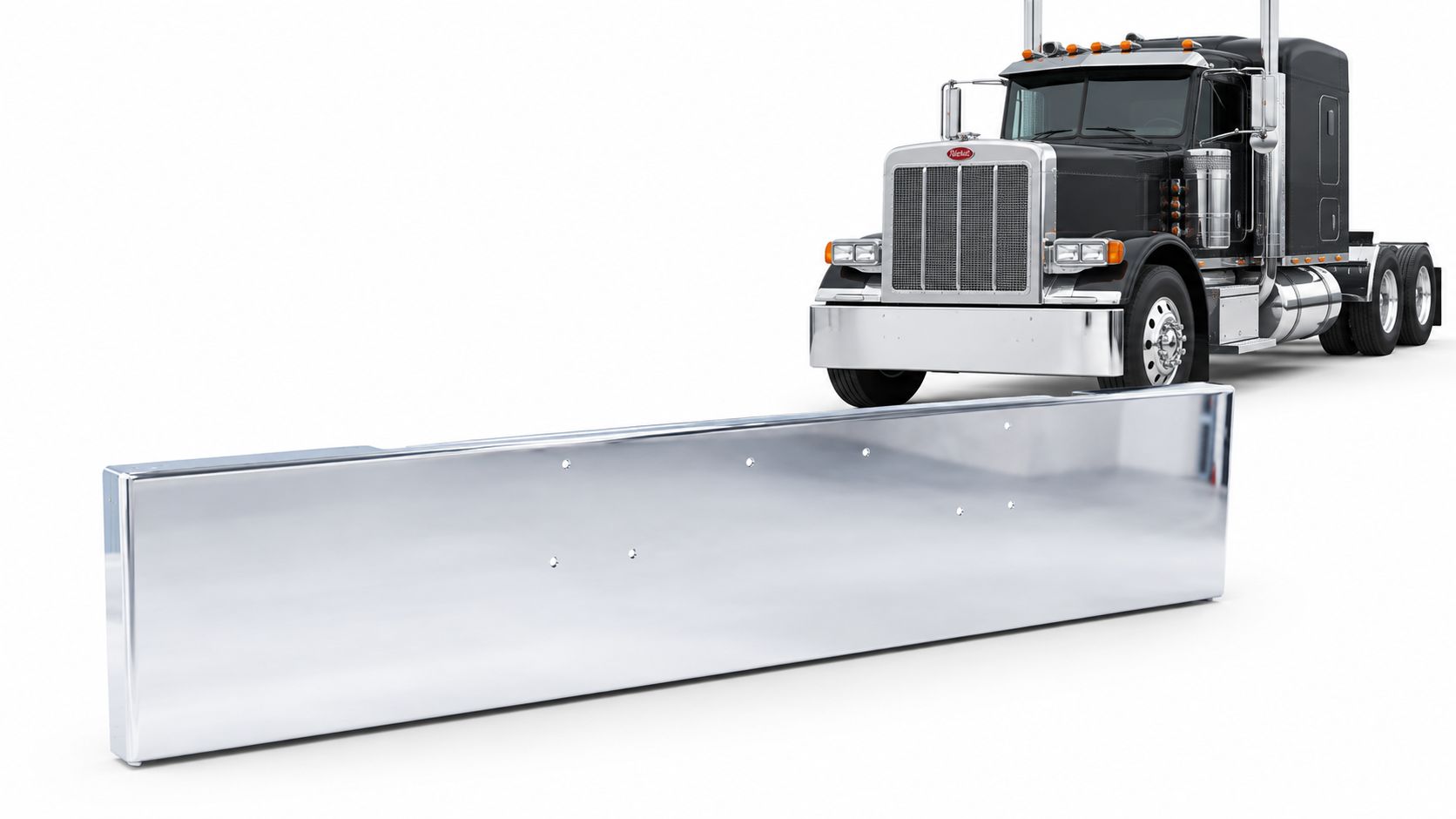
OEM and premium aftermarket side by side
| Feature | OEM Replacement | Premium Aftermarket |
|---|---|---|
| Cost | Factory replacement pricing may be higher | More material and finish options across different price levels |
| Lead time | Depends on dealer inventory and factory supply | Often available through specialized truck-parts suppliers |
| Material options | Usually tied to the original configuration | May include chrome-plated steel, 430 stainless, or 304 stainless |
| Customization | Limited to factory designs | Options can include drop depth, cutouts, mount style, and finish |
| Fitment | Intended for the listed factory application | Must be verified by model, year, generation, and mounting setup |
| Installation | Usually follows factory repair procedures | Direct bolt-on designs can reduce fabrication work |
The important comparison isn't “OEM good, aftermarket bad.” It's factory match versus application-specific value. A premium aftermarket bumper can make sense when the truck needs a different style, stronger corrosion resistance, or faster access to a replacement. A low-cost part that needs cutting or arrives with the wrong cutouts can cost more after labor and downtime.
For a specific older application, the Chrome bumper for Peterbilt 378 / 379 is listed with 10-gauge chrome-plated steel, a mirror-polished finish, optional 3 mm chrome-plated 304 or 430 stainless, standard or blind mounting, and direct bolt-on installation for the listed Peterbilt models. The listing also identifies a triple-layer hexavalent chrome process with 35 microns of nickel and sells the bumper individually.
Before ordering, compare the full installed cost. Include freight, shop labor, mounting hardware, possible modifications, return shipping, and the cost of taking the truck out of service. The OEM bumper versus aftermarket comparison is useful for organizing that decision around the truck's actual operating needs.
Material Grades and Bumper Thickness Explained
A bumper's shine tells you almost nothing about how it will behave after repeated exposure to salt, water, vibration, and road debris. Buyers should identify the base metal, the finish, and the thickness before comparing a Peterbilt 389 bumper, a Kenworth W900 chrome bumper, or an 18 inch drop bumper.
Type 304 stainless steel contains about 18% chromium and 8% nickel, while Type 430 stainless steel contains roughly 16% to 18% chromium and no nickel, as explained in this stainless steel material guide. Chromium creates a passive surface layer that slows rust. Nickel improves corrosion resistance, toughness, and formability.
Match the metal to the route
Type 304 is usually the stronger choice for trucks that run winter roads, coastal routes, or areas where salt and chemicals stay on the bumper. Type 430 still provides useful corrosion resistance and can deliver a bright, polished appearance. It generally makes more sense for milder exposure when the buyer wants stainless construction without choosing the more corrosion-resistant grade.
Chrome-plated carbon steel is another practical option. It can provide a traditional show-truck appearance and solid service when the finish is maintained and the truck isn't constantly exposed to severe salt. The weak point is exposed or damaged steel beneath the plating. Once corrosion reaches that surface, the finish can deteriorate faster than an appropriately selected stainless application.
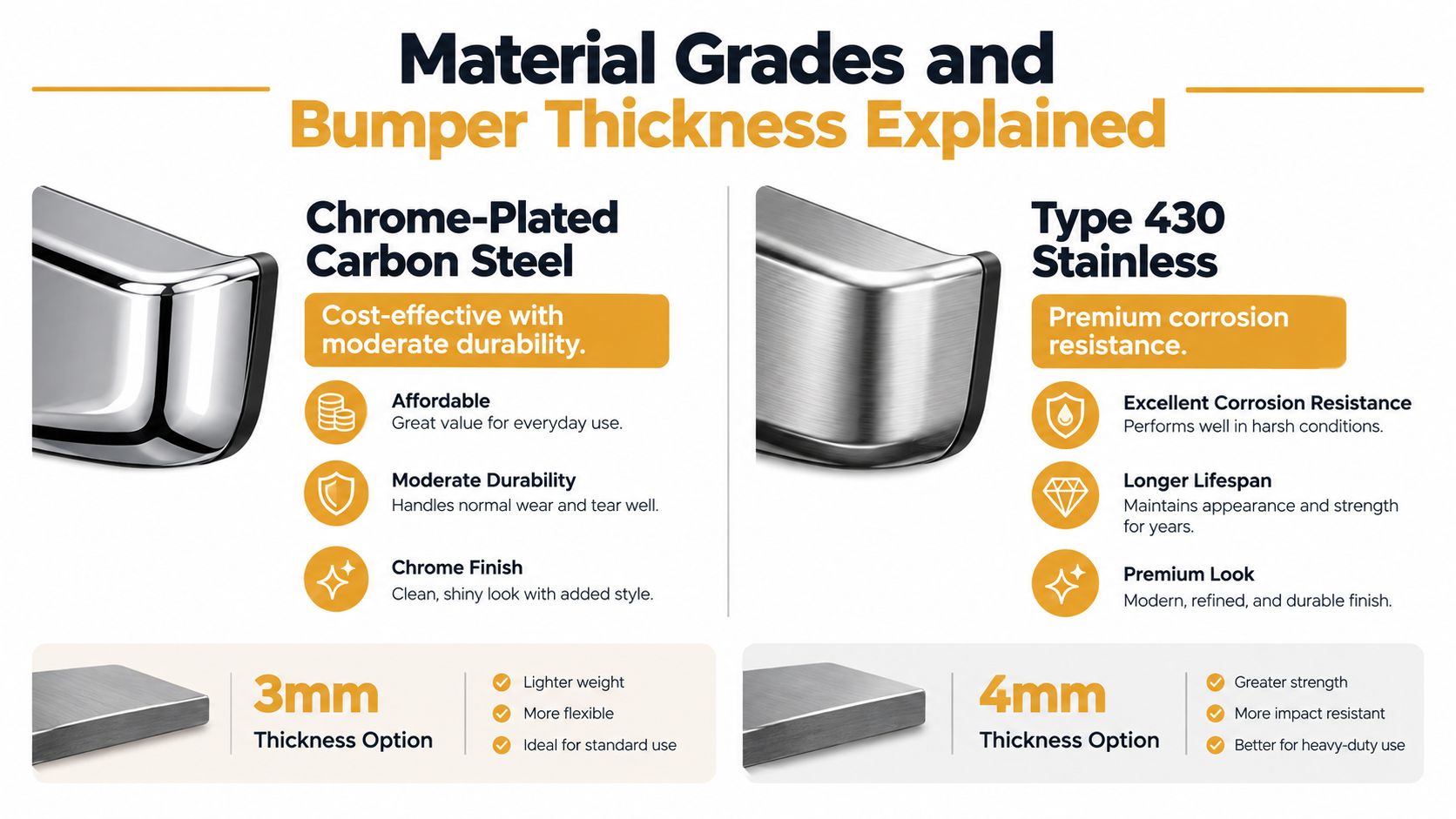
Read gauge and profile details carefully
Peterbilt's parts catalog lists a 16-inch 389 tow bumper in 10-gauge material, and other Peterbilt bumper applications include 18-inch designs, according to the Peterbilt insurance and collision catalog. 10-gauge steel is approximately 0.1345 inch thick. That thickness affects durability, but it isn't the only factor.
Reinforcement, bracket design, end caps, cutouts, and the way the bumper transfers impact into the frame all matter. Ask whether a listed dimension refers to the face, the drop, or the total profile. A deeper bumper may change approach angle and ground clearance on a low truck or a vehicle that uses steep loading ramps.
Look for these specifications before purchase:
- Base metal: Confirm whether the part uses carbon steel, 430 stainless, or 304 stainless.
- Thickness: Ask for actual gauge or millimeter thickness, not only a marketing term such as heavy duty.
- Finish: Check whether the surface is polished stainless or chrome-plated, and ask how the finish is applied.
- Construction: Review reinforcement, mounting brackets, tow holes, sensor openings, and license-plate cutouts.
The stainless steel versus carbon steel guide can help buyers compare corrosion behavior before choosing a finish for a specific route.
Verifying Fitment Before You Buy
A bumper can be made for a Peterbilt and still be wrong for your truck. Model names cover multiple generations, year ranges, submodels, and mounting layouts. A listing that says “fits Peterbilt 389” is only a starting point.
Start with the VIN and the truck's build information. Record the model, model year, front-end generation, frame setup, existing bumper dimensions, mount type, and any previous repair work. Trucks with custom frames, repaired horns, altered brackets, or mixed-generation components need more than a broad model match.
Use a fitment decision tree
- Confirm the exact model and year range. A 379, 389, 567, or 579 may require different mounting points and cutouts. Don't assume that a familiar model name identifies one universal bumper.
- Measure the existing part. Record width, height, face depth, drop, bolt-hole spacing, bracket position, and the location of openings.
- Photograph the mounting points. Take clear pictures of the frame horns, brackets, tow holes, sensor openings, and any repairs. Send them to the supplier before ordering if the configuration is unusual.
- Classify the installation. A direct bolt-on needs the correct holes and brackets. A minor-modification part may need limited changes. A fabrication-required part can involve cutting, drilling, welding, or new brackets.
- Check the cutouts. Tow hooks, sensors, license plates, fog lights, and other accessories must match the truck's equipment.
- Verify the finish and material. A correct shape with the wrong grade may still fail your route's corrosion demands.
The word “fits” doesn't always mean the replacement performs identically to the original. That distinction matters when the bumper takes impact loads, carries accessories, or relies on specific reinforcement.
Before you pay: Ask the supplier to confirm the VIN, generation, dimensions, mounting style, and cutout layout in writing. A few minutes of verification can prevent return freight and a stalled repair bay.
Previous repairs deserve extra attention. A truck may have factory-style bodywork on one side and altered brackets on the other. If the supplier can't explain whether the bumper is direct bolt-on, modification-ready, or fabrication-required, treat the fitment as unverified.
Lifecycle Costs and Fleet Maintenance Strategy
The purchase price is only one line in the maintenance record. A bumper that arrives quickly but needs modification may cost more than a properly specified premium part. A lower-cost finish that corrodes after repeated salt exposure can also create another replacement cycle.
Vehicle age changes the maintenance picture. A fleet-maintenance study found that average annual parts costs can rise by as much as 50% after Class 8 trucks pass six years of age, as reported in the commercial fleet maintenance study. Aging trucks see more failures across structural, suspension, steering, braking, electrical, and engine-adjacent systems.
The same study reports average truck preventive-maintenance intervals of 2.3 months. Use those inspections to look for cracked mounting points, corrosion under brackets, loose fasteners, deformation, and damage around cutouts. Finding a weak mount during scheduled service is cheaper than finding it after a bumper moves or breaks on the road.
Calculate total installed cost
Track more than the invoice. For each part family, record:
- Purchase cost and freight
- Installation hours and technician labor
- Expedited shipping or rental equipment
- Downtime and missed loads
- Return freight or modification work
- Warranty claims and repeat repairs
- Failure date, truck age, mileage, and duty cycle
A U.S. Department of Transportation study found that annual mileage, fuel consumption, and service span influence Class 8 maintenance and repair needs, as detailed in this Class 8 lifecycle analysis. A high-mileage over-the-road tractor faces different vibration, thermal cycling, road salt, and impact exposure than a local vocational truck.
That's why fleets should compare cost per operating mile, unscheduled removals, installation time, warranty outcomes, and downtime. A premium bumper may earn its place through better corrosion resistance or fewer repeat repairs, while a simpler part may be adequate for a lightly used truck in a mild climate. The total cost of ownership guide provides a practical framework for making that comparison.
Choosing Trusted Suppliers and Direct Bolt-On Solutions
A supplier should be able to answer fitment questions before taking the order. If the only information available is a product photo and a broad model name, the buyer is carrying too much risk.
Look for a manufacturer or distributor that can provide model-specific configuration choices, mounting details, material specifications, finish information, warranty terms, and shipping policies. A 3D configurator can help buyers select the truck brand, model, year, bumper style, cutouts, mount, and finish before production. It doesn't replace physical verification, but it can reduce errors caused by vague catalog descriptions.
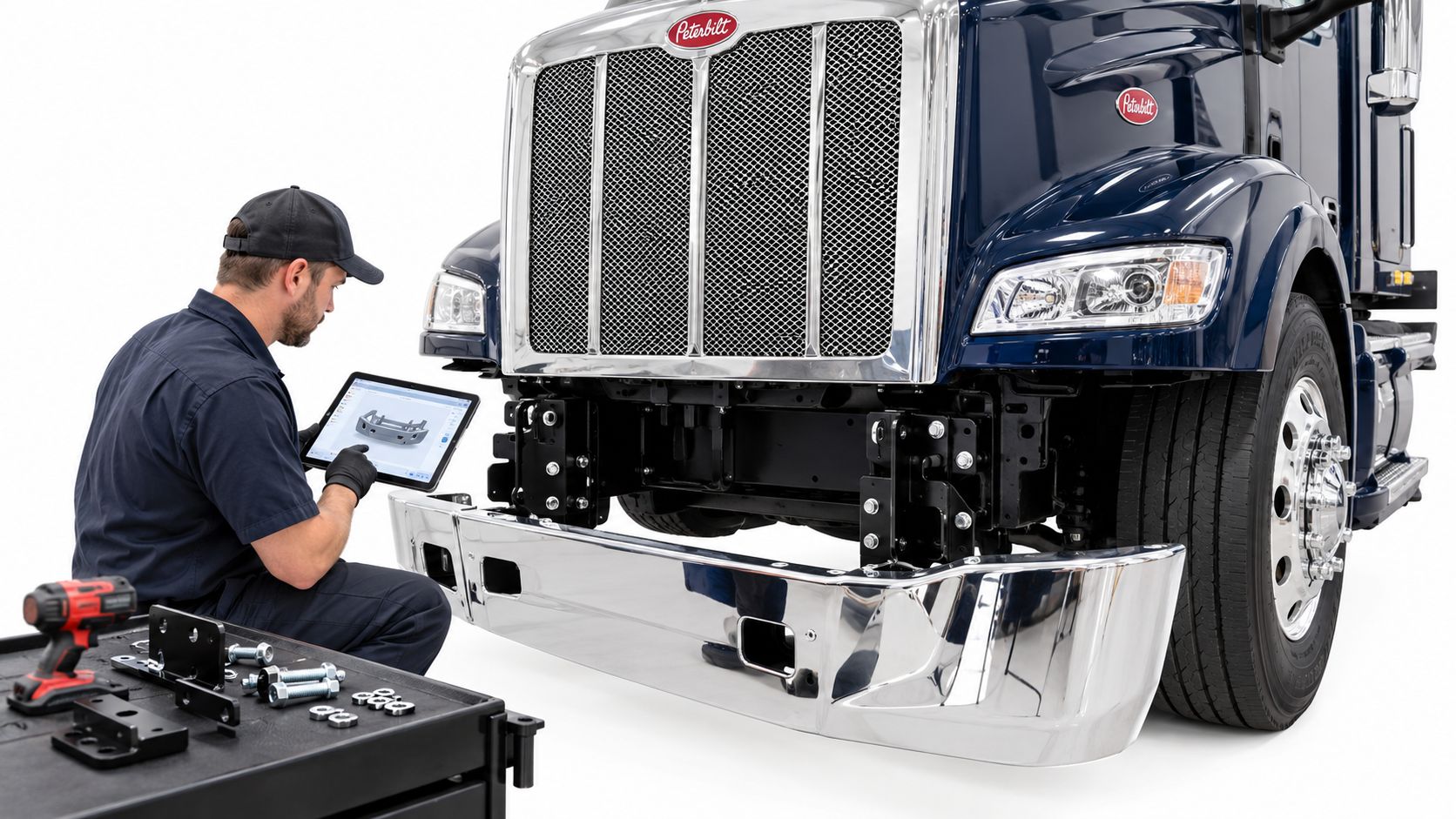
What a serious supplier should document
- Material: State whether the bumper uses chrome-plated carbon steel, 430 stainless, or 304 stainless.
- Construction: Provide thickness, reinforcement, bracket, cutout, and mount details.
- Installation: Identify direct bolt-on, minor-modification, or fabrication-required fitment.
- Finish: Explain the polishing and plating process instead of using only the word chrome.
- Support: Publish warranty coverage, returns instructions, freight procedures, and contact information.
- Compliance support: Help the fleet retain specifications, invoices, and installation records.
FMCSA requires carriers to systematically inspect, repair, and maintain commercial motor vehicles. Parts and accessories must remain in safe and proper operating condition, and additional accessories can't reduce operational safety, as described in the FMCSA new entrant regulations. A decorative bumper still needs secure mounting, sound structural interfaces, and proper inspection records.
The finishing process also deserves attention. A triple-layer chrome process with a stated nickel layer gives the buyer more useful information than a claim that the surface is merely premium. Ask how the supplier controls welds, polishing, plating, packaging, and final inspection. Fast shipping helps, but accurate fitment and documented construction prevent the expensive problems that fast shipping can't fix.
This short installation demonstration shows why a configured, direct-fit part can reduce unnecessary shop work:
Installation and Long-Term Care
A direct bolt-on bumper still needs careful installation. Park the truck on a level surface, support the part safely, and compare the new bumper with the old one before removing hardware. Check bracket alignment, frame condition, tow openings, sensor locations, and clearance around lights and body panels.
Use the manufacturer's torque guidance for mounting fasteners. Don't pull a misaligned bumper into place by over-tightening bolts. That can distort brackets, place stress on the frame horns, or leave the bumper sitting unevenly. After installation, check the bumper from the front and both sides, then inspect the mounting points again after the truck has seen normal road vibration.
Keep the finish working
Road salt and harsh chemicals attack finishes when they remain on the surface. Rinse the bumper with clean water after salt exposure, use a suitable truck-safe cleaner, and dry the surface rather than allowing contaminated water to evaporate on it. Avoid abrasive pads that can scratch polished stainless or chrome.
During preventive maintenance, inspect:
- Fasteners and brackets: Look for looseness, elongation, cracks, and shifted alignment.
- Edges and cutouts: Check for chips, peeling, rust bloom, and stress around openings.
- Lower surfaces: Inspect the drop and underside for impact damage and road debris.
- Frame interfaces: Look for corrosion or deformation where the bumper transfers load.
- Finish condition: Clean early signs of staining before they become pits or permanent dull spots.
A bumper's service life depends on more than gauge. Correct fit, sound mounting, suitable material, route exposure, and regular inspection all affect whether the part protects uptime or creates another repair. Choose the material for the truck's working environment, verify every dimension before ordering, and keep installation records for the fleet file.
Galhor Inc. offers configurable chrome bumpers for Peterbilt, Kenworth, Freightliner, and Volvo Class 8 trucks, with material, finish, cutout, and mounting options designed around direct-fit applications. Visit Galhor Inc. to compare bumper configurations, verify your truck details, and order a replacement built for long-haul use and real-world road conditions.