

Semi Truck Accessories Guide for Owner Operators and Fleets
A storm is moving across Texas, your Peterbilt 389 is pulling hard, and the front end is showing every mile of its working life. A damaged bumper, weak marker light, or loose step isn't just a cosmetic problem. It can create a safety issue, add inspection risk, and keep the truck parked while you wait for the right replacement.
The right semi truck accessories should serve a clear purpose. A bumper needs to protect the front end and resist corrosion. Lighting must improve visibility without creating fitment or compliance problems. Trim, steps, and aerodynamic parts should survive long hauls, weather, road debris, and repeated washing. For owner-operators and fleet managers, appearance matters, but uptime and total ownership cost matter more.
Table of Contents
- Introduction to Semi Truck Accessories
- Overview of Semi Truck Accessory Categories
- How to Choose Lighting and Trim
- How to Select Bumpers and Aerodynamic Kits
- Installation Considerations and Fitment
- Maintenance Best Practices and Material Choices
- Conclusion and Next Steps
Introduction to Semi Truck Accessories
A truck that looks sharp earns respect at the dock, but a truck that stays on the road earns money. That distinction matters when you're choosing accessories for a Peterbilt, Kenworth, Freightliner, or International.
Suppose a driver finds a broken step during a pre-trip inspection. The repair may be simple, but the truck still needs a safe replacement before the next run. A loose light or damaged bumper can create the same problem. Fleets face the added challenge of keeping replacement parts consistent across several trucks while limiting installation time.
Practical rule: Buy accessories for the conditions your truck actually faces, not only for the way it looks in a parking lot.
The aftermarket covers protection, lighting, storage, appearance, and efficiency. A direct-fit part can reduce fabrication work and shorten shop time. A properly selected stainless component can resist road salt and moisture better than a thin plated surface. A well-maintained lighting system helps other drivers see your truck during rain, darkness, and poor visibility.
Resale value also enters the decision. A clean, straight front bumper and complete trim package show that the truck has been maintained. They won't fix neglected mechanical systems, but they can support a professional presentation when it's time to sell or trade.
Overview of Semi Truck Accessory Categories
The global truck accessories market is valued at USD 6.86 billion in 2026 and is projected to reach USD 10.54 billion by 2035, with a 4.89% CAGR over that period, according to Business Research Insights' truck accessories market estimate. Semi truck accessories are part of that broader aftermarket ecosystem, which serves heavy-duty protection, utility, appearance, and performance needs.
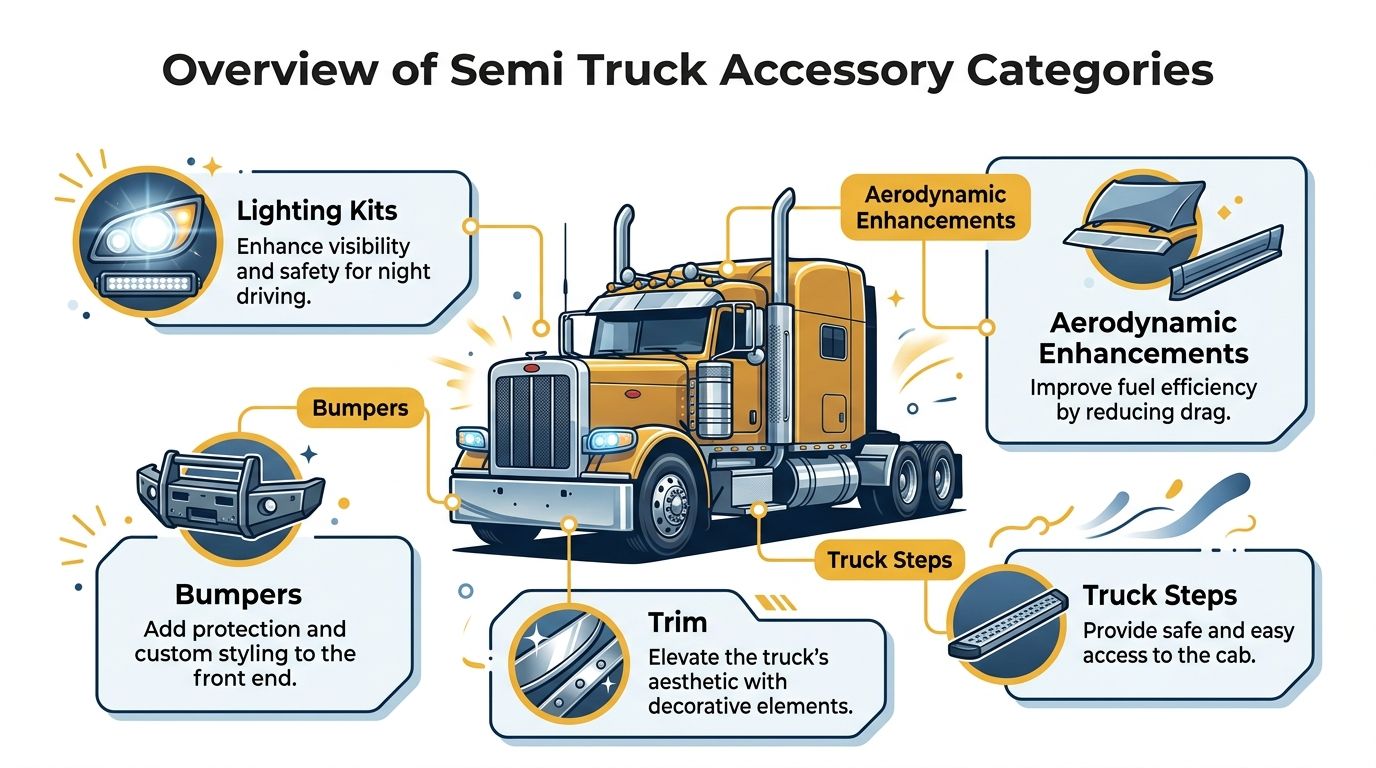
The main accessory groups
Bumpers take the most abuse at the front of the truck. Buyers compare carbon steel, chrome-plated stainless, and polished stainless based on impact protection, finish, thickness, and corrosion exposure. A Peterbilt 389 bumper or Kenworth W900 chrome bumper also has to match the truck's frame, grille, tow points, and light openings.
Lighting kits include marker lights, headlight assemblies, auxiliary lamps, and rear light bars. Good lighting improves visibility and helps other motorists understand the truck's position and movement. Poor wiring, weak seals, or incorrect mounting can turn an upgrade into a maintenance problem.
Trim adds a finished appearance around the grille, hood, cab, mirrors, and exhaust area. Chrome gives a bright traditional look. Polished stainless offers a durable metal finish, while blacked-out trim suits a more modern build.
Aerodynamic enhancements include air dams, side skirts, and related panels. They reduce exposed airflow around the tractor and trailer connection. The value is strongest for trucks that spend most of their time on highway routes.
Truck steps support safe cab access. A step should match the mounting location, carry repeated use, and resist flexing, corrosion, and damage from boots, ice, and road spray.
One product example is the Steel chrome bumper, made by Estañadora, the owner of Galhor, Inc. It uses 10-gauge chrome-plated steel, a mirror-polished finish, and a triple-layer hexavalent chrome process with 35 microns of nickel. The design supports direct bolt-on installation, with standard and blind mount options and no drilling or cutting required.
Owner-operator and fleet priorities
Owner-operators often balance personal style with repair cost. Fleets usually place more weight on repeatable fitment, parts availability, installation time, and consistent maintenance. Both groups benefit from choosing accessories by service conditions rather than catalog appearance alone.
How to Choose Lighting and Trim
Start with fitment. Confirm the truck's exact make, model, year, mounting style, grille design, and existing light openings before ordering. A light that looks right on a Freightliner Cascadia may not match a Peterbilt 389 harness, bracket, or grille layout.
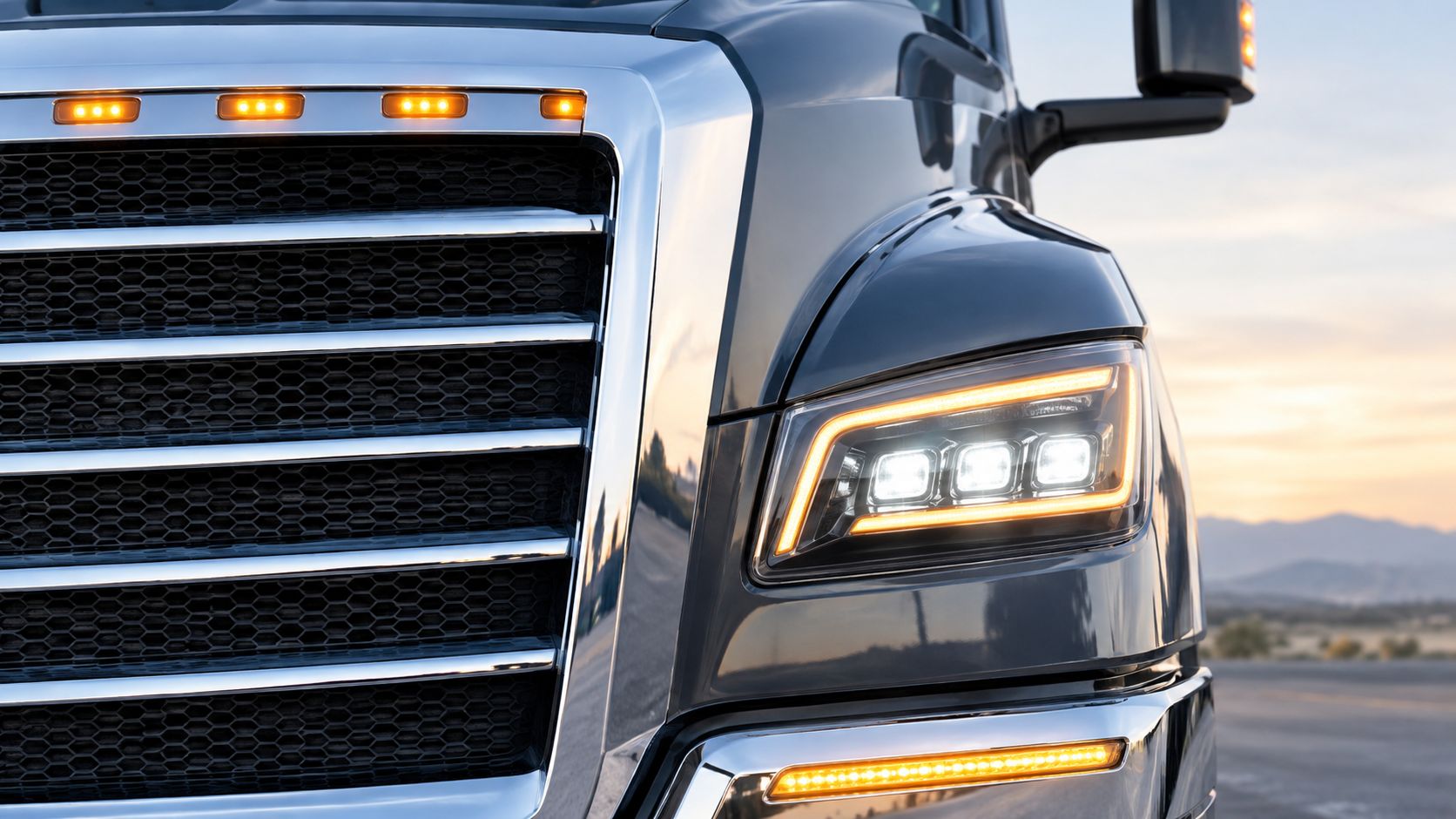
Build a lighting checklist
- Use case: Choose lighting for long-haul night driving, yard work, weather exposure, or appearance. A marker light package and a forward-facing auxiliary lamp solve different problems.
- Weather protection: Look for sealed housings and an appropriate IP rating when lights will face rain, wash bays, snow, and road spray. The rating should match the location, not just the marketing description.
- Electrical compatibility: Check voltage, connector style, polarity, wiring length, and fuse requirements. Poor connections often cause flickering, intermittent failures, and repeat service calls.
- Beam control: More light isn't automatically better. Aim lamps correctly and keep the beam from creating glare for oncoming traffic.
- Service access: Select housings that allow lens, bulb, or unit replacement without removing half the front end.
Trim needs the same discipline. Chrome works well for a classic show-truck appearance, but scratches and water spots are easy to see. Polished stainless can provide a strong exterior finish with less concern about a plated layer lifting from a damaged base. Black trim hides small marks better, though it may show dust and salt residue.
U.S. fleets prioritize installation reliability. Heavy-duty fitment guidance also stresses that grade-matched fasteners and correct hole patterns help prevent vibration loosening on assemblies exposed to road shock, as reflected in commercial vehicle inspection guidance from Alberta.
For rear visibility and layout ideas, review this practical guide to rear light bars for semi trucks.
Shipping also affects the purchase. In-stock parts can keep a truck moving, while made-to-order trim may require shop scheduling around production time. Ask whether the part is ready to ship, how it will be packed for freight, and whether replacement lenses or harnesses are easy to source.
Use the video below as a visual reference for front-end lighting and trim planning.
How to Select Bumpers and Aerodynamic Kits
A bumper is a working part, not a decoration. For a long-haul Peterbilt 389, Kenworth W900, Freightliner Cascadia, or International, the selection should start with material, construction, fitment, and corrosion exposure.
Chrome-plated carbon steel is often the practical choice when initial cost and traditional appearance lead the decision. It can deliver a bright finish, but the plated surface becomes vulnerable when chips, dents, or flexing damage the chrome. Stainless options cost more, yet they make more sense for trucks that run through road salt, wet regions, gravel roads, or frequent winter weather.
Typical chrome plating is only 2–4 thousandths of an inch thick, while stainless-clad bumper skins can be about 42 thousandths of an inch thick, according to Hendrickson's technical comparison of Class 8 bumper construction. When a rock chip or impact opens the plated layer, moisture can reach the base steel. The thicker stainless outer layer provides a larger barrier against rust initiation.
Compare the bumper choices
- Chrome-plated carbon steel: Strong and familiar, with a classic mirror finish. It's a sensible option for controlled corrosion exposure and appearance-focused builds, but damaged plating needs quick attention.
- Chrome-plated 430 stainless: A lower-cost stainless route with useful corrosion resistance. It fits buyers who want a chrome look with more protection than basic plated steel.
- Chrome-plated 304 stainless: The premium choice for harsh outdoor use. It costs more, but it offers better resistance where salt, moisture, and repeated exposure make replacement expensive.
Don't buy a drop bumper by style alone. An 18 inch drop bumper changes front-end appearance and may affect approach clearance, tow hardware, light cutouts, and parking-lot contact points. Verify the truck model, bumper height, mount style, tow-hook openings, fog-light cutouts, and grille relationship before ordering.
Aerodynamic kits deserve the same practical review. Air dams and side skirts can reduce exposed airflow, but they must match the tractor, trailer, ride height, and operating routes. A damaged panel that requires frequent repair can erase the value of a poorly chosen kit. Highway fleets should focus on secure mounting, replacement access, and a design that won't interfere with inspections or routine service.
For bumper design, material selection, cutouts, and fitment planning, use this semi truck bumper guide.
Buy for the route: Stainless earns its keep fastest where salt, water, gravel, and repeated impact make plated steel maintenance a regular expense.
Installation Considerations and Fitment
Direct bolt-on does not mean universal. The truck's year, model, grille, frame brackets, bumper height, light openings, and mount style all need to match the accessory.
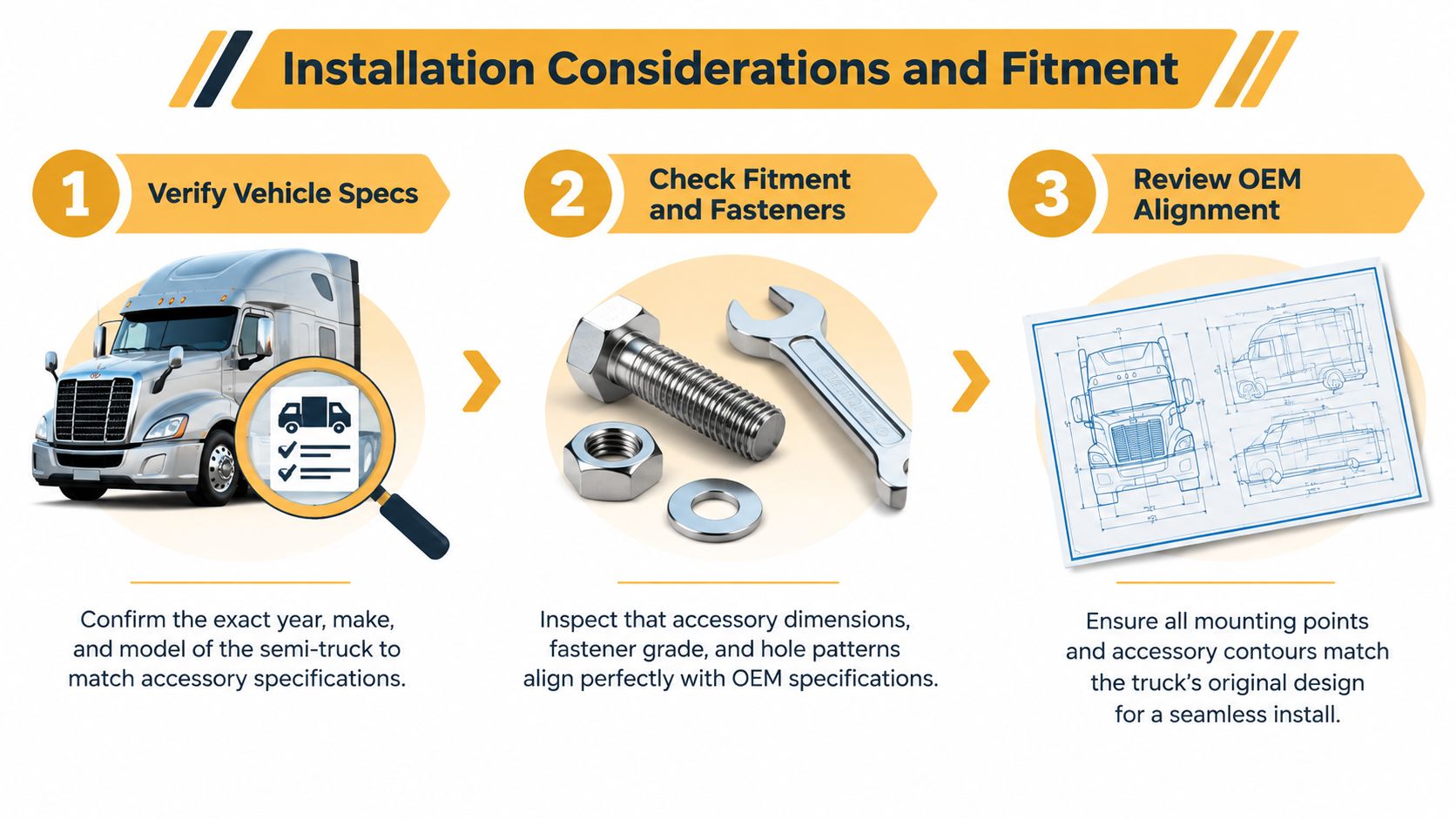
Follow the fitment process
- Verify vehicle details. Record the exact make, model, year, front-end configuration, and bumper mount. Don't rely on a broad label such as “fits Peterbilt.”
- Compare the hole pattern. Lay the replacement beside the original part when possible. Check mounting points, light cutouts, tow openings, and clearance around the grille and frame.
- Inspect fasteners. Use the correct bolt size, grade, washers, and locking method. Commercial vehicle inspection rules specify minimum bolt counts by size and material to help prevent loosening under heavy vibration and road shock.
- Prepare the mounting surface. Remove dirt, rust scale, damaged hardware, and burrs. A clean, flat surface supports even clamping.
- Align before tightening. Start every fastener by hand, support the bumper, and confirm the gaps before final tightening. Follow the manufacturer's torque instructions rather than guessing.
Mixed-metal contact needs attention. Stainless, chrome-plated steel, carbon steel, and aluminum can react differently in moisture, especially when road salt sits between surfaces. Use compatible washers, isolate dissimilar metals where the installation design calls for it, and seal exposed areas without trapping water.
Fleet shops should document the fitment and fastener setup after installation. That record helps the next technician order the same configuration and reduces re-work across similar units. Owner-operators should keep the model, mount, cutout, and material information with the truck's service records.
This truck accessories installation guide provides additional planning points for direct-fit accessory work.
Maintenance Best Practices and Material Choices
Material determines how much maintenance a bumper or trim piece will demand. Carbon steel depends heavily on intact plating and prompt repair after damage. Grade 430 stainless offers a cost-focused middle path, while grade 304 is the better choice for wet, salty, and high-abrasion routes.
Type 304 stainless contains about 18% chromium and 8% nickel, while type 430 contains about 16% chromium and no nickel, according to this 430 stainless steel material reference. The nickel in 304 supports stronger corrosion resistance in outdoor exposure. Industry guidance also identifies 304 as the stronger option for harsh environments and 430 as a better fit for drier, milder conditions, as explained in this 304 versus 430 stainless comparison.
Material Comparison for Bumpers and Trim
| Material | Composition | Corrosion Resistance | Typical Lifespan | Cost Factor |
|---|---|---|---|---|
| Chrome-plated carbon steel | Carbon steel with plated chrome surface | Depends on intact plating, vulnerable at chips and dents | Route and damage dependent | Lower initial cost |
| 430 stainless | About 16% chromium, no nickel | Moderate, can show surface rust in humid or chloride-rich exposure | About 6–18 months before visible corrosion in harsh outdoor conditions | Lower than 304 |
| 304 stainless | About 18% chromium and 8% nickel | Strong resistance to moisture, salt, oxidation, and outdoor corrosion | Roughly 2–5 years before visible corrosion in harsh outdoor conditions | Premium |
The lifespan comparison comes from technical material testing guidance on 430 and 304 stainless. Supplier guidance places 430 at approximately 20–30% cheaper than 304 because it uses little or no nickel, as described in this 430 stainless steel cost guide.
Clean chrome and stainless with mild soap, clean water, and a soft cloth. Remove salt and road film before they dry onto the surface. Inspect seams, bolt areas, light cutouts, lower edges, and behind brackets for trapped moisture or corrosion.
Don't polish over damage and call the job finished. Repair exposed steel, replace rusted hardware, and check mounting points during regular service. A few minutes of inspection can prevent a loose bumper, failed trim bracket, or expensive replacement during a dispatch window.
Conclusion and Next Steps
Choose semi truck accessories by route, truck model, material, fitment, finish, and service access. Stainless usually makes more sense in harsh corrosion conditions, while chrome-plated carbon steel can suit controlled exposure and appearance-led builds. Confirm the hole pattern and fasteners before installation, then keep the surface clean and inspect damage early.
Galhor's 3D configurator supports direct bolt-on bumper selection by brand, model, year, style, cutouts, and finish. In-stock stainless options can ship within 48 hours, while made-to-order carbon steel units typically ship in 4–6 weeks, with Texas-based support in Magnolia.
Galhor Inc. offers configurable direct bolt-on bumpers for Peterbilt, Kenworth, Freightliner, and Volvo Class 8 trucks, with chrome-plated carbon steel, 430 stainless, and 304 stainless options. Visit Galhor Inc. to match your truck, finish, cutouts, and shipping needs, then upgrade your truck today with a bumper built for long-haul use.