

Semi Truck Body Parts Guide for Class 8 Owners
You're sitting at a yard with a cracked fender, a bent bumper bracket, and a load that needs to roll tonight. The truck still starts, but the wrong semi truck body parts can turn a simple repair into missed dispatch time, poor visibility, water intrusion, or a second trip to the parts counter.
The right replacement starts with function, not shine. A bumper, cab mount, or reinforcement bar carries load or supports the cab. A hood, fender skin, fairing, or grille surround may protect components and manage airflow, but it usually isn't a structural repair. This guide helps owner-operators, fleet managers, and truck enthusiasts sort those parts by job, fitment, material, finish, and bolt-on path before ordering for a Peterbilt, Kenworth, Freightliner, International, Volvo, Mack, or another Class 8 truck.
Table of Contents
- What Every Owner-Operator Should Know About Semi Truck Body Parts
- Main Categories of Semi Truck Body Parts Explained
- Cab Panels, Fenders, and Hood Components
- Bumpers, Reinforcement Bars, and Tow Hooks
- Fairings, Cab Mounts, Mirrors, and Grilles
- Material Choices for Chrome and Stainless Body Parts
- Bolt-On Replacement and Installation Tips
- Why Direct Bolt-On Configured Parts Reduce Downtime
- Quick-Reference Fitment Table for Class 8 Body Parts
- Buying Checklist for Long-Term Durability and ROI
- Frequently Asked Questions About Semi Truck Body Parts
What Every Owner-Operator Should Know About Semi Truck Body Parts
A driver usually notices body damage in the worst place, a crowded yard, a fuel island, or the shoulder. A cracked fiberglass fender may have started with road debris. A bent bumper bracket may trace back to a dock rub or a minor impact. Winter salt can attack the underside long after the original damage is forgotten.
Those failures matter for more than appearance. Broken panels can expose wiring, reduce mirror or lamp visibility, and let corrosion move into mounting points. A crooked hood or loose fairing can also affect airflow and create more vibration in the cab. Professional heavy-duty body repair focuses on both appearance and structural integrity because body damage can affect corrosion resistance, resale value, aerodynamics, and compliance concerns, as described by Four Star Freightliner's heavy-duty paint and body service guidance.
Separate load-carrying parts from body shells
Use this basic split at the parts counter:
- Structural parts: Bumpers, reinforcement bars, tow-hook supports, and cab mounts transfer or support loads. Damage to these parts needs careful inspection, not filler or cosmetic cover-up.
- Exterior shells: Hoods, fender panels, sleeper skins, grille surrounds, and fairings shape the truck and shield working components. They may bolt on, but some assemblies also use rivets, adhesives, or bonded joints.
- Visibility and access parts: Mirrors, steps, handholds, and light openings affect safe operation and daily comfort.
Practical rule: If a part carries recovery force, supports the cab, or connects directly to the frame, treat it as structural until a qualified technician proves otherwise.
A replacement panel can protect resale value and restore a professional fleet appearance. It can't straighten a bent frame bracket or replace a cracked reinforcement. Knowing that difference keeps you from paying for a polished surface while leaving the problem underneath.
Main Categories of Semi Truck Body Parts Explained
A Class 8 truck's exterior makes more sense when you sort it into working families. That approach helps you identify the correct replacement before comparing a Peterbilt 389 bumper, a Kenworth W900 chrome bumper, or an 18 inch drop bumper.
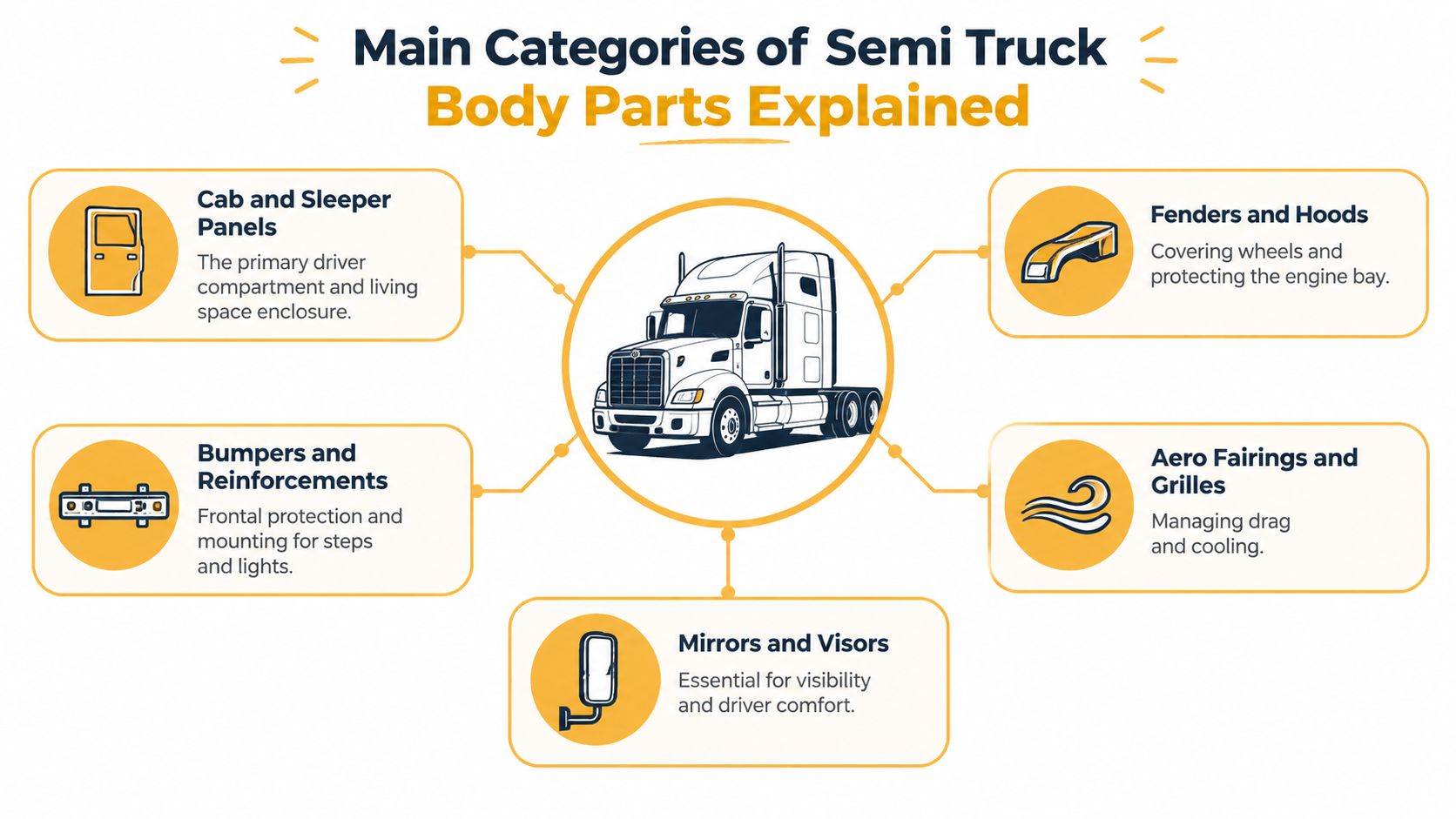
The five shop categories
| Part family | Main job | Common service problem |
|---|---|---|
| Cab and sleeper panels | Enclose the driver area and living space | Cracks, dents, loose seams, and water entry |
| Fenders and hoods | Cover wheels and protect the engine bay | Fiberglass damage, broken brackets, hood misalignment |
| Bumpers and reinforcements | Protect the front end and transfer impact loads | Bent face bars, cracked mounts, corrosion, stretched holes |
| Aero fairings and grilles | Manage airflow and direct cooling air | Missing hardware, damaged edges, blocked airflow |
| Mirrors and brackets | Provide rear and side visibility | Loose housings, broken tabs, failed heaters, wrong bases |
Most bumpers, mirror assemblies, grille surrounds, and cab-mount components are service parts designed for replacement. A direct bolt-on unit uses the intended mounting pattern. Fairings and cab panels may need more care because previous repairs can enlarge holes, distort the cab, or leave behind rivets and adhesive.
The North American heavy-duty parts market shows how specialized this category has become. One marketplace lists more than 500,000 heavy-duty truck parts, with 77,827 cab, body, and interior listings, including 580 cab mounts, 770 cab fairings, 6,649 cab assemblies, 5,840 door assemblies, and 553 cab exterior panels in its catalog, as shown by Tristan Fleet's cab and body inventory. Those listings don't mean every part fits every truck. They do show why model, year, cab length, mounting style, and options must be confirmed before purchase.
Cab Panels, Fenders, and Hood Components
Start with the truck's identity before you price a hood or fender. The same badge can cover different mounting patterns, cab lengths, and production changes. A Peterbilt 379 hood isn't automatically a Peterbilt 389 hood, and a Volvo VNL panel may change with the truck generation.
Match the shell to the truck
Check these details before removing the damaged part:
- Peterbilt: Compare 379 and 389 hood bolt patterns, grille shape, hinge locations, and light openings. A close-looking hood can still require drilling.
- Kenworth: T600, T660, and T680 fender bracket spacing and hood hardware can differ. Photograph the brackets before ordering.
- Freightliner: Cascadia sleeper panels can change between 125th and 126th production. Confirm the sleeper configuration, not just “Cascadia.”
- Volvo: VNL generation breaks can affect hood edges, grille surrounds, fender supports, and lamp openings.
Fenders come as full, half, single, or axle-specific designs. A “universal” fender often means extra drilling, spacers, or bracket work. That may make sense for a custom build, but it isn't the same as a configured replacement that uses the existing holes.
Material changes the repair plan. Fiberglass is light and can be repaired when the damage is limited, but cracked mounting areas need proper reinforcement. SMC panels have different repair requirements and may resist ordinary fiberglass methods. Aluminum reduces weight and won't rust like steel, but it can crease, distort, and require specialized repair. Ask whether the hood or panel arrives painted, color matched, or primed only. A primed panel still needs preparation and paint work.
Replace one panel or the whole side
A single cracked cab corner or battery box cover can be the sensible repair when adjacent panels are straight and the paint can be matched. Replace a complete side when several panels have fading, mismatched repairs, or damaged mounting flanges. The second option costs more up front, but it may produce a cleaner professional appearance and protect resale value.
For full fender planning, review this practical guide to designing full fenders for a semi. Measure first, confirm the cab and hood identifiers, then compare the part's material, finish, and included brackets before you place the order.
Bumpers, Reinforcement Bars, and Tow Hooks
A semi truck bumper is a working assembly, not just a polished face bar. It protects the radiator support, headlights, hood latches, steering components, and front sheet metal. It may also carry steps, handholds, license-plate lamps, fog lights, tow eyes, and grille guards.
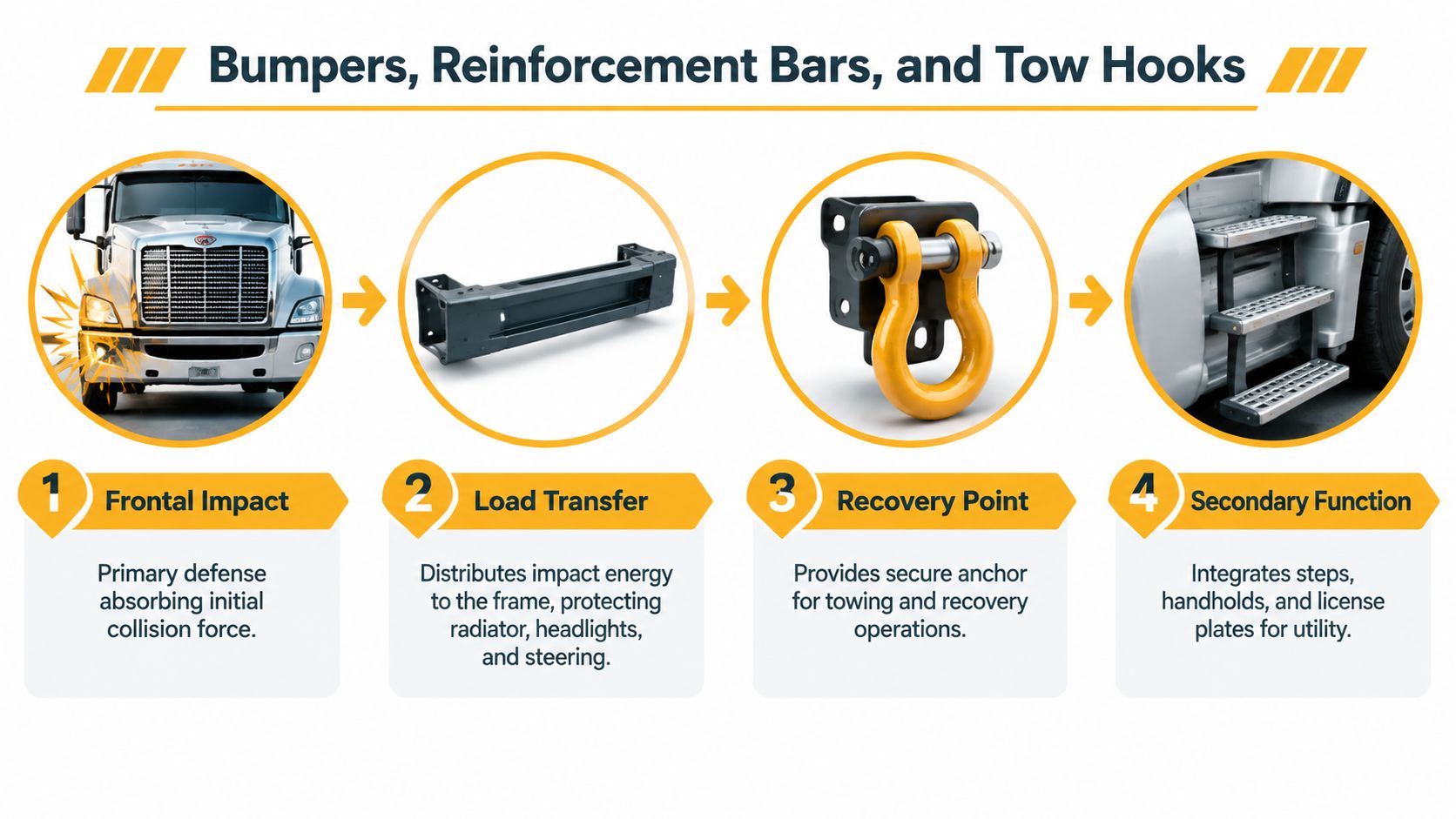
Before ordering a Peterbilt 389 bumper, Kenworth W900 chrome bumper, Freightliner bumper, or 18 inch drop bumper, record:
- Truck make, model, year, and cab configuration.
- Bumper shape, height, mount style, and mounting-hole pattern.
- Light openings, fog-light cutouts, sensors, and license-plate provisions.
- Whether the original assembly is one piece or two piece.
- Bracket design and reinforcement-bar condition.
The reinforcement must match the face bar and frame brackets. Two bumpers can look identical from the front while transferring impact or recovery loads differently. Inspect gauge, bends, welds, corrosion, cracks around tow-hook pockets, and captive nuts. Tow hooks and D-rings need a rating suitable for the intended recovery load. Pin diameter alone doesn't prove capacity.
Before final torque: Test-fit the reinforcement, confirm bracket alignment, and inspect the frame rails for stretched holes. A new bumper won't correct a bent support.
Bracket design can change between chassis configurations, including trucks built for an 18 inch bumper and those built for a 24 inch bumper. Check air-cooled and non-air-cooled applications where the bracket package differs. For a configured option, the Steel chrome bumper uses 10-gauge chrome-plated steel, a mirror-polished finish, direct bolt-on installation, and a triple-layer hexavalent chrome process with 35 microns of nickel. Standard and blind mounts are available, with no drilling or cutting required according to the product information.
Use the bumper and tow-hook design guide to compare recovery-point and mounting needs before ordering.
A cosmetic bumper should never hide a cracked structural support. Replace or repair the reinforcement first, then verify light connectors, parking sensors, hood clearance, and panel gaps.
Fairings, Cab Mounts, Mirrors, and Grilles
The parts around the cab do four different jobs, and fitment errors show up quickly. A fairing can disturb airflow or leave a sleeper gap exposed. A cab mount can change cab height and vibration. A mirror can leave a driver with the wrong view. A grille can look correct while restricting cooling air.
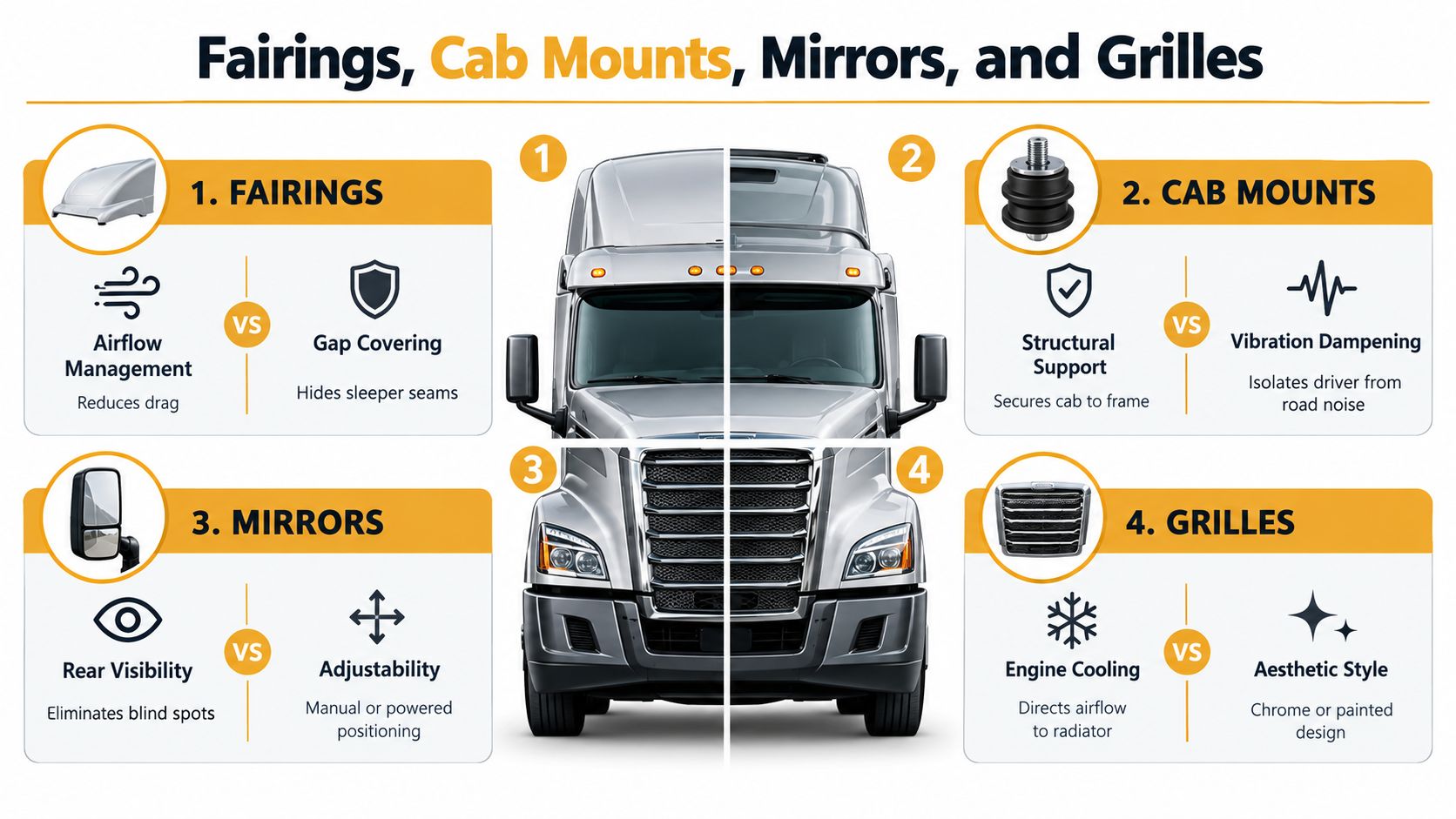
Confirm the hidden fitment points
Roof and side fairings may cover sleeper seams, visor supports, antenna mounts, and clearance-light wiring. Check sleeper length, roof shape, mounting-hole condition, and whether the replacement is intended for the same aerodynamic package. An old cab roof with enlarged holes may need repair before a new fairing can sit flat.
Cab mounts are different. Upper mounts hold the cab, while rubber, spring, or air elements control movement and vibration. Use the complete mount assembly and the correct retainers for the truck's suspension and cab height. Don't substitute a mount because the bolt pattern looks close.
Mirror fitment includes more than the housing. Match the door cutout, mounting base, heater circuit, power-adjustment harness, and remote wiring. A mismatched housing can break tabs, loosen the door, or pinch wires when the mirror is adjusted.
Grilles need to align with hood and fender gaps while leaving the radiator and charge-air cooler unobstructed. Confirm whether the assembly includes the surround, insect screen, emblem provisions, and headlight wiring. Year changes on Peterbilt, Kenworth, Freightliner, International, and Volvo trucks can move small brackets or connector locations.
Before removal, photograph every mount and connector. Label the harnesses, install the grille loosely, check hood clearance, and tighten fasteners only after the gaps are even.
Material Choices for Chrome and Stainless Body Parts
Choose the substrate for the work the part performs. Chrome-plated carbon steel, 430 stainless, and 304 stainless can all make sense, but they handle corrosion, impact, cost, and repair differently.
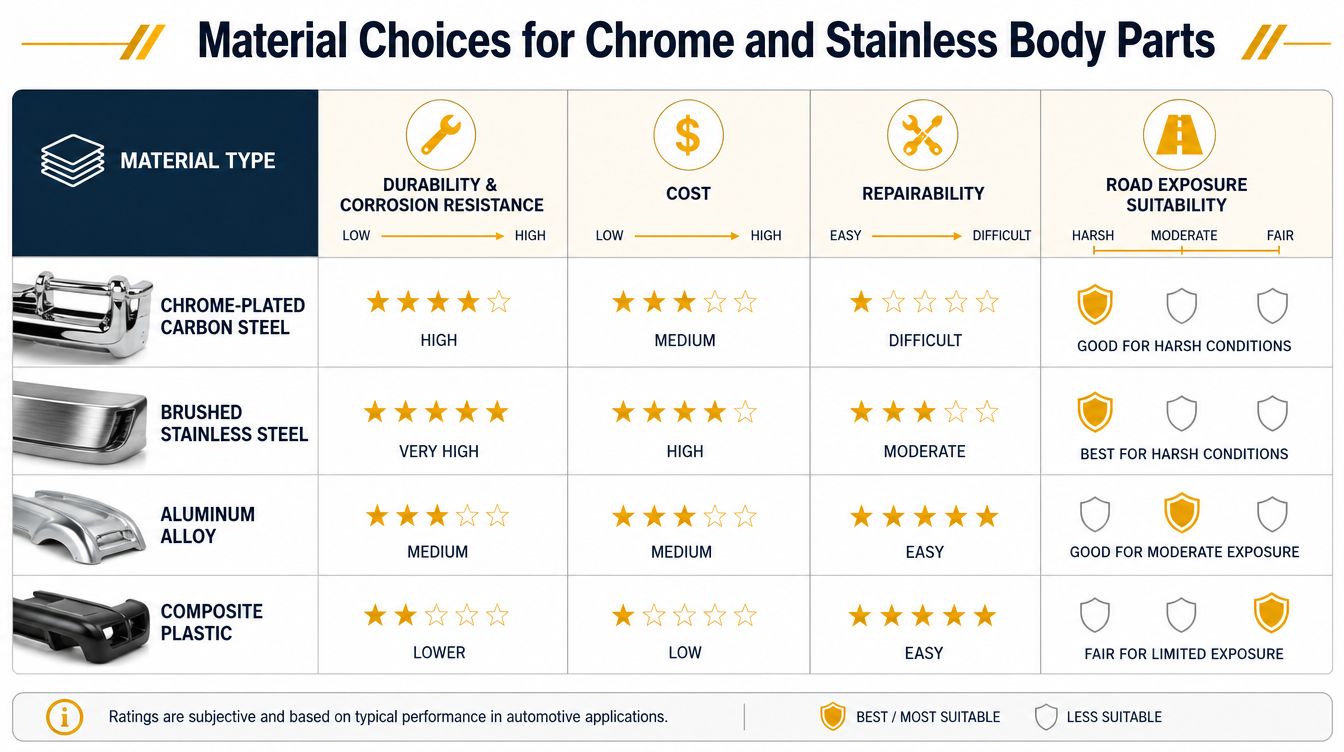
| Material | Where it works well | Main trade-off |
|---|---|---|
| Chrome-plated carbon steel | Bumpers, supports, brackets, and appearance-focused builds | Salt and chips can let corrosion move under plating |
| 430 stainless steel | Trim, formed panels, grilles, mirrors, and many bumper applications | Better than plated steel in many conditions, but still needs cleaning |
| 304 stainless steel | Polished bumpers, hardware, brackets, and severe winter exposure | Higher cost and regular polishing requirements |
Chrome-plated carbon steel carries load through the steel. The chrome supplies the visible finish and some surface protection. Once a stone chip or deep scratch exposes the substrate, moisture can work under the plating. Cleaning contamination promptly helps, but touch-up won't restore a damaged plating system.
430 stainless steel is a practical exterior material because it resists corrosion from atmosphere, fresh water, steam, and many petroleum products. Its resistance to chloride stress-corrosion cracking at high temperatures is superior to austenitic 304 and 316 in the cited material information, making it a strong fit for some chrome bumper applications, as described in this 430 stainless steel technical sheet.
304 stainless steel offers stronger corrosion resistance and ductility, which can justify the added cost on northern routes, salted roads, and exposed hardware. It isn't maintenance-free. Road film, chemicals, heat, deep scratches, and impact can still discolor or distort a polished part.
Plating thickness matters too. Finishing guidance recommends a total nickel deposit of at least 0.0005 inches, or 0.5 mils, about 12.7 microns, as explained in this nickel and chrome finishing guide. Another nickel-chromium plating specification lists total coating thicknesses of 20.25 µm and 25.25 µm for specified finishes, with chromium thickness requirements in the stated ranges.
For heavy exposure, construction also matters. A Hendrickson bumper material guide describes a stainless-clad bumper using 42-thousandths-of-an-inch stainless outer material, while a typical chrome-plated bumper's chrome layer is only two to four-thousandths of an inch. That is why clad stainless provides more rust protection than decorative plating alone.
For commercial applications, corrosion testing also matters. SAE J2721 guidance addresses corrosion test methods for metallic components and assemblies used on medium trucks, heavy trucks, buses, and trailers. Ask about substrate, coating, welds, fasteners, and test validation, not just mirror shine. A practical chrome and stainless comparison is also available in this guide to semi truck chrome parts.
Bolt-On Replacement and Installation Tips
A clean bolt-on replacement still needs a controlled installation. On a Class 8 day cab, park on level ground, set the brakes, disconnect the batteries, and protect the front harnesses before removing the grille or bumper.
A practical bumper swap
- Document the old assembly. Photograph bracket positions, harness routing, light connectors, sensor locations, and shims.
- Remove access panels. Disconnect grille and headlight harnesses before unbolting the bumper.
- Use suitable tools. A 3/4-inch drive impact with deep 15/16 and 1-1/8 sockets handles common main bracket hardware. A long pry bar can help shift the reinforcement from alignment dowels.
- Inspect before installation. Check frame rails, captive nuts, brackets, welds, and reinforcement alignment. Don't install over stretched holes or bent supports.
- Set the brackets first. Use the truck or component manufacturer's torque specification. The correct value depends on bracket design, bolt grade, and application.
- Fit the face bar loosely. Center it, check hood clearance, align the gaps, and route wiring away from sharp edges.
- Torque in sequence. Tighten the main hardware evenly. Chrome trim bolts need much less torque than structural fasteners, and over-tightening can crack stainless filler panels.
- Finish the electrical check. Test headlights, fog lamps, marker lights, parking sensors, and license-plate lamps. Check headlight aim after reassembly.
Use anti-seize where appropriate on stainless hardware, but don't let it contaminate friction surfaces or replace the specified locking method. A 50-mile road test can reveal panel movement, bracket seating problems, rattles, or changing gaps before the truck returns to full service.
Shop habit: Tighten the part only after the hood, grille, lights, and bumper agree with one another. A perfect bumper position can still be wrong if the hood won't clear it.
Why Direct Bolt-On Configured Parts Reduce Downtime
Universal-fit parts look affordable until the truck is on the lift. The shop may need to drill new holes, shim brackets, modify harness connectors, repaint a mismatched panel, or cut around a light opening. Each adjustment creates another place for movement, corrosion, wiring damage, or fitment complaints.
A configured part is built around a specific truck identity. The correct bracket geometry, pre-drilled holes, connector style, hardware, and cutouts reduce guesswork for a Peterbilt 379, Kenworth W900, Freightliner Cascadia, or Volvo VNL. The technician removes the old part, checks the underlying supports, installs the replacement, and torques it to specification.
What direct fitment protects
- Uptime: Fewer fabrication steps mean less time with the truck in the bay.
- Installation quality: Factory-style holes and brackets reduce stress on panels and fasteners.
- Warranty clarity: A part installed as designed is easier to inspect if a problem appears.
- Corrosion control: Correct seams and fasteners reduce exposed gaps where salt and water collect.
- Resale value: Straight gaps, matching finish, and proper hardware make the truck look maintained.
Universal brackets still have a place on custom builds or trucks with heavily modified frames. They don't make sense when the truck is a standard configuration and a direct-fit assembly is available. For an owner-operator, the cheapest invoice isn't always the lowest total cost. The better comparison is part price plus fabrication, paint, wiring, rework, and lost earning time.
Quick-Reference Fitment Table for Class 8 Body Parts
Use this table as a starting point, not as a substitute for VIN, cab, sleeper, and bracket verification. Model families can contain production changes, and a direct-fit part must match the truck's actual configuration.
| Body Part | Compatible Models | Year Range | Material Option |
|---|---|---|---|
| Front bumpers | Peterbilt 379, 389, 579; Kenworth W900, T680, T880; Freightliner Cascadia, Columbia, Coronado; Volvo VNL, VNX | Confirm by model year and mount style | Chrome-plated carbon steel, 430 stainless, 304 stainless |
| Hood assemblies | Peterbilt 379, 389, 579; Kenworth W900, T680, T880; Freightliner Cascadia, Columbia, Coronado; Volvo VNL, VNX | Confirm hood generation and hinges | Fiberglass, SMC, aluminum |
| Cab panels | Peterbilt, Kenworth, Freightliner, Volvo, Mack, International | Confirm cab and production break | Steel, aluminum, composite |
| Sleeper panels | Peterbilt 379, 389, 579; Kenworth T680, T880; Freightliner Cascadia; Volvo VNL; Mack Anthem, Pinnacle | Confirm sleeper length and generation | Composite, aluminum, steel |
| Fenders | Peterbilt, Kenworth, Freightliner, Volvo, Mack, International | Confirm bracket spacing and axle layout | Fiberglass, SMC, aluminum |
| Fairings | Peterbilt, Kenworth, Freightliner Cascadia, Volvo VNL | Confirm roof, sleeper, and aero package | Composite, fiberglass, aluminum |
| Cab mounts | Peterbilt, Kenworth, Freightliner, Volvo, Mack, International | Confirm suspension and cab height | Steel mount with rubber, spring, or air element |
| Mirrors | Peterbilt, Kenworth, Freightliner, Volvo, Mack, International | Confirm door cutout and wiring | Plastic housing, steel or aluminum bracket |
| Grilles | Peterbilt, Kenworth, Freightliner, Volvo, Mack, International | Confirm hood and headlight generation | Chrome-plated steel, stainless, aluminum, composite |
Ask the vendor to confirm whether the part is direct fit, what hardware is included, and which finish is stocked for your exact model.
Buying Checklist for Long-Term Durability and ROI
A durable purchase starts before you open the catalog. Gather the VIN, cab number, model year, sleeper length, bumper height, mount style, and photos of the existing brackets. For hoods and fenders, record hinge locations, bolt spacing, grille shape, and light openings.
Then check the part itself:
- Fitment: Confirm the year, model, cab configuration, bracket pattern, cutouts, and mount type.
- Material: Consider 304 stainless for severe salt exposure, 430 stainless for selected exterior applications, and chrome-plated carbon steel where load, appearance, and purchase cost fit the job.
- Construction: Inspect gauge, formed edges, weld seams, reinforcement, captive nuts, and fastener material.
- Finish: Look for even plating or polish, clean edges, protected mounting seams, and no visible chips or dull areas.
- Shipping: Choose a vendor that can confirm stock, production timing, freight method, packaging, and damage-claim steps before payment.
- Support: Get written warranty terms and a clear return process for a misidentified or damaged part.
A well-fitted bumper or panel protects more than the truck's appearance. It reduces rework, supports resale value, and helps keep the truck earning. Fast shipping matters, but accurate shipping matters more. A part that arrives quickly and doesn't fit still costs a workday.
Frequently Asked Questions About Semi Truck Body Parts
Which bumper fits a 2018 Peterbilt 579 or a 2021 Kenworth T680?
Don't order from the model name alone. Confirm the year, cab configuration, bumper height, mount style, hole pattern, light openings, and reinforcement brackets. A configured Peterbilt 579 bumper and Kenworth T680 bumper should be listed separately unless the supplier verifies the exact application.
Does chrome-plated steel hold up better than 304 stainless in road salt?
No material is maintenance-free. Chrome-plated steel can work well when the plating stays intact and the truck is cleaned, while 304 stainless generally gives more corrosion resistance for severe salt exposure. Compare the substrate, coating system, thickness, welds, and hardware.
How do I confirm hood and fender fitment?
Use the cab number, VIN, model year, hood generation, hinge locations, bracket spacing, axle position, and clear photos. Ask for a direct-fit confirmation before ordering a fiberglass, SMC, or aluminum replacement.
Can Cascadia and Mack Anthem mirrors or fairings interchange?
Assume they don't unless the door cutout, mounting base, wiring, sleeper length, roof shape, and bracket locations match. Small generation changes can make a visually similar part wrong.
Do universal brackets make sense?
They can suit custom trucks or modified frames. For a standard Class 8 truck, direct bolt-on brackets usually reduce drilling, rewiring, shimming, and return risk.
Galhor Inc. offers configurable, direct bolt-on chrome bumpers for Peterbilt, Kenworth, Freightliner, and Volvo Class 8 trucks, with chrome-plated carbon steel, 430 stainless, and 304 stainless options. Visit Galhor Inc. to verify your truck's fitment, finish, mounting style, and shipping path before you order.