

Semi Truck Exterior Accessories: A Buyer's Guide
You've just finished a winter run and the truck is wearing the route. Slush is packed behind the bumper, salt has dulled the lower trim, and one mirror is still carrying ice from the last pass through the Midwest. The right accessories made the trip easier. The wrong ones became another maintenance bill.
That's why semi truck exterior accessories deserve more than a style-first decision. A bumper, mirror, visor, light, or fairing has to fit the truck, survive the route, and justify its place in your cost per mile. For Peterbilt, Kenworth, Freightliner, and International owners, the cleanest-looking part isn't always the part that delivers the best return.
Table of Contents
- Why Exterior Accessories Matter for Class 8 Trucks
- The Main Types of Semi Truck Exterior Accessories
- Stainless Steel vs Chrome Plating vs Carbon Steel
- Aerodynamics, Fuel Economy, and Highway Performance
- Matching Accessories to Owner-Operator and Fleet Needs
- Fitment, Installation, and Regulatory Basics
- How to Choose the Right Accessories and Order with Confidence
Why Exterior Accessories Matter for Class 8 Trucks
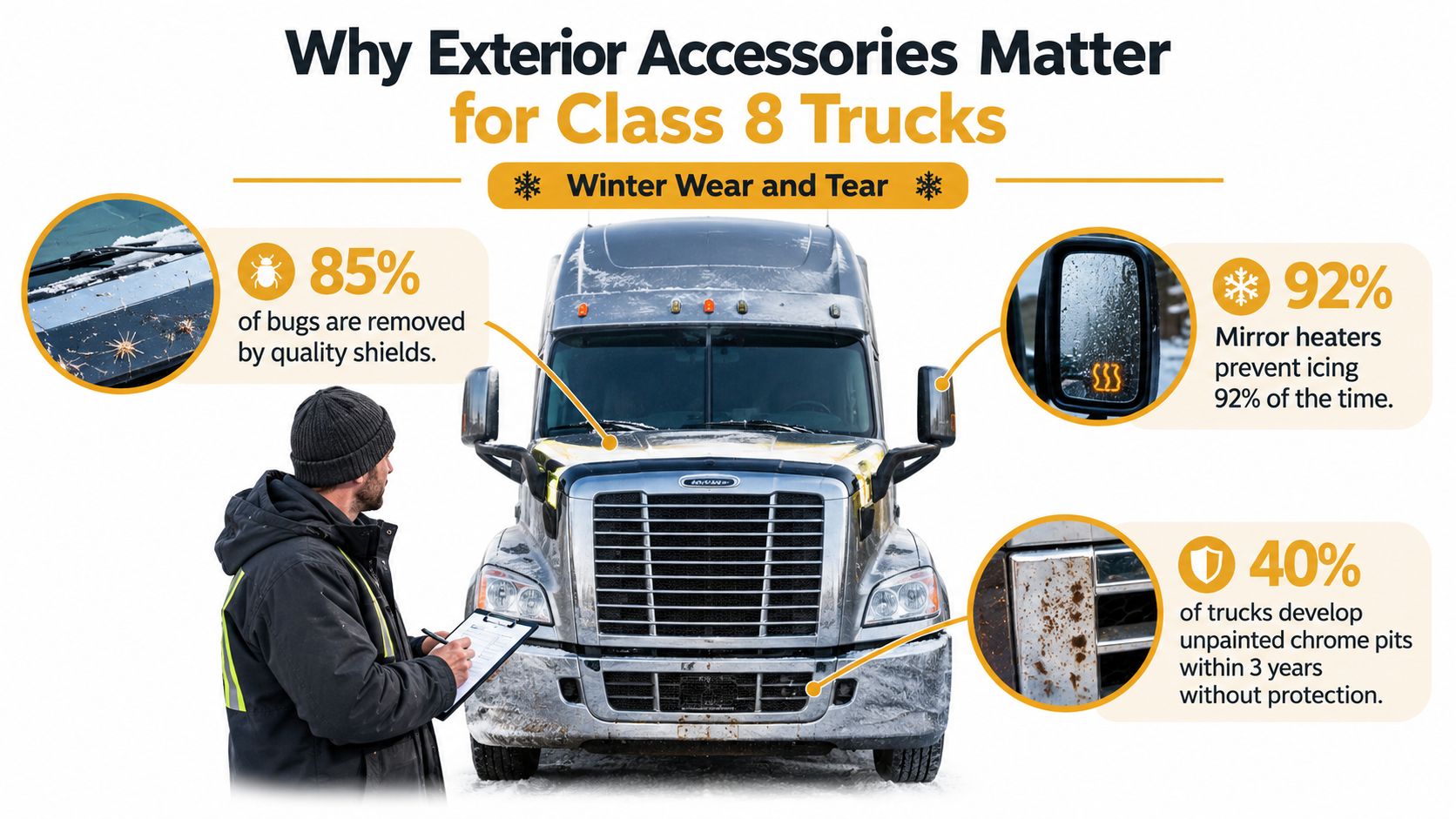
A driver walking the lot after a hard winter run can usually spot the winners without opening the hood. A good bug shield has kept the windshield and paint cleaner. Heated mirrors are clear enough to use. The bumper still has a straight face instead of bent brackets and peeling plating. The mudflaps have taken the rock spray instead of letting it hammer the trailer and frame.
That inspection tells you more than a showroom display. Exterior parts either protect uptime or create another repair job. A bumper can protect lighting and front-end components from road debris. Proper mudflaps can reduce spray and rock damage. A well-fitted visor can help with glare and chips, but a poorly designed one can add drag or create mounting trouble.
Style has a cost
Truck customization has been part of American trucking culture for generations. The industry traces back to the 1930s, and SEMA reported that truck enthusiasts spent $6.94 billion on aesthetic accessories in 2006, while total specialty and performance accessory spending reached $11.95 billion. Those figures show that exterior styling became a major commercial category, not a small hobby, as documented in this history of truck accessories.
Chrome also has a long connection to truck appearance. An industry study found that 56% of drivers believed bright products improve a vehicle's appearance, while 45% wanted manufacturers to use more chrome trim, according to the cited chrome appearance study. That explains the appeal of polished bumpers, grille trim, light bezels, and wheel accents. It doesn't answer whether a part will survive your route.
Shop rule: Buy exterior parts by route, material, fitment, and service access. Appearance comes after those four checks.
Road salt, coastal air, acid wash chemicals, gravel, and repeated loading-yard contact expose weak finishes quickly. A polished 304 stainless bumper may cost more than chrome-plated carbon steel, but corrosion resistance can matter more than the purchase price when replacement means downtime. The same logic applies to mirrors and aerodynamic parts. A mirror shape that looks sharp but increases drag can raise operating cost at highway speed.
The Main Types of Semi Truck Exterior Accessories
Start with the part that takes the first hit. Bumpers come in standard, set-back, tow, and deck-plate styles. Match the bumper to the truck's frame, tow-hole layout, fog-light openings, mounting style, and front-end configuration. A Peterbilt 389 bumper won't fit a Peterbilt 579 just because both trucks carry the same badge. The same warning applies to a Kenworth W900 and a T680, or a Freightliner Classic and a Cascadia.
A bumper may use chrome-plated carbon steel, 430 stainless, or 304 stainless. Check the gauge or thickness, bracket design, cutouts, and whether the part is direct bolt-on. A direct-fit replacement usually protects labor time better than a part that needs drilling, cutting, or custom brackets.
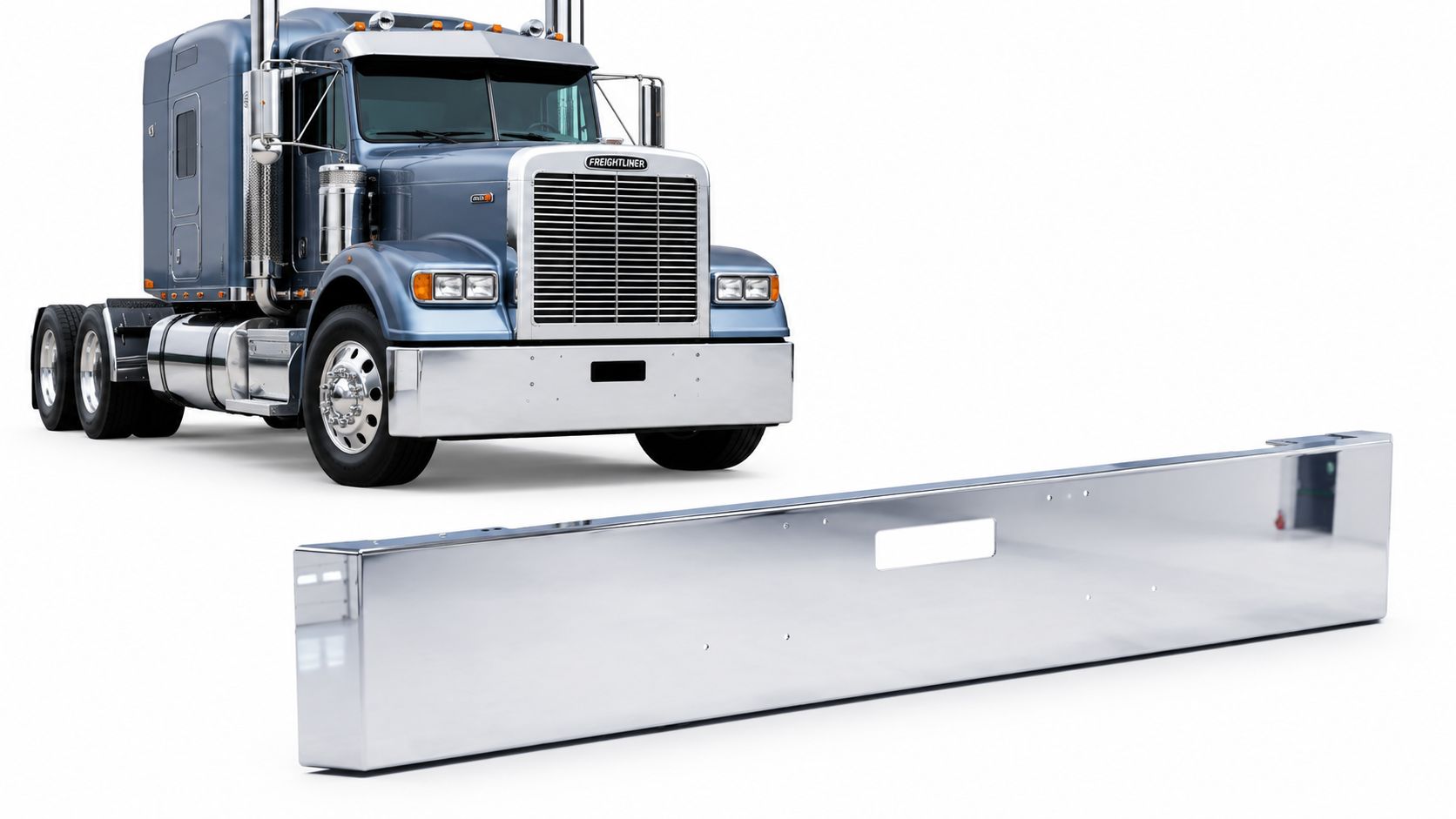
Chrome bumper for Freightliner Classic is listed with 10-gauge chrome-plated steel, a mirror-polished finish, and a 3 mm chrome-plated 304 or 430 stainless option. It offers standard and blind mounting, a triple-layer hexavalent chrome process with 35 microns of nickel, and direct bolt-on installation for the Freightliner Classic without drilling or cutting.
Match the accessory to its job
Bug shields and hood shields take insect impact and some road debris before the hood and windshield do. Verify hood shape and mounting points, especially on older Peterbilt and Kenworth platforms.
Mudflaps and quarter fenders control spray and protect equipment behind the tractor. Heavy-duty fleets should favor reinforced mounts and replaceable flap designs over decorative pieces that are difficult to service.
Visors manage glare and add a strong custom look. Painted aluminum or fiberglass can suit a uniform fleet appearance. Polished stainless suits a long-haul owner who accepts regular cleaning. Deep drop designs can protect glass, but they need correct cab fitment and clearance.
Lighting includes headlights, marker lights, turn signals, work lights, and grille-mounted units. Choose sealed housings, proper harnesses, and compliant output. Brightness alone isn't a quality test.
Mirrors should match the door, bracket, heater, remote-control, and camera configuration. Aerodynamic housings matter on highway tractors, while vocational trucks may need greater impact protection.
Aerodynamic add-ons include roof fairings, sleeper extenders, side skirts, tail skirts, and chassis fairings. They need correct cab height and trailer alignment. A fairing sized for a high-roof sleeper can look wrong and work poorly on a mid-roof truck.
| Accessory Category | Primary Function | Common Fitment |
|---|---|---|
| Bumper | Front-end protection and appearance | Peterbilt 389, Kenworth W900, Freightliner Classic, Cascadia |
| Bug shield | Hood and windshield protection | Hooded Peterbilt, Kenworth, Freightliner, International |
| Mudflaps | Spray and debris control | Most Class 8 tractors |
| Visor | Glare control and styling | Hooded and aerodynamic sleeper cabs |
| Lighting | Visibility, signaling, and work illumination | All major Class 8 platforms |
| Mirrors | Rear visibility, heating, and airflow management | Peterbilt, Kenworth, Freightliner, International |
| Aerodynamic fairings | Airflow management and fuel efficiency | Highway sleepers and matched trailers |
| Grille and fender trim | Appearance and front-end protection | Model-specific hood and cab configurations |
Bolt-on parts are the practical choice for fleet inventory. Weld-on parts and harness adapters may be necessary on custom builds, but they add labor and complicate replacement. Confirm the exact model year before ordering.
Stainless Steel vs Chrome Plating vs Carbon Steel
The material decision starts with the environment, not the showroom. Chrome-plated carbon steel usually delivers a bright finish at a lower entry cost. Its steel base still depends on the plating system for protection. Once salt, chips, or wash chemicals reach seams, edges, or damaged areas, rust can spread underneath the finish.
430 stainless steel brings more chromium to the material and remains magnetic. Independent material guidance identifies 430 stainless as having about 17% chromium and no nickel, while 304 stainless contains about 18% chromium and 8% nickel. The same guidance gives 304 the stronger corrosion resistance in chloride and salt exposure, as explained in this stainless bumper material guide.
Practical comparison
| Material | Finish and appearance | Corrosion behavior | Best use |
|---|---|---|---|
| Chrome-plated carbon steel | Bright chrome over steel | Depends heavily on intact plating and protected edges | Dry routes, budget replacements, show-focused builds |
| Chrome-plated 430 stainless | Chrome appearance with stainless substrate | Better resistance than carbon steel, but not the strongest salt option | Mixed service and appearance-focused trucks |
| Chrome-plated 304 stainless | Bright chrome or polished stainless | Strongest choice of these options for salt and chloride exposure | Northern routes, coastal work, long service life |
Don't confuse a thick, well-applied finish with a corrosion-proof substrate. A triple-layer chrome process and a nickel layer can improve appearance and protection, but scratches and exposed edges still need attention. Stainless also needs the right cleaning method. Abrasive pads can leave permanent marks on polished surfaces.
Material recommendation: For repeated winter salt exposure, choose 304 stainless when the budget supports it. Choose 430 when you need a practical middle ground. Use chrome-plated carbon steel when upfront cost and appearance matter more than harsh-climate longevity.
Your truck's duty cycle decides whether the extra material cost pays back. A Texas-based owner running dry southern lanes may have fewer corrosion concerns than a truck crossing salt-treated roads through the Great Lakes. Review the differences between stainless steel and carbon steel construction before you compare only the finish.
Thickness matters too. A thin decorative panel isn't a substitute for a properly supported bumper. Check the stated gauge or millimeter thickness, bracket strength, weld quality, and warranty coverage. A part that bends or cracks at the mount can cost more than the original price difference.
Aerodynamics, Fuel Economy, and Highway Performance
Exterior parts can change fuel use even when the truck still looks right. SAE testing found that a standard rearview mirror set produced a glass-area-based drag coefficient of 1.81 and raised a typical truck's drag by about 8.5%. A teardrop-shaped accessory mirror still increased drag by about 10%, while a fully faired mirror set reduced that contribution to 5.3% of total aerodynamic drag, with estimated savings of about 800 liters of diesel over 150,000 kilometers of annual driving, according to the SAE mirror study.
That doesn't mean every polished part hurts fuel economy. It means the accessory needs to work with the truck's airflow. On a loaded Class 8 tractor-trailer traveling about 60 mph, rolling resistance and aerodynamic resistance are nearly equal. A national laboratory report notes that a 1% change in aerodynamic drag coefficient changes total road-load force by roughly 0.5%, because rolling resistance doesn't change. See the heavy-truck aerodynamic report for the underlying road-load analysis.
| Accessory | Approx. Cd Impact | Fuel Effect | Operating Verdict |
|---|---|---|---|
| Fully faired mirror system | Lower mirror drag contribution | Can reduce highway drag | Strong choice for long-haul tractors |
| Standard exterior mirrors | Drag contribution measured at 1.81 glass-area-based Cd | Raises highway drag | Choose only when fitment and visibility require it |
| Roof fairings and sleeper extenders | Can reduce airflow separation when matched correctly | Meaningful on highway duty cycles | Prioritize on dedicated highway trucks |
| Visors and bug shields | Depends on depth, shape, and mounting | May add drag while protecting glass | Use a measured design, not the largest design |
| Mudflaps and trim | Usually limited aerodynamic value | Mostly neutral to modest impact | Buy for protection and serviceability |
Independent testing also reports that fairings and related drag-reduction devices can cut overall drag by double-digit percentages, as summarized in the same national laboratory report. Don't add a deep drop visor or oversized bug shield to every truck. Use them where glass and paint damage are constant, then accept the airflow trade-off knowingly.
Wheel and tire choices belong in the same system decision. A polished accessory package should not force you to ignore weight, balance, or maintenance access. Review aluminum wheels for semi trucks alongside exterior upgrades when building a highway tractor.
Matching Accessories to Owner-Operator and Fleet Needs
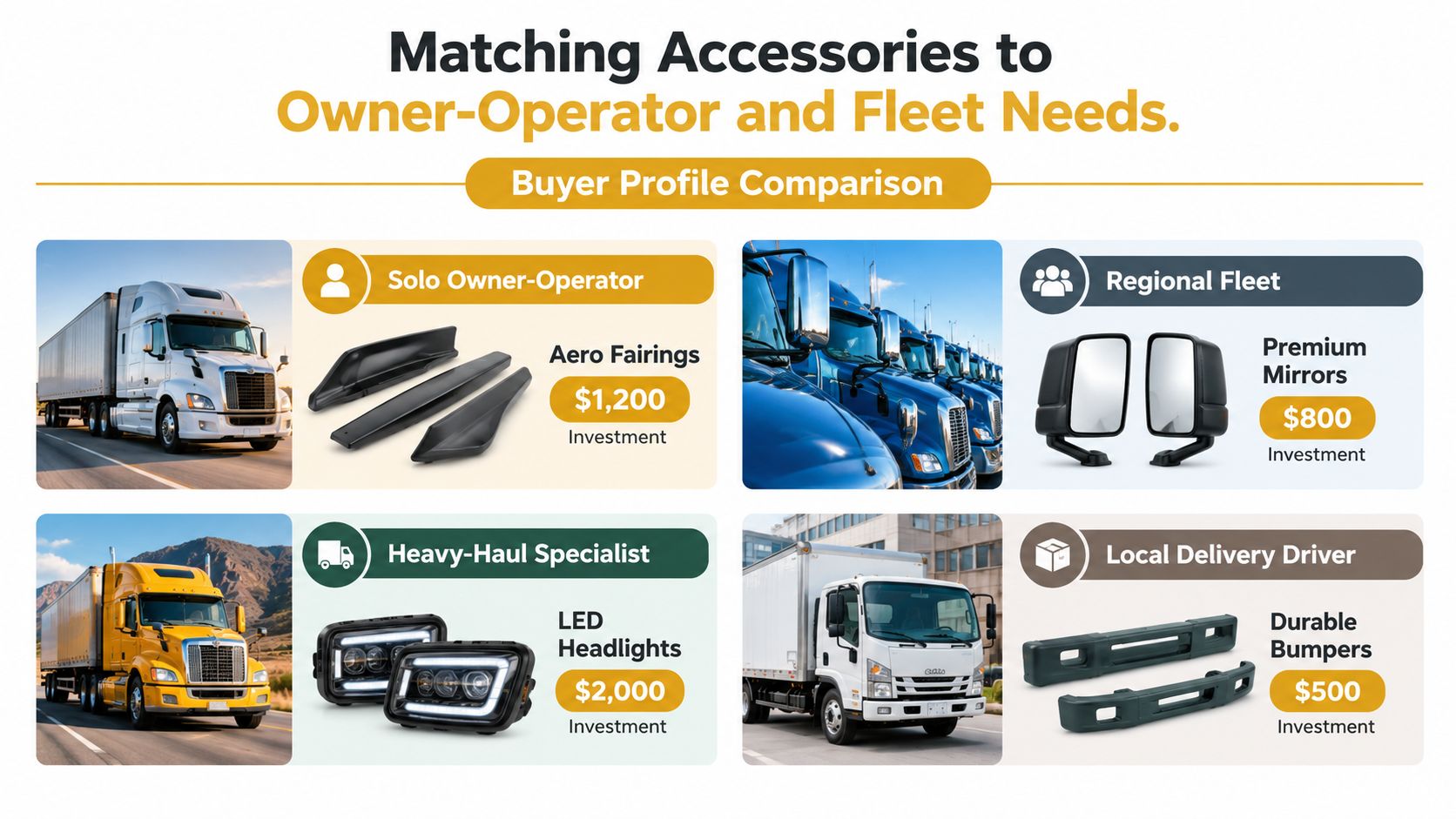
The right package depends on who pays when a part fails. An owner-operator may accept more cleaning to get a custom finish. A regional fleet usually needs parts that drivers can replace quickly and maintenance teams can stock across multiple trucks.
Long-haul solo owner-operator
Choose aerodynamic mirrors, matched fairings, reliable LED headlights, and corrosion-resistant trim. A polished 430 stainless setup can provide the custom look without making every small scratch a paint repair. Use 304 stainless for the bumper if the truck regularly sees road salt, coastal humidity, or aggressive winter wash chemicals.
A Peterbilt 389 or Kenworth W900 owner may want a chrome bumper and drop visor. Make sure the visor clears the hood, the bumper matches the tow and fog-light cutouts, and the finish doesn't create a cleaning routine you won't maintain.
Regional fleet
Standardize the parts that fail most often. Bolt-on bumpers, durable mudflaps, basic LED or halogen lighting, and common mirror assemblies make inventory easier. Skip highly customized visors when drivers and routes vary. A simple direct replacement can reduce truck-off-road time.
For Freightliner Cascadia, International LT, Peterbilt 579, and Kenworth T680 fleets, document model year, cab height, bumper style, bracket type, and lighting connector before placing a stocking order. Mixed-roster fleets should avoid assuming that one part fits every truck in the same brand family.
Vocational and heavy-haul work
Choose reinforced bumpers, protected lighting, strong mirror brackets, and debris-resistant hardware. Construction yards, oilfield roads, and heavy-haul staging areas can destroy long aerodynamic pieces. Side skirts and exposed trim often make less sense when the truck leaves paved highways.
Keep the bumper thick and the mounting points accessible. A part that looks clean but blocks recovery points or complicates roadside repairs isn't helping the operation.
Chrome-shop and show-truck builds
This buyer values finish depth, symmetry, and coordinated trim. Hex chrome, polished 430 stainless, and matching grille, visor, fender, and wheel accents can create a strong visual package. The owner also needs to accept the maintenance that comes with a bright finish, including regular washing and polishing after dirty routes.
Cost-control test: If the accessory needs special cleaning, record that labor as part of ownership. A show finish is a valid choice, but it isn't free after checkout.
Fitment, Installation, and Regulatory Basics
Fitment starts with the truck's identity, not the brand name alone. Record the make, model, model year, hood or aerodynamic cab, sleeper height, bumper mount, tow-hole layout, light cutouts, and mirror bracket. A Peterbilt 379 or 389 has different front-end needs from a 579. A Kenworth W900 isn't interchangeable with a T680 or T880. Freightliner Classic, Columbia, Cascadia, Volvo VNL, Mack Anthem, and International LT also use different mounting and body configurations.
Check the mounting method
Ask these questions before checkout:
- Is it direct bolt-on? Confirm whether factory holes and brackets are used.
- Are cutouts correct? Verify tow hooks, fog lights, sensors, and marker lights.
- Does the harness match? LED swaps may need adapters, sealed connections, or revised mounting.
- Will service access remain clear? Don't cover recovery points, tow hardware, or inspection areas.
- Does the finish match the rest of the truck? Polished stainless beside blacked-out trim can look accidental.
Rear impact protection isn't a styling part. FMVSS No. 224 requires most new trailers and semitrailers with a GVWR of 10,000 pounds or more to use a rear impact guard that meets FMVSS No. 223. The guard must attach to the chassis according to the installation instructions required by the rule, as stated in NHTSA's rear impact protection document.
Installation instructions matter just as much as the part itself. Review truck accessory installation guidance before removing the old component. Oversized bumpers and large trim pieces may ship by LTL freight and require a delivery plan. Inspect the packaging before signing, photograph visible damage, and confirm the return process before ordering a made-to-fit part.
How to Choose the Right Accessories and Order with Confidence
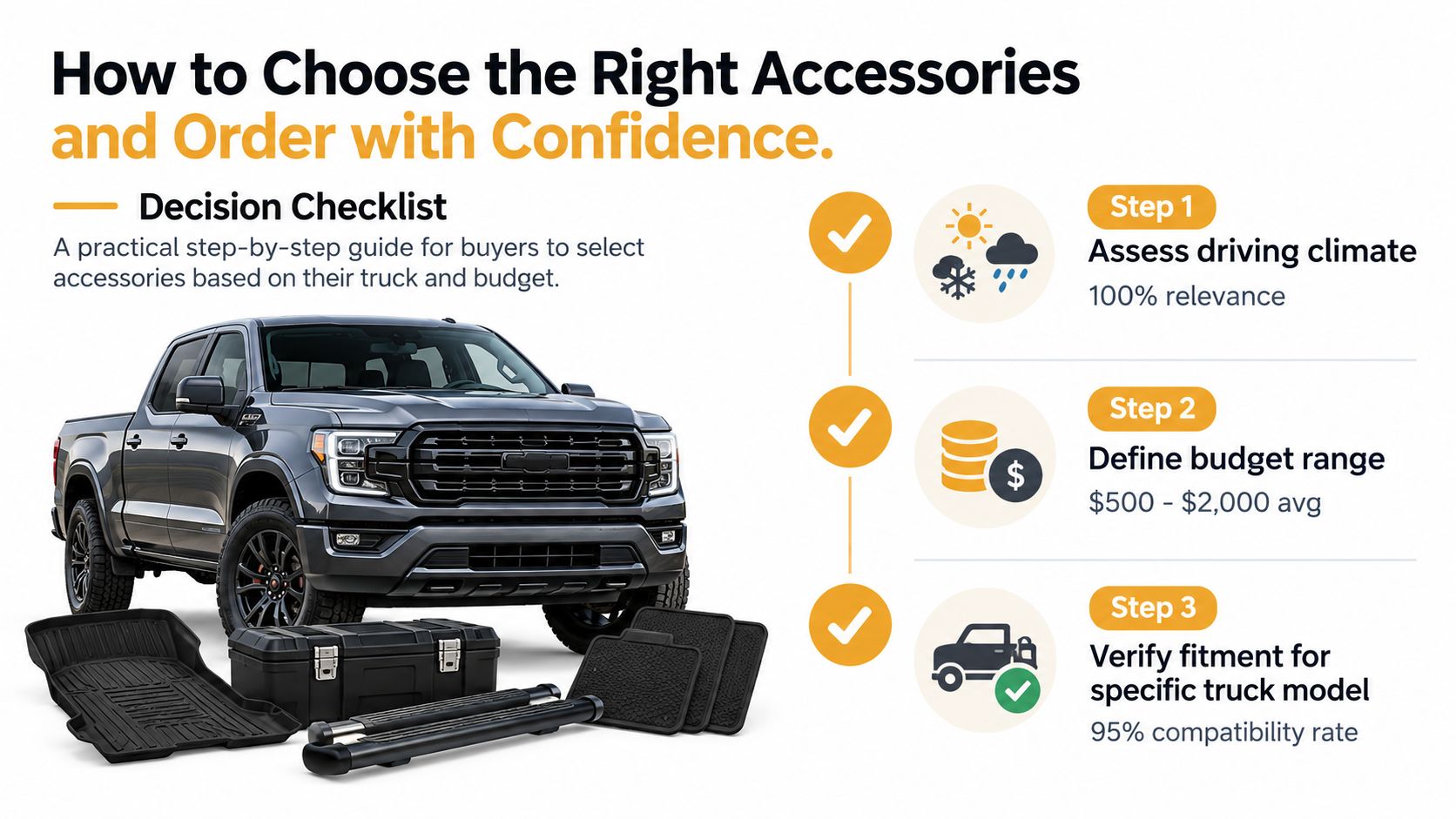
A good order begins with a written spec. Don't rely on a seller's general “fits Peterbilt” label. Your truck's year, hood, cab height, sleeper, bracket, cutouts, and finish all affect the final fit.
Use this buying sequence
- Identify the truck. Record make, model, model year, hood or aerodynamic configuration, sleeper height, and current bumper mounting style.
- Define the route. Salt, coastal humidity, gravel, wash chemicals, construction work, and long highway miles each point to a different material and accessory package.
- Choose the substrate. Use 304 stainless for severe chloride and road-salt exposure. Consider 430 stainless for a balance of appearance and corrosion resistance. Use chrome-plated carbon steel when the route is less corrosive and the lower initial cost matters.
- Verify the finish. Compare polished stainless, painted surfaces, and chrome plating as maintenance decisions, not just color choices.
- Confirm installation. Check bolt-on versus drilling, bracket requirements, harness adapters, cutouts, and access to tow hardware.
- Review delivery details. Confirm packaging, freight handling, lead time, inspection steps, warranty terms, and return conditions before payment.
Two ordering mistakes show up repeatedly. Buyers select a fairing built for a different cab profile, then blame the part when the brackets don't line up. Others combine polished stainless with blacked-out trim and create a mismatched front end that requires another round of parts.
Make your next move simple:
- Take photos and measurements of the current bumper, brackets, openings, and truck identification plate.
- Choose the material and finish based on climate, route, maintenance time, and expected service life.
- Order from a supplier that can confirm fitment, provide clear installation details, and arrange reliable shipping across the United States.
Galhor Inc. offers configurable chrome bumpers for Peterbilt, Kenworth, Freightliner, and Volvo Class 8 trucks, with material options that include chrome-plated carbon steel, 430 stainless, and 304 stainless. Visit Galhor Inc. to verify your truck's fitment, finish, mounting style, and delivery options before you upgrade.