

Valley Chrome Plating Bumpers: What Sets Them Apart
You're standing in a truck-stop parking lot, looking at a bumper that used to shine. Now the lower edge has pits, the chrome is lifting near a bracket, and road salt has started showing through. The seller says it's a Valley chrome plating bumper, but that phrase alone doesn't tell you what you're buying.
A real buyer needs better answers. What metal sits under the finish? How thick is the nickel? Does the bumper fit your Peterbilt 389, Kenworth W900, Freightliner Classic, or International without cutting? And can the supplier ship before the truck misses more work?
Table of Contents
- What Valley Chrome Plating Bumpers Actually Means
- How Decorative Chrome Plating Is Built Layer by Layer
- Comparing Carbon Steel, 430 Stainless, and 304 Stainless Substrates
- Valley Chrome Plating vs Galhor's Triple-Layer Chrome Stack
- Matching the Right Material to Your Truck and Routes
- Common Chrome Bumper Claims Worth Questioning
- Choosing Your Next Bumper and Getting It on the Truck Fast
What Valley Chrome Plating Bumpers Actually Means
A driver once asked that question at a chrome shop counter: “Is Valley chrome plating bumpers a brand, or is it just a finish?” The answer matters because the phrase gets used loosely.
Valley usually points to a regional chrome-shop tradition, tied to areas such as California's San Fernando Valley and Salt Lake's valley corridor. It isn't a trademarked bumper product. Over time, the term became associated with deep decorative chrome work seen on Peterbilt 379s, Peterbilt 389s, and Kenworth W900s. In practical truck talk, it often means a bright decorative finish built over a polished metal base.
That finish isn't one dip in one tank. A proper decorative system uses a prepared substrate, copper, nickel, and a thin chromium top layer. The explainer on chrome plating for bumpers shows why the stack matters more than the word “chrome” on a listing.
What the buyer is really getting
A typical decorative bumper stack includes:
- Polished base metal: The surface must be smooth before plating. Deep scratches and poor weld work don't disappear because chrome goes over them.
- Copper layer: Copper helps fill small surface defects and gives later layers a better foundation.
- Nickel layers: Nickel supplies most of the corrosion barrier and leveling work.
- Chromium top layer: Chromium delivers the blue-white appearance, hardness, and resistance to staining.
Commercially workable chromium plating was developed in 1924, and car companies had begun using the finish by the end of the 1920s, according to this industrial overview of nickel and chrome plating. That history explains the look. It doesn't guarantee the quality of a modern bumper.
Ask for the substrate type, nickel thickness, layer count, and fitment details. If the seller only says “Valley chrome” or “show chrome,” you still don't know whether the bumper is carbon steel, 430 stainless, or 304 stainless, or how it will handle your routes.
How Decorative Chrome Plating Is Built Layer by Layer
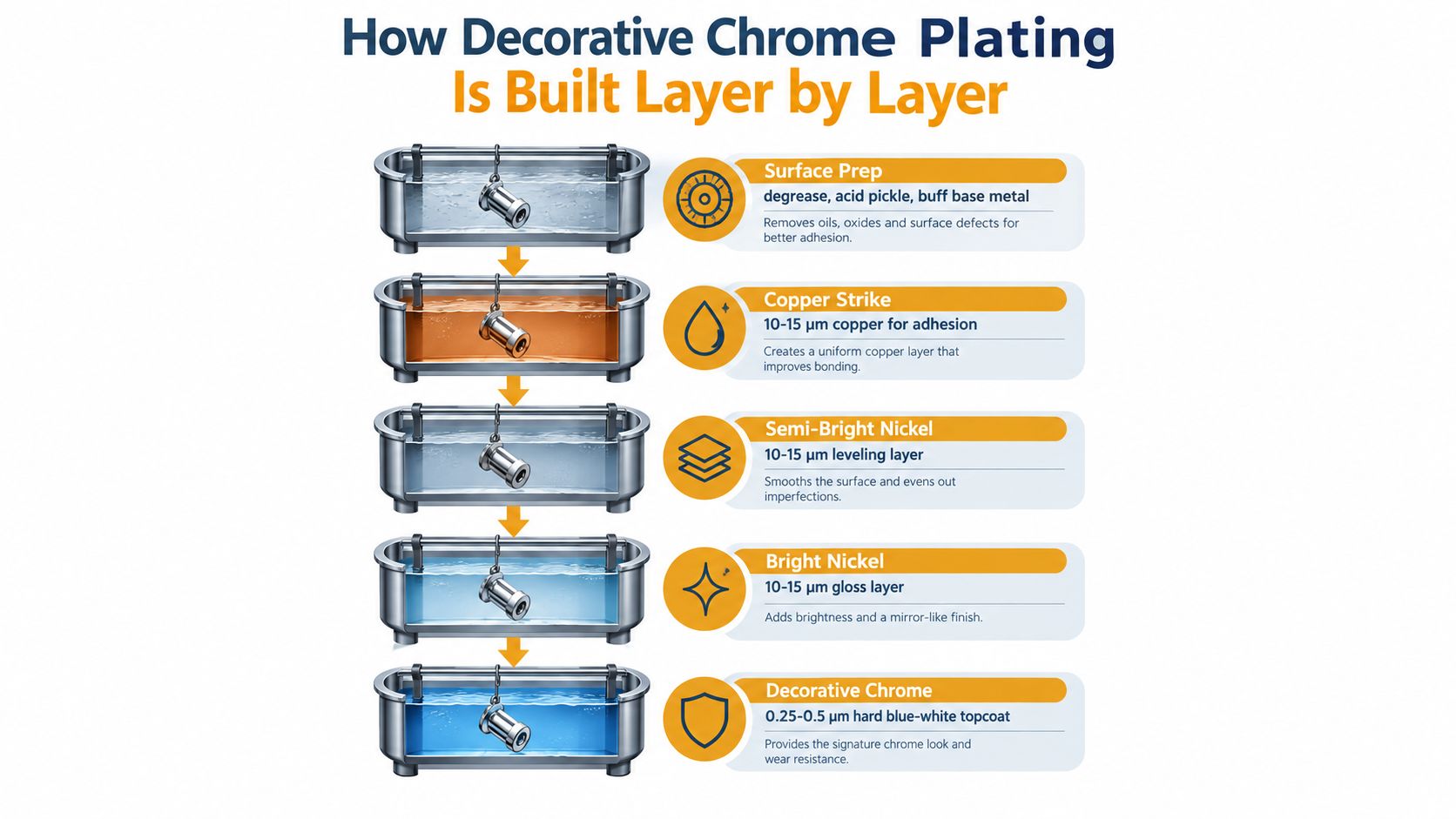
A Class 8 bumper that looks sharp in the parking lot can start failing after one stone strike if the shop rushed surface preparation. Decorative chrome plating is built before the part reaches the chrome tank. The finisher degreases the bumper, uses an acid pickle to remove contamination, then buffs the base metal until it is ready. Pores, scratches, and weld marks left underneath will remain visible in the finished surface.
The working layers
First comes the copper strike. Copper improves adhesion and helps level minor surface defects that polishing alone cannot remove. It gives the next layer a cleaner foundation.
Next comes nickel. This is the layer a bumper buyer should question first. Decorative systems commonly use a nickel layer around 10 micrometers, with a broader range of 5 to 25 micrometers depending on the application, while the chromium layer is only about 0.003 to 0.005 millimeters thick, according to ISO 1456 decorative nickel-chromium plating guidance.
A production line may apply semi-bright nickel for ductility and corrosion resistance, followed by bright nickel for leveling and gloss. Nickel provides most of the corrosion barrier and determines much of the bumper's service life. Chromium supplies the blue-white color, surface hardness, and stain resistance, but its thin cap cannot compensate for insufficient nickel or poor preparation.
The final bath adds decorative chromium. This micro-layer creates the familiar shine and helps protect the surface from staining. It will not repair a rough substrate, careless polishing, or weak base metal.
Shop rule: Ask for the nickel thickness before you pay for the reflection.
Review the chrome plating process guide to see the sequence. Galhor's published Steel chrome bumper specifies 10-gauge chrome-plated steel, a mirror-polished finish, direct bolt-on installation, standard and blind mount options, and a triple-layer hexavalent chrome process with 35 microns of nickel. That published stack gives a Class 8 buyer a concrete benchmark, since many competitors never disclose nickel thickness. The bumper is sold individually and covered against defects in workmanship and materials.
Comparing Carbon Steel, 430 Stainless, and 304 Stainless Substrates
A bumper can shine under showroom lights and still be the wrong choice for the truck. The substrate has to match the route, weather, and downtime you can tolerate. Carbon steel, 430 stainless, and 304 stainless each serve a different buyer.
Chrome Bumper Substrate Comparison
| Property | Cold-Rolled Carbon Steel | 430 Stainless Steel | 304 Stainless Steel |
|---|---|---|---|
| Corrosion behavior | Depends heavily on intact plating | Better than carbon steel, but vulnerable at damaged areas | Strong resistance in wet and salty service |
| Magnetic behavior | Magnetic | Generally magnetic | Generally non-magnetic |
| Nickel content | Not applicable as a stainless grade | Very little nickel | About 8% nickel |
| Chromium content | Not applicable as a stainless grade | Moderate chromium content | About 18% chromium |
| Best fit | Show trucks and controlled use | Cost-conscious regional work | Harsh routes and lower downtime tolerance |
| Main concern | Rust after a breach | Corrosion at welds and chips | Higher material cost |
Carbon steel delivers the classic decorative chrome look at a sensible cost. The problem begins after a stone strike, bent corner, cracked plating, or moisture trapped behind a bracket. Once the finish breaks, rust can spread quickly. Use it on a truck that stays indoors or runs mostly dry routes. Do not treat it as a smart shortcut for a northern fleet exposed to road salt.
430 stainless is the middle-ground choice. It polishes well and often costs less than 304 across product lines. It still needs attention around welds, chips, and damaged edges, especially in the Midwest and other areas that use de-icer. If the truck works regional routes and the budget matters, 430 can make sense.
304 stainless earns its place on severe routes. Its combination of about 18% chromium and 8% nickel gives it better corrosion resistance than 430 in harsh or wet trucking environments, as explained in this 304 versus 430 stainless comparison and our stainless steel versus carbon steel guide. I would choose it for daily service in the Northeast, Gulf Coast, or any operation where a bumper replacement disrupts scheduling.
Decorative chrome has always sold the reflection. The working truck needs the metal underneath it. Galhor publishes a hexavalent triple-layer stack with 35 microns of nickel, giving buyers a measurable benchmark that many competitors leave unpublished.
A technical comparison of chrome-plated and stainless-clad truck bumpers notes that stainless cladding around 42 mils provides more protection than a 2 to 4 mil chrome plating layer when impact or deformation lets moisture reach the metal. Choose the substrate first. Judge the shine after that.
Valley Chrome Plating vs Galhor's Triple-Layer Chrome Stack
“Valley chrome” describes a style and regional plating approach, not one fixed specification. That means two bumpers carrying the same label can have very different substrates, nickel thicknesses, warranties, and delivery schedules.
Galhor publishes a specific stack: 35 microns of nickel under a triple-layer hexavalent chrome finish, with a clear coat used on its 304 stainless configuration. Many Valley-style jobs on carbon steel use copper, nickel, and chrome, but the nickel measurement often isn't published. Without that number, you're comparing descriptions instead of construction.
Valley Chrome Plating vs Galhor Triple-Layer Chrome
| Spec | Valley-Style Chrome on Carbon Steel | Galhor Hex Triple-Layer on 304 Stainless |
|---|---|---|
| Substrate | Carbon steel, unless the shop states otherwise | 304 stainless steel |
| Nickel thickness | Often not published, and varies by shop | 35 microns, published by the manufacturer |
| Chrome layer | Decorative chromium top layer | Hexavalent decorative chromium top layer |
| Corrosion data | Must be requested from the individual shop | Warranty coverage is stated for manufacturing defects and materials |
| Finish | Usually polished decorative chrome | Mirror-polished finish |
| Lead time | Depends on the plating shop and repair queue | Confirm current stock and shipping timing before ordering |
The difference isn't that one bumper has magic chrome. The difference is spec transparency. A buyer can evaluate 35 microns of nickel when the manufacturer publishes it. A buyer can't evaluate “triple plated” if the seller won't identify the layers or thickness.
Corrosion testing also shows why thickness matters. One industrial reference reports that a nickel-chrome system with 30 microns of nickel can be guaranteed for 500 hours in acetic-acid salt spray or 1,500 hours in neutral salt spray under ISO 9227 testing. With 10 microns of nickel, the same reference lists 150 hours in acetic-acid salt spray or 500 hours in neutral salt spray, as reported in this hard chrome technical reference.
Those figures aren't a promise for every Valley job or every Galhor bumper. They're a reminder to request actual test data instead of accepting shine as proof. For a Class 8 truck, the practical benchmark is simple: published substrate, published nickel thickness, clear fitment, and a warranty you can read.
Matching the Right Material to Your Truck and Routes
Start with the truck, but don't stop at the badge. A Peterbilt 379 bumper and a Peterbilt 389 bumper may share a familiar long-nose look, yet mounting details, cutouts, brackets, and model year still need confirmation. The same applies to a Kenworth W900 chrome bumper, Kenworth T800, Freightliner Classic, or International.
Use this decision path
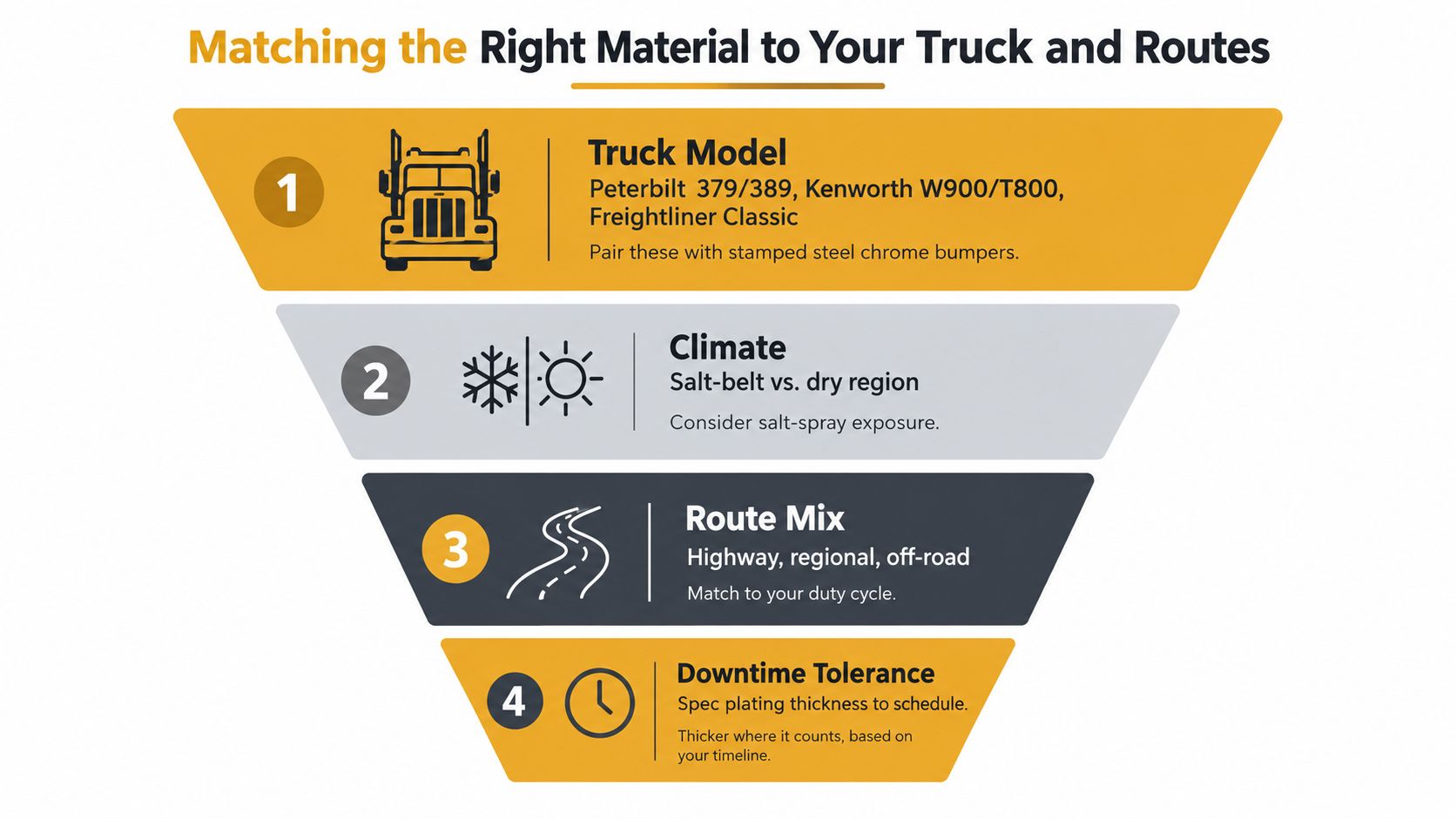
Start with fitment. Confirm the exact truck model, year, bumper style, mount type, light openings, and tow-hook or fog-light cutouts. A direct bolt-on bumper is valuable only when the configuration matches the truck.
Then check the climate. Salted Northeast roads attack damaged finishes. Gulf Coast humidity keeps moisture working behind seams and brackets. Southwest dust brings abrasion, while Midwest freeze-thaw cycles expose weak edges and stone chips. For most severe routes, 304 stainless is the safer recommendation because the substrate itself provides stronger corrosion resistance than plated carbon steel after impact.
Next, judge the duty cycle. A show truck that runs occasional events has different needs from a fleet tractor working every day. A made-to-order carbon-steel bumper can make sense when the owner prioritizes the traditional chrome look and can schedule the vehicle around production. A stainless bumper makes more sense when the truck needs to keep hauling through bad weather.
Finally, measure downtime tolerance. Don't remove a working bumper before you know the replacement schedule. In-stock stainless can be the practical route for an owner-operator who can't park the truck while a carbon-steel unit goes through a re-chrome process.
Route advice: The cheapest bumper is expensive when it keeps a revenue-producing tractor parked.
Match the style to the job
A polished bumper can improve the truck's appearance, but style choices still affect use. A drop bumper may give a Peterbilt 389 or Kenworth W900 the stance you want, while an 18 inch drop bumper can create clearance and approach-angle concerns on rough lots, steep docks, and unpaved yards. Check the truck's actual operating environment before choosing a deep drop.
For Class 8 buyers, material, thickness, mount style, finish, and delivery should appear on the quote. If one of those items is missing, the quote isn't complete.
Common Chrome Bumper Claims Worth Questioning
Chrome bumper listings are full of shiny words and thin specifications. Don't buy based on the reflection in a product photo.
Five phrases that need proof
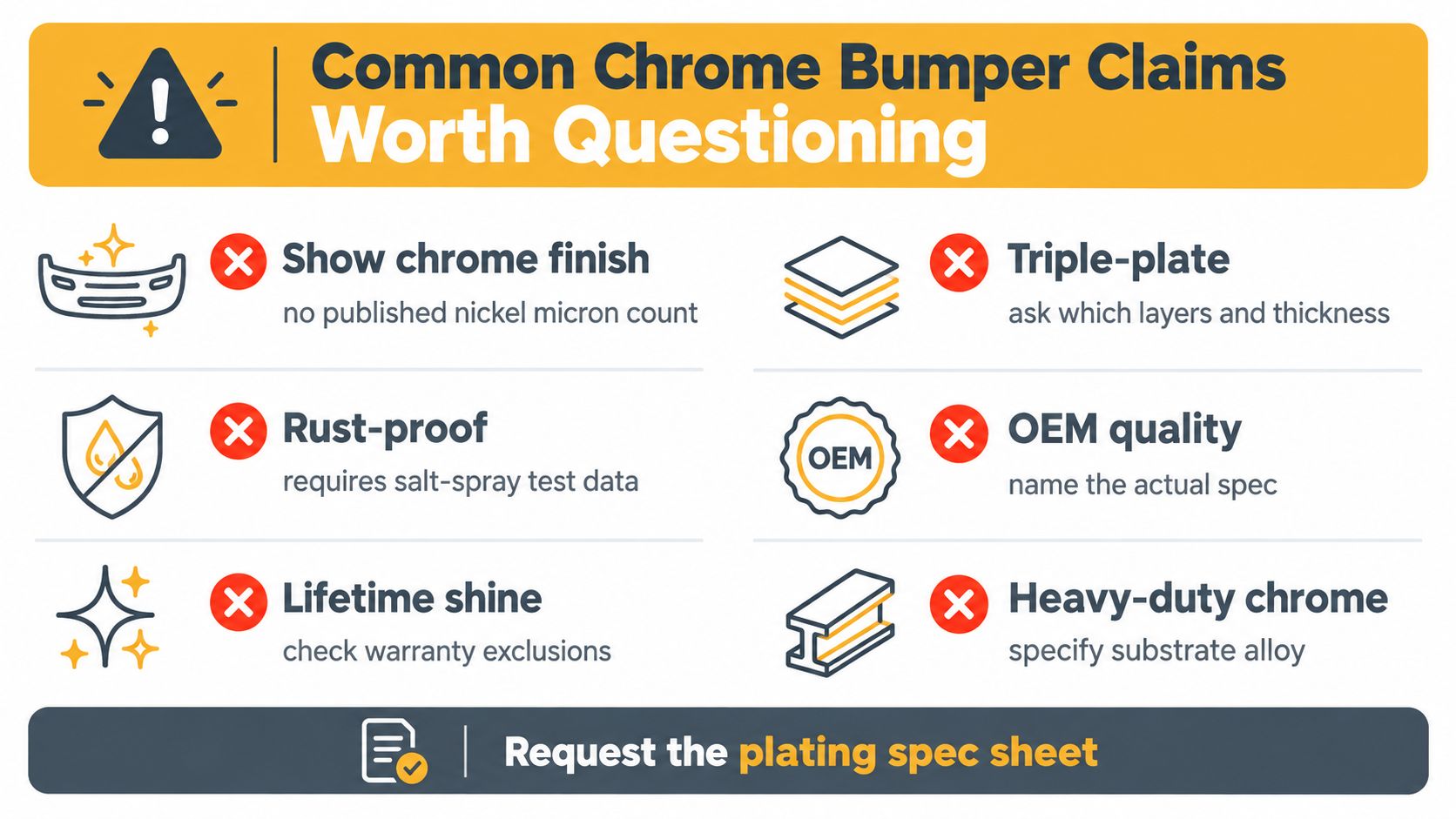
- “Show chrome finish.” This says nothing about the substrate or nickel thickness. Ask, “What is the nickel thickness in microns, and what metal is underneath?”
- “Triple plated.” Three layers could mean several different processes. Ask the seller to name each layer and provide its thickness.
- “Will not rust.” Carbon steel can rust after impact or a plating breach. Ask for the substrate, clear-coat details, and salt-spray data.
- “Same as OEM.” That phrase hides the actual construction. Ask for the material grade, gauge or thickness, plating stack, and fitment standard.
- “Lifetime warranty.” The warranty may cover workmanship while excluding peeling, pitting, corrosion, or road damage. Ask exactly what the finish warranty covers and what it excludes.
“Heavy-duty chrome” belongs on the same watch list. Heavy-duty describes a use case, not a measurable plating specification. A reputable seller should tell you whether the bumper uses carbon steel, 430 stainless, or 304 stainless, then state the nickel thickness and installation method.
The seller's response tells you a lot. If you get a clear spec sheet, you can compare products. If you get another adjective, keep your wallet in your pocket.
Choosing Your Next Bumper and Getting It on the Truck Fast
A smart bumper purchase follows a short checklist. It keeps a driver from paying for a bright finish that doesn't match the route, the truck, or the shop schedule.
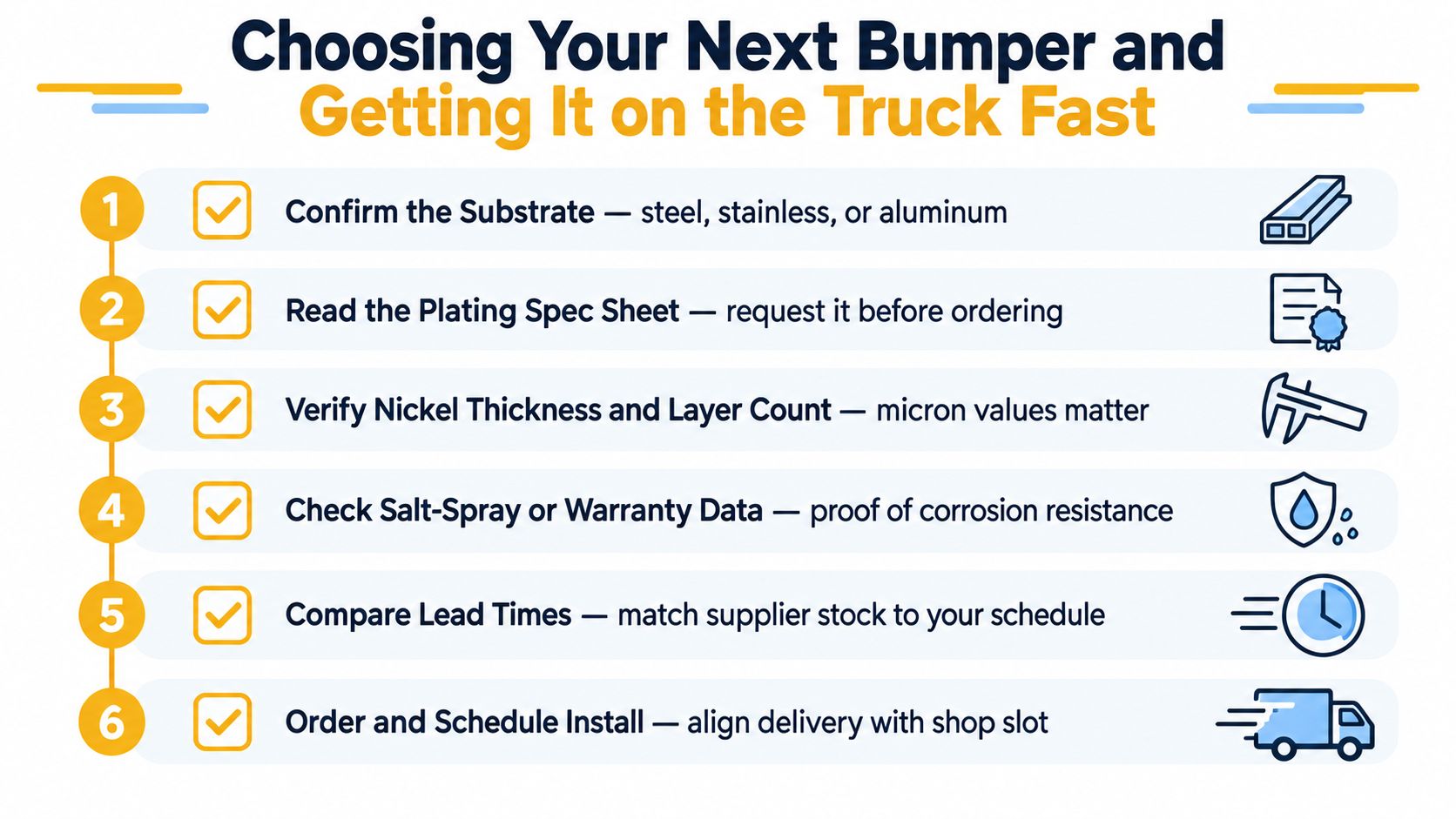
- Confirm the substrate. Write down whether the bumper is carbon steel, 430 stainless, or 304 stainless. Don't accept “metal” as an answer.
- Read the plating spec sheet. Request the actual process before ordering. Look for copper, nickel, chrome, and any clear coat.
- Verify nickel thickness and layer count. Micron values matter because nickel supplies the main corrosion barrier in decorative systems.
- Check salt-spray or warranty data. A warranty covering only workmanship may not cover finish failure. Read the exclusions.
- Confirm fitment. Match the bumper to the exact Peterbilt, Kenworth, Freightliner, International, or Volvo model and year. Verify standard mount, blind mount, light cutouts, and any custom openings.
- Lock the shipping timeline. Ask whether the unit is ready to ship or made to order, then schedule delivery around the installation slot.
Make the downtime decision
Choose made-to-order carbon steel when the budget, traditional chrome appearance, and production schedule fit your operation. Choose stainless when the truck runs daily through salt, humidity, or rough roads and a replacement would cost more than the material upgrade.
Ask for the bumper's weight, installation requirements, return policy, and current shipping estimate before paying. Fast shipping across the United States only helps if the supplier confirms the correct configuration and freight arrangement.
Galhor Inc. offers configurable direct bolt-on chrome bumpers for Class 8 applications, including chrome-plated steel and stainless options, with published details for its triple-layer hexavalent process and 35-micron nickel specification. Review the fitment and delivery details before ordering, then visit Galhor Inc. to request a quote and choose a bumper that matches your truck, route, and downtime schedule.