

Aftermarket Semi Truck Parts Guide for US Truckers
You're rolling out of a truck stop before sunrise in a Peterbilt, Kenworth, Freightliner, or International. The load is booked, the route is long, and a bumper or suspension part that looked like a bargain is already loose, corroded, or waiting on a replacement. One failed part can mean more than the cost of the part itself. It can mean missed work, a service call, lost time, and a truck that isn't earning.
That's why aftermarket semi truck parts deserve a total-cost view. The lowest purchase price doesn't always produce the lowest operating cost. Material grade, finish, thickness, exact fitment, shipping time, and warranty support all affect how long the truck stays on the road.
The heavy-duty truck aftermarket is a large business tied to fleet maintenance, aging vehicles, and the high use of Class 8 trucks. One market forecast estimated the global sector at USD 67.4 billion in 2025, with projected growth to USD 96.8 billion by 2034 at a 4.2% compound annual growth rate. Another forecast estimated USD 89.06 billion in 2024, rising to USD 125.01 billion by 2032 at about 4.3% CAGR. These forecasts show why replacement parts are a core operating need, not a small side market. Heavy-duty truck aftermarket market analysis

This guide focuses on the choices that matter in American trucking. You'll see how aftermarket and OEM parts compare, why 304 and 430 stainless behave differently on salted roads, how to verify fitment, and how to select a bumper, lighting component, suspension part, or cab accessory without creating another downtime problem.
Table of Contents
- Introduction to Aftermarket Semi Truck Parts for American Truckers
- What Aftermarket Semi Truck Parts Are and How They Work
- Aftermarket vs OEM Parts and Which Delivers Better Value
- How to Choose the Right Materials Finishes and Fitment
- Buying Guide for Bumpers Lighting Suspension and Accessories
- Installation and Maintenance Tips That Extend Part Life
- Upgrade Your Truck Today With the Right Aftermarket Parts
Introduction to Aftermarket Semi Truck Parts for American Truckers
A cheap bumper can look fine in the shop and still become an expensive decision after a winter season. Road salt gets behind damaged plating, vibration works loose hardware, and a part with poor fitment forces the installer to drill, shim, or pull brackets into position. The truck may leave the bay looking finished, but the owner has paid for extra labor and accepted another failure point.
That's the wrong way to judge aftermarket semi truck parts. The useful question isn't only, “What does this cost today?” Ask instead, “Will this part fit correctly, resist the environment, arrive when I need it, and protect my truck's uptime?”
U.S. demand is already substantial. Parts demand for Class 6 through Class 8 trucks, trailers, and container chassis reached USD 31.6 billion in 2019, according to a forecast presented at Heavy Duty Aftermarket Dialogue. That forecast projected the market at USD 37 billion in 2024, while a later summary estimated the U.S. heavy-duty automotive aftermarket at USD 39.3 billion in 2024. U.S. heavy-duty automotive aftermarket overview
For an owner-operator, the right part has to survive long hauls, rough pavement, winter spray, heat, and frequent loading cycles. A fleet manager also needs predictable supply, clear warranty terms, and fitment information that reduces returns. A chrome shop needs accurate mounting points, clean cutouts, and a finish that still looks professional after real road use.
This guide keeps the decision practical:
- Durability: Choose the material and finish for the roads and weather your truck sees.
- Fitment: Match make, model, year, mounting style, cutouts, and axle or suspension specifications.
- Uptime: Confirm shipping, installation requirements, warranty coverage, and return terms before ordering.
- ROI: Compare the part cost with labor, replacement frequency, downtime, and the effect of poor alignment or corrosion.
A sharp-looking truck matters. So does keeping it moving. The best purchase protects both.
What Aftermarket Semi Truck Parts Are and How They Work
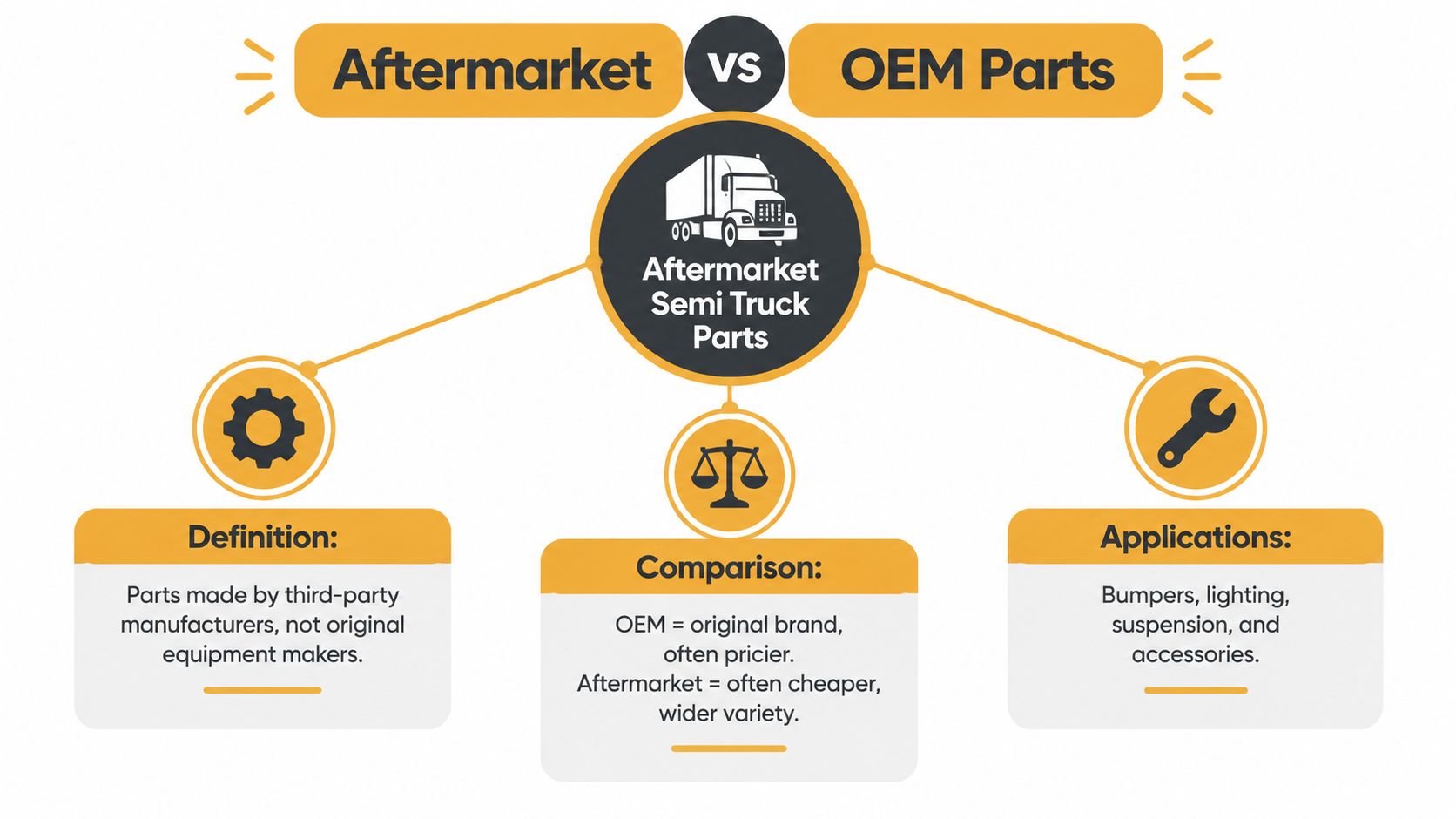
Aftermarket semi truck parts are replacement or upgrade components made and sold by companies other than the original truck manufacturer. OEM parts come through the original equipment brand. Remanufactured parts are used components rebuilt to a serviceable condition. Aftermarket parts cover a broad range, from basic replacement components to upgraded or custom pieces made for a specific truck application.
Think of the difference like work boots. OEM boots come from the same factory brand supplied with the original uniform. Aftermarket boots come from another maker and may offer different materials, tread, fit, or price. The label doesn't tell you everything. Construction and application do.
The main categories
A Class 8 truck uses hundreds of parts, but buyers usually encounter a few major groups:
- Exterior protection: Bumpers, grille panels, brackets, fenders, and steps protect the truck and shape its appearance.
- Lighting: Headlights, marker lights, fog-light assemblies, and LED replacements support visibility and legal operation.
- Suspension and steering: Air springs, shock absorbers, tie rods, king pins, bushings, and related parts influence ride control, steering, and load handling.
- Exhaust and emissions: Exhaust components and emission-related systems need correct application information because changes in regulation and vehicle electronics can affect service requirements.
- Cab accessories: Visors, mirrors, trim, stainless panels, and other accessories improve function or appearance without replacing the entire vehicle.
A bumper doesn't control the engine, but it still carries a real operating job. It absorbs exposure to weather and road debris, supports lighting or accessory cutouts, and must attach securely to the truck frame or mounting brackets. A suspension part has an even more direct effect on handling because it works inside the truck's load path.
How the choice affects the truck
The part must match the job. A polished accessory may be selected for appearance, while an air spring or tie rod must match the truck's suspension geometry and duty cycle. A nominally similar part can still create problems if its bracket position, bushing design, axle rating, or clearance differs from the original application.
For example, a Chrome bumper for Freightliner Classic is offered in 10-gauge chrome-plated steel, with a 3 mm chrome-plated 304 or 430 stainless option, a mirror-polished finish, standard or blind mount, and direct bolt-on installation without drilling or cutting. Its chrome process uses triple-layer hexavalent chrome with 35 microns of nickel, and it's sold individually with configuration-dependent cutouts. Freightliner Classic chrome bumper details
The buyer's job is to look past the word “aftermarket.” Confirm who made the part, what it's made from, how it mounts, and whether it matches the truck's real operating conditions.
Aftermarket vs OEM Parts and Which Delivers Better Value
OEM parts can be the simplest choice when a fleet has strict approval rules, an active warranty concern, or a repair process built around the truck manufacturer's catalog. The part number is familiar, the dealer network is established, and the service department may already know the installation procedure.
Aftermarket parts can make more sense when the buyer needs broader style options, faster access, different materials, or a replacement that addresses a known weakness. The quality range is wide, so the buyer has to compare construction rather than assume every aftermarket part is equal.
| Decision Factor | Aftermarket | OEM |
|---|---|---|
| Purchase cost | Often offers more price choices and configurations | Usually carries the original brand premium |
| Availability | May be available through independent distributors or direct sellers | May depend on dealer inventory or factory supply |
| Appearance | Broad choice of chrome, polished stainless, custom cutouts, and styles | Usually follows the original factory design |
| Fitment | Can be exact, but the listing must identify make, model, year, and mounting details | Built around the original application |
| Warranty support | Depends on the manufacturer and seller | Usually follows the truck brand or dealer policy |
| Best use | Custom appearance, replacement flexibility, and application-specific upgrades | Warranty-sensitive repairs and standardized fleet procedures |
Where aftermarket usually earns its keep
An owner-operator who wants a Peterbilt 389 bumper, Kenworth W900 chrome bumper, or an 18 inch drop bumper may need options that aren't available through an OEM parts counter. A fleet replacing collision-damaged bumpers may also value direct shipping and a clear bolt-on design over a factory-branded box.
The important distinction is part quality and application control. A low-cost bumper with weak brackets or poor hole placement can erase any savings through installation labor and rework. A properly specified part with the right thickness, finish, and mounting pattern can reduce those risks.
Practical rule: Compare the installed cost, not just the invoice. Include freight, labor, modifications, expected maintenance, and the cost of taking the truck out of service.
OEM remains a reasonable choice for warranty-sensitive components or systems where the manufacturer requires a specific part. Aftermarket often wins for exterior parts, custom finishes, and replacement work where the buyer can verify the design and supplier.
For a deeper look at the trade-offs, compare OEM and aftermarket parts for cost, warranty, and performance. The value decision belongs to the person responsible for the truck's operating budget. Brand familiarity helps, but it doesn't replace checking material, fit, warranty, and service conditions.
How to Choose the Right Materials Finishes and Fitment
Material choice controls how a part handles weather, impact, scratches, and maintenance. A bumper used on a winter-maintenance route faces a different threat than one used mostly in dry Southwest conditions. Road salt, magnesium chloride, moisture trapped in seams, and scratches through plating can all change the service life of exterior metal.
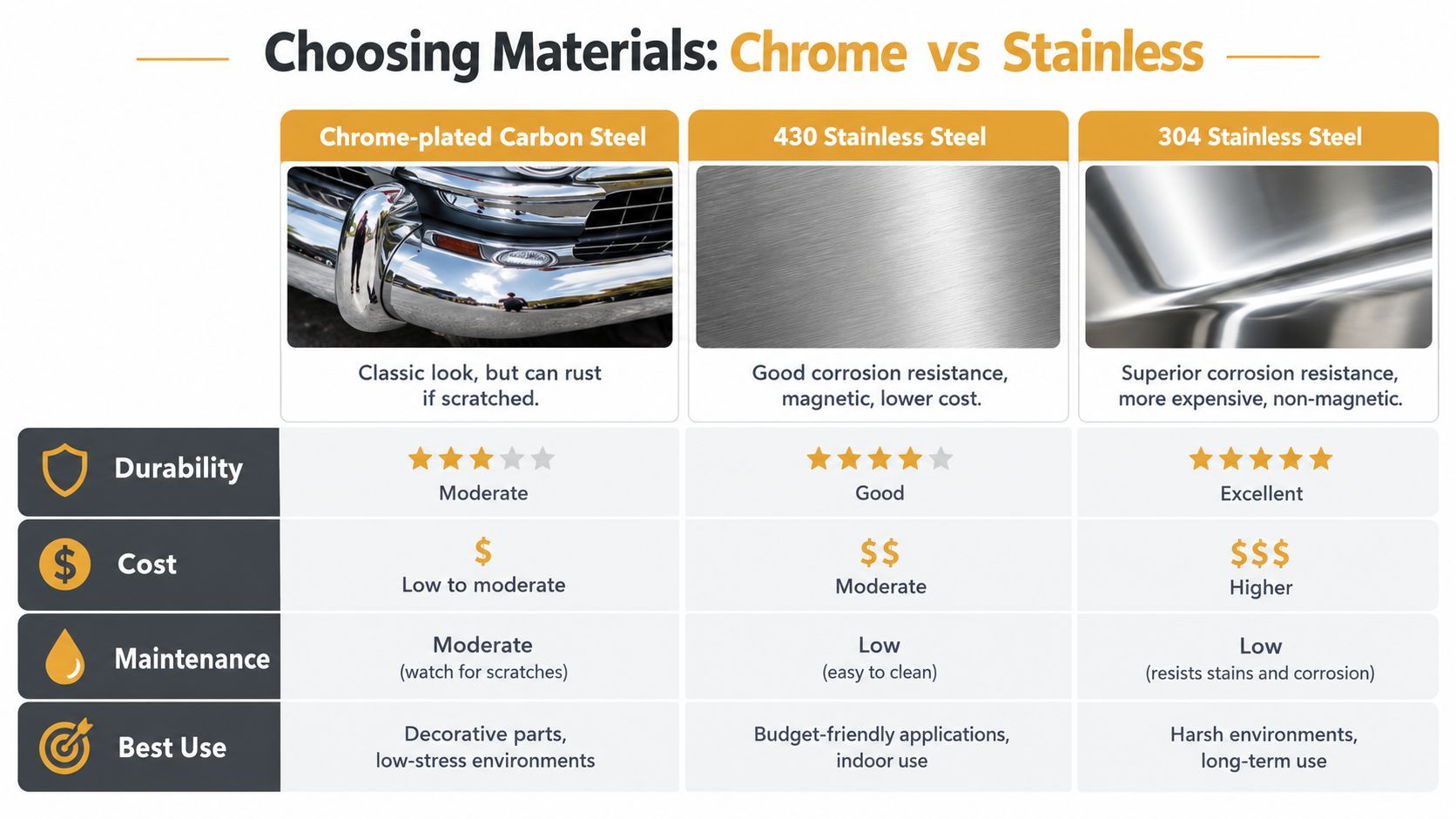
Chrome-plated carbon steel
Chrome-plated carbon steel gives a traditional bright-truck appearance and can provide a strong bumper structure when the gauge and manufacturing are appropriate. The weakness is exposed base metal. If the chrome layer is damaged and moisture reaches the steel, corrosion can start beneath the finish.
A quality finish matters. Galhor's catalog describes a triple-layer hexavalent chrome process with 35 microns of nickel and a mirror-polished surface. That information is more useful than a vague “chrome finish” label because it tells the buyer to ask how the surface was prepared and plated.
430 versus 304 stainless
Grade 430 stainless steel resists atmosphere, fresh water, steam, and many petroleum products. Its resistance to pitting and crevice corrosion is lower than 304, so the distinction matters when a bumper sees road spray and salt. Stainless steel grade comparison
Grade 304 stainless steel generally provides stronger resistance to pitting and chloride exposure than 430. A U.S. DOT-backed corrosion study found that 304L stainless steel showed no significant corrosion in SAE J2334 testing. The same study found that 410 stainless corroded 5 to 13 times faster in magnesium chloride than sodium chloride, proving that salt chemistry matters, not just the amount of salt on the road. U.S. DOT-backed corrosion study
Thickness, geometry, and fit
Thickness is only useful when the seller identifies the actual gauge or millimeter measurement. Ask whether the part uses 10-gauge steel, 11-gauge 430 stainless, or 3 mm stainless, and confirm how the thickness applies to the bumper shell, brackets, and mounting areas.
A good part also avoids water traps. Sealed geometries, protected edges, and coatings on exposed metal reduce fluid contact and corrosion initiation. Crevices around brackets, cutouts, and fasteners deserve special attention because they hold salt and moisture after the visible surface looks dry.
Fitment must be exact. Check:
- Truck identity: Freightliner, Peterbilt, Kenworth, Volvo, or International.
- Model and year: A Peterbilt 389 isn't automatically the same as another Peterbilt model.
- Mounting style: Standard mount, blind mount, bracket design, and bolt pattern.
- Cutouts: Fog lamps, tow hooks, sensors, license plates, and other openings.
- Finish: Chrome, polished stainless, or another specified surface.
- Use case: Highway, winter service, heavy loads, rough job sites, or show-truck duty.
A direct bolt-on fit reduces drilling, shimming, bracket stress, vibration, and alignment problems. For more detail on stainless applications, review stainless steel truck parts and material selection.
Buying Guide for Bumpers Lighting Suspension and Accessories
Start with the truck, not the product photo. A bumper may look right online and still fail to match the year, brackets, cutouts, or hood configuration. The same rule applies to suspension and lighting. Identify the exact application before comparing price.
Use this purchase checklist
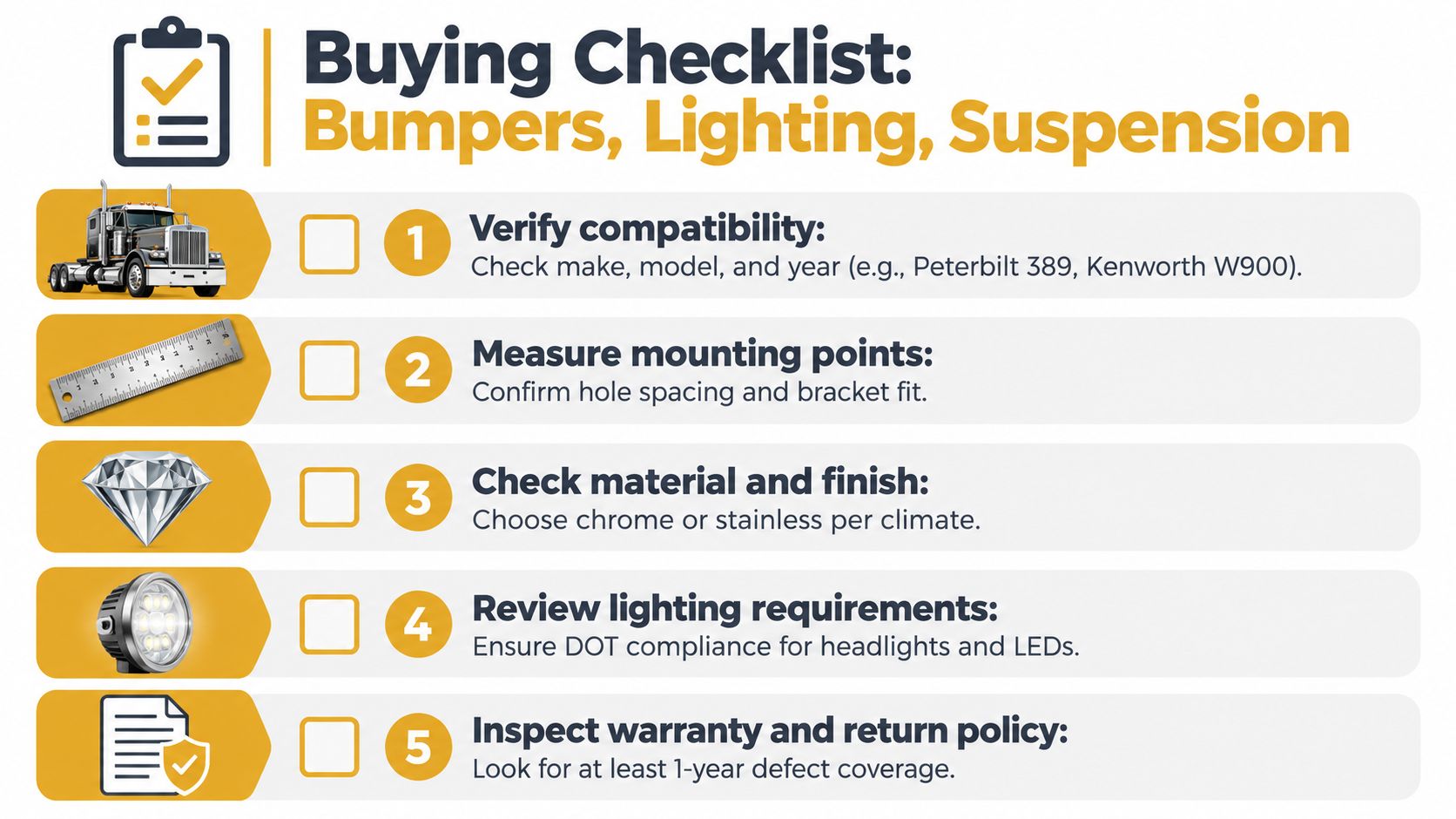
- Verify compatibility: Record the make, model, year, mounting style, and required cutouts. Search terms such as “Peterbilt 389 bumper” or “Kenworth W900 chrome bumper” are useful starting points, but the product listing should confirm the application.
- Measure mounting points: Confirm hole spacing, bracket position, frame clearance, and hardware requirements. A direct bolt-on part should not require forced alignment, cutting, or improvised brackets.
- Check material and finish: Look for the stainless grade, steel gauge or millimeter thickness, plating process, nickel layer, and surface finish. “Chrome” alone doesn't tell you how the part will handle scratches or salt.
- Review lighting requirements: Headlights, marker lamps, fog lights, and LED assemblies must match the truck and meet applicable U.S. requirements. Verify the listing's compliance information rather than assuming a bright light is automatically legal.
- Inspect warranty and returns: Confirm what defects are covered, who handles the claim, and how freight damage must be documented. A clear policy protects the purchase when a large part arrives with shipping damage.
Plan delivery before the truck is down
Large bumpers often move through less-than-truckload shipping, or LTL. Multiple shippers share trailer space, and freight typically moves through pickup, terminal sorting, line-haul, destination sorting, and final delivery. That model can make sense for a bumper or grille that doesn't fill a trailer. How LTL freight moves through the trucking network
Ask whether the part is in stock or made to order. Galhor's publisher information states that in-stock 430 and 304 stainless flat bumpers can ship within 48 hours, while made-to-order carbon steel units typically ship in 4 to 6 weeks. Those are different planning windows, so match the material choice to the repair schedule and the truck's next dispatch.
For fleets and owner-operators, fast shipping across the United States can be worth more than a small price difference when the truck is already sidelined. Still, speed shouldn't replace fitment verification. A wrong part that arrives quickly is still a downtime expense.
Installation and Maintenance Tips That Extend Part Life
Installation begins before the first bolt goes in. Inspect the brackets, frame mounts, hardware, wiring, and nearby panels. If a previous bumper was damaged, measure the mounting points and check for bent brackets rather than forcing the new part into a damaged structure.
Direct bolt-on installation is preferred because it limits drilling and modification. Set the bumper in position, start all hardware before tightening, and align the gaps and cutouts. Use the manufacturer's specified torque procedure, then recheck the fasteners after the truck has seen road vibration.
Suspension and chassis parts require more than visual alignment. Air springs, shock absorbers, tie rods, king pins, and bushings must match the axle rating, bushing geometry, and duty cycle. Technical documentation for Class 8 chassis systems treats these parts as core components for steering control, ride stability, and load handling. Class 8 suspension and chassis technical documentation
Installation rule: Never solve a fitment problem by pulling a bracket into position with the bolts. Find the mismatch before the hardware carries that stress.
Poor geometry can show up later as vibration, alignment drift, or uneven tire wear. If a steering or suspension component has been replaced, inspect related mounting points and schedule the required alignment checks before returning the truck to long-haul service.
Keep the finish working
Chrome and stainless need regular cleaning after road spray, especially in winter. Rinse salt and chemical residue from seams, cutouts, brackets, and the back side of the bumper. Dry the surface instead of letting water sit in crevices.
Inspect for chipped plating, trapped debris, loose hardware, and early discoloration. A scratch through chrome-plated carbon steel needs faster attention than a surface mark on stainless because exposed carbon steel can rust beneath the finish. Avoid harsh tools that create new scratches while removing road film.
For a practical installation sequence, use this semi truck bumper installation guide. Good maintenance won't correct a bad material choice or wrong fitment, but it will protect a properly selected part and reduce preventable replacements.
Upgrade Your Truck Today With the Right Aftermarket Parts
The right aftermarket part is a working decision, not an impulse purchase. For a bumper, compare chrome-plated carbon steel, 430 stainless, and 304 stainless against the truck's climate, route, appearance goals, and expected service life. For suspension, steering, lighting, and emissions-related components, verify the exact application and any compliance-sensitive requirements before ordering.
Owner-operators should calculate the cost of a replacement alongside labor and lost operating time. Fleet managers should standardize the information required on every purchase order, including truck make, model, year, material, thickness, mounting style, cutouts, warranty, and delivery plan. Chrome shops and upfitters should confirm the part can be installed without unnecessary drilling, cutting, or bracket changes.
Connected trucks and changing emissions rules are also shifting aftermarket buying. Industry coverage points to telematics, digital inventory systems, predictive maintenance, stricter emissions rules, and electrification as factors changing the parts mix. It also identifies projected 2027 EPA NOx standards and California zero-emission rules as developments that may increase demand for specialized service capabilities and different component types. Heavy-duty aftermarket transformation and regulation outlook
That doesn't mean every truck needs a completely new parts strategy today. It means buyers should keep records, verify applications, and choose suppliers that provide clear technical details. A good-looking truck still has to make the next run.
Order the part that fits your truck, matches your road conditions, and supports the uptime you need. If you're ready to select a bumper by brand, model, year, style, cutouts, and finish, use a 3D configurator, confirm the mounting details, and arrange fast shipping across the United States before the old part creates a bigger problem.
Galhor Inc. offers configurable direct bolt-on chrome bumpers for Class 8 trucks, with chrome-plated carbon steel, 430 stainless, and 304 stainless options, plus warranty and LTL shipping support. Visit Galhor Inc. to build the right bumper for your Peterbilt, Kenworth, Freightliner, or Volvo and upgrade your truck today.