

Chrome Truck Accessories Buyer Guide
You're staring at a bumper that's seen one too many winters, and the shine is gone before the truck payment is. That's the chrome truck accessories problem for most owner-operators: the part that looks simple from ten feet away can turn into rust, poor fitment, or a lighting headache once the miles and weather start stacking up. If you want your chrome truck accessories to hold up on a Peterbilt, Kenworth, Freightliner, or International, you have to think past the shine and look at the metal, the mounting, and the legal details.
Table of Contents
- Why Chrome Truck Accessories Matter for Class 8 Rigs
- Choosing the Right Base Metal for Your Operating Environment
- The Science of a Mirror Finish and Nickel Undercoats
- Verifying Fitment Before You Order
- Navigating Federal Lighting and Compliance Rules
- Maintenance Routines That Protect Your Investment
- Balancing Lead Times and Long-Term Value
Why Chrome Truck Accessories Matter for Class 8 Rigs
A Class 8 truck doesn't live a showroom life. It lives on salted highways, in rain, through bug hits, around gravel, and under constant washing that wears down weak finishes fast. That's why front-end parts matter so much. They're not just dress-up pieces, they're the first line of defense on a truck that's working hard every day.
In 2021, Class 8 trucks represented approximately one-third of all trucks weighing more than 10,000 pounds in the United States, yet they generated nearly two-thirds of all truck miles (TT News). That kind of mileage means a bumper, grille surround, or trim piece sees a lot more abuse than a casual observer would expect. When a truck spends that much time on the road, durability and corrosion resistance stop being nice extras and become buying requirements.
Practical rule: If the truck earns its keep on the highway, the front end should be built for long service, not short-term shine.
That's why a polished bumper on a Peterbilt 389 or a Kenworth W900 isn't just about looking sharp at the fuel island. It helps preserve the truck's appearance, reduces the odds of early replacement, and supports resale value when the rig eventually changes hands. It also explains why many buyers look for direct-fit parts that match the truck's real operating life, not just the catalog photo. For a broader style-and-fit perspective, see this chrome accessory guide for big rigs.
The right chrome part should survive wash cycles, road spray, and the vibration that comes with long-haul freight. If it can't do that, it's not an upgrade. It's a quick replacement waiting to happen.
Choosing the Right Base Metal for Your Operating Environment
The finish gets the attention, but the base metal decides a lot of the truck's real-world value. That's where owners get burned. A bumper can look like chrome from across the yard and still behave very differently once it's running winter routes or coastal lanes.
The stainless choice matters because not all grades resist corrosion the same way. The ASSDA stainless-steel guide identifies 430 as a ferritic grade with lower corrosion resistance than 304, so buyers need to treat them as separate material options based on exposure to road salt and moisture rather than interchangeable labels (ASSDA). That matters for truckers who deal with salt, humidity, or frequent wash-downs. A chrome-plated carbon steel bumper can still be the right pick in some cases, but only if the buyer understands the maintenance burden and service life trade-offs.
A good way to think about it is simple. Match the material to the route, then match the finish to the look you want. If the truck runs through corrosive conditions, the cheaper upfront choice can become the more expensive part after rework, downtime, and replacement.
Base Metal Comparison for Class 8 Bumpers
| Material | Corrosion Resistance | Best Operating Environment | Relative Cost |
|---|---|---|---|
| Chrome-plated carbon steel | Lowest of the three in harsh service | Dry climates, lighter exposure, budget-focused builds | Lowest upfront |
| 430 stainless steel | Better than carbon steel, lower than 304 | Mixed-duty use, moderate exposure, appearance-focused trucks | Mid-range |
| 304 stainless steel | Stronger corrosion resistance in demanding service | Salt, moisture, coastal routes, frequent washing | Higher upfront |
A truck that runs winter freight or lives near the coast should not be judged on mirror finish alone. A truck that stays cleaner and sees less exposure can sometimes get by with a less expensive build. The point is to buy the right part for the route, not the prettiest part on the lot.
For a deeper material comparison, the stainless steel versus carbon steel breakdown is worth checking before you place an order.
The Science of a Mirror Finish and Nickel Undercoats
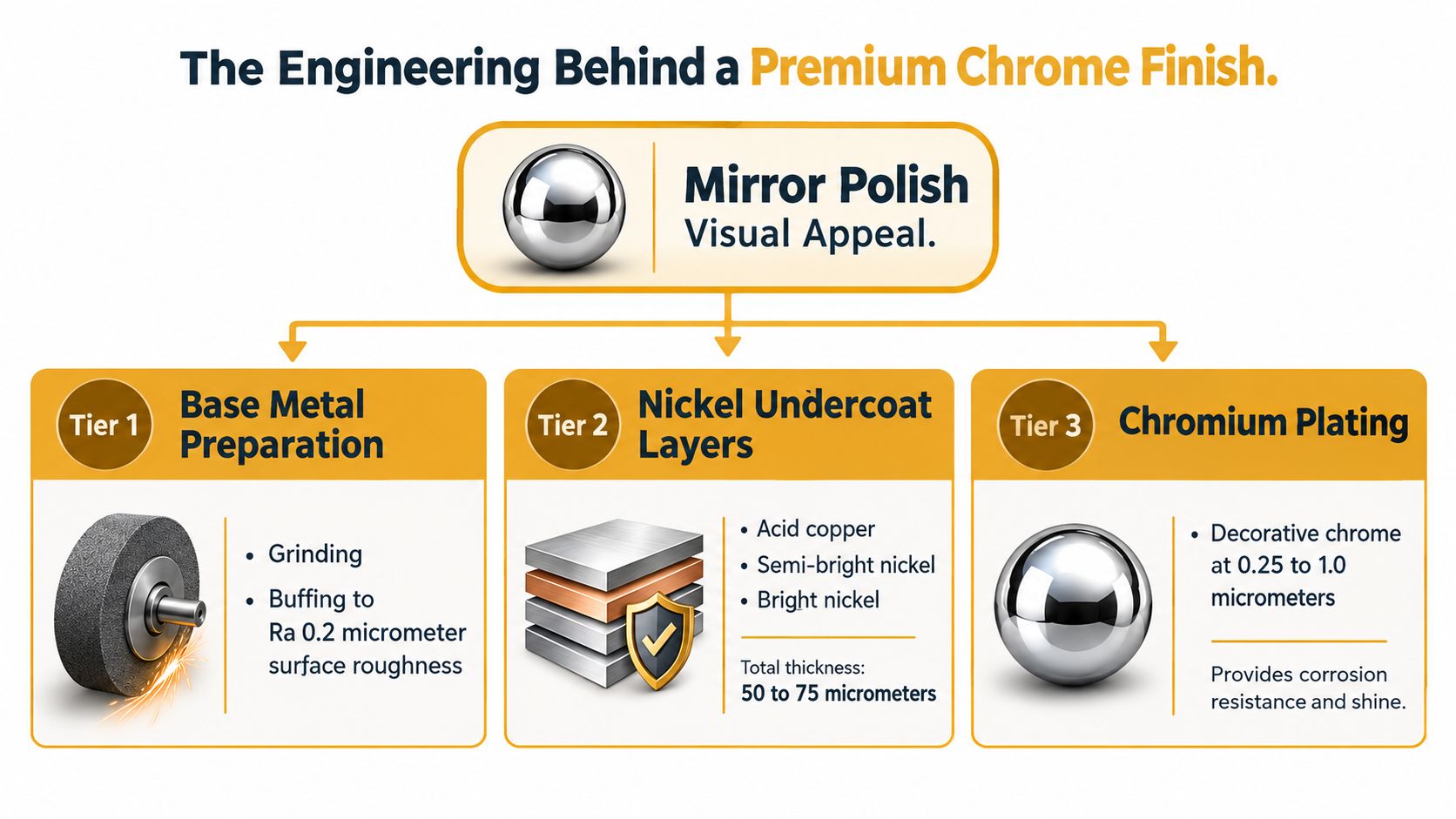
A lot of buyers focus on the chrome layer and miss the part that really protects the steel. That's a mistake. For plated truck accessories, the chromium flash gives you brightness and hardness, but the nickel layer beneath it does the heavy lifting against moisture and salts. According to the available technical reference, corrosion protection depends primarily on the continuity and thickness of the nickel layer, with a common decorative system using approximately 20 micrometers of bright nickel as the main barrier (MFF).
What actually keeps the rust out
A mirror finish can hide weak work for a while, but it can't fix poor plating. If the undercoat is thin, porous, or uneven, the finish may still look good until the first winter season exposes the weak spots. Once that happens, moisture and salt find the path through pores, and rust starts where you least want it, on edges, cutouts, weld zones, and mounting holes.
A bright face doesn't prove a strong coating. The underlayers decide how long that shine survives.
That's why coating questions matter so much when you're comparing a polished bumper or grille piece. Ask about layer structure, thickness records, and inspection methods, not just the mirror effect. If a seller can't explain the plating system clearly, that's a warning sign for a truck that's going to live in hard service.
The nickel plating thickness guide is useful if you want to understand why one bumper stays bright while another starts spotting early. The same principle applies whether you're buying a Freightliner replacement bumper or a custom Peterbilt 389 bumper for long-haul use.
Verifying Fitment Before You Order
A lot of return freight starts with one bad assumption, that the truck name is enough. It isn't. Fitment lives in the details, model year, bracket spacing, cutouts, and bolt pattern all matter. If you skip those checks, you can end up with a bumper that looks right but doesn't bolt up without extra work.
Check these points before you buy
- Exact model and year: Don't order by brand alone. Confirm the truck's build year and model variant.
- Bolt pattern: Some trucks changed mounting arrangements across production years, so the hole layout has to match the chassis.
- Cutouts and openings: Fog-light slots, tow-hook openings, and air-dam provisions all affect whether the part fits the truck cleanly.
- Hood and axle setup: Two trucks with the same badge can still need different brackets or bumper shapes.
- Direct-bolt-on claim: Verify that the part matches the existing mount points before you count on no-drill installation.
International gives a good example of why this matters. International 9900-series trucks can have different bumper mounting arrangements, with pre-2003 models typically using a three-bolt pattern and 2003-and-newer models using a four-bolt pattern (4 State Trucks). That one change can be the difference between a smooth install and a wasted afternoon.
A Peterbilt 389 bumper or Kenworth W900 chrome bumper should be checked the same way. Brand name gets you in the right neighborhood, but not always to the right house. If the bumper needs fog-light cutouts or tow-hook provisions, confirm those before you buy. The right part should line up cleanly with the truck and leave the front end looking factory-correct, not improvised.
Navigating Federal Lighting and Compliance Rules
A deep drop bumper can look aggressive on a big truck, but it can also create a problem if it covers or crowds required lights. That's where style runs into compliance. Trucks that measure 80 inches or more in overall width need specific amber and red clearance and identification lamps, and the lamps must be placed correctly so they stay visible (NHTSA).
That means bumper cutouts are not just a styling choice. If the front-end accessory blocks a marker, crowds an identification lamp, or forces a bad relocation, the truck can end up with inspection trouble even if the chrome looks perfect. The same risk shows up with reflective trim and auxiliary lamps if they interfere with factory lighting patterns.
A clean installation has to preserve what the truck already needs to stay road-legal. The safest approach is to treat lighting as part of the bumper design, not an add-on after the fact. If the accessory changes the truck's visible lighting package, it needs a second look before it goes on the road.
For owners who want to dig deeper into placement and visibility, this compliance-focused truck lighting discussion is a useful starting point. The core point is simple, more lighting isn't always better if it hides the lights the truck is required to show.
Maintenance Routines That Protect Your Investment
Even a good stainless bumper can look tired fast if it's ignored. Road salt, bug residue, diesel soot, and hard-water spots all work on the finish over time. The fix is not complicated, but it does need consistency.
Start with regular washing using mild soap and clean water. Get the salt off first, especially after winter runs. Don't scrub chrome with abrasive pads or harsh chemicals, because once the surface gets scratched, it loses the clean reflective look that truck owners pay for.
Keep the finish alive with a simple routine
- Rinse first: Flush off loose grit before touching the surface.
- Wash gently: Use soft microfiber cloths or mitts, not rough scrub pads.
- Dry fully: Water left on edges and seams can leave marks or spotting.
- Inspect the corners: Check around holes, seams, and brackets where corrosion starts first.
- Protect the surface: Use a finish-safe sealant if the product maker allows it.
Clean the truck before grime becomes damage. Waiting turns a quick wash into a repair job.
Pay attention to the places you can't see from the driver seat. The hidden side of the bumper and the mounting area are where problems show up first. If those spots stay clean and dry, the visible face usually follows.
This is also where material choice pays off. A truck running frequent washes in bad weather needs more care than a dry-climate weekend build. The better the prep and upkeep, the longer the part stays sharp and the less often you're forced back into the shop.
Balancing Lead Times and Long-Term Value
A bumper replacement is usually urgent. Maybe the truck took a scrape, maybe the old part is corroding out, or maybe the whole front end is getting an upgrade before the next run. At that point, lead time matters almost as much as material.
The cost side matters too. Truck parts and labor costs rose 27.4% over the reported period, which raises the pain of replacing parts early or paying for extra labor on a bad fit (Fleet Equipment Magazine). That's why the cheapest bumper on day one isn't always the cheapest bumper over the life of the truck. If it rusts early, fits poorly, or creates lighting issues, you pay again.
A practical buying checklist
- Confirm the material. Decide whether chrome-plated carbon steel, 430 stainless, or 304 stainless fits the route.
- Verify fitment. Match the year, brackets, and cutouts before checkout.
- Check finish details. Ask how the nickel and chrome layers are built.
- Review lighting openings. Make sure the design won't interfere with required lamps.
- Look at shipping speed and support. Fast delivery matters when the truck can't sit still.
The right supplier should give you a bumper that bolts up cleanly, looks right, and survives real road use. One option in that lane is Galhor Inc., which builds configurable chrome bumpers for Class 8 trucks with material choices, cutouts, and finish options geared toward direct-fit replacements and fleet use. That kind of setup makes sense when you need to get a truck back on the road without guessing at fitment.
If you're ready to upgrade a Peterbilt, Kenworth, Freightliner, or International, order with the truck's exact specs in hand and choose the finish that matches your route, not just your taste. For direct-fit chrome truck accessories built around durability and real-world use, visit Galhor Inc. and get the right bumper for the miles ahead.