

Peterbilt Chrome Accessories: The 2026 Buyer's Guide
You're at the parts counter with a damaged Peterbilt front end, or you're scrolling through bumper options after a long week on the road. One product shows chrome-plated carbon steel. Another offers 430 stainless. A premium listing points to 304 stainless. The photos look similar, but the wrong choice can mean poor fitment, corrosion around the mounting points, or a truck sitting while you wait for a replacement.
This Peterbilt chrome accessories guide focuses on the decisions that matter: substrate, thickness, bumper style, cutouts, chassis geometry, finish, maintenance, and route conditions. It applies to owner-operators, fleet managers, chrome shops, and custom builders working with Peterbilt, Kenworth, Freightliner, and International trucks.
Table of Contents
- Why the Right Peterbilt Chrome Accessories Matter
- The Main Peterbilt Chrome Accessory Categories
- Material Chemistry and What It Means for a Working Truck
- Comparing Carbon Steel, 430 Stainless, and 304 Stainless Head to Head
- Fitment, Bolt-On Compatibility, and the Numbers That Actually Matter
- Matching the Right Material to How and Where You Run
- Installation, Maintenance, and Long-Term Care
- Choosing the Right Chrome Setup and Next Steps
Why the Right Peterbilt Chrome Accessories Matter
A chrome bumper does more than change the truck's appearance. It protects the front end, frames the grille, carries lights and tow-point openings, and becomes one of the first parts people notice at a fuel stop. For an owner-operator, it also affects replacement cost, downtime, and the truck's resale presentation.
Peterbilt's long-hood platform has created a deep market for replacement and custom parts. Peterbilt introduced the Model 351 in 1954. The Model 379 arrived in 1986, and the Model 389 replaced it in 2006. Peterbilt reports that more than 100,000 Model 389 units were produced, creating a large installed base for collision replacements, refurbishment, and appearance upgrades. See Peterbilt's history of purposeful innovation for the company's model background.
That history explains why buyers still compare parts for the Peterbilt 379, 388, 389, and 589. The trucks may share a familiar long-hood profile, but their bumper mounting, grille relationship, taper, thickness, and cutouts can differ. A bumper that looks right in a product photo may still need fabrication if the supplier hasn't confirmed the truck's actual configuration.
The buying decision at the counter
Start with three questions:
- What route does the truck run? Northern salt, coastal humidity, mixed interstate exposure, and show-truck use create different corrosion risks.
- What geometry does the truck have? Model year alone isn't enough. Axle position, bumper style, mounting pattern, and openings matter.
- What downtime can you accept? An in-stock stainless bumper serves a different need than a made-to-order carbon steel unit.
The useful guide for visual planning is Galhor's Peterbilt accessory overview, but don't buy from a photo alone. Match the material and finish to the route, then match the bumper to the chassis.
The Main Peterbilt Chrome Accessory Categories
Most buyers shop for four groups of Peterbilt chrome accessories. The bumper gets the most attention, but the supporting pieces determine whether the front end works as a complete setup.
Full front bumpers
The main choices include standard taper, deep taper, Texas square, and heavy-duty logger styles. A standard taper keeps the classic long-hood profile. A deep taper adds more visual depth and can change approach clearance. Texas square and logger designs suit owners who want a tougher, more upright front-end appearance.
Look for the listed material, thickness, finish, mount style, and cutouts. A 10-gauge chrome-plated carbon steel bumper offers a steel core under the finish. Stainless options may be listed by grade, such as 430 or 304, and by thickness. A product described as polished stainless isn't automatically the same as a chrome-plated stainless bumper.
Brackets and reinforcements
Brackets transfer bumper loads into the frame. Reinforcements help support the bumper around mounting points and cutouts. If the truck works hard in rough yards, construction access roads, or winter conditions, bracket alignment matters as much as the face finish.
Lights, sensors, and tow openings
Cutouts must match the equipment already on the truck. Confirm fog-light openings, tow-hook access, radar or sensor requirements, and any custom light arrangement before ordering. A clean-looking bumper that blocks a sensor or forces a shop to enlarge an opening isn't a direct-bolt-on solution.
Trim and exterior accents
Grille inserts, hood accents, mirror covers, fender accents, and other trim pieces complete the look. They're easier to change than a full bumper, but finish and substrate still matter. Different metals can age differently when exposed to the same wash chemicals and road spray.
The long production history of Peterbilt's conventional trucks keeps demand strong for both working replacements and show-truck upgrades. Buyers need the vocabulary to ask whether the part is chrome-plated carbon steel, chrome-plated 430 stainless, or chrome-plated 304 stainless, rather than judging only by shine.
Material Chemistry and What It Means for a Working Truck
The finish is what you see. The substrate is what remains when the finish gets scratched, chipped, or worn through.
Chrome-plated carbon steel uses a steel core, commonly specified in this product category as 10-gauge steel. The steel depends heavily on the plating system for corrosion protection. A stone chip at the lower edge, a scratch near a fastener, or trapped salt behind a bracket can expose the core and start a rust problem.
Type 430 stainless steel is ferritic stainless steel with approximately 14–18% chromium and little or no intentional nickel, according to this stainless steel material guide. It offers good corrosion resistance, formability, and oxidation resistance for general road use. It's a practical middle choice when the truck sees normal moisture and road spray but doesn't spend its life in heavy salt or constant washdown.
Type 304 stainless steel typically contains approximately 18–20% chromium and 8–11% nickel. That chemistry gives it strong resistance in many industrial and chemical environments. It remains vulnerable to chloride-related pitting and crevice corrosion, but it is generally the stronger selection for coastal routes, deicing-salt corridors, and persistently wet operating conditions.
For a deeper explanation of stainless selection, review corrosion-resistant stainless steel grades.
The practical rule: The chrome plating may be the same across the options. The substrate determines how the bumper behaves after the plating is compromised.
What the finish can and can't do
Chrome-plated carbon steel can look excellent when the surface stays intact. Stainless beneath the plating gives you more corrosion resistance if damage reaches the substrate, but it doesn't make the outer finish immune to neglect. Scratches, damaged plating, trapped salt, and unsealed fastener interfaces can all become localized corrosion sites.
That's why a price gap isn't only about how the bumper looks on installation day. It's about how much risk you're accepting after stone strikes, winter brine, humid air, and repeated cleaning. Choose carbon steel for controlled conditions and budget-focused replacements. Choose 430 for a balanced working-truck setup. Choose 304 when route exposure makes corrosion prevention the priority.
Comparing Carbon Steel, 430 Stainless, and 304 Stainless Head to Head
The table below is a buying guide, not a promise that every supplier uses identical construction. Confirm the actual product drawing, thickness, finish, mount, and lead time before placing an order.
| Material | Corrosion Resistance | Weight | Typical Lead Time | Cost Tier |
|---|---|---|---|---|
| Chrome-plated carbon steel | Depends strongly on intact plating. Damaged areas can rust. | Lightest option in this comparison when built from 10-gauge steel | Made-to-order units may require 4–6 weeks. Confirm with the supplier. | Entry |
| Chrome-plated 430 stainless | Good general corrosion and oxidation resistance. Less suited to heavy chloride exposure than 304. | Moderate | In-stock options may ship within 48 hours. Confirm stock status. | Mid-tier |
| Chrome-plated 304 stainless | Strongest choice here for coastal air, deicing salt, and persistently wet wash environments, though it can still pit in chloride conditions. | Heaviest option in this comparison | In-stock options may ship within 48 hours. Confirm stock status. | Premium |
The carbon steel option makes sense when upfront cost and quick replacement planning matter more than maximum corrosion reserve. It can be the right call for a dry-region truck, a controlled show build, or a fleet that replaces damaged parts before corrosion spreads. The trade-off is simple. Once the plating fails, the underlying steel has less protection.
430 stainless is the middle ground. It gives a working truck a more forgiving substrate without pushing the buyer into the premium material tier. It suits many mixed-route tractors, especially when the owner keeps the bumper washed, dried, and inspected.
304 stainless earns its premium position on routes where salt and moisture are routine. Northern fleets, coastal owner-operators, and trucks exposed to frequent chemical washdown should consider it first. It won't eliminate cleaning, and it won't prevent every pit, but it reduces substrate risk when the finish takes a hit.
All three choices still depend on the finish. A stainless substrate doesn't rescue a bumper that has damaged plating, trapped salt, or neglected fasteners.
Thickness matters, too. A thicker or deeper bumper can change weight, clearance, and mounting load. Don't compare material grades while ignoring construction. Ask for the steel specification, bumper thickness, reinforcement design, cutout layout, and mounting hardware.
Fitment, Bolt-On Compatibility, and the Numbers That Actually Matter
A Peterbilt 389 bumper should be selected against chassis geometry, not just the words “389 bumper” in a product title.
Peterbilt body-builder data for the Model 389-131 lists the front-axle-to-frame dimension at approximately 19.6 inches and the frame-front-to-bumper-front dimension at approximately 11.4 inches. The reference uses a 0.25-inch-thick bumper. Compare those measurements with the supplier's drawing before ordering a deep-taper or 18 inch drop bumper. The dimensional reference is available in this Peterbilt body-builder document.
Check these items before ordering
- Exact model and year. Confirm whether the truck is a 378, 379, 388, 389, or 589, then verify the model year and variant.
- Front-axle position. Axle setback changes the relationship between the bumper, tires, hood, and frame.
- Bumper style. Standard taper, deep taper, Texas square, and logger styles don't share the same geometry.
- Mounting-hole pattern. Compare the truck's holes with the supplier's standard mount or blind mount drawing.
- Required openings. List tow hooks, fog lights, sensors, marker lights, and any custom equipment.
- Thickness and drop. A 0.25-inch reference bumper, a deep face, or an 18 inch drop can affect clearance and approach angle.
Fitment is validated against the truck's chassis, not against its model name on a website page.
A direct-bolt-on bumper should preserve clearance around headlights, steering components, tow points, tires, hood movement, and bodywork. Prior collision repairs can alter the final position even when the truck started with standard factory geometry. Measure the truck in the shop and compare it with the supplier drawing. That small check can prevent a costly return or fabrication job.
Matching the Right Material to How and Where You Run
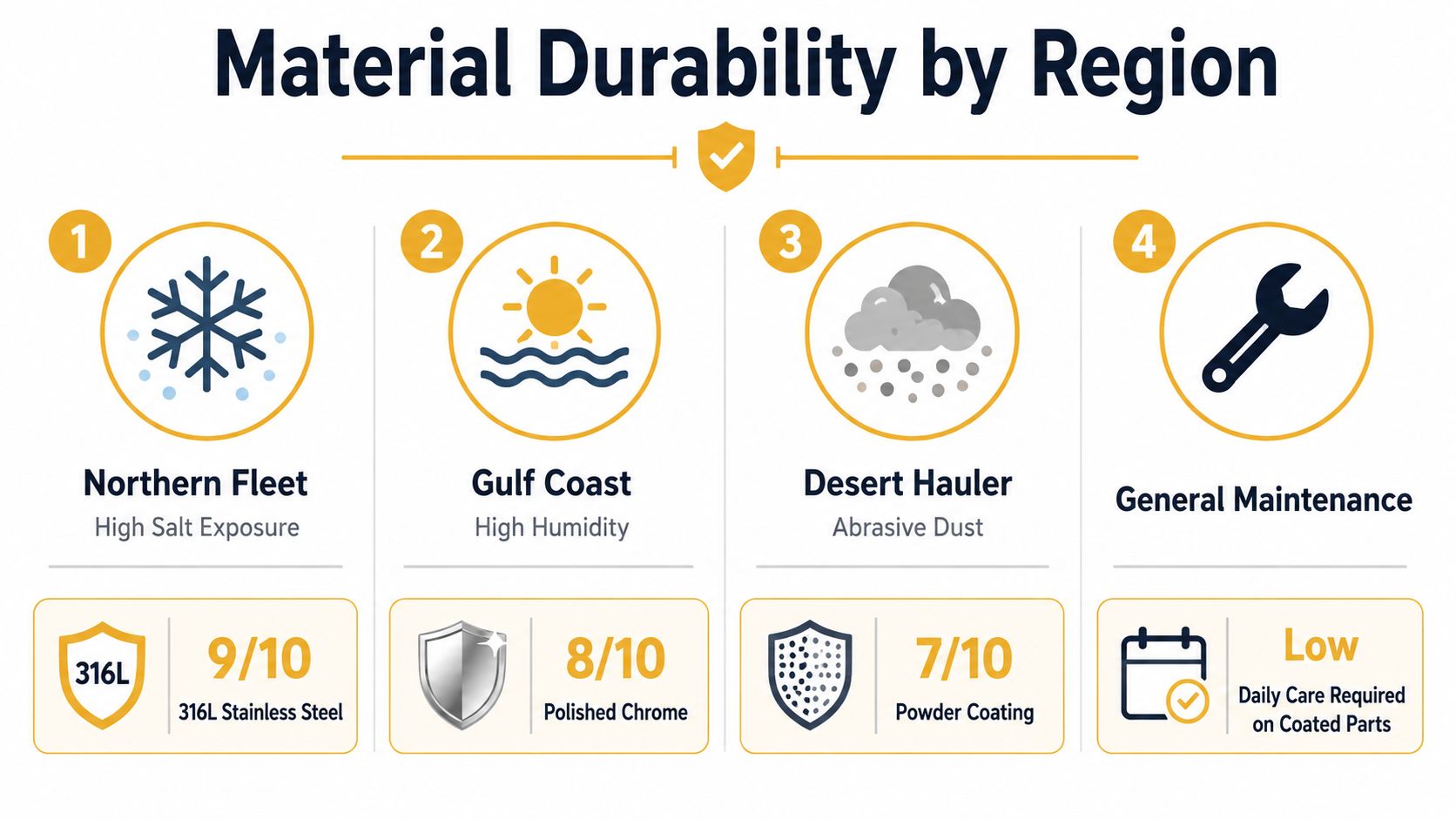
The right bumper depends on the route, not the product photo. A polished face may look identical at delivery, but northern brine, coastal air, and dry abrasive roads place different demands on the substrate and maintenance routine.
Northern fleet
A fleet operating through deicing-salt corridors should start with 304 stainless. Salt collects around lower edges, brackets, fasteners, and cutouts, especially when trucks return from wet roads and sit before washing. 430 can work with disciplined cleaning, but 304 gives the maintenance team more corrosion resistance where chloride exposure is part of the job.
Gulf Coast owner-operator
Humid air and salt spray make 304 stainless the safer recommendation for a working Peterbilt. The owner who runs near the coast should inspect mounting interfaces and cutout edges often. A polished or chrome finish still needs washing and drying because humidity doesn't stop at the visible face.
Weekend show truck
A show truck can choose 430 or 304 stainless based on budget, availability, and how much protection the owner wants during storage and transport. Both can deliver a sharp appearance when the finish is maintained. Carbon steel can also make sense for a controlled build, but any exposed damage deserves prompt attention.
High-mileage dry-van hauler
A mixed-interstate hauler watching return on investment may choose 430 stainless for a balance of cost and corrosion resistance. Chrome-plated carbon steel remains a reasonable budget choice when the truck runs mostly in dry conditions and the operator accepts more inspection responsibility.
A premium stainless substrate doesn't make a bumper maintenance-free. Chrome finish, fastener areas, cutouts, and trapped road debris still need correct cleaning and inspection.
The same logic applies to a Kenworth W900 chrome bumper, Freightliner bumper, or International front-end setup. Match the material to the route, then confirm the truck-specific geometry.
Installation, Maintenance, and Long-Term Care
“Direct bolt-on” should mean the bumper uses the truck's intended mounting locations without drilling or cutting the main structure. Common configurations include standard mount and blind mount options for the 378/379 and 388/389/589 platforms, but the correct mount still must be confirmed before ordering.
Start installation with a clean inspection of the frame, brackets, holes, and surrounding components. Replace bent hardware, repair damaged threads, and test-fit the bumper before fully tightening anything. Check the hood, lights, tow equipment, steering clearance, and any sensor openings through the full range of movement.
A routine that protects the finish
- Wash regularly: Use pH-neutral soap and clean water to remove road film, salt, and chemical residue.
- Dry promptly: Don't let brine or wash chemicals sit around seams, fasteners, cutouts, or the lower edge.
- Inspect the interfaces: Look for plating damage, rust staining, pits, loose hardware, and trapped debris.
- Use gentle tools: Soft wash materials protect the finish better than aggressive scrubbing.
- Treat damage early: Small chips and scratches are easier to control before moisture reaches the substrate.
Peterbilt operator guidance warns against scouring pads, abrasive chrome polish, and highly acidic cleaners. These products can strip the nickel and chrome layers and accelerate corrosion regardless of the underlying material. Use chrome bumper polishing guidance as part of a controlled maintenance routine, not as a substitute for washing and inspection.
Plan around availability
In-stock 430 and 304 flat bumpers may ship within 48 hours, while made-to-order carbon steel units typically ship in 4–6 weeks. Verify the current stock position before ordering, especially after a collision. A clear manufacturing-defect warranty, published returns policy, freight terms, and documented material specification should be part of the purchase decision.
Choosing the Right Chrome Setup and Next Steps
Use this matrix to make the decision quickly:
| Truck and operating need | Recommended direction |
|---|---|
| 378 or 379 replacement with a controlled budget | Chrome-plated carbon steel, after confirming mount and cutouts |
| 388, 389, or 589 mixed-route work truck | Chrome-plated 430 stainless for balanced value |
| Northern salt-belt or Gulf Coast operation | Chrome-plated 304 stainless |
| Show truck with strong appearance demands | 430 or 304 stainless, depending on budget and care |
| Deep-taper or 18 inch drop setup | Any material can work, but verify chassis dimensions, clearance, and supplier drawings first |
For a Peterbilt 389 bumper, confirm the truck's axle position, bumper style, thickness, hole pattern, cutouts, and mount type before you compare prices. Treat lead time as part of the cost. A replacement that ships quickly can keep a truck moving, while a lower-priced made-to-order part may create a longer scheduling problem.
Choose the bumper that matches the route, not the one with the biggest product photo. Demand plain-language material specifications, mounting options, finish details, warranty terms, and shipping information.
Galhor Inc. offers configurable chrome bumpers for Peterbilt, Kenworth, Freightliner, and Volvo Class 8 trucks, with chrome-plated carbon steel, 430 stainless, and 304 stainless options. Use the 3D configurator to select the truck, year, style, cutouts, mount, and finish, then visit Galhor Inc. to order a setup built around your route and fitment needs.